
ASVAB Exam Hub
How the 2026 Solar Eclipse Teaches Students Astronomy
Use the August 12, 2026 total solar eclipse as a live practice problem for the astronomy concepts that recur on standardized science tests: new-moon alignment, umbra vs. penumbra, the Moon's orbital tilt, and eclipse seasons. Master the small concept set once, and any eclipse question — this year or any other — becomes answerable.
- gre
- mcat
- asvab
- sat
- act
- digital-adaptive
- official-material
- section-strategy
- test-date-timeline
If an exam asks why solar eclipses are rare, why totality is narrow, or why a solar eclipse happens at new moon, the August 12, 2026 total solar eclipse is a clean worked example. The short answer is this: a solar eclipse needs the Moon between Earth and the Sun at new moon, but the Moon’s orbit is tilted by about 5 degrees, so most new moons pass above or below the Sun-Earth line instead of blocking the Sun. Eclipses happen only when new moon also occurs close enough to one of the Moon’s orbital nodes, inside an eclipse season of roughly 35 days; there are two such seasons each year.[1]
That one paragraph already handles a surprising number of diagram questions. The rest is precision: which shadow reaches Earth, how wide that shadow is, why some observers see totality while others see only a partial eclipse, and why the same basic alignment can produce total, annular, partial, or hybrid eclipses.
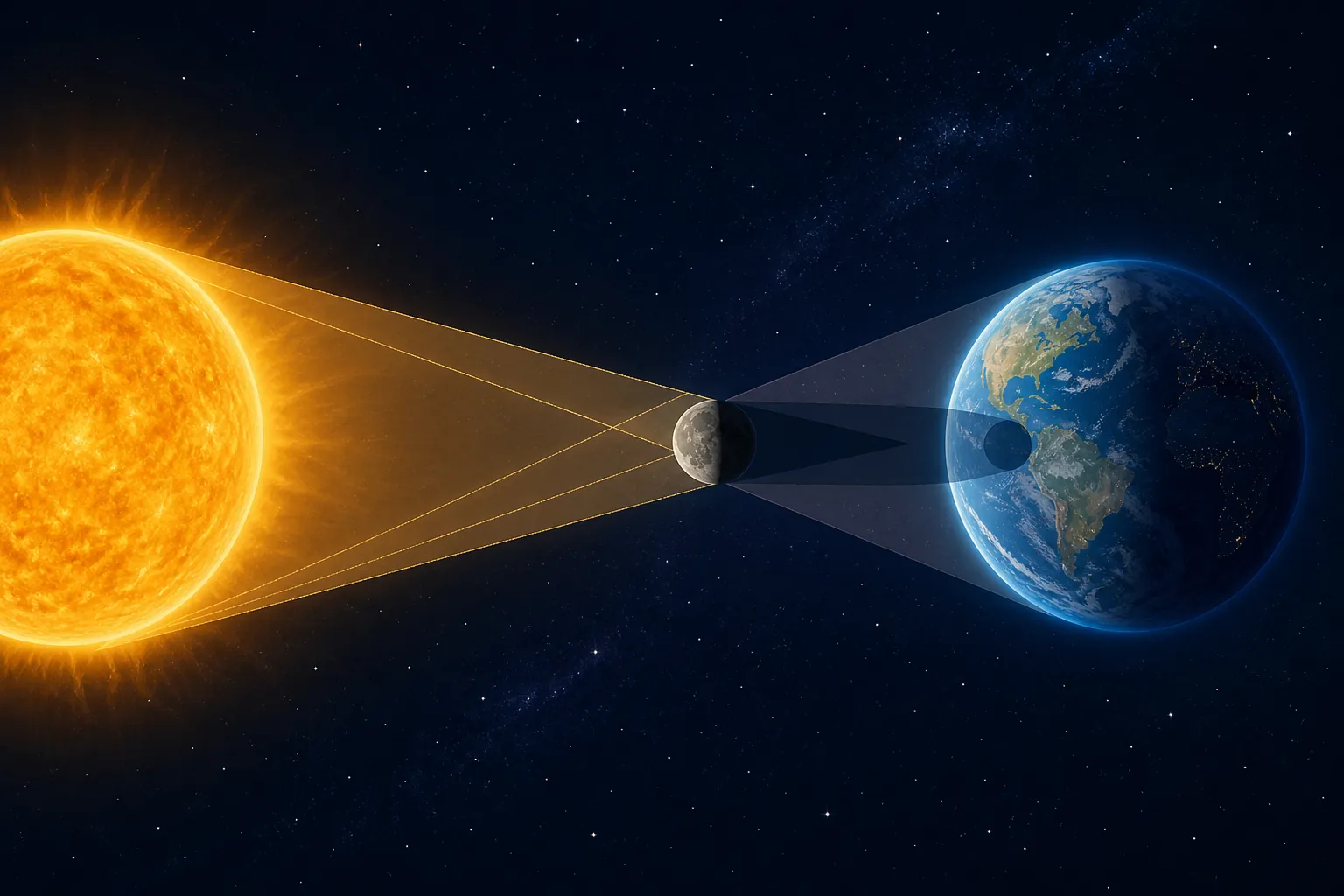
Start with new moon, then ask why the line usually misses
A solar eclipse is not just any Moon-Sun event. It is specifically a new-moon event. At new moon, the Moon is on the Sun-facing side of Earth, so the possible order is Sun → Moon → Earth. If the Moon’s shadow falls on Earth, people in that shadow see some part of the Sun covered.[1]
The trap answer is usually: “There is a solar eclipse every new moon.” That sounds reasonable only if the Moon’s orbit were in the same flat plane as Earth’s orbit around the Sun. It is not. The Moon’s orbit is tilted by about 5 degrees relative to Earth’s orbital plane, so during most new moons the Moon’s shadow misses Earth.[1]
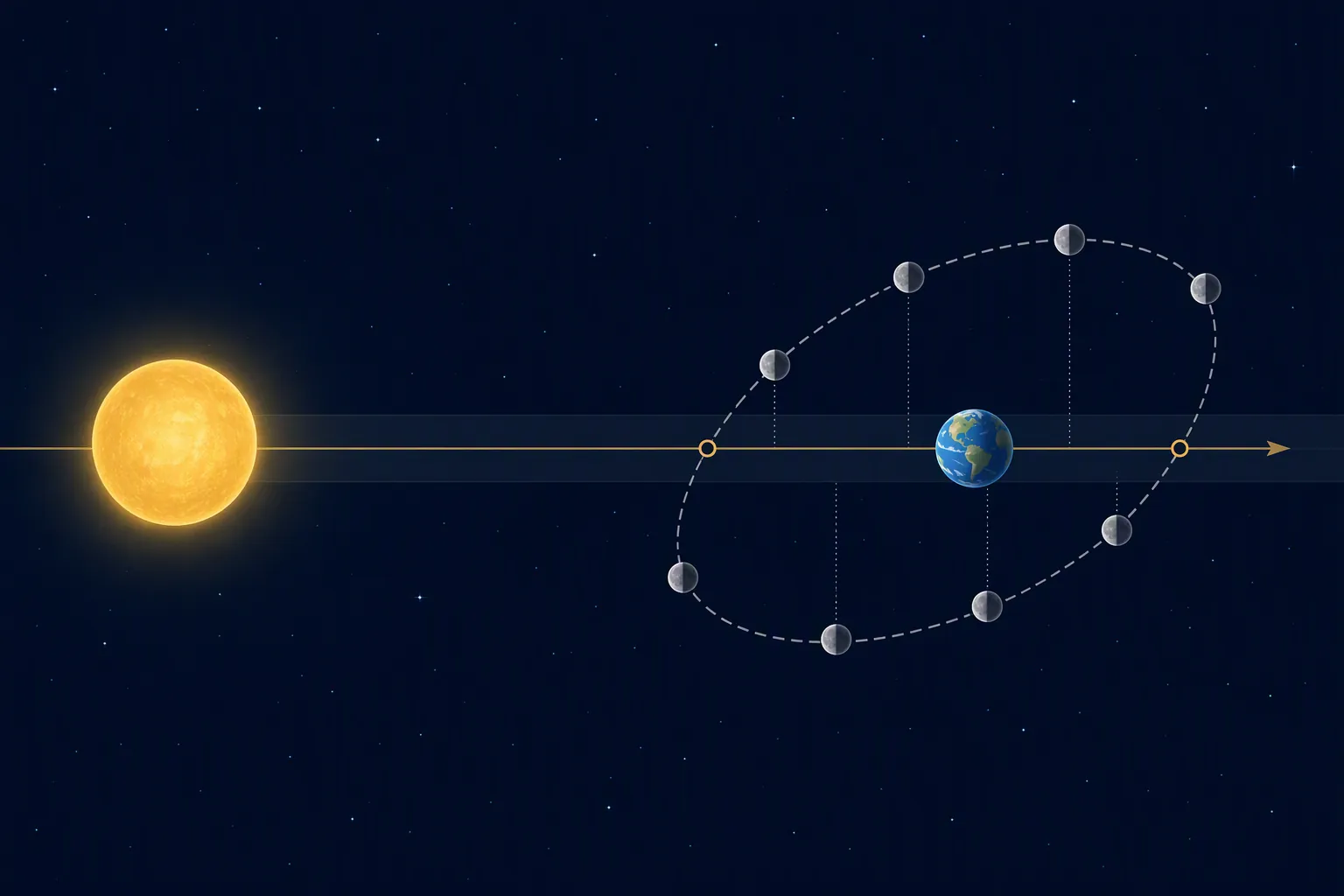
The useful word here is node. A node is where the Moon’s tilted orbital path crosses the plane of Earth’s orbit. If new moon happens near a node, the Sun, Moon, and Earth can line up closely enough for an eclipse. If new moon happens away from a node, the phase is still new moon, but the shadow misses.
That is why “new moon” is necessary but not sufficient. In test language, it is the condition that puts the Moon on the correct side of Earth; the node/ecliptic geometry decides whether the alignment is close enough to matter. If moon phases themselves are the weak spot, review the Buck Moon ASVAB General Science guide before trying eclipse diagrams. Eclipse questions punish phase confusion quickly.
The 2026 eclipse is the practice problem, not the rule
On August 12, 2026, the Moon is close enough to the Sun-Earth line at new moon for a total solar eclipse. The event’s published details make it vivid: eclipse magnitude 1.0386, Saros 126 member 48 of 72, maximum totality of 2 minutes 18 seconds, and the first total solar eclipse for mainland Europe since 1999.[2]
Those labels do not all have equal test value. “Saros 126 member 48 of 72” is a cataloging fact: useful if you are studying eclipse cycles, less useful if the question is asking why every new moon is not an eclipse. The 1.0386 magnitude is more directly useful because it tells you this is a total eclipse case, not an annular one. At maximum, the Moon’s apparent diameter is large enough to cover the Sun’s disk completely from the central path.[2]
The global timing also works better as a diagram label than as something to memorize. Timeanddate lists the first partial phase at 15:34 UTC, totality from 16:58 to 18:34 UTC, and greatest eclipse around 17:46 UTC on August 12, 2026.[3] Those times describe the moving shadow. They are not the concept. The concept is that the Moon’s shadow sweeps across Earth as Earth rotates and the Moon continues along its orbit.
| 2026 fact | What a student should extract from it |
|---|---|
| Total solar eclipse on August 12, 2026 [2] | New moon plus node alignment: the Moon is between Earth and Sun, and the shadow reaches Earth. |
| Magnitude 1.0386 [2] | The Moon appears large enough to cover the Sun completely along the central path. |
| Maximum totality 2 minutes 18 seconds [2] | Totality is temporary because the umbra is small and moving. |
| Totality from 16:58 to 18:34 UTC globally [3] | Different locations enter and leave the Moon’s umbra at different times. |
| Saros 126, member 48 of 72 [2] | Eclipses belong to repeatable cycles, but cycle labels are usually secondary to alignment and shadow geometry. |
Umbra and penumbra explain why totality is narrow
Once the alignment is close enough, the next exam move is to follow the shadow. The Moon’s umbra is the darker central shadow where the Sun is completely blocked. The penumbra is the lighter outer shadow where only part of the Sun is blocked.[1]
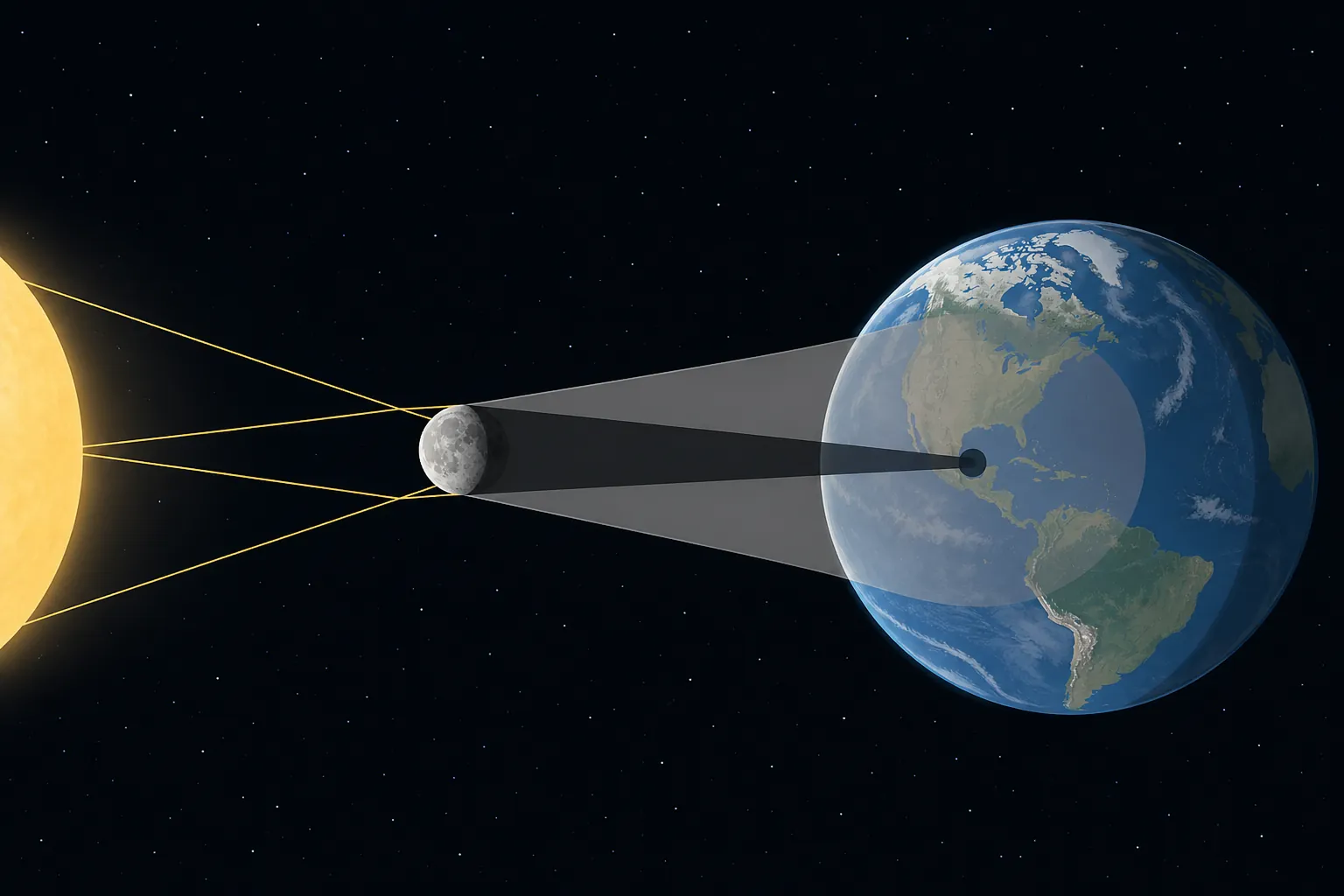
That geometry explains a common observation that otherwise sounds like event trivia: one town can see totality while another town, not very far away, sees a partial eclipse. The umbra is narrow — about 50 miles wide as a simplified rule of thumb — while the penumbra can cover a region more than 1,000 miles wide. A person inside the umbra sees the Sun fully covered. A person inside the penumbra sees only part of the Sun covered.[1]
This is where many multiple-choice questions try to swap vocabulary. If the question says the observer is in the umbra, think total eclipse, assuming the umbra reaches Earth. If the observer is in the penumbra, think partial eclipse. If the diagram shows Earth in the middle and the Moon moving into Earth’s shadow, that is not this event; that is lunar-eclipse geometry. For more practice separating the two shadow setups, use the blood moon astronomy study guide.
Total, annular, partial, and hybrid are not four unrelated events
NASA groups solar eclipses into total, annular, partial, and hybrid types.[4] The categories are easier to remember if you do not start by memorizing names. Start with two questions: does the Moon line up centrally enough, and does its apparent size fully cover the Sun?
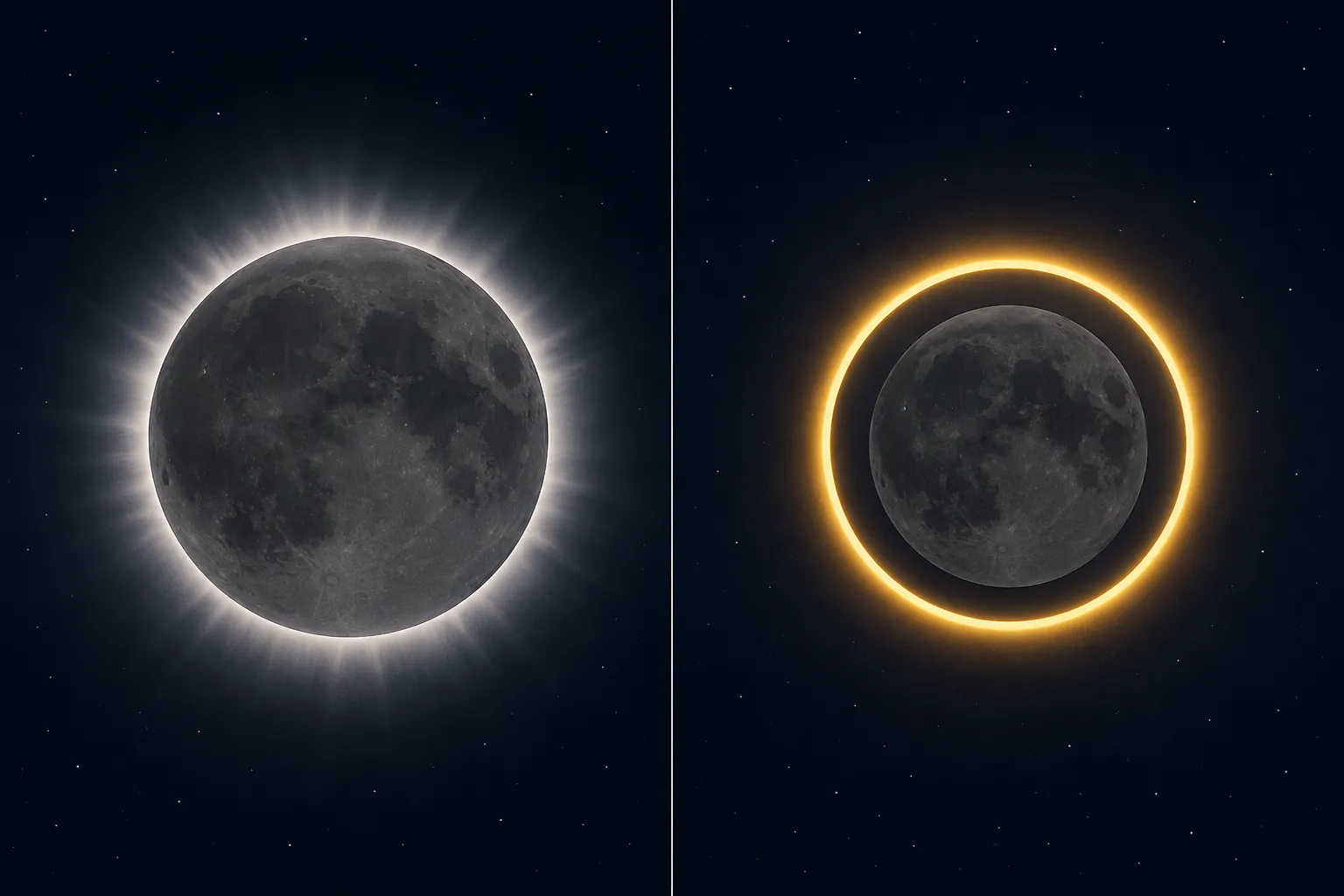
Totality is possible because of a scale coincidence: the Sun is about 400 times wider than the Moon, but it is also about 400 times farther away, so the two can appear nearly the same size in Earth’s sky.[1] When the Moon appears large enough and the umbra reaches the observer, the Sun’s bright disk is fully covered. That is a total solar eclipse.
An annular eclipse uses nearly the same alignment, but the Moon appears slightly too small to cover the Sun completely. The result is a bright ring of sunlight around the Moon. A partial eclipse happens when the observer is in the penumbra or when the alignment is off-center enough that only part of the Sun is covered. A hybrid eclipse changes between total and annular along different parts of the eclipse path.[4]
| Solar eclipse type | Test-friendly recognition rule |
|---|---|
| Total | The Moon fully covers the Sun for observers in the umbra. |
| Annular | The Moon is centered but appears too small, leaving a ring of sunlight. |
| Partial | Only part of the Sun is covered, usually because the observer is in the penumbra. |
| Hybrid | The eclipse changes between total and annular along the path. |
The August 12, 2026 eclipse belongs in the total category because, along the central path, the Moon’s apparent disk covers the Sun’s disk completely. The magnitude value greater than 1 is one numerical clue that this worked example is total rather than annular.[2]
What standardized-test questions usually want from an eclipse
No single official exam source says, “The 2026 eclipse will be on the test.” That would be the wrong claim anyway. The safer exam-prep judgment is that eclipse mechanics sit inside standard astronomy and physical-science concepts that are easy to draw, compare, and disguise in passages: phases, shadows, orbital inclination, apparent size, and light paths.
A passage does not need to mention August 2026 to test the same reasoning. It might show a tilted lunar orbit and ask why eclipses are not monthly. It might place three observers across the Moon’s shadow and ask who sees totality. It might describe a bright ring and ask whether the eclipse is total or annular. It might give a diagram with Earth between the Sun and Moon and expect the reader to notice that the setup is lunar, not solar.
- If the Moon is between Earth and the Sun, think solar eclipse possibility.
- If Earth is between the Sun and Moon, think lunar eclipse possibility.
- If the Moon is at new moon but away from a node, expect no solar eclipse.
- If the observer is in the umbra, expect totality when the umbra reaches Earth.
- If the observer is in the penumbra, expect a partial eclipse.
- If the Moon appears too small to cover the Sun, expect annularity rather than totality.
For physics-heavy exams, the apparent-size point can connect to angular size and light-path reasoning. If that is the angle you are studying, the sky-blue and Sun-yellow explainer is a better next step than another travel-focused eclipse article.
Safety is simple, and it is different from lunar-eclipse safety
Solar viewing safety is not a side detail. NASA’s rule is plain: use eclipse glasses or viewers that meet ISO 12312-2, do not use ordinary sunglasses, and use indirect methods such as a pinhole projector if you do not have proper solar viewers. The only time it is safe to look without eclipse glasses is during the brief total phase, and only for viewers actually inside the path of totality.[5]
That last condition matters. If you are in a partial-eclipse region, there is no safe naked-eye moment. The Sun is never fully covered from your location. This is one reason not to borrow lunar-eclipse habits for a solar eclipse. A blood moon is viewed under different geometry and different safety rules; if you are comparing the two for study purposes, use the blood moon safety study guide as the separate reference point.
The year becomes secondary once the model works
The August 12, 2026 eclipse is memorable because it is a real total eclipse with a central path, a maximum duration, a catalog identity, and a public viewing story. For studying, its better use is smaller and sturdier: it lets you rehearse the whole solar-eclipse model in one event.
You should be able to reconstruct five answers without memorizing the date: it happens at new moon because the Moon must be between Earth and the Sun; it is not monthly because the Moon’s orbit is tilted and eclipses require node alignment; totality is narrow because the umbra is narrow; partial-eclipse regions are wider because the penumbra is wider; and totality differs from annularity because the Moon’s apparent size is sometimes large enough to cover the Sun and sometimes not.
Once those pieces are in place, “2026” is no longer the thing holding the answer together. It is just the worked example you used to learn the mechanics.
References
- Why Do Eclipses Happen? — NASA Science
- Solar eclipse of August 12, 2026 — Wikipedia
- Solar Eclipse on August 12, 2026 — timeanddate
- Types of Solar Eclipses — NASA Science
- Eclipse Viewing Safety — NASA Science
Related exhibits & inventory
Verified outcomes
- not-score-proven → not-score-proven
When to Do HIIT for Better Memory and Exam Focus
- No baseline score reported → No verified final scoreLimited
Can NYT Strands Daily Actually Build Vocabulary?
- pre-final grades → 0.65 SD higher
A Sleep-First Routine to Stop Falling Asleep While Studying
- Not a score log → Not a score logModerate
Does Air Quality Affect Study Focus? Yes — by How Much?
Planners
Tool verdicts
A lesson substitute only for motivated adult beginners with MIDI keyboards focused on songs; otherwise a supplement.
Monthly $19.99; 6-month $83.94; annual ~$119.88-$120; checked 2026-08-27EvidenceModeratePixel 11 Pro is the cheaper study-app buy for flashcard-heavy students; iPhone 17 Pro only for notes-first Apple users.
$1,099/256GB each; AnkiMobile $24.99 iOS vs AnkiDroid free; checked 2026-08-26EvidenceModerateGalaxy S26 Ultra offers the more complete out-of-box exam-prep workflow; Pixel 11 Pro suits students who prefer assembling their own study stack.
Pricing not included in this workflow comparison (2026-08-26)EvidenceModerate
Questions about this plan
Ask a question about a specific section, timeline, or citation in this plan — or flag something that needs correcting.
Comments
Join the discussion with an anonymous comment.