
Can NYT Strands Daily Actually Build Vocabulary?
Evidence label: Limited. Source type: community-sourced, self-reported anecdote. Last reviewed: August 26, 2026.
The claim “I used NYT Strands daily to build vocabulary” has one useful human signal and no verified outcome data. The direct support is a Reddit r/NYTStrands comment, visible through a search snippet, saying the puzzle helped “expand my English vocabulary”; the thread itself could not be crawled here, and the snippet does not provide a baseline vocabulary measure, a study log, a before/after test, or a verified SAT, ACT, or GRE score report [1].
That matters because this is not a claim about enjoyment. It is an outcome claim. A daily puzzle can be delightful and still fail the test-prep question: should a student with a fixed exam date count those minutes as vocabulary study? On the current evidence, Strands earns a small warm-up slot, not logged vocabulary time.
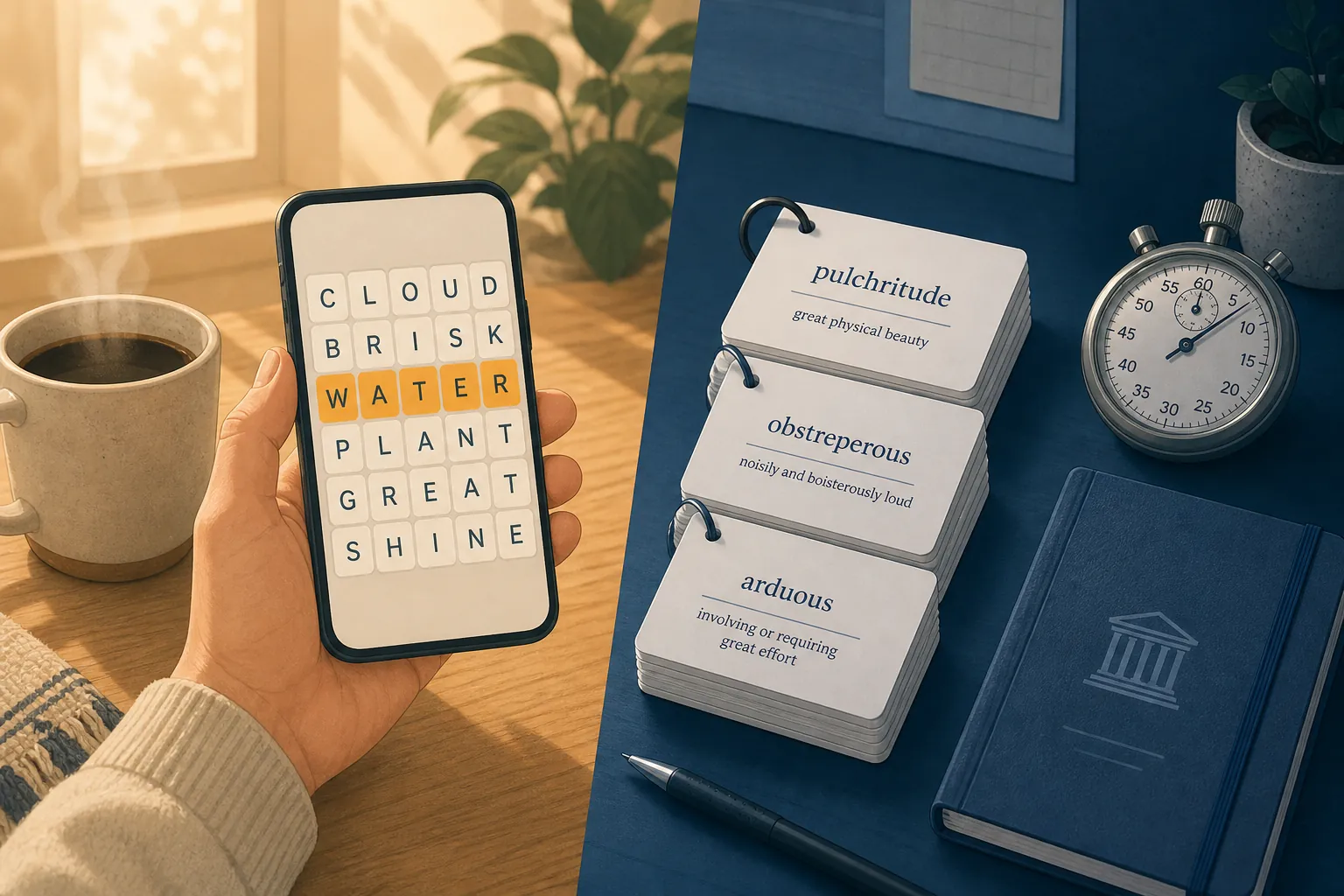
For anyone arriving from the headline rather than the app: NYT Strands is a daily word-search-style puzzle built around a theme. Solvers connect adjacent letters to uncover theme words and a spangram that stretches across the grid. The vocabulary question begins after that, with what the game actually rewards.
What Strands trains before it trains vocabulary
The strongest description of Strands as a cognitive task does not make it sound like a vocabulary course. The Word Finder characterizes the puzzle as rewarding “more than vocabulary,” specifically pattern recognition, theme interpretation, and letter-adjacency logic; it also notes that constructors avoid obscure vocabulary and that difficulty usually comes from path complexity rather than rare words [2].
Lifehacker’s gameplay comparison points in the same direction. It describes Strands skill as finding words from out-of-order letters, recognizing spelling patterns, inferring the theme, and discovering the spangram. Its solve-time framing is also revealing: an easy puzzle may take about two minutes, while a trickier one may run past five minutes [3]. That is a pleasant morning ritual. It is not much time for encoding meanings, retrieving definitions, checking usage, and seeing the same word again under delay.
A player can absolutely notice a word in Strands. The weaker leap is assuming that noticing becomes exam-usable vocabulary. In a grid, the solver can succeed by seeing a spelling shape, testing adjacent letters, and matching the theme. None of those actions requires producing a definition, choosing between near-synonyms, or explaining how a word changes meaning in a sentence.
This is why the Strands vocabulary practice hub treats the game as exposure first. Exposure is not worthless. It can lower friction. It can keep a tired student in contact with words. It can even generate the occasional “I should look that up” moment. But it is not the same as a study system that makes a learner retrieve meaning later without the grid doing half the work.
The word pool looks too ordinary and too one-time to carry the claim
The corpus evidence makes the problem sharper. WordsRated’s third-party, self-published analysis of more than 600 Strands puzzles, current as of December 2025, reports 3,070 unique theme words, with 86% of theme words falling between four and eight letters and 80% appearing in exactly one puzzle. It lists MUSIC, QUEEN, WATER, CHEESE, and BACON among the most-used words [4].
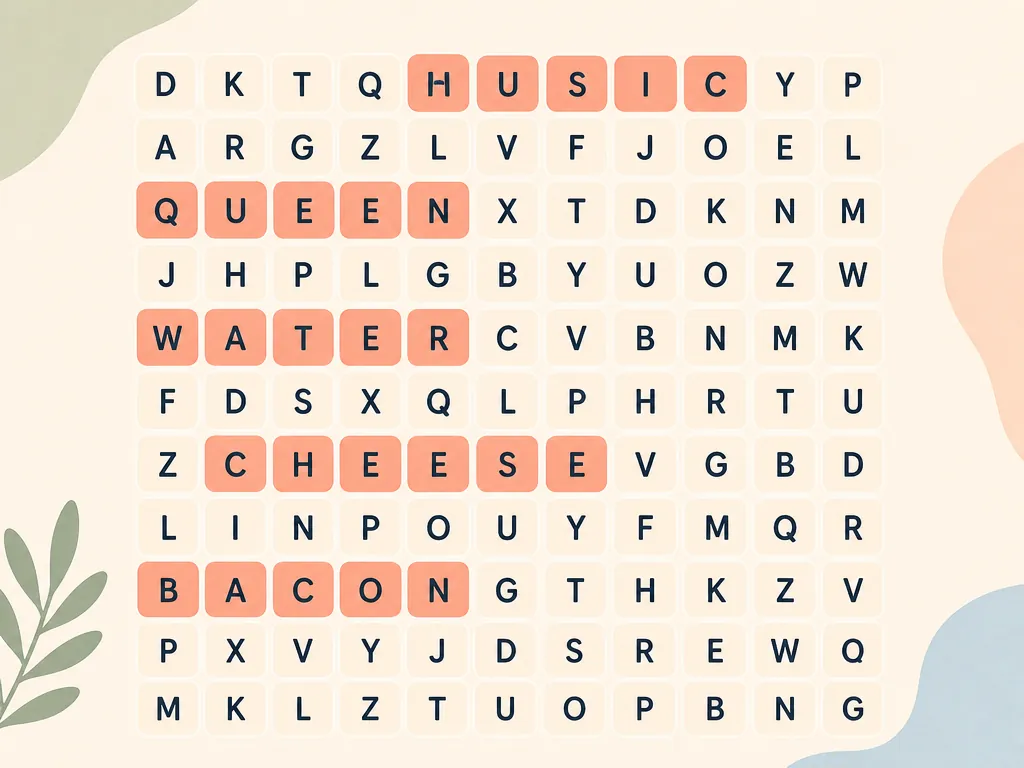
That analysis is not peer-reviewed, and it should not be treated as an official NYT dataset. It is still useful for this narrower question because it matches what experienced solvers can feel: Strands usually runs on common theme words. The point is not that short words are easy in every context. “Claim,” “conduct,” and “charge” can become serious exam words when the sentence turns. The point is that a puzzle built from words like WATER or CHEESE does not, by itself, create the kind of repeated meaning work that test vocabulary requires.
The one-time exposure figure is especially inconvenient for the study claim. If most theme words appear in exactly one puzzle, Strands is not naturally spacing those words for the learner [4]. A student may see a word once, connect it, feel a small click, and move on. Unless that word is captured somewhere else, the game has not created a retrieval schedule.
For the fuller dataset discussion, use the site’s Strands vocabulary corpus analysis. The short version for this claim is enough: a large pool of mostly short, ordinary, low-repeat words supports incidental contact, not a controlled vocabulary program.
NYT’s own public numbers fit the daily-ritual reading better than the study-method reading. A company press release says 83% of solvers find the spangram daily, the completion rate is about 81%, and Strands became the third most-searched NYT game [5]. Those are signs of an accessible puzzle people can finish, not evidence that solvers retain new vocabulary or raise exam scores.
SAT, ACT, and GRE vocabulary are not just word spotting
The modern SAT does not reward memorizing endless lists of exotic words the way many students imagine. PrepScholar describes SAT vocabulary as appearing within Craft and Structure, about 13–15 questions or roughly 28% of Reading and Writing, with medium-difficulty words tested in context [6]. Princeton Review similarly says up to eight SAT questions may ask for the most precise word or phrase, and it gives examples of common words such as “claim” and “conduct” shifting meaning by context [7].
That is not a perfect match for Strands. In Strands, a theme can help a solver identify a word without deeply processing its meaning. On the SAT, context is the obstacle. The student has to decide which meaning fits the sentence, which synonym is too broad, which option has the wrong connotation, or which ordinary-looking word is being used in a less ordinary way.
The GRE makes the mismatch even plainer. ETS describes GRE Verbal Reasoning as including Reading Comprehension, Text Completion, and Sentence Equivalence, with tasks that require understanding meaning, context, relationships among words and concepts, and the fit between sentence parts [8]. ETS also offers GRE Vocabulary Flashcards with more than 1,600 questions, which is at least a structured vocabulary-practice model rather than a single daily grid [9].
The ACT should be handled with the same caution as the SAT, not folded into a generic “vocab test” bucket. Its reading and English work still asks students to interpret words and phrases in context, but the practical problem is similar: the exam score depends on timed interpretation, not on having recently seen a friendly theme word in a puzzle.
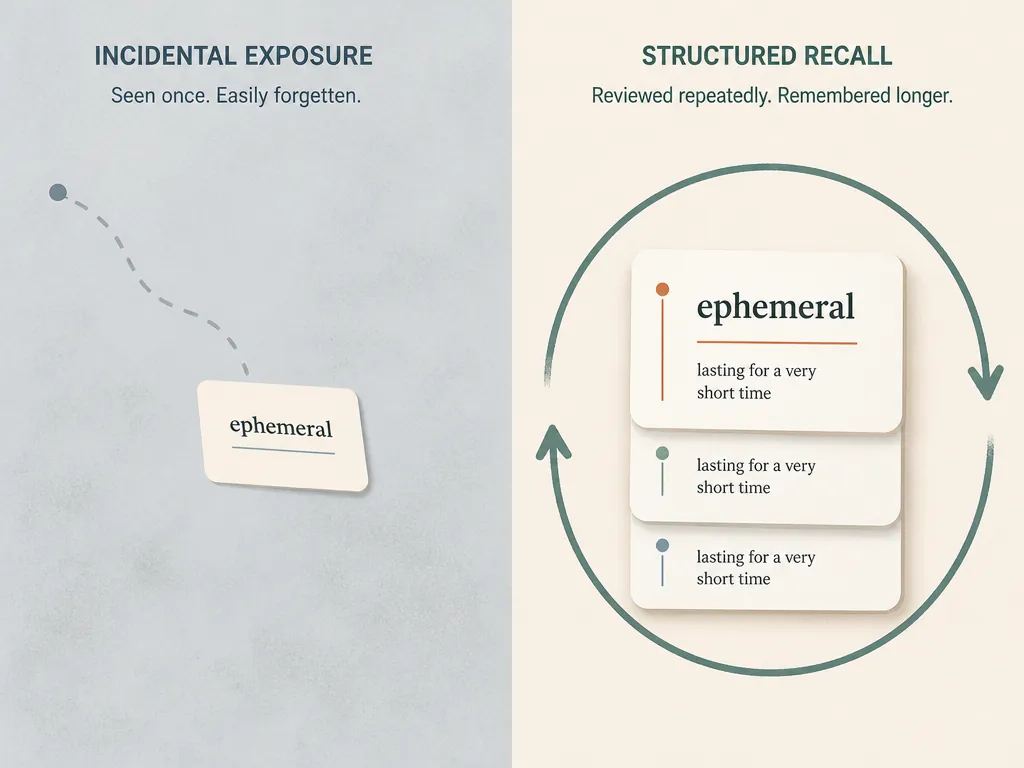
This is where flashcards, retrieval practice, and spaced repetition differ from Strands. A flashcard or logged vocabulary system asks the learner to produce or select meaning after a delay. PrepScholar, as test-prep vendor advice, says active recall, spaced repetition, and retrieval practice beat passive review “by a wide margin” [6]. Wikipedia’s spaced repetition article describes the method as a learning technique that has been shown to increase learning rate and is well suited to vocabulary [10]. The exact tool matters less than the loop: encounter, define, use, forget a little, retrieve again.
Structured educational games can perform much better than casual puzzle exposure, but that evidence should not be borrowed carelessly. Chen et al.’s 2016 meta-analysis found a large effect for digital game-based learning in structured classroom settings, reported as d = 1.027 [11]. Applying that effect to a few minutes of NYT Strands over coffee would be synthesis, not direct evidence. The game in the study literature is usually embedded in instruction, feedback, goals, and assessment. Strands is a puzzle.
When Strands can count, and when it cannot
Strands can count as a warm-up. If opening the puzzle makes a student sit down, switch into word mode, and avoid the first ten minutes of phone drift, that is a real behavioral benefit. Lifehacker’s two-to-five-minute solve framing is about the right scale for it [3].
It can also create vocabulary leads. If a word is unfamiliar, oddly used, or exam-relevant, capture it. Put it into a flashcard. Add a sentence. Review it tomorrow, then later. The site’s Strands vs. flashcards comparison and SRS capture method for Strands words cover that process in more detail.
Without that second step, Strands should not go into the study log as vocabulary practice. “Played Strands” records contact. “Reviewed 20 GRE cards, missed 6, rescheduled them, and wrote two example sentences” records practice. Those are different claims, and only one gives a test-taker useful accountability when the exam date gets close.
| Use of Strands | How to count it |
|---|---|
| Solved the daily grid and moved on | Warm-up or recreation |
| Noted one unfamiliar word but did not review it later | Vocabulary exposure |
| Logged the word, defined it, used it in context, and reviewed it later | Vocabulary study |
| Replaced official SAT, ACT, or GRE practice with Strands | Misallocated prep time |
The same allocation logic appears in the site’s Connections vocabulary focus audit and Wordle study-time verdict: games can be useful at the edge of a study session, but they do not become score-outcome methods just because they involve words.
The allocation decision
For a GRE, SAT, or ACT student, the cleanest rule is boring and useful: give Strands two to five minutes if it helps you start. Then leave the puzzle and do the work the exam will actually inspect.
- For SAT vocabulary, move to official-style Reading and Writing practice, context questions, and precise word-choice review. Use the SAT exam hub for exam-specific routing.
- For ACT vocabulary, prioritize timed passage work, sentence-level meaning, and grammar or rhetoric questions where word choice affects the answer. Use the ACT exam hub for the exam path.
- For GRE vocabulary, use structured word lists, Text Completion and Sentence Equivalence practice, active recall, and spaced review. Use the GRE exam hub for verbal prep.
Verdict: Limited evidence. The “I used NYT Strands daily to build vocabulary” claim is plausible as a personal feeling and unsupported as a verified score-outcome claim. Strands offers incidental payoff, a low-friction warm-up, and the occasional word worth capturing. It should not be counted as logged GRE, SAT, or ACT vocabulary study unless the student turns those words into reviewed retrieval practice.
References
- What do you like about Strands?, Reddit
- NYT Strands Solver Guide, The Word Finder
- How Wordle, Connections, and Strands Stack Up in Gameplay, Lifehacker
- NYT Strands Statistics, WordsRated
- Solvers Can Now Play Strands in The New York Times Games App, The New York Times Company
- SAT Vocabulary Words You Must Know, PrepScholar
- SAT Vocabulary, The Princeton Review
- Verbal Reasoning Measure, ETS
- Prepare for the GRE General Test, ETS
- Spaced repetition, Wikipedia
- The effects of digital game-based learning on learning performance: A meta-analysis, British Journal of Educational Technology, 2016
Related case links
No matching exam hub found
Browse the exam hubs directory to find the study plan for this exam.
Did a similar plan work for you?
Share whether a comparable timeline and starting point produced a similar result — this is verification discussion, not general commentary.
Comments
Join the discussion with an anonymous comment.