
Why Agentic AI Is an Infrastructure Transformation
Accuracy Warning — Agentic AI
Agentic AI can confidently act on stale data or weak permissions, producing fluent but unreliable results; most deployments have not reached dependable production scale.
- Accuracy:
- Limited
- Tested:
- Assessing the claim that agentic AI is an infrastructure transformation using 2026 enterprise research
- Last tested:
- 2026-08-27
Last reviewed: August 27, 2026
Method note: The learner-facing verification method in this article is editorial synthesis of enterprise technology research. It is not evidence of agentic AI adoption in schools, universities, or education technology.
“Agentic AI is an infrastructure transformation” is troublesome because it compresses two claims into one. First, what makes a technology infrastructure rather than an application feature? Second, what has agentic AI added that an ordinary generative AI feature does not?
The short answer is that the phrase refers to a proposed underlying computing layer: agents connected to data, context, workflow logic, security controls, governance, and operational monitoring. Applications can then use that shared layer to assign and supervise work. Calling this an infrastructure transformation is defensible in 2026, but the evidence supports construction more strongly than completion. Organizations report substantial upgrade requirements while relatively few have scaled agents to tangible value.

What the word “infrastructure” is doing here
A chatbot embedded in one product is a feature. It receives a prompt and generates a response inside the boundaries of that product. Even an impressive experimental agent can remain a standalone demonstration. Infrastructure appears when multiple applications, teams, or workflows depend on shared systems that let agents obtain context, use tools, coordinate actions, and operate under common controls.
Slack describes an agentic operating system as “an infrastructure that enables agents to do real work.” Its inventory includes agents, data access, context or memory, workflow logic, orchestration, and governance. Slack also offers a useful functional contrast: a chatbot behaves more like a consultant that answers, while an agent behaves more like a teammate that can act within a workflow.[1]
- Agents interpret goals, choose actions, and use available models or tools.
- Context and memory supply information about the user, task, prior actions, and current state.
- Data access connects the agent to documents, databases, software services, or other authorized sources.
- Orchestration determines which agent, model, tool, or workflow runs next.
- Security and governance constrain permissions, sensitive data use, approvals, and accountability.
- Operational monitoring records behavior, failures, cost, latency, and outcomes so people can inspect the system.
The list matters more than the “operating system” metaphor. A vendor does not prove that it has created infrastructure merely by applying that label. The test is whether these capabilities form a dependable shared layer beneath real work.
What agentic AI adds to generation
Generative AI primarily produces content in response to input. Agentic systems add a control loop around generation: they interpret a goal, plan or select an action, use tools, observe what happened, and decide what to do next. IBM, Salesforce, and MIT Sloan describe versions of this distinction, although the terminology is not perfectly standardized across providers.[2][3][4]
That does not mean every agent is fully autonomous. An agent may require approval before sending a message, changing a record, making a purchase, or releasing work. Human checkpoints are part of the architecture, not evidence that the system has ceased to be agentic.
The consequential shift is from generating a possible answer to changing the state of another system. Once software can act, the surrounding layer must answer harder questions: Which identity is acting? What data can it retrieve? Which tool can it call? What happens when its input is malicious or its conclusion is wrong? Who approves a sensitive action? Can the organization reconstruct the decision afterward?
The 2026 evidence: high intent, low scaled value
Two findings give the infrastructure claim its proper scale. Google Cloud surveyed 1,402 IT leaders for its 2026 infrastructure report. Eighty-three percent said their organizations needed infrastructure upgrades to support production-grade agentic systems. The same report found that 52% were operating hybrid multicloud environments, 91% considered power consumption when selecting hardware, and four in five identified security, governance, or MLOps among their leading challenges.[5]
Those figures measure reported conditions and priorities among surveyed IT leaders. They are evidence that organizations expect agentic systems to affect underlying compute, deployment, data, and control environments. They do not show that the upgrades are complete, that agents are widely effective, or that the investment has produced economic value.
McKinsey’s April 2026 enterprise evidence supplies that missing constraint. Nearly two-thirds of enterprises had experimented with agents, but fewer than 10% had scaled them to tangible value. Eight in ten cited data limitations as an obstacle.[6]
| Evidence | What it supports | What it does not establish |
|---|---|---|
| 83% report needing infrastructure upgrades | Strong organizational intent and perceived technical requirements | Completed deployment or proven return |
| Nearly two-thirds have experimented with agents | Broad experimentation | Production scale or dependable performance |
| Fewer than 10% have scaled agents to tangible value | Scaled results remain uncommon | That all agent projects fail |
| Eight in ten cite data limitations | Data readiness is a recurring deployment barrier | That data is the only barrier |
The Google Cloud and McKinsey findings belong together. If the first is quoted alone, agentic infrastructure can sound nearly established. If the second is quoted alone, the field can look like a failed application trend. Read together, they describe an early build-out: substantial perceived demand for new foundations, extensive experimentation, recurring data problems, and limited demonstrated scale.

Why a persuasive agent demo can fail in production
A demonstration usually begins with a prepared task, clean access to the relevant information, and a person ready to overlook rough edges. Production use introduces missing records, ambiguous instructions, changing permissions, tool failures, unusual cases, and people who expect the system to work consistently.
McKinsey’s separate account of lessons from more than 50 agentic AI builds reports that demos can become frustrating in real use, producing what it calls “AI slop” and eroding trust. The authors argue that agents need to be onboarded in a way comparable to employees rather than merely switched on.[7] This evidence comes from a set of builds, not from the enterprise survey behind the scaling figures, so the two should not be treated as one sample.
Onboarding an agent means defining its job, supplying the right context, limiting its permissions, testing its decisions, setting escalation rules, and teaching users when to rely on it. It also means correcting the surrounding workflow. If an agent depends on inconsistent customer records or outdated internal documents, a more capable model may simply make bad actions more fluent.
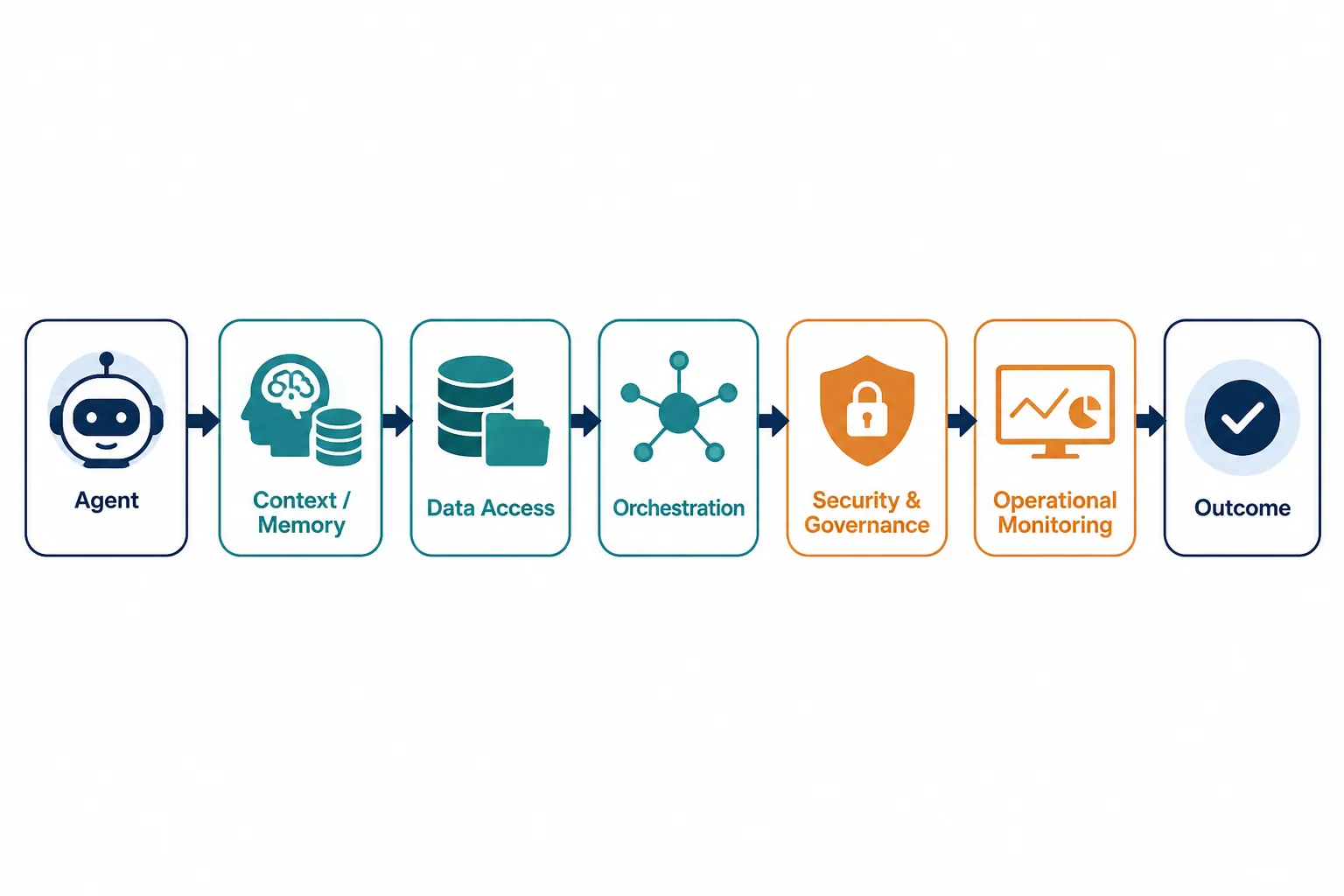
Trace one proposed action through the system
Consider a hypothetical study-support agent asked to reorganize a learner’s schedule after a missed assignment. The example is illustrative, not a documented deployment.
- The agent interprets the request and identifies the intended outcome.
- Context or memory supplies the learner’s existing plan, preferences, and prior activity.
- Authorized data access retrieves relevant deadlines and current task status.
- Orchestration chooses the appropriate model or scheduling tool and determines the order of operations.
- Security and governance rules prevent access to unrelated records and decide whether the proposed change requires confirmation.
- The system presents or executes the revised plan, depending on its permissions.
- Monitoring records the action and detects errors, abnormal behavior, or a need for human review.
A chatbot could suggest a new schedule from text pasted into a conversation. The infrastructural version depends on persistent identity, live data connections, permission boundaries, workflow execution, and auditability. Every additional connection also creates another place for stale data, excessive access, tool errors, or unreviewed actions to cause harm.
This is why data limitations can block scale even when model quality appears adequate. The agent must retrieve the correct information in a usable form, understand what it is allowed to do with that information, and pass a reliable result to another system. A failure anywhere in that chain appears to the user as an agent failure.
EY shows what a layered build-out can look like
EY describes constructing a three-layer enterprise agentic platform and reports creating more than 50,000 agents over nine months.[8] The case makes the architecture visible: supporting many agents involves platform layers rather than thousands of isolated chat windows.
It remains one company’s account of its own implementation. The number of agents does not by itself reveal how many are regularly used, how independently they act, how much value they produce, or whether another organization could reproduce the result. It illustrates the form of an infrastructure build-out; it does not establish its prevalence or general effectiveness.
Useful analogies—and where they stop helping
Electric grids, the internet, and cloud platforms are useful explanatory analogies because each places shared capabilities beneath many applications. In the same limited sense, an agentic layer could let different products draw on common identity, context, tools, orchestration, and governance instead of rebuilding them separately.
These comparisons are editorial analogies, not findings from the cited research. Agentic AI has not thereby acquired the maturity, standardization, reach, or reliability of electricity, internet protocols, or established cloud services. A clear system diagram can show that a platform is technically coherent long before it shows that the platform is economical or widely adopted.
Executive attention is evident, though still different from results. In a December 2025 Accenture report, 94% of surveyed leaders expected agentic AI to change platform strategy, while 57% said that strategy required reinvention.[9] These are reported expectations in an Accenture study, not direct measurements of completed agent deployment.
MIT Sloan also reports that 35% of organizations had adopted the relevant technology by 2023 and another 44% planned to deploy it.[4] Because the underlying MIT Sloan Management Review and BCG survey was not available in the supplied research materials, those figures offer limited methodological visibility here. They are best treated as a sign of reported adoption and planned adoption in that source, not as a definitive 2026 market baseline.
How learners can check the next infrastructure claim
The unresolved gap in 2026 is itself the useful lesson: real platform construction and high organizational intent coexist with low demonstrated scale. When the next article says agents are becoming infrastructure, check the claim in this order.
- Identify the alleged underlying layer. Look for shared data access, context, orchestration, permissions, governance, and monitoring—not merely an AI interface.
- Locate evidence of actual deployment. A product announcement, prototype, experiment, and production system represent different stages.
- Separate organizational intent from scaled results. “Plans to invest,” “needs upgrades,” and “expects change” do not measure realized value.
- Label the evidence. Record whether it comes from a survey, a set of project observations, a vendor disclosure, an independent study, or a single-company case.
- Inspect what the number measures. Agent count is not user adoption; experimentation is not effectiveness; adoption is not return on investment.
- Verify forecasts at their primary source. If a prediction appears only through another company’s citation, follow the reference before repeating it.
The same evidence discipline applies when evaluating study products. The site’s guides to AI study-tool privacy, catching AI hallucinations, using detection as a signal rather than proof, and labeling evidence in an AI feature case provide related ways to avoid turning a promising capability into a stronger claim than the evidence permits. For infrastructure-specific source checking, the cloud computing security study guide reinforces the habit of verifying technical claims against official material.
References
- What is an agentic OS? — Slack
- What is Agentic AI? — IBM
- What is Agentic AI? — Salesforce
- Agentic AI, explained — MIT Sloan
- The State of Infrastructure in the Agentic AI Era — Google Cloud, 2026
- Building the foundations for agentic AI at scale — McKinsey & Company, April 2026
- One year of agentic AI: Six lessons from the people doing the work — McKinsey & Company
- Building an enterprise-scale agentic AI operating system — EY
- New rules of platform strategy in the age of agentic AI — Accenture, December 2025
Authoritative source
No specific exam hub matched
Browse the exam hubs directory for the authoritative plan on any of the five exams.
Report an error in this tool's output
Found something this tool got wrong beyond what's documented above? Report it so the accuracy log stays current.
Comments
Join the discussion with an anonymous comment.