
ASVAB Exam Hub
Use the July 2026 Buck Moon for ASVAB General Science Prep
Learn how observing the July 29, 2026 Buck Moon can help ASVAB test-takers master the astronomy question types on the General Science subtest, including moon phases and eclipse mechanics.
- gre
- mcat
- asvab
- sat
- act
- digital-adaptive
- official-material
- section-strategy
- test-date-timeline
If you searched for “buck moon july 2026 viewing times for astronomy class,” the ASVAB use is narrower than the skywatching articles make it sound. The July full moon can help you practice the Earth-Sun-Moon positioning that shows up in General Science, but it is not a reason to turn astronomy into your whole study plan.
On the CAT-ASVAB, General Science gives you 16 questions in 8 minutes. Astronomy is only one part of that subtest, with about 2-3 questions per form among topics such as planet classification, Moon-Earth-Sun movement, and celestial objects.[1] That is enough to matter, especially if those questions make you hesitate, but not enough to steal time from biology, chemistry, physics, and earth science.
The useful part of the July 2026 Buck Moon is that it gives you something to point at. The full moon peaks at 10:36 a.m. EDT on July 29, 2026. Since that happens during daylight for much of the United States, the practical observation window for a class assignment is the evening moonrise, around 8:33 p.m. EDT depending on location.[2] You are not trying to memorize a romantic moon name. You are trying to answer: where are the Sun, Earth, and Moon when the Moon looks full?
What to Watch on July 29
The name “Buck Moon” comes from a seasonal naming tradition, but for ASVAB prep the name is the least important fact. The testable fact is the phase. A full moon happens when the Moon is on the opposite side of Earth from the Sun, so the side facing Earth is lit.
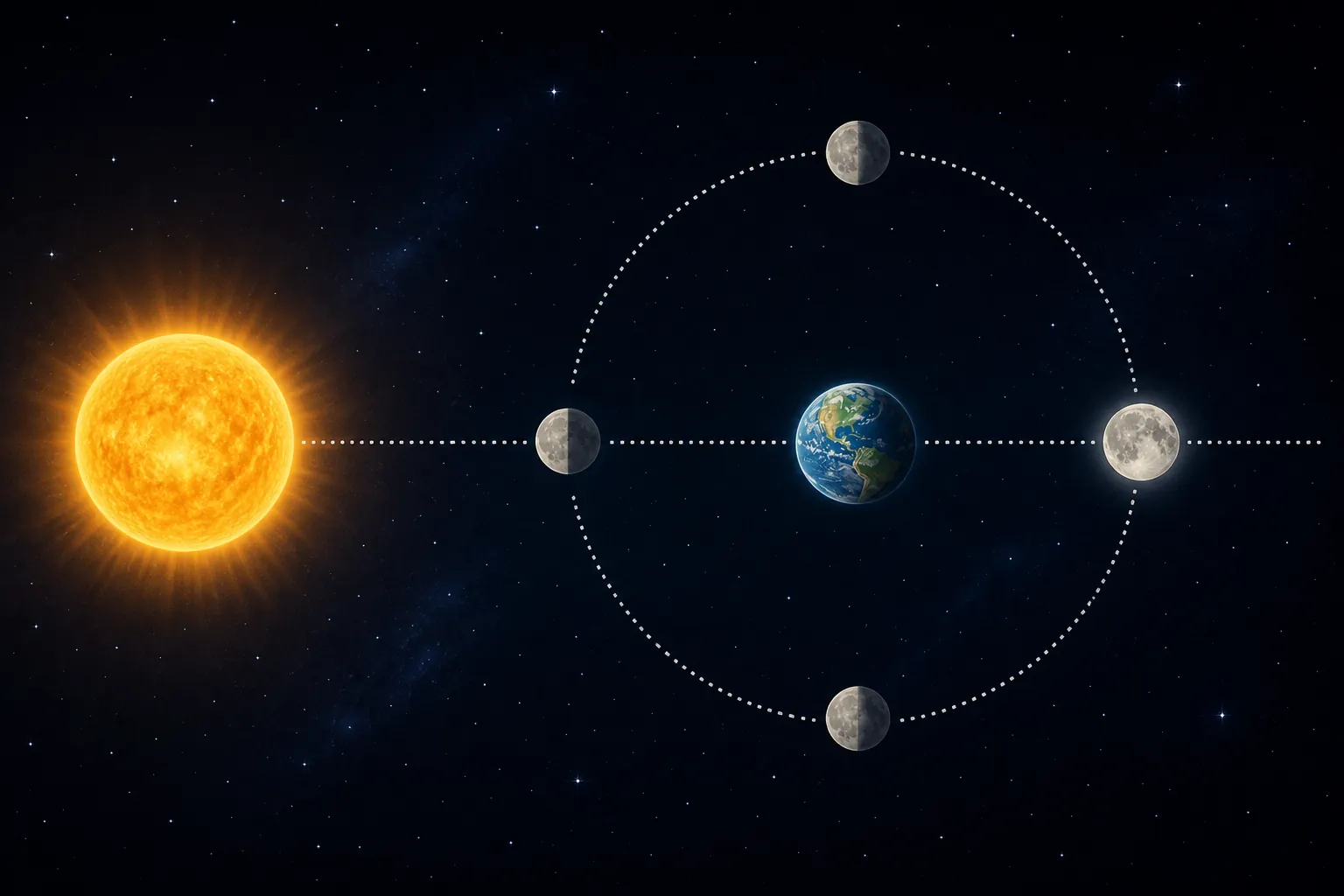
That position also explains the timing. NASA’s Moon phase guidance gives the clean rule: full moons rise around sunset and set around sunrise.[3] Do not treat that as trivia. It is a position check. If the Sun is going down in the west and the full Moon is coming up in the east, Earth is between their directions from your point of view.
For your observation notes, write down only the things that would help you rebuild the diagram later:
- Date and time observed: evening of July 29, 2026, near local moonrise.
- Moon appearance: full or nearly full disk.
- Moon direction: rising in the eastern sky if observed near moonrise.
- Sun direction: opposite side of the sky, near or below the western horizon.
- Geometry sentence: Earth is between the Sun and the full Moon, though not necessarily lined up perfectly enough for an eclipse.
That last clause matters. A full moon does not automatically mean a lunar eclipse. The Moon’s orbit is tilted, so most full moons pass above or below Earth’s shadow. ASVAB-style eclipse questions care about the alignment, not the nickname.
From Full Moon to Solar Eclipse Geometry
The July 29 full moon is especially useful because it sits about two weeks before the August 12, 2026 total solar eclipse. That is the half-cycle you want to understand: full moon to new moon. The August 12 eclipse occurs one synodic month after the prior new moon and one half-cycle after the July full moon, giving you a live sequence from “Moon opposite the Sun” to “Moon between Earth and Sun.”[4][5]
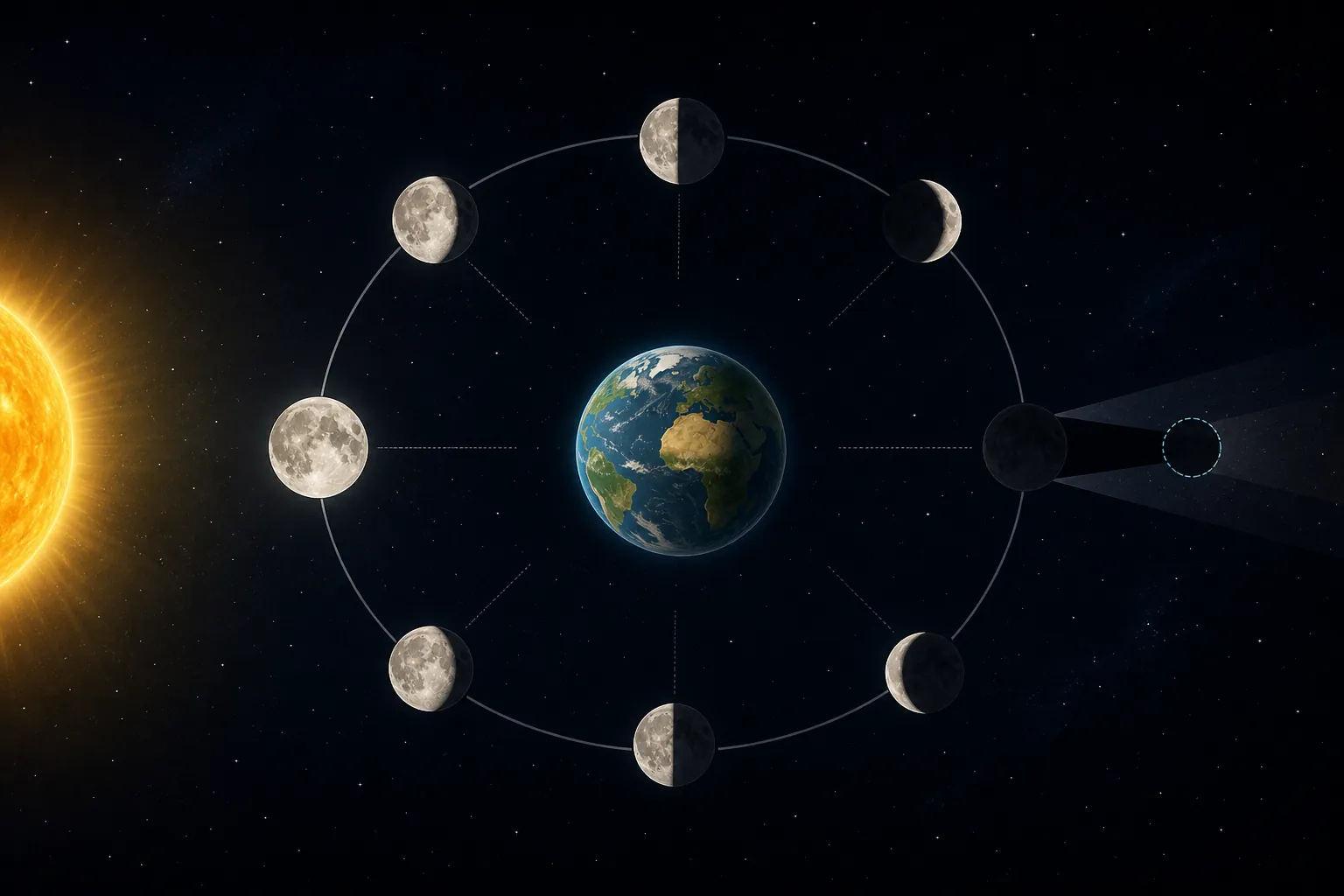
After July 29, the Moon moves through waning phases. “Waning” means the lit portion visible from Earth is decreasing. The Moon is still half lit by the Sun in space; what changes is how much of that lit half faces Earth.
| Observation period | What changes | ASVAB idea to attach |
|---|---|---|
| July 29 full moon | The visible face looks fully lit | Moon is opposite the Sun with Earth between their directions |
| Days after full moon | The lit portion begins shrinking from night to night | The Moon is moving away from the full-moon position |
| Around third quarter | About half the disk appears lit | Phase depends on viewing angle, not on Earth’s shadow |
| Waning crescent | Only a thin lit portion remains visible | The Moon is approaching the Sun’s direction in the sky |
| August 12 new moon and eclipse alignment | The Moon is between Earth and the Sun | Solar eclipse geometry requires the Moon to block sunlight from reaching part of Earth |
The table is not asking you to memorize dates for each intermediate phase. It is asking you to keep the motion straight. At full moon, the Moon is opposite the Sun. At new moon, the Moon is in the same general direction as the Sun. A solar eclipse can only happen near new moon because the Moon has to get between Earth and the Sun.
This is where students often mix up cause and appearance. Phases are not caused by Earth’s shadow covering the Moon. That mistake sounds reasonable if you only think about the dark part of the Moon’s face. But the normal monthly phases come from the Moon’s position in orbit and the viewing angle from Earth. Earth’s shadow is involved in a lunar eclipse, which is a different event.
The Three Question Types This Observation Helps With
ASVAB astronomy questions usually do not ask you to give a poetic description of the Moon. They ask whether you can identify a relationship quickly. Under an 8-minute General Science section, a slow diagram in your head costs more than you think.[1]
1. Identify the Full Moon Position
For a full moon, put Earth in the middle of your mental setup. The Sun is on one side. The Moon is on the other side. The side of the Moon facing Earth is sunlit, so it looks full.
If a question gives you rise and set timing instead of a diagram, use NASA’s timing rule. A full moon rising around sunset and setting around sunrise means the Moon is opposite the Sun in the sky.[3] That is the same geometry stated as a clock clue.
2. Separate Lunar Eclipse From Normal Moon Phases
A known ASVAB-style practice item asks what position is required for a lunar eclipse, and the answer is that Earth lies between the Moon and the Sun.[6] That is close to full-moon geometry, but it adds a stricter requirement: the three bodies must line up so the Moon passes through Earth’s shadow.
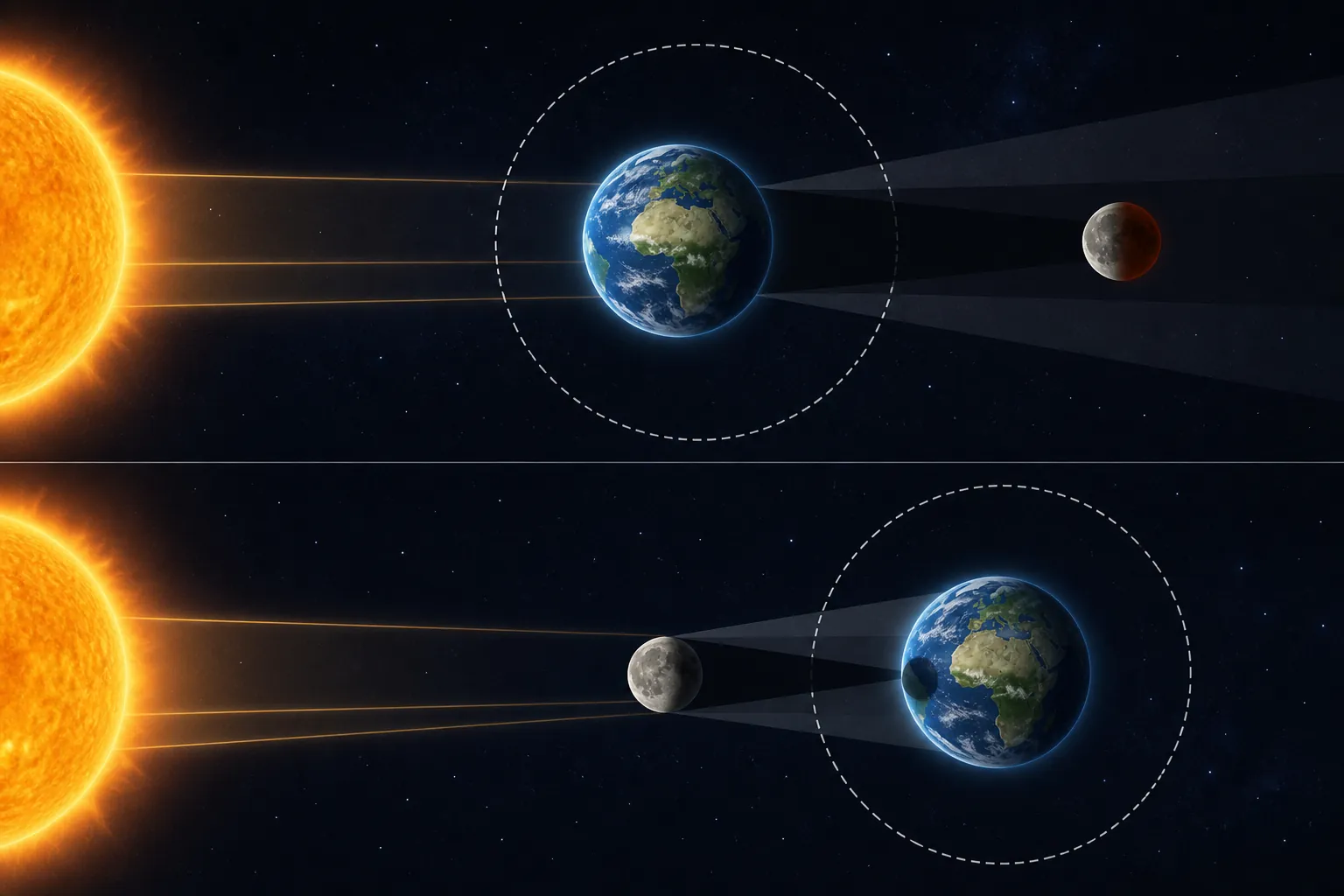
Use one sentence for the distinction: normal phases are caused by changing viewing angles as the Moon orbits Earth; a lunar eclipse is caused by Earth’s shadow falling on the Moon. If you can say that without looking at notes, you have removed one of the common traps.
3. Recognize Solar Eclipse Alignment
A solar eclipse uses the opposite alignment from a lunar eclipse. The Moon is between Earth and the Sun. That can only happen near new moon, because the Moon has to be in the Sun’s direction from Earth.
The August 12, 2026 total solar eclipse makes the point cleanly because it follows the July 29 full moon by about two weeks.[4][5] Watch the full moon, then track the shrinking lit portion over the next several nights. You are watching the Moon move from the opposite side of the Sun to the Sun’s side of the sky.
A Short Practice Routine
Do this like a lab check, not like a sightseeing assignment. Ten minutes is enough if you make the observation carry the right load.
- On July 29, observe the Moon near evening moonrise if your sky is clear. Note the time, direction, and phase.
- Draw a simple Sun-Earth-Moon line for full moon: Sun, Earth, Moon.
- Add one sentence explaining why a full moon rises around sunset.
- Every few nights after that, sketch the Moon’s visible shape and label it waning.
- Before August 12, draw the new-moon solar eclipse setup: Sun, Moon, Earth.
- Answer one comparison prompt from memory: Which body is in the middle during a lunar eclipse, and which body is in the middle during a solar eclipse?
If clouds block your view, the assignment still works as a reasoning exercise. Use the published full-moon time and moonrise estimate, then explain what you would expect to see and why. The ASVAB does not grade your weather. It grades whether you can connect the visible phase to the position.
Keep the Yield Honest
The Buck Moon is a good compact review tool because it ties together three things that students often keep separate: what the Moon looks like, when it rises, and where it sits relative to Earth and the Sun. That is useful for ASVAB General Science.
It is still only a small slice of the section. After you can explain full moon, lunar eclipse, and solar eclipse alignment without guessing, move on. Your main General Science time still has to cover the broader mix of life science, physical science, and earth and space science topics. Use the July 2026 Buck Moon as a live diagram, not as an excuse to over-study moon names.
References
- ASVAB General Science Practice Test, ASVAB Test Practice
- Moonrise and Moonset Calculator, Time and Date
- Moon Phases, NASA
- Full moon calendar 2026: When to see the next full moon, Space.com
- A Total Solar Eclipse Is Coming In 2026, Forbes
- ASVAB General Science Question 221, CrackASVAB.com
Related exhibits & inventory
Verified outcomes
No verified outcomes on file for this exam yet
See Methodology for how outcome evidence is disclosed once logged.
Planners
No planner filed for this exam yet
A downloadable timeline template for this exam hasn't been published yet.
Tool verdicts
AI-tool cautions
No AI tools tested for this exam yet
No hands-on AI-accuracy logs have been filed for this exam.
Questions about this plan
Ask a question about a specific section, timeline, or citation in this plan — or flag something that needs correcting.
Comments
Join the discussion with an anonymous comment.