
DSST Exam Hub
Blood Moon Viewing Guide and Astronomy Study Tips for the DSST
The August 27-28 almost blood moon is more than a sky show — it's a free live demonstration of the celestial mechanics and light concepts that make up a quarter of the DSST Astronomy exam. This guide tells you what to look for and how to use each eclipse phase as a study checkpoint before test day.
- gre
- mcat
- asvab
- sat
- act
- digital-adaptive
- official-material
- section-strategy
- test-date-timeline
On August 27-28, 2026, the Moon gives DSST Astronomy students something unusually useful: a scheduled, free, visible demonstration of material that appears on the exam blueprint. The event is a 96% partial lunar eclipse, not a total eclipse, but that label undersells its study value. A lunar eclipse puts Earth-Moon-Sun geometry, umbra and penumbra, orbital nodes, and coppery-red eclipse color into one sky event.
That matters because the DSST Astronomy exam is not a casual sky quiz. The official exam page lists 100 multiple-choice questions, a 2-hour time limit, an ACE-recommended passing score of 400, and 3 semester-hour credits. Its content outline gives Science of Light 15% of the exam and Celestial Systems 10%, with Astrophysics another 15% where light and spectra still matter heavily.[1]
If you are testing about a month after the eclipse, you can turn one night outside into a study checkpoint for a meaningful slice of the DSST. It will not replace official prep. It can make a diagram stop being a diagram.
Why This Partial Eclipse Is Worth DSST Time
The August 27-28 eclipse is described as 96% partial, with the Moon nearly swallowed by Earth’s umbra and only a thin bright portion left outside the darkest shadow. Space.com reports that it will be visually close to totality, visible across North and South America, Europe, and Africa, and the best lunar eclipse until December 31, 2028.[2] EarthSky also identifies the August 27-28 full Sturgeon Moon eclipse as a partial lunar eclipse with broad visibility.[3]
For DSST purposes, “partial” does not make the event second-rate. The exam does not need you to have witnessed totality. It needs you to understand what must line up, which part of Earth’s shadow the Moon enters, why the Moon darkens unevenly, and why the red color appears at all. A 96% partial eclipse gives you those observations without asking you to buy equipment or wait for a campus lab.
| What you see during the eclipse | DSST concept to attach to it | Where it fits on the exam |
|---|---|---|
| Moon gradually darkens before the deepest phase | Penumbra and umbra are different shadow regions | Celestial Systems |
| A curved dark bite moves across the lunar disk | Earth is between the Sun and Moon during a lunar eclipse | Celestial Systems |
| The Moon can turn coppery-red instead of disappearing | Earth’s atmosphere scatters and filters sunlight | Science of Light |
| The eclipse happens on a full Moon, but not every full Moon | The Moon’s orbit is tilted, so eclipses require node alignment | Celestial Systems |
| Color and brightness change as the eclipse deepens | Light carries information through wavelength, scattering, and absorption | Science of Light and Astrophysics |
The Fast Viewing Plan
Check your local timing before the night of August 27-28, because visibility depends on location and the eclipse unfolds over phases rather than in one instant. If your region has a view, choose a place with an open horizon, give your eyes time to adjust, and avoid making the phone screen your main instrument. CU Boulder’s eclipse viewing guidance emphasizes that lunar eclipses can be viewed without special eye protection, and that binoculars or a telescope can improve the view but are not required.[4]
- Before going outside, write three terms on a note: umbra, penumbra, Rayleigh scattering.
- During the early phase, note when the Moon first looks subtly dimmer rather than sharply bitten.
- During the deeper phase, sketch the bright sliver and the darker red region.
- Afterward, explain in two sentences why this happened during a full Moon but does not happen every month.
This is a study session, not a photography assignment. A quick sketch with labels will help more than fifty unreviewed photos. If clouds interfere, use the same observation checklist with a reputable livestream or post-event animation, but still write the explanation in your own words.
What To Study While You Watch
Umbra And Penumbra: Do Not Treat “Shadow” As One Thing
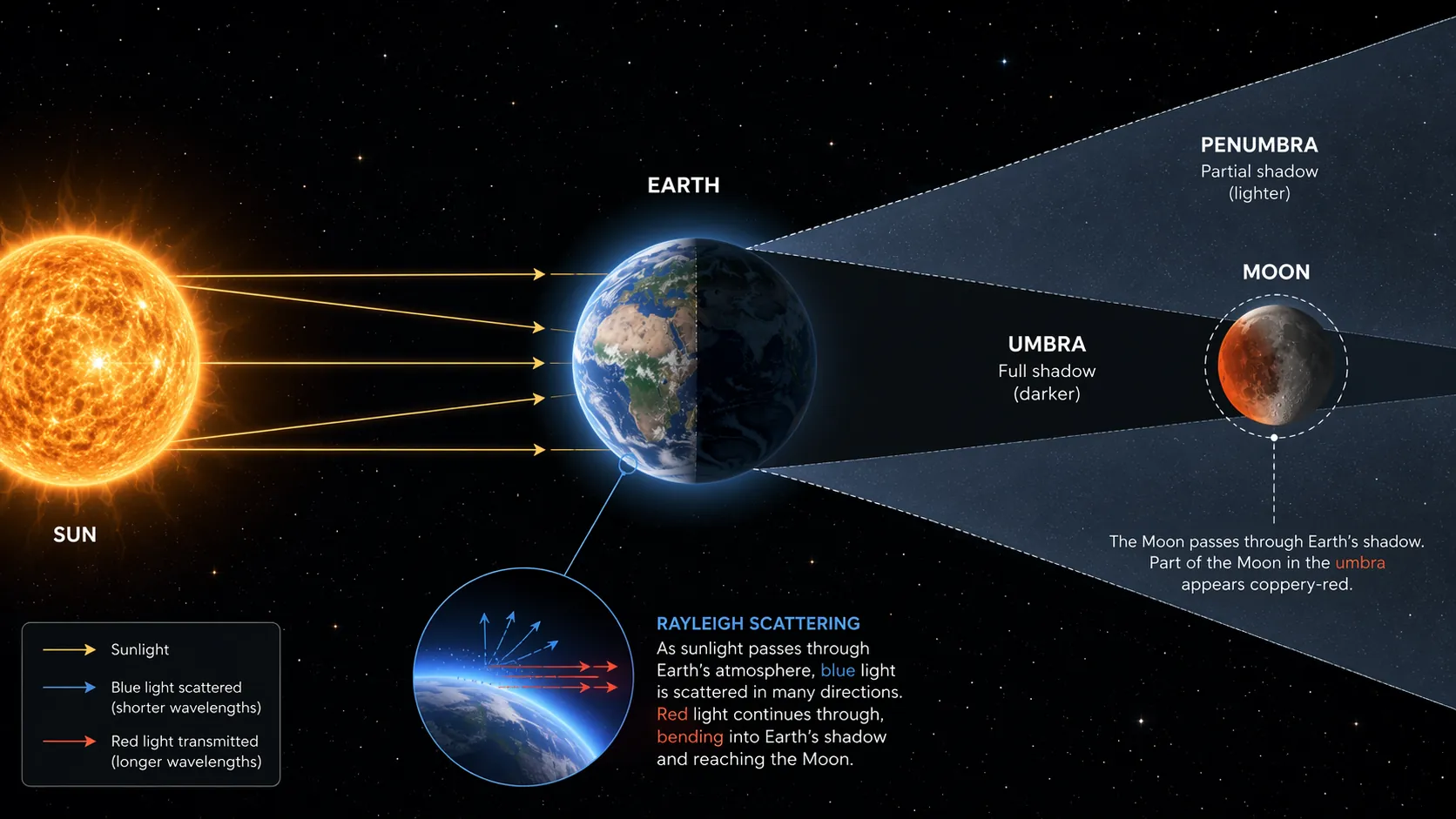
The first DSST-ready observation is the shadow structure. The penumbra is the lighter outer shadow, where the Sun is only partly blocked from the Moon’s point of view. The umbra is the darker inner shadow, where Earth blocks direct sunlight more completely. NASA’s lunar eclipse education materials use eclipse viewing as a way to get students observing these Moon-shadow changes rather than only memorizing a diagram.[5]
During the early penumbral stage, the Moon may look only slightly shaded. That subtlety is useful. Many students remember the dramatic dark bite but forget that the penumbra exists because it is harder to see. For DSST review, write a comparison: the penumbra produces partial shading; the umbra produces the deepest darkening and the strongest red appearance.
Earth-Moon-Sun Alignment: Name The Middle Object
A lunar eclipse happens when Earth is between the Sun and the Moon. That sentence sounds too simple until a test question reverses the geometry. In a solar eclipse, the Moon is between Earth and the Sun. In a lunar eclipse, Earth’s shadow falls on the Moon.
While watching the dark curve move across the Moon, say the order out loud: Sun, Earth, Moon. Then add the phase requirement: lunar eclipses occur at full Moon because the Moon must be opposite the Sun in our sky. If a practice question asks why a lunar eclipse is associated with full Moon, the answer is geometry, not color.
Why There Is Not An Eclipse Every Month
This is where the live event earns its time. If the Moon is full every month, why is there not a lunar eclipse every month? Because the Moon’s orbit is tilted relative to Earth’s orbital plane. Most full Moons pass above or below Earth’s shadow. An eclipse requires the full Moon to be near one of the orbital nodes, the points where the Moon’s orbit crosses Earth’s orbital plane.
That node constraint is a classic place where students lose the thread. They remember “full Moon” and stop there. For DSST prep, full Moon is necessary but not sufficient. The Moon also has to be close enough to the line where the orbital planes intersect. The August 27-28 event is a clean way to attach that extra condition to a real date.
The Red Color: Light Is Doing The Work
The phrase “blood moon” is memorable, but the DSST value is in the physics behind the color. During a lunar eclipse, some sunlight still reaches the Moon after passing through Earth’s atmosphere. Shorter blue wavelengths scatter more strongly, while longer red wavelengths are more likely to continue through and illuminate the Moon. That is why the eclipsed Moon can look coppery or red instead of simply black.
Tie that observation to Science of Light immediately. Light has wavelength. Scattering depends on wavelength. Atmospheres can change the light that reaches an observer or an object. Those ideas do not stay inside eclipse questions; they also support broader astronomy topics involving spectra, color, and what light reveals about distant objects.
The One-Month DSST Astronomy Study Rhythm
If the eclipse lands about a month before your target test date, do not let the excitement pull your plan out of shape. Use it as a checkpoint inside a broader DSST schedule. OpenStax’s astronomy study advice emphasizes steady work with concepts, vocabulary, sketches, and self-testing rather than passive reading alone.[6] That is exactly the mode this exam rewards.
| Time window | Main task | Eclipse-linked study move |
|---|---|---|
| Before August 27 | Review the official DSST outline and start core astronomy vocabulary | Pre-learn umbra, penumbra, lunar phase, orbital plane, wavelength, and scattering |
| August 27-28 | Observe the eclipse deliberately | Sketch the Moon, label the shadow region, and write the Sun-Earth-Moon order |
| First week after the eclipse | Drill Celestial Systems | Explain why eclipses need full Moon plus node alignment |
| Second week after the eclipse | Drill Science of Light | Connect red eclipse color to wavelength-dependent scattering |
| Final stretch | Practice mixed DSST questions under time pressure | Review missed items by concept, not by whether they mention eclipses |
The official content weights should decide how much time each topic gets. Science of Light and Celestial Systems together account for 25% of the exam, and eclipse-related light concepts can also reinforce parts of Astrophysics.[1] That does not mean one eclipse covers one-third of the test. It means the event gives you a concrete anchor for concepts that appear in high-value areas.
Before The Eclipse: Prime The Terms
Do the boring work first. Read the DSST content outline. Make a small vocabulary sheet. Draw the Sun, Earth, and Moon from memory. Then draw it again with the Moon’s orbit tilted. If you cannot explain why most full Moons miss Earth’s shadow before the eclipse, you will probably enjoy the event and still miss the exam point.
A useful pre-eclipse page has two columns: “what I expect to see” and “what concept it proves.” Fill it before you go outside. During the eclipse, correct it. That little correction step is where observation becomes studying.
The Night Of The Eclipse: Capture Evidence, Not Just Impressions
Write down the sequence. First the Moon looks normal or only slightly dimmed. Then the shadow becomes more obvious. Near the deepest part, most of the Moon is in Earth’s darker shadow and may look copper-red, with a remaining bright sliver because this is partial rather than total. Keep the word “partial” in your notes so you do not turn a real event into a wrong test statement.
Then ask three DSST-style questions while the view is still fresh: Which body is casting the shadow? Which shadow region is darkest? What property of light helps explain the red color? If you can answer those without checking your phone, you have turned the event into retrieval practice.
After The Eclipse: Convert The Memory Into Points
The day after the eclipse, do not reread everything. Start with a blank page and redraw the event. Label the Sun, Earth, Moon, umbra, penumbra, and the direction of sunlight. Then write a short explanation of Rayleigh scattering without using the phrase “because it is a blood moon.” The nickname is not an explanation.
Next, move into practice questions. Missed items should be sorted by concept: phase geometry, orbital nodes, shadow vocabulary, wavelength, spectra, or general celestial motion. That sorting matters because DSST questions may test the same idea without mentioning the August eclipse at all.
A Brief ASVAB Note For Military Learners
If you are coming from ASVAB prep into DSST work, some astronomy basics will feel familiar. ASVAB General Science review commonly includes topics such as eclipses, planets, and Moon phases.[7] DSST Astronomy asks for a deeper college-credit version of that knowledge, but the entry point is not foreign.
StudyMethod’s ASVAB exam prep guide and hurricane science study tips for ASVAB follow the same practical rule: use a real-world event to make science testable. For DSST Astronomy, the eclipse is the real-world event, but the standard is higher. You need the mechanism, not just the name of the phenomenon.
What Not To Overlearn From One Eclipse
One eclipse should not distort your entire DSST plan. Do not spend days memorizing eclipse folklore, historical blood moon references, or advanced eclipse timing details unless your broader astronomy materials require them. The exam blueprint is the controlling document. The eclipse is useful because it demonstrates tested concepts, not because every fact about it is equally testable.
Also keep the source labels straight. Space.com and EarthSky are useful for event visibility and viewing context. NASA and university materials are useful for observation and teaching guidance. The official DSST page is what tells you the exam format and content weights. Mixing those roles is how study advice becomes confident in the wrong places.
The August 27-28 almost blood moon will not pass the DSST for you. But if you watch deliberately, record what changes, and review the concepts while the image is still fresh, the Moon can do something a textbook diagram often cannot: make the mechanics visible before you walk into a 100-question, 2-hour exam.
References
- Astronomy — DSST, GetCollegeCredit
- An 'almost blood moon' is coming on Aug. 27 — the best lunar eclipse until NYE 2028, Space.com
- Partial lunar eclipse of the August 27-28 full Sturgeon Moon, EarthSky
- Tips for viewing a total lunar eclipse, blood moon, CU Boulder Today
- How to Watch a Total Lunar Eclipse — Teachable Moment, NASA JPL Education
- A How to Study for an Introductory Astronomy Class, OpenStax Astronomy 2e
- What You Should Know about Astronomy for the ASVAB, Dummies
Related exhibits & inventory
Verified outcomes
No verified outcomes on file for this exam yet
See Methodology for how outcome evidence is disclosed once logged.
Planners
No planner filed for this exam yet
A downloadable timeline template for this exam hasn't been published yet.
Tool verdicts
AI-tool cautions
No AI tools tested for this exam yet
No hands-on AI-accuracy logs have been filed for this exam.
Questions about this plan
Ask a question about a specific section, timeline, or citation in this plan — or flag something that needs correcting.
Comments
Join the discussion with an anonymous comment.