
MCAT Exam Hub
Why Is the Sky Blue and the Sun Yellow?
This guide decodes why the sky is blue and the sun looks yellow as a single physics mechanism — Rayleigh scattering — and shows how the same concept maps to MCAT Chem/Phys Category 4D content and ACT Science reasoning.
- gre
- mcat
- asvab
- sat
- act
- digital-adaptive
- official-material
- section-strategy
- test-date-timeline
On a clear day, the sky and the sun are not two separate color mysteries. They are one light-path problem. The sky looks blue because shorter-wavelength light from the sun is scattered sideways by molecules in Earth’s atmosphere, so that blue light reaches your eye from many directions. The sun itself looks yellow-white because the direct beam reaching your eye has had some of that blue light scattered out of it along the way.[1]
That distinction matters more than the word “blue.” A student who can track scattered light versus transmitted light can predict the color of the noon sky, explain why the low sun turns orange-red, and survive an exam passage that swaps colors for wavelengths, frequencies, or photon energies.
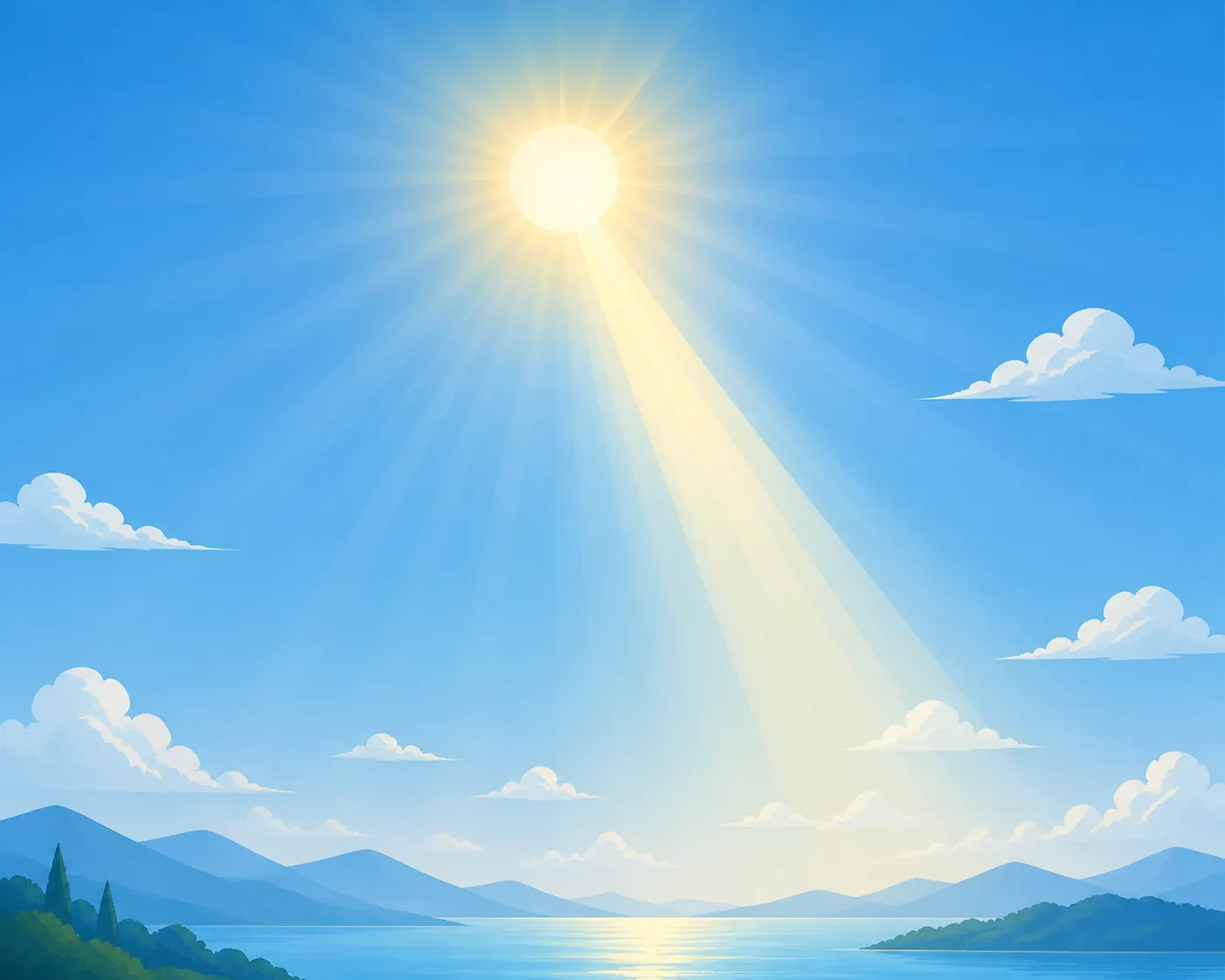
One scene, two paths for light
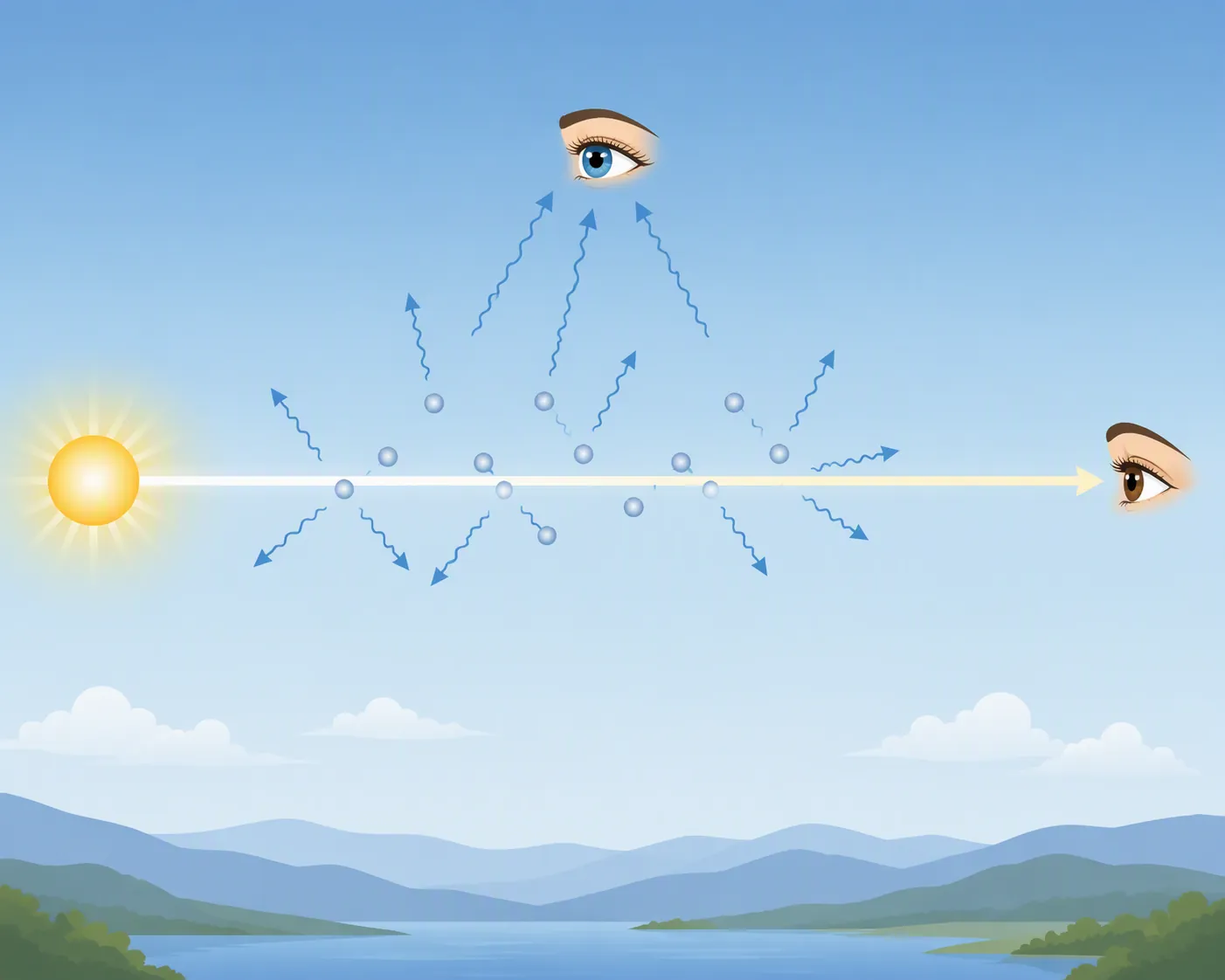
Sunlight enters the atmosphere as a broad mixture of visible wavelengths. Some of that light continues almost straight from the sun to your eyes. That is transmitted light. Some of it is redirected by tiny atmospheric molecules, especially nitrogen and oxygen. That is scattered light.
If you look away from the sun and still see blue sky, you are not seeing a blue object painted on the atmosphere. You are seeing short-wavelength sunlight that was scattered into your line of sight. If you look toward the sun, the light reaching you has traveled more directly, and some of its short-wavelength blue component has already been redirected out of that direct beam.
The rule that makes blue dominate the sky
The useful physics name is Rayleigh scattering. It applies when light scatters from particles much smaller than the wavelength of the light. In that regime, scattered intensity is proportional to the inverse fourth power of wavelength: shorter wavelength, much stronger scattering.[2]
scattered intensity ∝ 1 / λ⁴That fourth power is the part worth keeping. It is not just that blue light scatters “a little more” than red light. A rough comparison using blue light near 400 nm and red light near 700 nm gives:
(700 / 400)⁴ ≈ 10So, under this simplified Rayleigh-scattering comparison, blue light around 400 nm is scattered about 10 times as strongly as red light around 700 nm.[2][3]
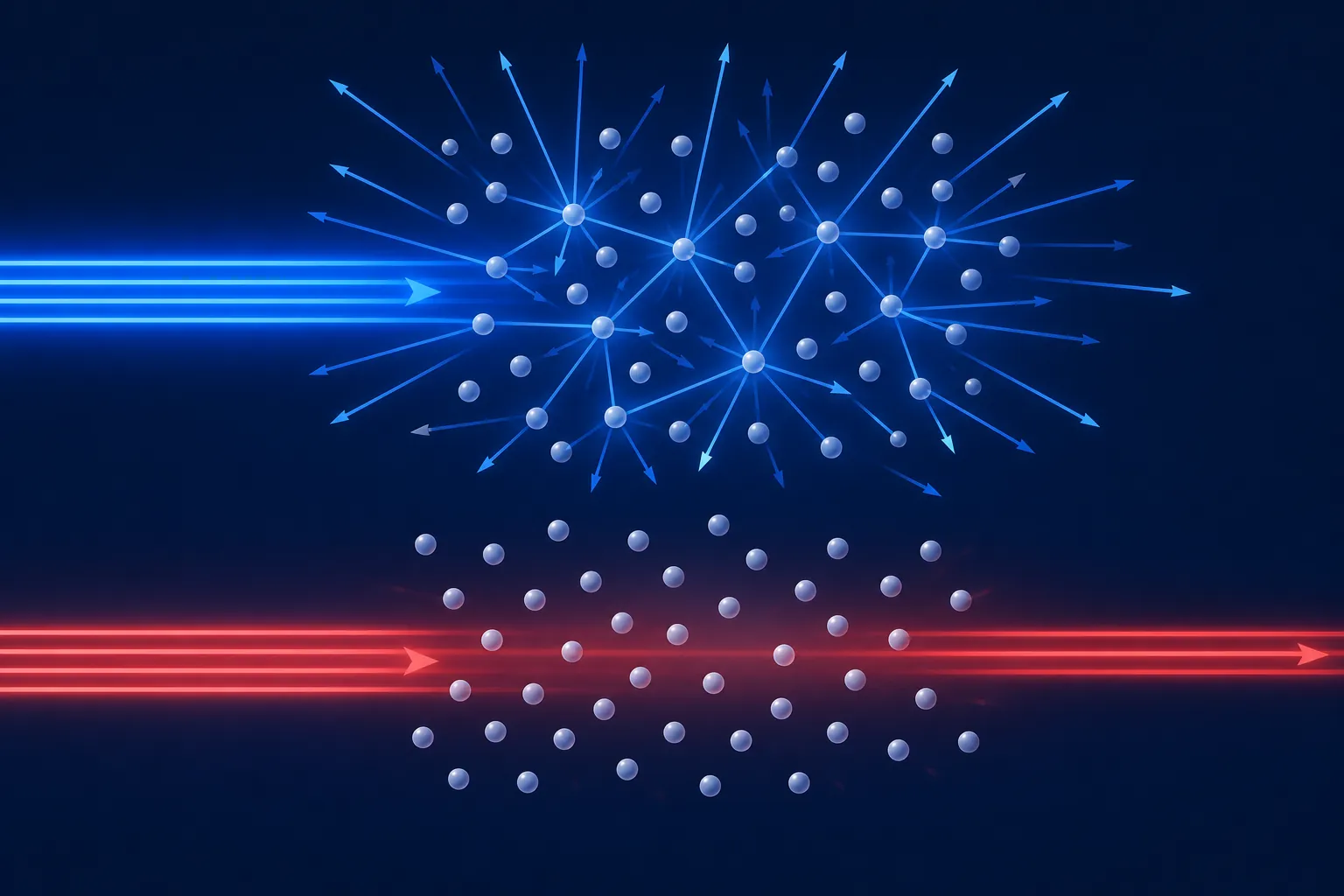
That one calculation explains why the sky is blue without treating color as a memorized label. Visible light spans roughly from violet near 380 nm to red near 750 nm, and one nanometer is one-billionth of a meter.[4] Blue and violet sit at the short-wavelength end. Red sits at the long-wavelength end. Rayleigh scattering therefore favors the short end of the visible spectrum.
| Color region | Relative wavelength | Rayleigh-scattering consequence |
|---|---|---|
| Violet/blue | Shorter visible wavelengths | Scattered strongly into many directions |
| Yellow/red | Longer visible wavelengths | Scattered less strongly; more likely to remain in the direct beam |
This is also where exam writers can switch language without changing the concept. Shorter wavelength means higher frequency, because wave speed equals frequency times wavelength. Higher frequency photons have higher energy, using E = hf. A question does not have to say “blue sky” to be testing the same ordering: shorter wavelength, higher frequency, higher photon energy, stronger Rayleigh scattering.
Why the sky is blue instead of violet
The inverse-fourth-power rule seems to invite a follow-up: if violet has even shorter wavelengths than blue, why does the sky not look violet? The answer is not one single override. The observed sky color depends on the sun’s spectrum, atmospheric effects, and human vision together.[5]
- The sun does not send equal intensity at every visible wavelength, so the input light is not a perfect flat rainbow.
- Some very short-wavelength light is affected by absorption higher in the atmosphere before it contributes much to ordinary sky color.[3][5]
- Human cone cells do not report the sky as a physics instrument would report isolated wavelengths; the visual system combines responses from different cone types, and that combined response is perceived as blue rather than violet.[5]
For a student, the safe version is this: Rayleigh scattering favors the shortest visible wavelengths, but the sky’s perceived color is determined by the scattered solar spectrum after atmospheric filtering and human visual response. Do not replace that with “violet is absent.” It is narrower and more accurate to say violet does not dominate the perceived color of the sky.
Why the noon sun is closer to white, and the low sun turns redder
At noon, when the sun is high overhead, sunlight travels through a shorter atmospheric path before reaching you. Less blue light is removed from the direct beam, so the sun appears closer to white or yellow-white.[6] It is still unsafe to stare at it; the color explanation is not a viewing recommendation.
Near sunrise or sunset, the geometry changes. Sunlight travels through a longer slice of atmosphere before reaching your eye. Along that longer path, more of the shorter-wavelength light is scattered out of the direct beam. The remaining transmitted light is richer in longer wavelengths, so the sun and nearby sky can look orange or red.[2][7]

The same path-length idea also helps explain why the sky near the horizon can look paler or whitish compared with the deeper blue overhead. Light from near the horizon has usually traveled through more atmosphere, and additional scattering by particles and aerosols can mix wavelengths more strongly, reducing the saturated blue appearance.[7]
Lunar eclipses use a related scattering story, but the geometry is different: sunlight is filtered through Earth’s atmosphere before reaching the Moon. If that is the application you are studying, use the site’s Blood Moon study guide rather than trying to make this sky-color explanation carry the whole eclipse case.
How this becomes an MCAT or ACT Science move
For the MCAT, the defensible claim is category-level: Rayleigh scattering belongs in the world of light and electromagnetic radiation, wavelength and frequency, photon energy, and optics-style reasoning covered by AAMC Chem/Phys Content Category 4D.[8] That does not mean an official MCAT item must ask, word for word, “Why is the sky blue?” It means the mechanism uses tested relationships.
| If a passage gives you... | The exam move |
|---|---|
| Wavelengths for two colors | Use the shorter wavelength as the one scattered more strongly; if Rayleigh scattering is specified, compare with 1/λ⁴. |
| Frequency or photon energy instead of wavelength | Convert the ordering: shorter wavelength means higher frequency and higher photon energy. |
| A diagram showing light from the sun to an observer | Separate light scattered into the observer’s line of sight from light transmitted directly from the source. |
| A longer atmospheric path at sunset | Predict more removal of short-wavelength light from the direct beam and a redder transmitted beam. |
For ACT Science, the same content usually matters less as a memorized definition and more as passage behavior. A hypothetical passage might give a graph of scattering intensity versus wavelength, or it might describe two atmospheric paths of different lengths. The student’s job is to follow the given relationship: as wavelength decreases, scattering increases; as path length increases, more short-wavelength light is removed from the transmitted beam.
The common trap is answering from the wrong light path. If a question asks why the sky away from the sun looks blue, use scattered light reaching the eye from the side. If it asks why the sun itself looks yellow-white or redder near the horizon, use transmitted light traveling directly from the sun to the observer after some wavelengths have been scattered out.
What to carry forward
- Blue sky: shorter-wavelength sunlight is scattered by atmospheric molecules and reaches your eye from many directions.
- Yellow-white sun: the direct transmitted beam has had some blue light scattered out, but not so much that only red remains.
- Red sunset: the same beam travels through a longer atmospheric path, so more short-wavelength light is removed before the direct light reaches you.
- Exam shortcut: do not memorize three color facts; track wavelength, scattering strength, path length, and whether the light is scattered or transmitted.
If you are placing this inside MCAT prep, fold it into your light-and-optics review and then connect it to the broader 12-week MCAT study plan. If you are using it for ACT Science, practice treating sky-color questions as data-and-inference problems, the same way you would in the meteor shower astronomy study guide. For another example of turning an everyday object into testable physics, move next to why airplane windows are round.
References
- Why Is the Sky Blue?, NASA Space Place
- Blue Sky and Rayleigh Scattering, HyperPhysics
- Why is the sky blue?, UCR Physics FAQ
- Why Is the Sky Blue?, NOAA NESDIS
- Rayleigh scattering, Wikipedia
- Why is the sky blue?, Royal Observatory Greenwich
- The Appearance of the Sky, UCAR
- Chemical and Physical Foundations of Biological Systems Section: Content Category 4D, AAMC
Related exhibits & inventory
Verified outcomes
Planners
No planner filed for this exam yet
A downloadable timeline template for this exam hasn't been published yet.
Tool verdicts
Questions about this plan
Ask a question about a specific section, timeline, or citation in this plan — or flag something that needs correcting.
Comments
Join the discussion with an anonymous comment.