
CHESS Planner
Build a Chess Study Plan That Improves Your Rating
Evidence label: observational study, not a guaranteed improvement formula. Source type: analysis of Chess.com rapid players. Last reviewed: August 26, 2026.
If you have one quiet hour after work, the largest rating lever is probably how you allocate it, not which opening you add to your repertoire. In a June 2026 study of 44,213 Chess.com players, gameplay produced an average of 0.86 rapid-rating points per hour, compared with 4.41 for game reviews and 5.21 for video lessons. The study is observational, limited to Chess.com rapid ratings, and weighted toward recreational players, so these figures are planning signals rather than promises. [1]
The mismatch is difficult to ignore. The average player spent 90.39% of platform time on games, while reviews accounted for 4.61%, lessons 0.99%, and puzzles 4.01%. Expert-level players rated 2000 or higher spent 14.31% of their time reviewing, compared with 3.77% among players rated below 200. [1] A practical chess study plan should therefore make games generate material for study, rather than letting game volume consume the week.
What the Evidence Actually Says
Southwick and colleagues grouped platform activities by their relationship with later rapid-rating change. Gameplay was the weakest of the main activities in the overall comparison. Reviews returned 4.41 points per hour, lessons 5.21, and deliberate-practice-aligned activity as a broader category 3.11, compared with 0.86 for gameplay. That makes reviews roughly five times as productive as gameplay in the reported average, and lessons roughly six times as productive. [1]
The numbers do not mean that one hour of reviewing will buy 4.41 rating points, or that one hour of games is worth exactly 0.86. The study did not randomly assign players to activities, did not use a control group, and cannot establish that the activity itself caused the rating change. More motivated players may review more carefully, use lessons at the right moment, or have other habits the dataset could not measure. The results also should not be transferred directly to Lichess, over-the-board ratings, or master-level training.
The useful conclusion is narrower: for a typical adult rapid player in roughly the 600 to 1800 range, hours currently spent on undigested games are a reasonable place to look for study time. Use the reported returns as weights for building a week, not as an individual rating calculator.
The rating bands make the allocation rule more specific. Beginners showed especially high observed returns for lessons at 17.81 points per hour. Intermediate players saw reviews at 4.87 points per hour. Among players rated 1000 or higher, reviews were the only activity that remained significantly better than gameplay, at 2.25 points per hour, while gameplay declined from 1.40 points per hour among beginners to 0.38 among 1000-plus players. [1]
Three Weekly Templates
Choose the template that fits the time you can repeat. Consistency matters here because the plan depends on a loop: play a serious game, review it, identify a recurring problem, and use lessons or puzzles to address that problem.
| Daily time | Weekly budget | Weekly structure |
|---|---|---|
| 30 minutes | About 3.5 hours | 3 serious games with review, 2 lesson blocks, 1 structured puzzle block, 1 rest or catch-up day |
| 60 minutes | About 7 hours | 3 serious games with review, 3 lesson blocks, 2 puzzle blocks, 1 older-game review, 1 opening or weekly-review block |
| 90 minutes | About 10 hours | 3 serious games with review, 4 lesson or review blocks, 3 puzzle blocks, 1 bounded opening block, 1 weekly pattern review |
The 30-Minute Plan
- Monday: 20 minutes of a lesson, 10 minutes writing the main idea in your own words.
- Tuesday: 15-minute serious rapid game, followed by 15 minutes of no-engine review.
- Wednesday: 20 minutes of structured puzzles, 10 minutes revisiting one missed theme.
- Thursday: 15-minute serious rapid game, followed by 15 minutes reviewing the first critical moment.
- Friday: 20 minutes of a lesson, 10 minutes connecting it to a position from your games.
- Saturday: 15-minute serious rapid game, followed by 15 minutes of review.
- Sunday: rest, catch-up, or a short review of the week's mistake log.
The 60-Minute Plan
- Monday: 30 minutes of lessons, 20 minutes of structured puzzles, 10 minutes updating the mistake log.
- Tuesday: 25-minute serious rapid game, 35 minutes of review.
- Wednesday: 40 minutes reviewing an older game, 20 minutes of lessons aimed at the recurring error.
- Thursday: 25-minute serious rapid game, 35 minutes of review.
- Friday: 30 minutes of lessons, 20 minutes of puzzles, 10 minutes recording one practical rule.
- Saturday: 25-minute serious rapid game, 35 minutes of review.
- Sunday: 30 minutes of opening maintenance, 30 minutes of weekly review or catch-up.
The 90-Minute Plan
- Monday: 40 minutes of lessons, 30 minutes of puzzles, 20 minutes reviewing a previous mistake.
- Tuesday: 30-minute serious rapid game, 60 minutes of review.
- Wednesday: 45 minutes reviewing an older game, 30 minutes of lessons, 15 minutes updating the mistake log.
- Thursday: 30-minute serious rapid game, 60 minutes of review.
- Friday: 30 minutes of lessons, 30 minutes of structured puzzles, 30 minutes applying the lesson to a game position.
- Saturday: 30-minute serious rapid game, 60 minutes of review.
- Sunday: 30 minutes of opening work, 30 minutes of puzzles, 30 minutes reviewing the week's patterns.
These are weekly templates, not rules about how many games a responsible player is allowed to enjoy. If a game regularly runs beyond the planned block, shorten the next activity rather than quietly turning the session into another playing-only day. The point is to preserve the review appointment.
Make the Game Pay for Itself
A serious game is not simply a game played at a slower time control. FM Nate Solon's 1-1-1 framework describes a serious game as a deliberate practice unit and argues that reviewing it has at least as much value as playing it. [4] That changes the scheduling decision: a 25-minute game may require another 25 to 35 minutes afterward, so it belongs on a day with review time available.
Use this review sequence:
- Replay the game without an engine. Stop at moments when you felt uncertain, spent a long time, changed your plan, or believed the position had turned.
- Mark the critical moments before checking the evaluation. Your task is to locate the decision that needs understanding, not to collect every engine inaccuracy.
- Write one takeaway for each important mistake. State what you missed and what you will look for next time, such as an opponent threat, a loose defender, or a better candidate move.
- Only then check the engine. Compare your explanation with the engine's preferred move and examine the variations needed to understand the reason.
- Save one position or question for later practice. A review that ends with a number has not yet become a training input.
GM Alex Colovic's January 2026 method emphasizes a no-engine-first approach, and ChessGoals' game-analysis guide likewise structures review around identifying key moments and understanding the decisions rather than immediately accepting computer moves. [2][3] This order matters for adult improvers because it shows whether the problem was calculation, evaluation, time management, opening familiarity, or a failure to notice the opponent's idea.
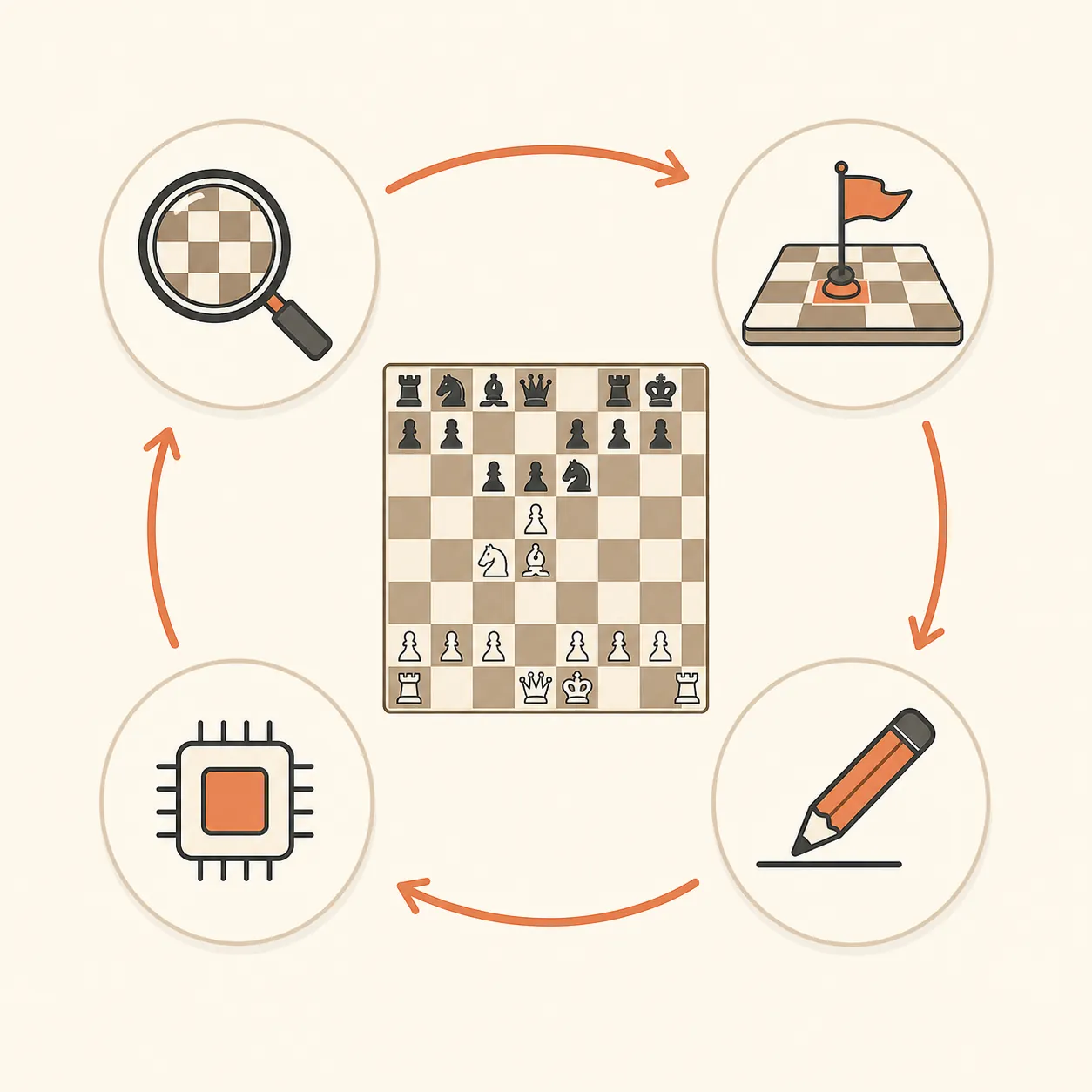
Keep the record small enough to use. A weekly log with the date, position, mistake type, and one corrective question is more useful than a long archive of engine lines. After several sessions, repeated entries tell you whether the next lesson should cover calculation, pawn breaks, endgames, or a particular opening structure.
Adjust the Mix by Rating
The templates give you a default week. Your rating band tells you where to bend it.
- Below about 1000 rapid: keep lessons prominent. The study found an especially large observed lesson return among beginners, so guided explanations can supply concepts that self-analysis does not yet reliably identify. Keep games short enough to review and use basic puzzles to reinforce the lesson.
- About 1000 to 1800 rapid: make review the center of the week. The intermediate band showed a strong review result, and your own games provide better evidence about what to study than a generic list of chess topics. Use lessons to answer problems that appear in the review log.
- Above 1000 generally: be cautious about adding more gameplay simply because the games feel productive. In the study, gameplay's observed return fell as rating increased, while review remained comparatively useful. That does not make playing irrelevant; it makes the post-game work harder to skip.
Openings Stay Bounded
Opening study is easiest to over-expand because it feels concrete: another line, another trap, another model game. A useful guardrail is to keep openings near 20% of study time until roughly 1800, as suggested in rating-band planning guidance. [5] Spend the rest of that block learning the plans and recurring structures that appeared in your games. The Chess.com Study Plan Directory also organizes study plans by level and topic, which can help you choose a bounded resource instead of collecting a repertoire without testing it. [6]
Puzzles Need a Method
The study's speed-puzzle result is a useful warning against automatic advice. Speed puzzles returned 0.73 points per hour and did not show a significant advantage over gameplay in the reported analysis, with p = .67. The authors note that speed formats may reward solving positions whose patterns a player already knows. [1]
That is not evidence that puzzles are useless. It is evidence that pressing through a large number of familiar, timed positions should not be confused with deliberate training. Use a smaller set, calculate before moving, explain the tactical idea, and revisit misses. The Woodpecker-method data reported by Disco Chess found approximately 10 percentage points of accuracy improvement and 21% faster solve times by the second cycle across 1,017 users and 120,513 attempts, but those results are observational and vulnerable to survivorship bias. [11] The practical lesson is to repeat and understand positions, not to worship a speed score.
What Progress Can Reasonably Look Like
A plan should be demanding enough to change behavior and modest enough to survive an adult schedule. World Chess suggests that five to seven focused hours per week can produce noticeable gains within a few months, while ChessWorld.net presents a broad range of roughly six to 18 months for moving from approximately 1000–1200 to 1500. These are guidance and ranges, not verified outcomes or promises. [7][8]
Individual cases show possibility, not a standard rate. Alex Crompton described moving from roughly 300 to about 1500 in around nine months while using 20 to 30 minutes per day of spaced-repetition tactics. [9] NM John Hartmann's analysis of approximately 8,000 USCF and FIDE players identified more than 1,000 documented gains of 200 or more points after age 25, with a median peak-rating age of 41. [10] Neither source tells you what your next six months will produce, but both push back against the assumption that adult improvement is already over.
Calibrate the Next Month
Run one template for four weeks before making major changes. Protect the review blocks first, keep gameplay as the smaller share, and log recurring mistakes rather than reacting to each rating swing. At the end of the month, ask which errors appeared repeatedly and whether your lessons and puzzles addressed them.
Then adjust one part of the mix. Add lesson time if your reviews expose basic gaps. Add structured puzzles if calculation or pattern recognition keeps appearing. Add a small opening block if the same early positions repeatedly leave you without a plan. Reduce game volume when games are accumulating faster than you can review them.
The plan is not an argument against playing chess. It is a way to make playing useful: games create positions, reviews explain decisions, lessons fill identified gaps, puzzles reinforce specific skills, and openings remain bounded until that loop is working. For an adult rapid player with limited hours, that is a more defensible default than spending nearly the entire week pressing Play.
References
- Not All Practice Is Created Equal — Psychological Science, 2026
- The Method: How to Study Chess So It Actually Improves Your Play — GM Alex Colovic, 2026
- How To Improve – The Art Of Game Analysis — ChessGoals, 2020
- Chess 1-1-1 Study Plan — FM Nate Solon, 2023
- How to Get Better at Chess: Study Plan for Different Rating Levels — TheChessWorld
- Study Plan Directory — Chess.com, updated January 27, 2025
- Chess Training Program — World Chess
- How Long Does It Take to Reach 1500 Chess Rating? — ChessWorld.net
- How to Learn Chess — Alex Crompton, 2021/2024
- Can Adults Improve at Chess? — NM John Hartmann
- Woodpecker Method Results — Disco Chess
Fill in this timeline
This is a skeleton schedule, not a performance claim — for section-by-section strategy to fill in each slot, read the exam hub. For evidence that a similar timeline worked, compare against real outcome logs.