
When to Do HIIT for Better Memory and Exam Focus
Evidence label: timing-sensitive, memory-focused, not score-proven. Last reviewed: Q3 2026. If you are using a HIIT workout for better memory and exam focus, the useful question is not simply whether to exercise. It is where the workout lands relative to the study block you are trying to protect.
A test-prep calendar is not an empty wellness template. It has one or two serious review blocks, a commute, meals, sleep, and a deadline that does not care how admirable your routine looks. The research trail is most useful when it is read as a timing map: a short vigorous bout before learning, a workout roughly four hours after learning, and an evening session before sleep each have supporting evidence. Exercise during the learning itself is the boundary line; it has not shown the same benefit and is a poor trade if it interrupts encoding.

The timing map
The broad backdrop is a 2024 meta-analysis by Qazi and colleagues on exercise and memory, which is useful for showing that the exercise-memory question is not built on one isolated experiment. It does not, by itself, hand a GRE, MCAT, SAT, ACT, or ASVAB student a complete weekly protocol. For that, the more useful evidence is narrower and more practical: studies that place exercise before learning, after learning, near sleep, or during encoding and then ask what happens to memory outcomes. [1]
| Timing window | Where it sits on the calendar | What it is trying to support | Evidence label | Planning warning |
|---|---|---|---|---|
| Short vigorous bout before learning | Before the main study block | Readiness for encoding: the point when new material first gets learned | Direct timing support from UCSB/Garrett 2024 material | Do not let the workout become so draining that it steals the study block |
| Workout roughly four hours after learning | After the study block, with a delay before exercise | Consolidation: the period when recently learned material is stabilized | Direct timing support from van Dongen 2016 | This is not the same as exercising immediately after every flashcard set |
| Evening HIIT before sleep | Later in the day, before the sleep period | Sleep-adjacent memory support | Direct support from Butavand 2025 | Use only if it does not disrupt your actual sleep |
| Exercise during studying | Inside the learning block itself | Usually marketed as focus support | No-benefit boundary in UCSB/Garrett 2024 material | Do not turn Anki, practice passages, or reading into a workout |
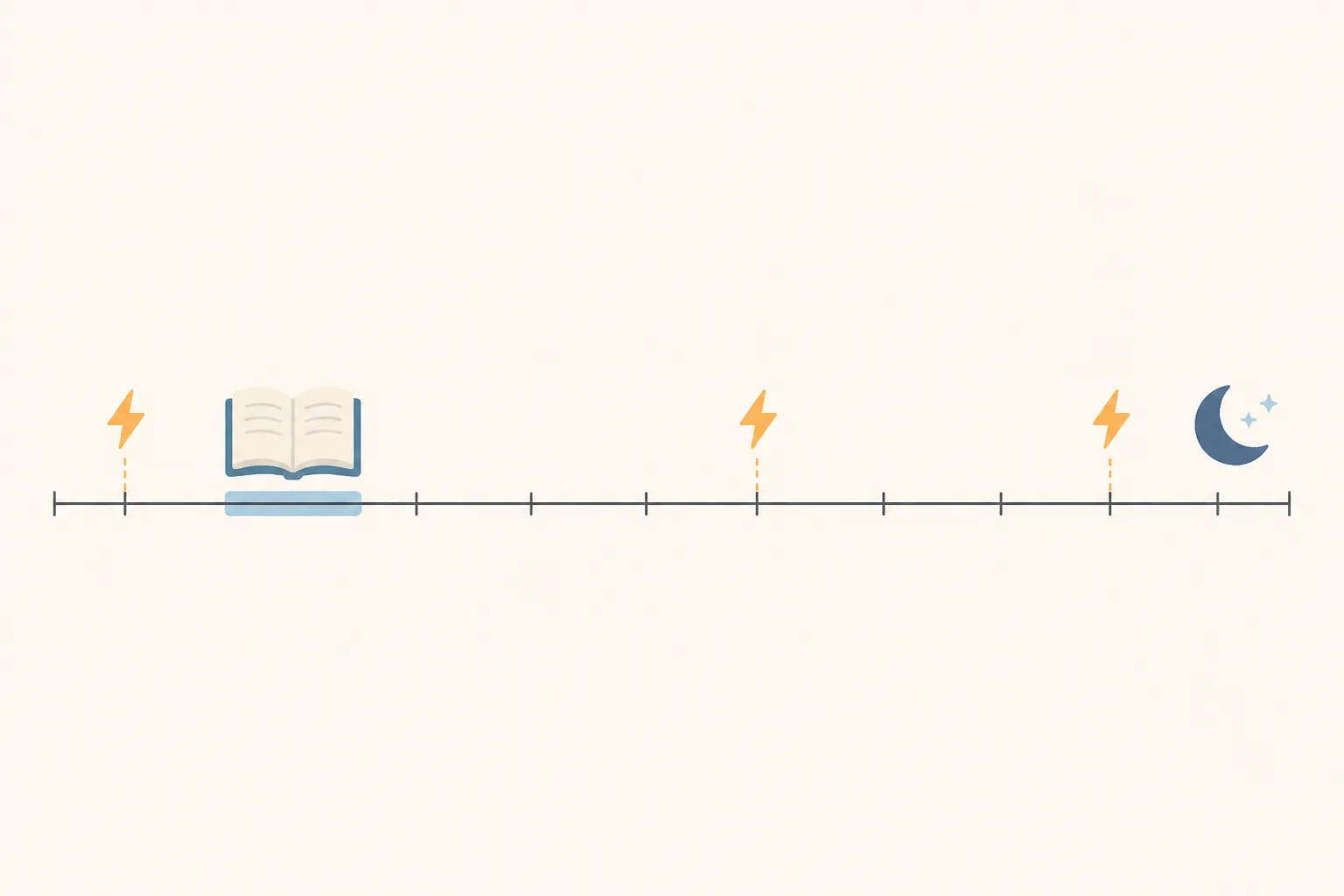
Before studying: use HIIT as a setup for encoding
The pre-study window is the easiest to misunderstand. It is not a license to exhaust yourself and then sit down with a biochemistry chapter while your legs shake. Its purpose is simpler: place a short vigorous bout before the learning period so the exercise belongs to the setup, not to the lesson.
The UCSB/Garrett 2024 material supports a short vigorous pre-learning window and also reports the useful negative finding: exercise during encoding showed no benefit. For a student, that distinction matters more than the generic claim that movement is good for the brain. Encoding is the first pass at getting material into memory. If the workout competes with reading, solving, recalling, or annotating, it is no longer helping the study block; it is occupying it. [2]
In planner terms, this is the window to choose when your best study block is about to start and you want a clean transition into it. Put the vigorous work before the timer starts. Then stop, cool down, and begin the task that actually needs memory: active recall, practice questions, passage review, formula reconstruction, vocabulary retrieval, or error-log repair.
What it should not become: burpees between flashcard reviews, sprints between practice passages, or a “movement break” every time a question feels difficult. That version protects neither the workout nor the studying. It slices encoding into fragments and then asks memory to behave as if nothing happened.
Roughly four hours after studying: protect the consolidation window
The roughly four-hour post-learning window comes from a cleaner scheduling idea: study first, leave the memory trace alone for a while, then exercise later. In van Dongen and colleagues’ 2016 Current Biology study, physical exercise performed four hours after learning improved later memory retention, while the timing of the exercise was central to the finding. [3]
For exam prep, this is a consolidation placement. It is not trying to make the first study block feel easier. It is placed after the work because the target is what happens to material after it has already been learned. That makes it a good candidate for a day when the important content block happens earlier: a Saturday morning physics review, an after-school SAT grammar block, or an MCAT amino acid session before lunch.
A reasonable calendar translation looks like this: complete the serious learning block, avoid immediately replacing it with another demanding memory task if you can, then put the workout later in the day near the four-hour mark. The exact daily schedule will vary, but the principle is not vague. The workout belongs after a delay, not in the middle of the lesson and not automatically the minute the notebook closes.
This window is especially useful for students who have one protected study block and a later exercise slot anyway. It does not ask you to buy more time. It asks you to stop placing the workout at random.
Evening before sleep: use only if sleep stays intact
The evening window is different from the four-hour window. Its logic is sleep-adjacent memory support: exercise happens later in the day before the sleep period, and the memory outcome is interpreted in relation to what follows overnight. Butavand 2025 in Scientific Reports supports this evening-before-sleep angle. [4]
That does not make late HIIT automatically wise for every test-taker. If evening intensity leaves you wired, pushes bedtime later, or makes sleep lighter, the calendar has already charged you too much. Memory support near sleep is only attractive if the sleep period remains a sleep period, not a recovery negotiation with your own nervous system.
Use this option when your day naturally puts exercise in the evening and you can finish it without disturbing bedtime. If the next morning contains a full-length practice test, an early shift, or a school day, the conservative choice is to protect sleep first. No HIIT timing study should persuade a student to turn seven workable hours in bed into five restless ones.
Do not combine the three windows into a “master protocol”
The three useful windows are independently supported. That sentence is doing important work. It means a pre-learning bout, a delayed post-learning bout, and an evening-before-sleep bout each have an evidence trail. It does not mean one study has tested all three as a stacked routine in a test-prep population and found that the full sequence raises exam scores.
That distinction protects your week. A student who reads “HIIT improves memory” may try to do a hard session before studying, another after studying, and another at night, then wonder why the actual review hours got worse. The research does not require that. It gives you timing options, not a command to fill every gap with intervals.
The strongest use of the evidence is selective: pick the window that fits the study block you most need to remember. If the block is about to happen, consider the short pre-study bout. If the block already happened and you have a later slot, consider the roughly four-hour placement. If evening exercise is already your stable routine and sleep survives it, consider the sleep-adjacent option.
How to place HIIT in a real test-prep week
Start with the study block, not the workout. Mark the block that carries the highest memory load: the chapter you keep forgetting, the question type that keeps reappearing in your error log, the vocabulary set that must survive until Saturday, the content review that feeds tomorrow’s practice test. Then choose one timing window around that block.
| Your day looks like this | Best-fit HIIT placement | Why this is the cleaner choice |
|---|---|---|
| You study right after school or work and need to start sharply | Short vigorous bout before the study block | It supports the setup for learning without interrupting encoding |
| You study earlier, then have a later open slot | Workout roughly four hours after learning | It aims at consolidation after the material has already been encoded |
| Your only reliable exercise slot is evening and bedtime is stable | Evening HIIT before sleep | It uses the sleep-adjacent window without sacrificing the sleep period |
| You are tempted to exercise while reviewing flashcards or videos | Do not use that slot | Exercise during encoding is the wrong trade based on the current boundary evidence |
A weekday example can stay simple. Suppose your protected study block is 6:30 to 8:00 p.m. If you want the pre-learning option, the workout belongs before 6:30, with enough buffer to sit down ready to work. If you want the delayed consolidation option, that same study block is probably too late for a comfortable four-hour delay on a normal night. If you want the evening-before-sleep option, the question becomes whether the workout lets you keep a stable bedtime. The calendar decides which evidence window is usable.
A weekend example is different. If you complete a high-value review block in the morning, the roughly four-hour post-learning window may fit neatly. If the important block is late afternoon, a pre-study bout may be cleaner. If Sunday evening is already your exercise time and it does not disturb sleep, the sleep-adjacent option may be the least disruptive. The point is not to create a perfect-looking fitness routine. The point is to stop letting a workout collide with the one block that was supposed to build recall.
Exam-day focus is a separate question
Memory during prep and focus on exam day are related, but they are not identical outcomes. The timing evidence here is more useful for placing HIIT around learning than for promising a sharper score-day mind. If you normally tolerate a brief vigorous workout well, a pre-study bout may help set up a practice session. That is still not the same as proving that a new HIIT routine on test morning improves official performance.
Do not debut intensity on exam day. Do not trade breakfast, transit time, admission procedures, or calm arrival for a last-minute experiment. If exercise is part of your test-day routine, it should be familiar and boring. The higher-value use of the research is in the weeks when memory is being built.
A clean rule for students with limited time
If you have 20–40 minutes a day for exercise, do not spend that time chasing every possible brain benefit. Put the session where it has a job.
- Before study: use HIIT as a short setup for the learning block.
- Roughly four hours after study: use it as a consolidation placement.
- Evening before sleep: use it only if bedtime and sleep quality remain protected.
- During study: do not use it as a focus hack.
Choose one window for the study block you most need to remember. Keep the workout outside encoding. Treat the three windows as options with separate evidence trails, not as a validated sequence that must be stacked into one heroic routine.
References
- Qazi et al. 2024 meta-analysis — Frontiers in Cognition
- UCSB/Garrett 2024 material on short vigorous pre-learning exercise and exercise during encoding
- Physical Exercise Performed Four Hours after Learning Improves Memory Retention and Increases Hippocampal Pattern Similarity during Retrieval — Current Biology — 2016
- Butavand 2025 study on evening HIIT before sleep — Scientific Reports — 2025
Related case links
No matching exam hub found
Browse the exam hubs directory to find the study plan for this exam.
Did a similar plan work for you?
Share whether a comparable timeline and starting point produced a similar result — this is verification discussion, not general commentary.
Comments
Join the discussion with an anonymous comment.