
How Did 5 People Actually Make an AI Feature in 48 Days?
Accuracy Warning — Seedance 2.0
Schedule, budget, shot count, and view counts are production-reported, not independently audited; long-form AI output still requires heavy shot selection, continuity tracking, and postproduction repair.
- Accuracy:
- Limited
- Tested:
- Fact-checking five-person, 48-day AI feature film production workflow and its filmmaking lessons
- Last tested:
- 2026-08-27
The useful question about Flames of Dachen is not whether five people can press a button and receive a feature film. It is whether a five-person team can preserve deliberate characters, space, art direction, editing, sound, and risk controls across 120 minutes—and what work disappears when the production is compressed into a headline.
This is a filmmaking case study within AI study tools, not an exam-prep guide. Its value lies in evidence labeling: separating what the production and its media carriers reported from what has been independently demonstrated.
The evidence card
| Claim | What the available evidence supports | Important limit |
|---|---|---|
| Crew, runtime and schedule | A five-person team reportedly completed a 120-minute feature in 48 days using ByteDance’s Seedance 2.0.[1] | Production self-report carried by China Daily; no independent production audit is supplied. |
| Shot count and start date | Chinese-language reporting says production began in March 2026 and the finished film contains 2,429 shots.[2] | These granular details are not established by the thinner English-language coverage. |
| Budget | The reported budget was below 500,000 yuan, compared with a production estimate of roughly 30 million yuan for a live-action version.[1][2] | No audited cost breakdown shows what was included, subsidized, supplied in kind, or excluded. |
| Distribution | The film was described as China’s first all-AI network narrative film to receive an official distribution license. It was released on iQiyi, Youku and Tencent Video on August 9, 2026.[2][3] | This was a controlled streaming release, not evidence of theatrical production or market performance. |
| Audience | The production was reported to have exceeded 1.45 million views within three days.[1][2] | The figure comes through state-linked reporting and is not accompanied by an independent platform audit or a detailed definition of a view. |
| Context | Flames of Dachen was made as a commemorative project connected to the 70th anniversary of the Dachen Islands evacuation.[1][3] | The historical mandate and government-adjacent context make this a specific production environment, not a neutral industry trial. |

That distinction does not make the accomplishment imaginary. A licensed, feature-length work was released on major streaming platforms, and multiple reports describe the same compact production. It does mean that five people, 48 days, 2,429 shots, the budget and the early view count should retain the label “production-reported.” The sources do not provide payroll records, model invoices, compute logs, revision counts or an independent cost audit.
The context also shaped the job. A commemorative historical film has a defined subject, a bounded period and a strong reason to favor a controlled visual treatment. Those constraints may have helped the team avoid some of the open-ended visual development that consumes time on other features. At the same time, historical specificity created its own burden: clothing, vessels, architecture, landscapes and behavior had to feel as though they belonged to one world.
What the five people actually had to solve
Chief producer Wang Zhengduo identified three central challenges: reconstructing the historical setting, maintaining visual consistency over a feature-length narrative, and controlling compliance and other production risks.[3] That description is more revealing than the crew count. It points to a workflow organized around preparation, repeated review and correction rather than effortless generation.
Historical preparation came before generation
The team interviewed surviving volunteers before systematically refining its modeling, scene rendering, dubbing and music.[1][3] Those interviews matter because they provided a source against which generated material could be judged. A prompt can produce an old fishing boat or a coastal village; it cannot decide whether that object is appropriate to this community, period and story unless the filmmakers first establish the relevant evidence.
For a student production, the equivalent may be less extensive, but the principle holds. Gather photographs, maps, oral histories, location references and material-culture research before generating finished shots. Record what is known, what is inferred and what is being stylized. Otherwise, visual fluency can conceal weak research rather than solve it.
A feature turns consistency into production labor
Beijing Film Academy professor Liu Debin credited the film with addressing two persistent long-form problems: character consistency and the stability of physical space across 120 minutes.[3] These are not cosmetic achievements. If a face, costume, doorway or coastline changes without narrative purpose, the viewer loses confidence in the scene. Editing cannot create a coherent eyeline when the generated geography keeps moving.
The reported 2,429 shots therefore deserve attention as 2,429 continuity obligations. Each accepted shot has relationships to the shots around it: screen direction, time of day, costume condition, character scale, emotional intensity, light, weather, lens behavior and ambient sound. Many shots will also have required rejected alternatives. The public number counts finished shots, not the generations reviewed and discarded to obtain them.
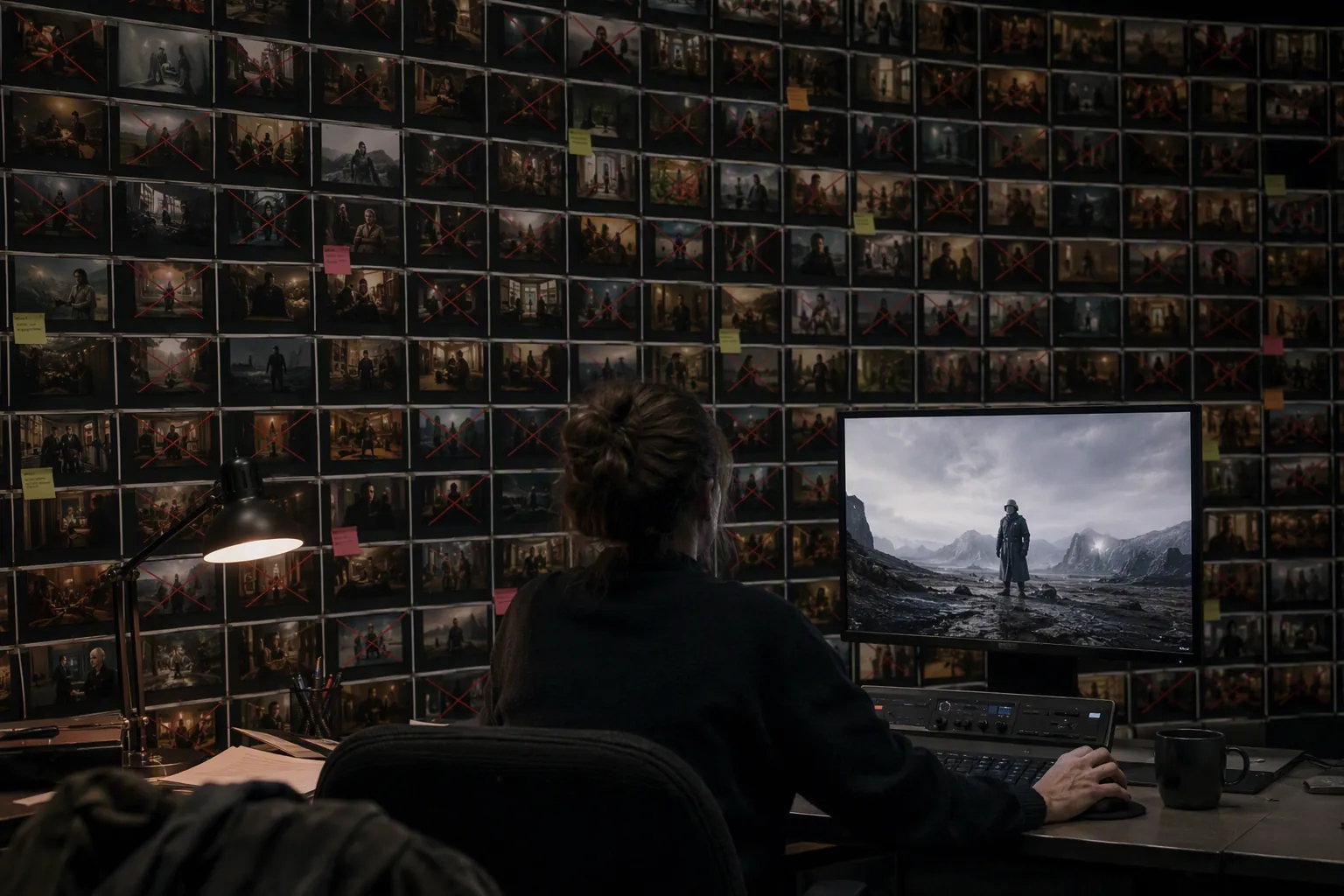
This is where the five-person framing becomes misleading if it is allowed to mean little labor. A compact team may remove transportation, construction, lighting setups and the coordination of a large physical set. It replaces part of that work with prompt iteration, asset management, selection, continuity tracking, repair, compositing, editorial judgment and sound work. Someone still has to reject the attractive image that breaks the scene.
Compliance was part of the pipeline
Risk control was one of Wang’s three named challenges, not paperwork added after picture lock.[3] For a licensed historical production, review can affect depiction, wording, costume, symbols, music and the treatment of identifiable people or institutions. Moving those checks late would create expensive regeneration across connected shots.
Student productions have a different approval environment, but they still need an early register covering likenesses, reference-image provenance, music rights, model terms, disclosure requirements and sensitive historical claims. A visually successful shot that cannot be distributed is not finished.
A student workflow worth copying
The transferable AI filmmaking workflow is less glamorous than the schedule. It begins by reducing uncertainty before expensive batches of motion are generated.
| Production task | Useful output | Decision it protects |
|---|---|---|
| Research and visual development | Evidence library, visual rules and exclusions | What belongs in the film’s world |
| Character development | Layered character sheets, costume states and expression references | Whether the same person survives across scenes |
| Style testing | A small approved set of representative frames | Whether the intended look is repeatable |
| Planning | Shot list, storyboards, animatic and scene geography | Whether the sequence works before final generation |
| Generation and review | Versioned clips with accept, reject and repair notes | Why a shot was selected and what must match next |
| Postproduction | Edit, compositing, cleanup, sound design, mix and compliance record | Whether the assembled film feels intentional and can be released |
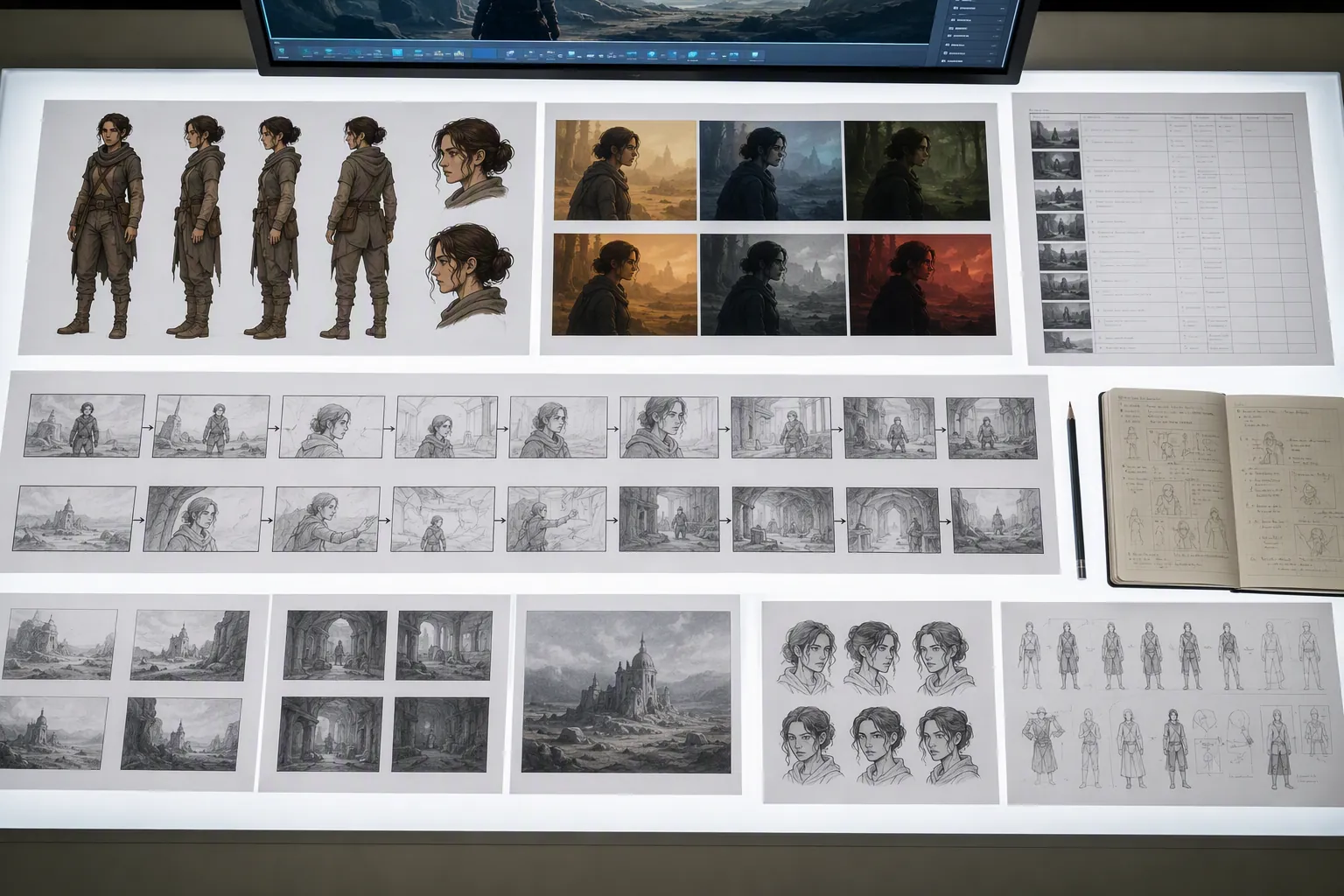
Lock the rules before chasing polished shots
Build character sheets that show more than a flattering portrait. Include front, profile and three-quarter views; full-body proportions; recurring expressions; costume layers; age and injury states; and important props. A character bible should also identify forbidden drift: features, colors or accessories the model tends to change.
Do the same for environments. Draw a simple floor plan for every recurring space, establish entrances and sightlines, and decide where major light sources sit. Save approved views of the space from multiple directions. These references give the editor something firmer than visual intuition when two individually appealing shots refuse to cut together.
Style tests should stress the proposed method rather than merely prove that it can make one beautiful frame. Test dialogue, hand interaction, walking, wide staging, low light and transitions between locations. If the film depends on a recurring boat, crowd or complex costume, test that element early. Failure during a short proof is information; failure after hundreds of approved close-ups is a redesign.
Cut the film before generating the expensive version
A shot list and rough animatic expose structural problems while images remain cheap to replace. They show whether the sequence has enough coverage, whether the geography reads and whether the intended runtime has been filled with dramatic action rather than visual padding. Temporary dialogue and crude sound are useful here because pacing often changes once a scene can be heard.
A documented GEN:48 short-film workflow offers a compact illustration: concept brainstorming, style tests, a layered character sheet, a shot list and animatic came before image-to-video generation, upscaling and sound design.[4] It should be treated only as evidence for pipeline mechanics. GEN:48 was a 48-hour short-film setting; Flames of Dachen was a 48-day feature. Similar task names do not make the schedules equivalent.
Budget for selection, repair and sound
Every generated clip needs a status and an owner. A simple review system should record the prompt or source image, model and settings, clip version, continuity dependencies, rejection reason, repair plan and rights status. Without that history, a small crew repeatedly solves the same problem and may be unable to reconstruct an approved result.
Sound should begin during the animatic, not after the visual budget is spent. AI imagery frequently arrives without production sound to bind bodies to rooms. Footsteps, cloth, water, machinery, breath and room tone establish scale and material weight. Dialogue performance, ambience and music must also agree about the emotional temperature of the scene. Flames of Dachen’s reported refinement of dubbing and music places those tasks inside the production process rather than treating them as automatic finishing layers.[1][3]
Where the attractive interpretation breaks down
The industry evidence does not support a broad claim that professional long-form filmmaking has become fast and cheap. In March 2026, iQiyi acknowledged that achieving professional drama or film quality in long-form AI narratives remained an industry challenge.[5] CNN also reported that a five-person team could make an “ordinary-quality” 120-minute project in roughly a week for about 15,000 yuan, but the quality qualifier is doing essential work.[5]
CNN renders the model name as “SeeDance 2.0,” while China Daily uses “Seedance 2.0”; this article follows China Daily’s spelling for the Dachen production.[1][5] The variance is minor, but it illustrates why granular production claims should remain attached to the source that actually provides them.
Polish can erase much of the apparent savings. Industry reporting includes a director’s assessment that hiding AI seams to reach a professional standard can require “doubling the compute.”[5][6] That does not establish a universal cost multiplier, but it warns against estimating a finished film from the price of an initial generation. Retries, upscaling, local fixes, compositing, storage, review time and unusable outputs belong in the budget.
The labor evidence is less celebratory. Reporting on China’s microdrama sector said that 95% of approximately 128,000 microdramas produced in the first quarter of 2026 were fully AI-generated. It also described per-minute rates falling from roughly 1,000 yuan to about 150 yuan and editing teams shrinking from five or six people to one.[5][6] These figures concern a high-volume short-form market, not feature filmmaking, but they show that adoption and worker benefit are different measurements.
The emerging “card-puller” role makes the hidden work easier to see: operators repeatedly generate clips, inspect the results and cull failures.[5][6] That job combines technical operation with taste, patience and continuity awareness, yet it can be priced as low-level throughput. A five-person credit does not tell us how intensely those five people worked, how much compute they supervised or whether the production model would remain sustainable across several projects.
What film students should—and should not—take from it
Film schools are already experimenting with generative AI, including a $10 million AI institute at USC, an LMU course on producing and screenwriting with AI, and a 17-student experimental course at Chapman.[7] The most useful distinction in that debate comes from USC professor Holly Willis: generation does not supply visual design, mise-en-scène, editing, timing or pacing.[7] Those remain filmmaking decisions even when no conventional camera crew is present.
Students should copy the Dachen team’s visible preparation: research the world, define characters and visual rules, test difficult actions, map recurring spaces, build an animatic, version every shot, plan sound early and review compliance before lock. They should also count rejection and repair as production rather than pretending unsuccessful generations never happened.
They should not copy the headline as a budget template. The available reporting does not reveal the complete cost base or independently verify the schedule. Nor does one commemorative project with a controlled style and streaming distribution establish what a different genre, visual language, rights environment or client-review process would cost.
Flames of Dachen is credible as a documented production achievement: a tiny team delivered a licensed, feature-length AI film and appears to have confronted long-form continuity seriously. Its 48 days and sub-500,000-yuan budget remain self-reported limits for this particular production. The durable lesson is not that five people now equal a conventional feature crew. It is that fewer people can attempt feature-scale work only when they replace set logistics with unusually disciplined planning, selection, continuity control and postproduction.
References
- China Daily coverage of Flames of Dachen — China Daily, August 25, 2026
- People’s Daily coverage of Flames of Dachen — People’s Daily, August 17, 2026
- Xinhua Zhejiang coverage of Flames of Dachen — Xinhua Zhejiang, July 14, 2026
- 48 Hours to Generate a Film — Runway
- Short drama and AI in China — CNN, August 22, 2026
- AI microdramas and China’s film-industry jobs — CNA
- How Hollywood’s Top Film Schools Teach Generative AI — IndieWire
Authoritative source
No specific exam hub matched
Browse the exam hubs directory for the authoritative plan on any of the five exams.
Report an error in this tool's output
Found something this tool got wrong beyond what's documented above? Report it so the accuracy log stays current.
Comments
Join the discussion with an anonymous comment.