
SAT, ACT, MCAT, GRE Exam Hub
How to Safely Watch the August 2026 Blood Moon — A Study Guide
Learn how to safely watch the August 2026 blood moon with the naked eye, and master the Rayleigh scattering, Danjon scale, and other eclipse science tested on the SAT, ACT, MCAT, and GRE.
- gre
- mcat
- asvab
- sat
- act
- digital-adaptive
- official-material
- section-strategy
- test-date-timeline
Yes: you can safely watch the August 2026 lunar eclipse with your naked eyes. You do not need eclipse glasses, a solar filter, or any special eye protection for a lunar eclipse. NASA’s safety rule is direct: lunar eclipses are safe to view directly, while solar eclipses require proper solar viewing protection because you are looking toward the Sun.[1]
That distinction matters more than the nickname. People will call this event a “blood moon” because the eclipsed part of the Moon may look reddish, but the scientifically useful label is more precise: the August 27–28, 2026 event is a deep partial lunar eclipse, not a total lunar eclipse. At maximum, 96.2% of the Moon will be inside Earth’s umbra, with peak eclipse at 04:13 UTC on August 28.[2]
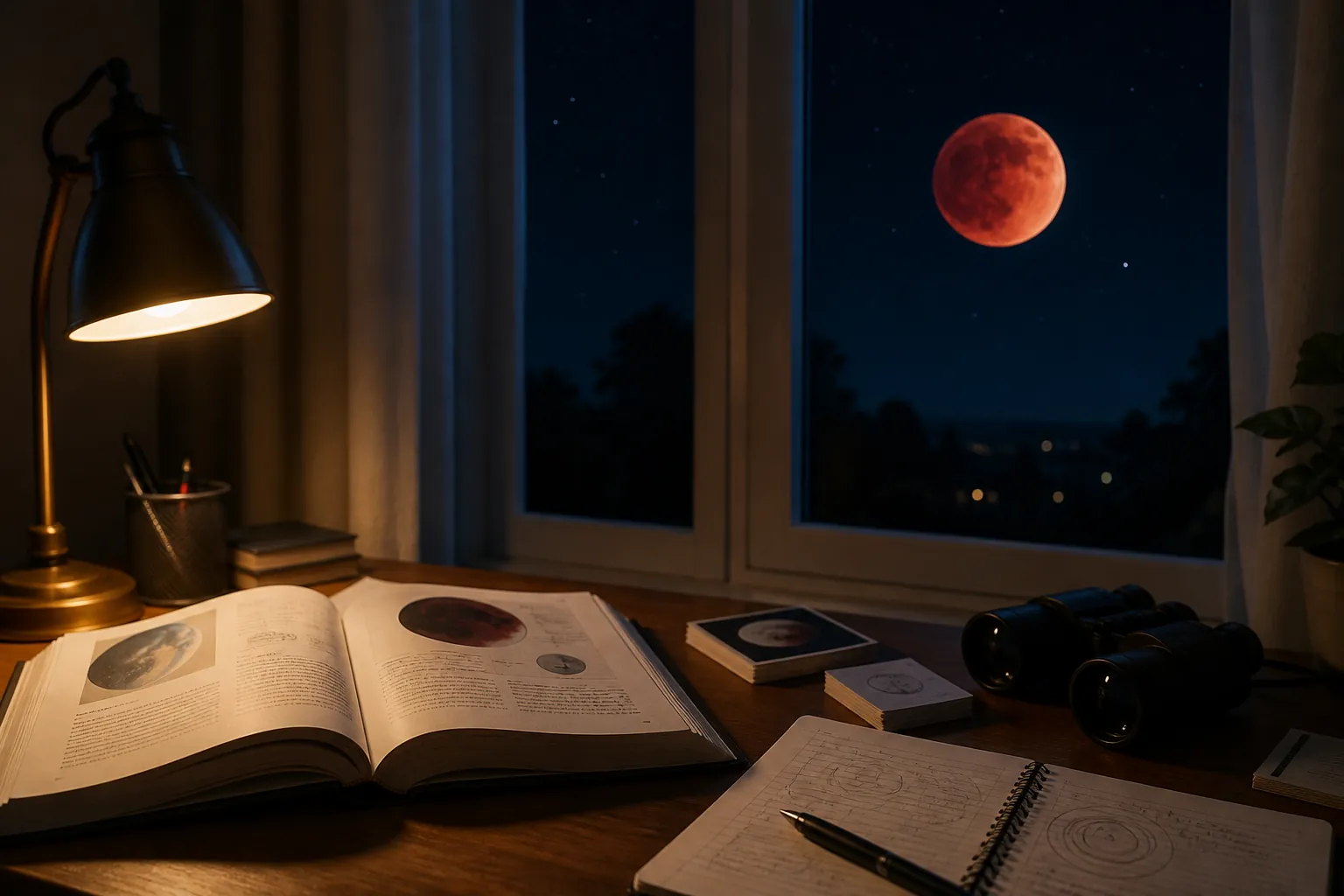
The One Safety Rule To Remember
| Event | What you are looking at | Eye protection? |
|---|---|---|
| Lunar eclipse | The Moon passing through Earth’s shadow | No. Naked-eye viewing is safe. |
| Solar eclipse | The Sun being blocked by the Moon | Yes. Use proper solar viewing protection except during the brief total phase of a total solar eclipse, where applicable. |
A lunar eclipse is safe because moonlight is reflected sunlight and is far dimmer than direct sunlight. During the eclipse, the Moon gets darker, not brighter. Binoculars or a telescope can make the shadow edge easier to see, but they do not turn the event into an eye-safety problem. The danger belongs to solar viewing, not lunar viewing.[1]
So the practical rule is short enough to keep under exam stress: lunar eclipse, safe to watch; solar eclipse, use certified solar protection. If a passage tries to blur those two, slow down. The object being observed decides the safety rule.
What Makes the August 2026 Event Worth Planning Around
The August 2026 eclipse is unusually close to total without crossing that line. A 96.2% umbral eclipse means nearly the whole lunar disk enters Earth’s dark central shadow, but a small portion remains outside total umbral coverage. Space.com describes it as the deepest partial lunar eclipse until at least 2028, with the next total lunar eclipse listed for December 31, 2028.[2]
| Viewing fact | August 2026 detail |
|---|---|
| Date | August 27–28, 2026 |
| Eclipse type | Deep partial lunar eclipse |
| Maximum umbral coverage | 96.2% of the Moon |
| Peak timing | 04:13 UTC on August 28 |
| Safety gear | None required for eye safety |
Because the timing is given in UTC, convert the peak time to your local time before you make plans. Do that conversion first, then check whether the Moon is above your horizon during the useful part of the eclipse. A student in one region may get a convenient late-evening event; another may find that maximum eclipse happens near dawn or below the horizon.
The word “partial” should not make you dismiss it. A shallow partial eclipse can be subtle. This one is deep enough that the shadow geometry should be obvious if the sky is clear and the Moon is visible from your location. Just do not call it total on a worksheet or in a short-answer explanation. Exams reward the boundary.
A Simple Viewing Plan That Does Not Become Another Homework Assignment
Start with the least complicated plan that can work: find the local peak time, step outside with a clear view of the Moon, and watch the shadow edge. You do not need a dark-sky site. City light makes stars harder to see, but the Moon is bright enough that a lunar eclipse can still be watched from many ordinary neighborhoods.
- Use your eyes first. The main observation is the shape and darkness of Earth’s shadow on the Moon.
- Bring binoculars if you have them. They help you see the boundary between the brighter lunar surface and the umbral shadow.
- Skip eclipse glasses. They are for solar viewing and will make the Moon unnecessarily hard to see.
- Check weather and horizon, not just the clock. Clouds and buildings can ruin a technically well-timed plan.
- Write down one observation: color, brightness, or shadow shape. That is enough to turn the event into a useful science memory.
If you do use binoculars, common 8x42 or 10x50 models are a good balance for lunar eclipse viewing because they offer useful magnification without becoming too shaky for many handheld observers.[6] More magnification is not automatically better if you spend the night fighting wobble. A tripod can help, but it is optional, not a requirement.
For students with a practice test the next morning, set a limit before you go outside. Watch near maximum if it is visible, make a short note, and go back in. A good observation is not the same as staying up until every phase is over.
Why a Lunar Eclipse Can Look Red
The red color comes from Earth’s atmosphere, not from the Moon producing red light. During a lunar eclipse, sunlight passes through the edge of Earth’s atmosphere before reaching the Moon. Shorter blue wavelengths scatter more strongly, while longer red wavelengths are bent, or refracted, through the atmosphere toward the lunar surface. NASA identifies this Rayleigh scattering process as the reason an eclipsed Moon can look red or coppery.[3]
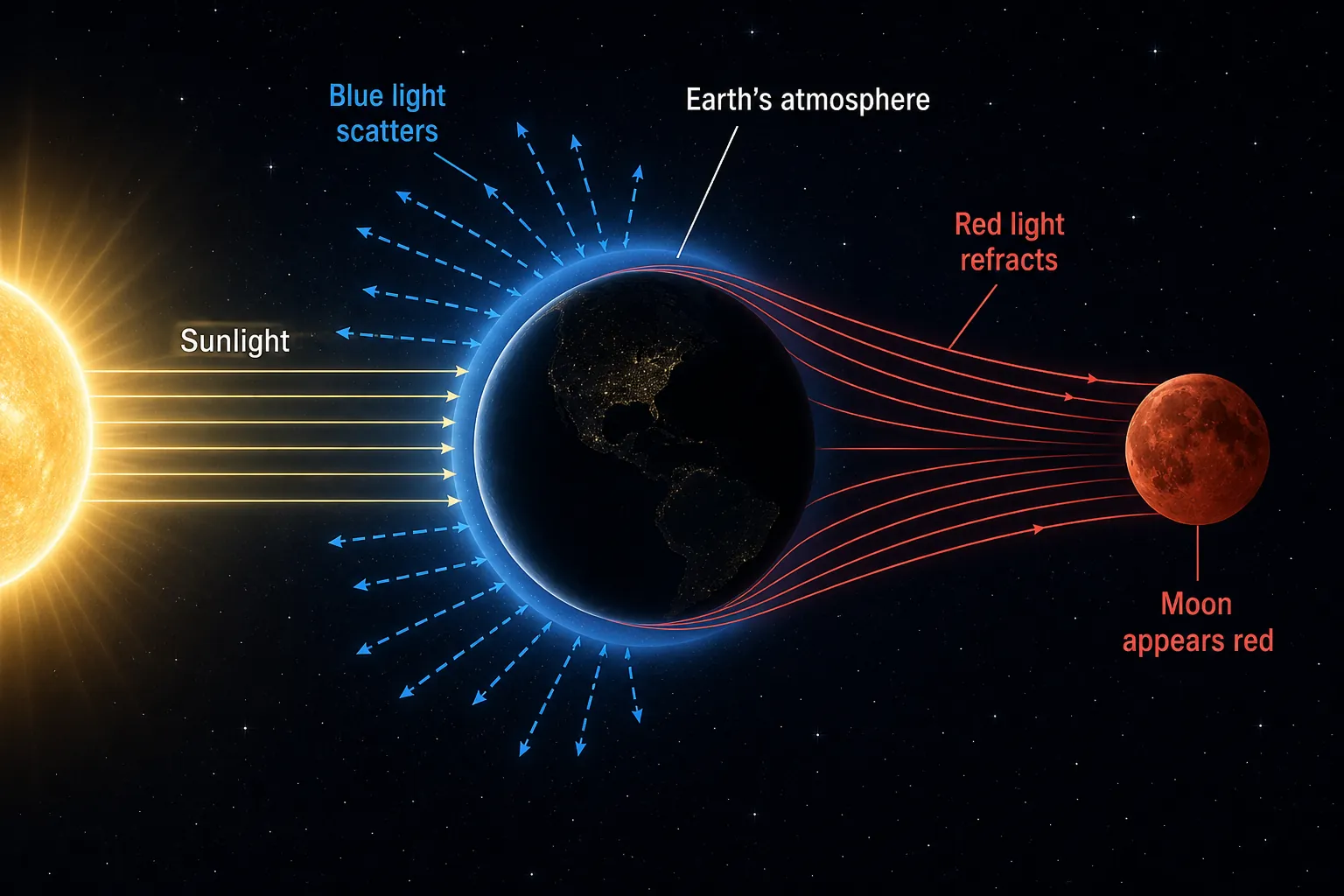
This is the same basic scattering idea behind a red sunrise or sunset. At low angles, sunlight travels through more atmosphere before it reaches your eyes. The shorter wavelengths are scattered out of the direct path more efficiently, leaving relatively more red and orange light. During a lunar eclipse, Earth’s atmosphere acts like a ring of sunrise-and-sunset light around the planet, sending reddish light into the shadow.
That does not guarantee one uniform color. Dust, clouds, aerosols, and the Moon’s position inside the shadow can all affect how bright or dark the eclipsed Moon appears. A deep partial eclipse may show strong reddish shading across much of the disk, especially near the umbra, but because the August 2026 event is not total, part of the Moon remains outside the umbra.[2][3]
Umbra, Penumbra, and the Geometry Exams Like
A lunar eclipse is a shadow problem. The umbra is the darker central part of Earth’s shadow, where the Sun is fully blocked from the Moon’s perspective. The penumbra is the lighter outer shadow, where the Sun is only partly blocked. NASA’s eclipse materials use this umbra-versus-penumbra distinction to explain why lunar eclipses can be penumbral, partial, or total.[4]
For the August 2026 event, the key word is umbra. The 96.2% figure refers to how much of the Moon enters Earth’s umbral shadow at maximum eclipse, not how much of the Moon merely enters the penumbra.[2] That difference is exactly the kind of detail a science passage can test: the number sounds like a near-total event because it is near-total, but the classification remains partial.
Another common exam trap is the monthly-eclipse question. If the Moon orbits Earth about once a month, why is there not a lunar eclipse every full Moon? The answer is orbital tilt. The Moon’s orbit is tilted by about 5 degrees relative to Earth’s orbital plane, so most full Moons pass above or below Earth’s shadow rather than through it.[4]
That small angle does a lot of work. It explains why alignment, not just phase, is required. Full Moon is necessary for a lunar eclipse, but it is not sufficient. The Sun, Earth, and Moon also need to line up near the points where the Moon’s tilted orbit crosses Earth’s orbital plane.
Use the Danjon Scale While You Watch
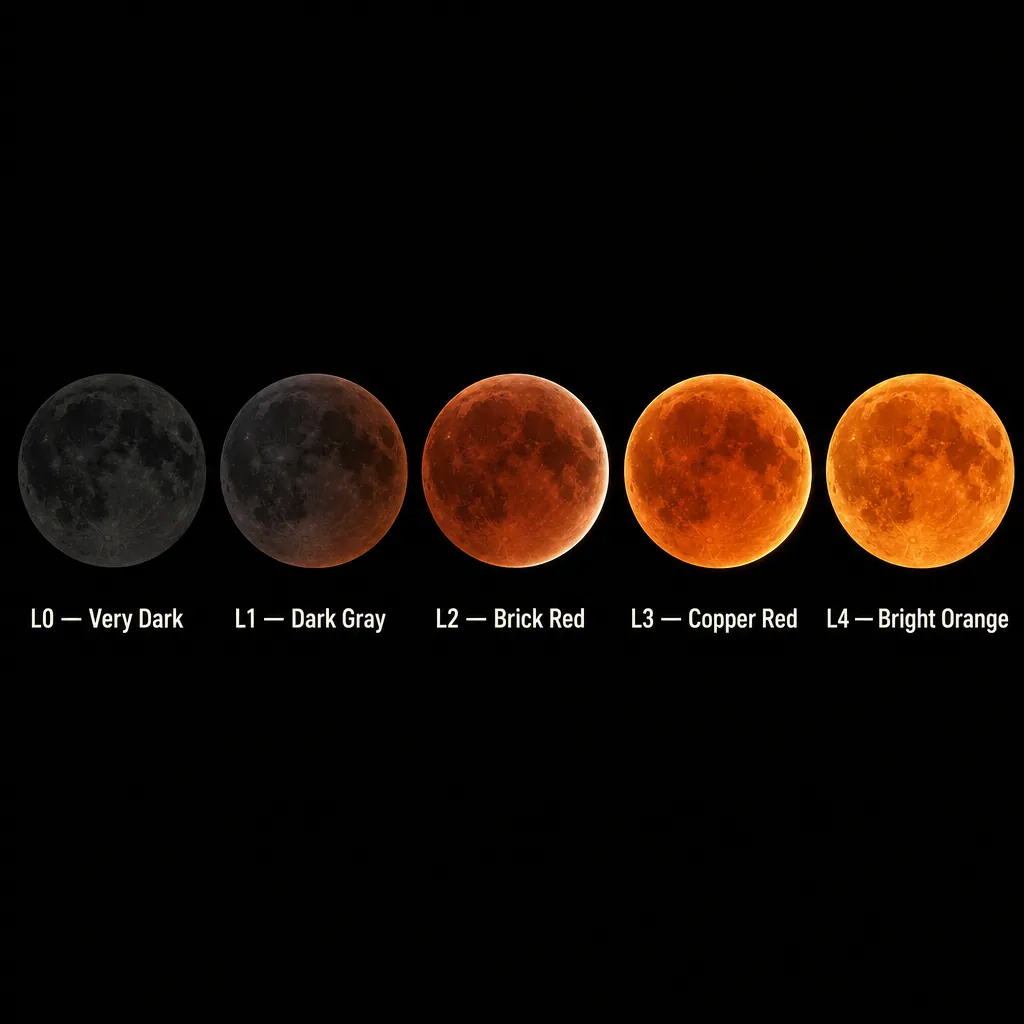
The Danjon Scale gives you something simple and legitimate to do during the eclipse: classify the Moon’s appearance from L0 to L4. NASA’s eclipse materials describe the scale as a way to rate the brightness and color of a lunar eclipse, from very dark to bright copper-orange.[5]
| Danjon rating | What you are looking for |
|---|---|
| L0 | Very dark eclipse; Moon nearly invisible |
| L1 | Dark gray or brownish eclipse; details hard to see |
| L2 | Deep red or rust-colored eclipse with a darker center |
| L3 | Brick-red eclipse, often with a brighter rim |
| L4 | Bright copper-orange eclipse with high visibility |
Because August 2026 is a partial eclipse, your rating may not describe the entire Moon equally. Focus on the darkest eclipsed region and note that uneclipsed or less-eclipsed portions may look much brighter. A useful observation might be: “Near maximum, the umbral region looked L2, while the remaining bright sliver made the full disk uneven.” That sentence is better science than simply writing “blood moon.”
The point is not to guess the “correct” color. The point is to connect observation to a defined scale. That is how a casual sky event becomes usable evidence: you name the feature, apply a classification rule, and acknowledge the limits of the observation.
The Aristotle Example, Without the Long Detour
Lunar eclipses also have a neat history-of-science use. NASA Jet Propulsion Laboratory teaching materials note that Aristotle used Earth’s round shadow on the Moon during lunar eclipses as evidence that Earth is spherical.[7] That example is passage-ready because it joins observation, inference, and model-building in one clean step.
The observation alone is not “Earth is spherical.” The observation is that Earth casts a consistently curved shadow on the Moon. The inference is that a spherical Earth explains that curved shadow. If an exam asks you to separate evidence from conclusion, that is the distinction to keep.
How This Shows Up on the SAT, ACT, MCAT, and GRE
You do not need to become an astronomer to make this event useful for test prep. The high-yield pieces are the ones that transfer: wavelength-dependent scattering, shadow geometry, classification systems, and evidence-based inference.
| Exam context | What the eclipse helps you practice |
|---|---|
| SAT and ACT Science-style passages | Reading graphs or descriptions about wavelength, color, brightness, and shadow position |
| MCAT physics and chemistry | Connecting wavelength, scattering, optics, and atmospheric filtering |
| GRE reading and quantitative reasoning | Separating definitions, evidence, causal explanations, and classification rules |
| General science literacy | Distinguishing media language such as “blood moon” from scientific labels such as partial lunar eclipse |
If you like this kind of event-to-exam bridge, the same reading habit applies to weather and engineering topics. A heat dome passage asks you to track pressure and trapped air; the heat dome vs. heat wave study guide uses that structure. The airplane-window physics explainer does the same thing with stress concentration. For a broader space-science study path, the Roman Telescope learning resource keeps the focus on what students are likely to read, compare, and infer from scientific materials.
Practice Questions
Use these as quick recall checks after the eclipse, not as a full study session.
- A student says they need eclipse glasses to watch the August 2026 blood moon. What correction should you make? Answer: Eclipse glasses are not needed for a lunar eclipse; they are needed for safe solar viewing.
- During a lunar eclipse, why does the Moon often look red instead of blue? Answer: Shorter blue wavelengths scatter more strongly in Earth’s atmosphere, while longer red wavelengths are refracted toward the Moon.
- The August 2026 eclipse reaches 96.2% umbral coverage. Why is it still called partial? Answer: Because not all of the Moon enters Earth’s umbra.
- What is the difference between the umbra and the penumbra? Answer: The umbra is the darker central shadow where the Sun is fully blocked; the penumbra is the lighter outer shadow where the Sun is only partly blocked.
- Why does a lunar eclipse not happen every full Moon? Answer: The Moon’s orbit is tilted by about 5 degrees, so most full Moons pass above or below Earth’s shadow.
- An observer rates the eclipsed region as L2. What kind of appearance are they reporting? Answer: A deep red or rust-colored eclipse, often darker toward the center.
- In the Aristotle shadow example, what is the evidence and what is the inference? Answer: The evidence is Earth’s curved shadow on the Moon; the inference is that Earth is spherical.
- A passage says “blood moon” and “total lunar eclipse” as if they always mean the same thing. What should you check? Answer: Check the actual eclipse type and whether the Moon fully enters the umbra.
If the eclipse falls close to a school deadline or practice exam, protect the schedule too. Convert the time, watch the part that matters, record one Danjon-style observation, and stop there. For students balancing late-summer weather, sleep, and testing, the fall heat-advisory study-planning guide is a useful companion.
References
- Eclipse Viewing Safety, NASA Science
- August 2026 lunar eclipse — Everything you need to know about the 96% blood moon, Space.com
- What is a blood moon and when can you see the next one in 2026?, NASA Science
- Eclipses and the Moon, NASA Science
- Danjon Scale of Lunar Eclipse Brightness, NASA Eclipse Web Site
- Total lunar eclipse gear guide, Fox Weather
- Lunar Eclipse Lesson Plan, NASA Jet Propulsion Laboratory
Related exhibits & inventory
Verified outcomes
No verified outcomes on file for this exam yet
See Methodology for how outcome evidence is disclosed once logged.
Planners
No planner filed for this exam yet
A downloadable timeline template for this exam hasn't been published yet.
Tool verdicts
AI-tool cautions
No AI tools tested for this exam yet
No hands-on AI-accuracy logs have been filed for this exam.
Questions about this plan
Ask a question about a specific section, timeline, or citation in this plan — or flag something that needs correcting.
Comments
Join the discussion with an anonymous comment.