
MCAT Exam Hub
How to Read Protein-Restriction Longevity Research
An evidence-tiered guide to the protein-restriction longevity literature — what's proven in animals, what human data can show, and what claims outrun the evidence.
- gre
- mcat
- asvab
- sat
- act
- digital-adaptive
- official-material
- section-strategy
- test-date-timeline
If you have heard that protein restriction extends lifespan, the first useful question is not “Should humans eat less protein?” It is: Which organism, which endpoint, and which kind of evidence? The protein-restriction longevity literature is strong in several model organisms, biologically plausible through conserved nutrient-sensing pathways, and still not direct human lifespan evidence. That distinction is the whole study skill.
A defensible study guide for protein-restriction longevity research has to keep at least four evidence tiers separate: animal lifespan studies, mechanistic necessity tests, human observational associations, and short human metabolic trials. Reviews in the field describe protein restriction as a reproducible longevity intervention in yeast, flies, and rodents, while also treating human translation as unresolved rather than established clinical advice.[1][2]

| Evidence tier | What it can show | What it cannot show by itself |
|---|---|---|
| Yeast, fly, mouse, and rat lifespan experiments | Whether a defined low-protein or amino-acid-restricted diet changes survival in that model | That the same diet safely extends human lifespan |
| Mechanistic studies | Whether pathways such as mTORC1, GCN2/eIF2α-ATF4, FGF21, IGF-1, and autophagy respond to protein restriction; knockout studies can test necessity | That pathway activation is automatically beneficial in every age, sex, or disease state |
| Human cohort studies | Whether reported protein intake is associated with mortality patterns in a population | Causation, controlled substitution, or the effect of changing diet in an individual |
| Short human trials | Whether protein restriction can alter markers such as FGF21, energy expenditure, insulin sensitivity, glucose, lipids, or body composition | Human lifespan, long-term safety, or older-adult outcomes |
That table is not a formality. It prevents the most common category error in this topic: treating a median-lifespan result in male mice, a mortality association in a cohort, and a five-week metabolic trial as if they answer the same question.
The mechanism is elegant, but mechanism is not a human outcome
Protein restriction is not just “less building material.” Cells and organs sense amino-acid availability. When dietary protein or particular amino acids fall, nutrient-sensing circuits shift growth, stress response, endocrine signaling, and recycling programs. That is why this literature is so tempting to overstate: it really does connect beautifully to pathways every MCAT student eventually meets.
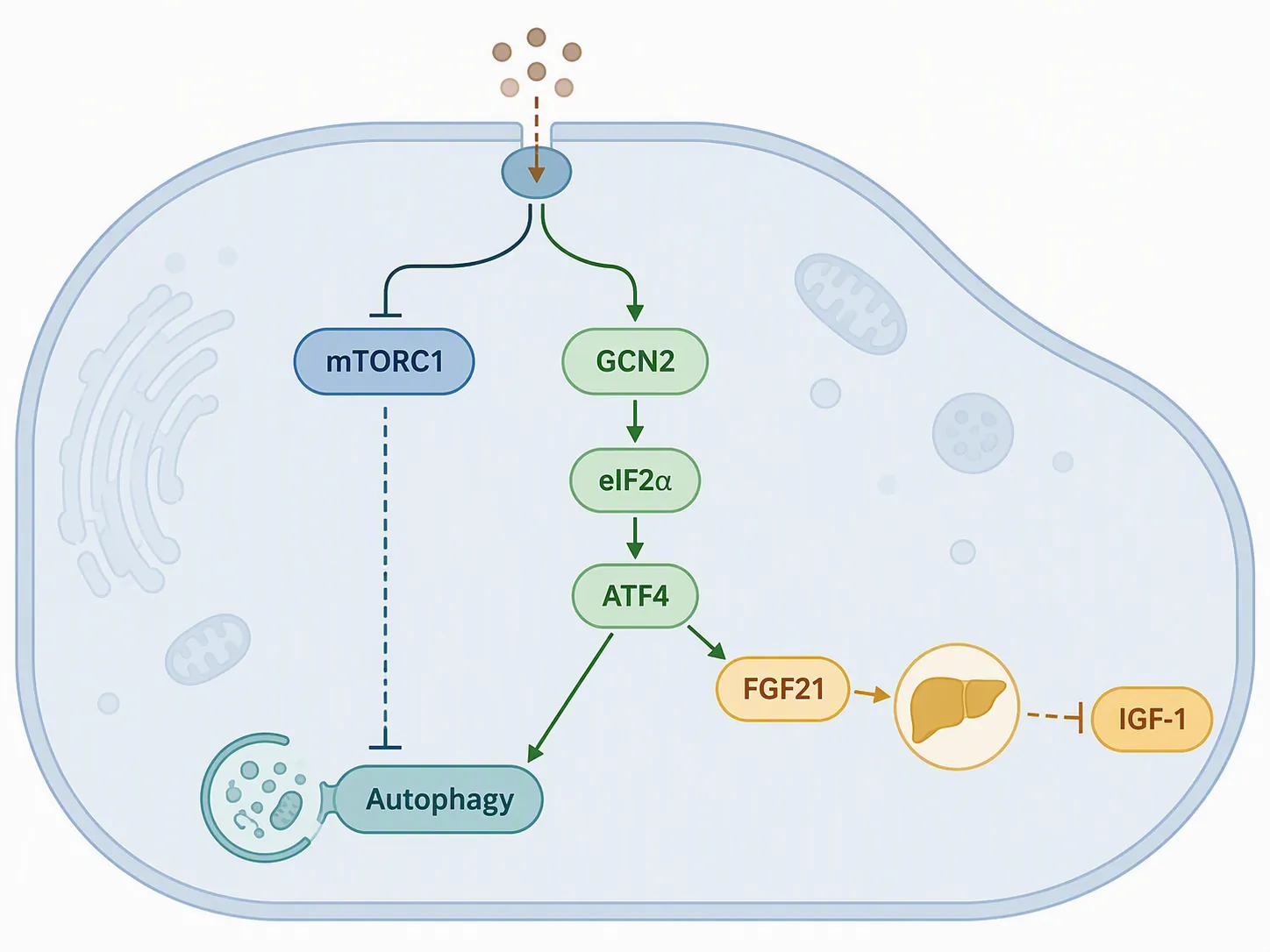
The compact version is this: protein restriction tends to inhibit mTORC1, activate the GCN2/eIF2α-ATF4 amino-acid stress pathway, raise hepatic FGF21, lower IGF-1, and induce autophagy. Each of those terms has a specific job in the logic chain. mTORC1 reads amino-acid abundance as permission for growth and biosynthesis. GCN2 detects uncharged tRNAs during amino-acid limitation and feeds into eIF2α phosphorylation and ATF4-driven transcription. FGF21 is a liver-derived endocrine signal that can change energy balance and metabolic behavior. IGF-1 links nutrient status to growth signaling. Autophagy lets the cell recycle damaged or unnecessary components.
The more serious mechanistic question is not whether these labels can be named. It is whether any of them are required for the lifespan phenotype. Hill and colleagues gave a cleaner answer than most pathway diagrams can: in male mice, FGF21 was required for the lifespan extension and metabolic benefits of protein restriction. In other words, FGF21 was not merely a correlated biomarker that rose during the intervention; removing it disrupted the effect the model was trying to explain.[3]
That is the kind of experiment worth lingering over. A knockout or loss-of-function design can ask a necessity question: if the proposed mediator is missing, does the intervention still work? If it does, the mediator may be decorative, redundant, or downstream. If it does not, the mechanism has become more than a figure caption. Hill 2022 studied male mice, so it should not be silently generalized to females or humans, but its experimental logic is exactly what students should learn to recognize.[3]
Mechanism also explains why protein restriction can affect more than lifespan. A pathway that changes growth signaling, stress resistance, endocrine output, and cellular recycling could plausibly alter glucose handling, adiposity, inflammation, organ remodeling, neurodegeneration phenotypes, or energy expenditure. But plausibility is not proof of a clinical endpoint. A conserved pathway is a reason to study translation; it is not translation.
Where lifespan has actually been measured
The lifespan evidence is strongest in model organisms. Reviews summarize protein restriction as lifespan-extending in yeast, flies, and rodents, with especially concrete results in rats and mice.[1][2] This is the reproducible zone of the literature. It is also the zone where diet composition, sex, strain, housing, control feeding, and age of onset matter enough to change the interpretation.

The rat numbers are memorable. A 2026 review compiling classic protein-restriction studies reports about a 40% median-lifespan increase in Sprague-Dawley rats from Ross 1961 and about a 52.7% increase in F344 rats from Horakova 1988.[2] Mouse results are also substantial but more conditional, with reported lifespan increases roughly in the 10–35% range depending on strain, sex, and diet composition.[2]
Those are not trivial effects. If a rodent diet reliably moves median lifespan by that amount, something biologically important is happening. The discipline is to describe the importance without smuggling in a human conclusion. Laboratory rodents are not small humans with shorter calendars. Standard chow is often formulated for growth, controls are frequently fed ad libitum, and a diet that is “restricted” relative to one lab diet may still not map cleanly onto an adult human diet pattern.
The missing rung is just as important: there are no direct primate lifespan data establishing that protein restriction extends lifespan.[2] That absence does not erase the animal work. It does keep the human claim in the hypothesis column.
“Protein restriction” is not one diet
The amino-acid studies are where the field gets more interesting and less slogan-friendly. Total protein restriction is one manipulation. Methionine restriction, branched-chain amino acid restriction, and isoleucine restriction are different manipulations. They may overlap mechanistically, but they should not be filed under one vague label if the actual diet differs.
Methionine restriction has long been reported to extend rat lifespan, and later reviews treat it as one of the classic amino-acid-specific interventions in the broader protein-restriction literature.[2] That matters because methionine is not merely a percentage of total protein; it is a sulfur-containing essential amino acid with links to methylation, redox biology, and growth signaling.
Branched-chain amino acid restriction adds a useful warning label about sex. Richardson and colleagues reported that lifelong dietary BCAA restriction increased median lifespan by about 30% in male mice, with no lifespan benefit in females.[4] A clean headline would say exactly that. A sloppy headline would say “BCAA restriction extends lifespan” and hide the sex-specific boundary.
Isoleucine restriction narrows the lens further. Green and colleagues reported that restricting isoleucine increased median lifespan in male UM-HET3 mice by about 33%, with a much smaller reported effect in females.[5] The point is not that everyone should start ranking amino acids at lunch. The point is that the biology is specific enough that “low protein” can be a crude label for multiple distinct experiments.
Healthspan-adjacent findings do not automatically become lifespan evidence
Some protein-restriction studies examine disease models or organ-level phenotypes rather than lifespan. For example, a 2024 Nature Communications study reported effects of protein restriction in an Alzheimer’s disease mouse model, and a 2025 Nature Aging research highlight discussed organ-level responses to protein restriction.[6][7] These are useful for understanding how broadly nutrient sensing can reach. They do not substitute for survival data, and they do not tell us whether chronic restriction would help an older adult preserve function.
The human evidence tier is real, but narrower
Human studies matter because humans are the target of the translation question. They also require a slower read. The human evidence does not consist of lifelong randomized protein-restriction trials with mortality endpoints. It consists mainly of observational associations and short metabolic interventions.
The most headline-prone paper is Levine et al. 2014, which analyzed 6,381 adults from NHANES III. In participants aged 50–65, high protein intake, defined as 20% or more of calories from protein, was associated with higher all-cause mortality and cancer mortality; the reported hazard ratio for all-cause mortality was 1.74, and cancer mortality was reported as more than fourfold higher. In participants aged 66 and older, the direction reversed, with high protein intake associated with lower all-cause mortality, reported as HR 0.72.[8]
That age reversal is not a footnote. It is the part that makes the study a test of evidence discipline. If someone extracts only “high protein linked to mortality” from Levine 2014, they have missed the most clinically sensitive feature of the paper. Older adults are not just middle-aged adults plus time; they face sarcopenia, frailty, illness recovery, and different risk tradeoffs.
Levine 2014 also has limitations that should travel with the result. Diet was based on a single 24-hour recall. The diabetes-mortality subgroup was small, with 21 diabetes deaths in the relevant analysis, producing wide uncertainty. The paper also disclosed that author V.D.L. held equity in L-Nutra, a company connected to fasting-mimicking diet products.[8] None of those limitations makes the study useless. They keep it in the observational-association tier.
Meta-analytic cohort evidence complicates a simple “less protein” message further. Naghshi and colleagues’ 2020 BMJ dose-response meta-analysis reported that each 3%-of-energy increment of plant protein was associated with 5% lower all-cause mortality, while animal protein did not show a clear association in the same simplified direction.[9] That is not the same as saying total protein restriction extends human lifespan. It points toward source, substitution, and dietary pattern questions.
| Human finding | Best interpretation | Common overreach |
|---|---|---|
| High protein at 20%+ of calories associated with higher mortality in ages 50–65 in Levine 2014 | A cohort association in a defined age band, with important limitations | “High protein is bad for everyone” |
| Association reversed at age 66+ in Levine 2014 | Older-adult protein risk-benefit may differ | Ignoring age and applying one rule across adulthood |
| Plant protein associated with lower all-cause mortality in Naghshi 2020 | Protein source and substitution matter in cohorts | “All protein should be reduced” |
| Short trials alter metabolic markers | Human physiology responds to protein restriction | “Human lifespan extension has been shown” |
Short human trials are mechanistically useful in a different way. Ferraz-Bannitz and colleagues reported that 27 days of protein restriction in patients with metabolic syndrome improved adiposity, insulin sensitivity, glucose, and lipids.[10] Nicolaisen and colleagues studied five weeks of eucaloric protein restriction in lean men and reported fasting FGF21 increases of 208–361%, about 19–21% higher energy intake needed to hold weight, and a 16% increase in clamp-measured insulin sensitivity.[11] These are serious physiological responses, and they fit well with the FGF21-centered animal mechanism. They are still short metabolic studies, not survival trials.
The difference between “marker moved” and “lifespan extended” is not pedantry. FGF21 can rise, insulin sensitivity can improve, and energy requirements can shift without proving that chronic protein restriction is safe, sustainable, or beneficial across decades. For older adults especially, that distinction matters. ESPEN/PROT-AGE guidance has commonly recommended about 1.0–1.2 g/kg/day of protein for healthy older adults, a context that sits uneasily beside casual advice to chronically restrict protein late in life.[12]
Questions to ask before accepting a protein-restriction claim
This literature is useful practice for reading biology because the same words can refer to very different designs. Before turning a paper into a conclusion, slow down at the design level.
- What organism was studied? Yeast, flies, mice, rats, and humans are not interchangeable evidence units.
- What was the endpoint? Lifespan, median survival, cancer mortality, insulin sensitivity, FGF21, body weight, and autophagy are different outcomes.
- Was it total protein restriction or a specific amino-acid manipulation? Methionine, BCAAs, and isoleucine deserve separate labels.
- Was the diet isocaloric? If calories fall along with protein, the study may partly test calorie restriction or reduced intake.
- What was the control diet? In animal studies, ad libitum-fed controls and growth-formulated chow can shape the apparent size and meaning of the effect.
- Was the mechanism tested by necessity? A knockout result carries different weight from a pathway marker that merely changes.
- Was the effect sex-specific? Several strong findings are male-only or much stronger in males.
- Is the human evidence observational or interventional? Cohorts can generate associations; short RCTs can test metabolic responses; neither directly proves human longevity.
- Does the conclusion change by age? Levine 2014 is the obvious warning case: ages 50–65 and 66+ pointed in different directions.
- Who could be harmed by overgeneralization? Older adults with frailty risk are not the right audience for casual chronic protein-restriction claims.
That checklist is the same research-reading move used in other exam-style evidence problems: label the design before trusting the conclusion. If you want more practice with that habit, StudyMethod’s hysterectomy and long-term incontinence risk guide works through hazard ratios, confidence intervals, and evidence certainty in a clinical context, while the bacteria-on-surfaces MCAT notes show how to compress studies into retention-ready tables.
The disciplined reading
Protein restriction is a robust animal-longevity phenomenon with plausible conserved mechanisms. The strongest version of the case includes real lifespan extension in model organisms, amino-acid-specific refinements, and mechanistic experiments such as FGF21 necessity in male mice. That is enough to make the biology worth studying carefully.
It is not enough to conclude that chronic protein restriction extends human lifespan. Human data currently stop at observational associations and short-term metabolic trials. They can show patterns, generate hypotheses, and confirm that human metabolism responds to protein restriction. They cannot yet answer the survival question.
For MCAT and pre-med study, that is the useful takeaway: follow the pathway, admire the mechanism, then return to the design. Biology rewards curiosity, but evidence rewards restraint. For building the rest of that skill set, keep this article next to your broader MCAT study tools rather than treating it as a longevity prescription.
References
- Protein restriction and longevity, Frontiers in Aging, 2024.
- The hallmarks of dietary restriction, Cell Press Blue, 2026.
- FGF21 is required for protein restriction to extend lifespan and improve metabolic health in male mice, Nature Communications, 2022.
- Lifelong restriction of dietary branched-chain amino acids has sex-specific benefits for frailty and lifespan in mice, Nature Aging, 2021.
- Dietary restriction of isoleucine increases healthspan and lifespan of genetically heterogeneous mice, Cell Metabolism, 2023.
- Protein restriction improves metabolic health and neurological phenotypes in an Alzheimer’s disease mouse model, Nature Communications, 2024.
- Organ-level effects of protein restriction, Nature Aging, 2025.
- Low Protein Intake is Associated with a Major Reduction in IGF-1, Cancer, and Overall Mortality in the 65 and Younger but Not Older Population, Cell Metabolism, 2014.
- Dietary intake of total, animal, and plant proteins and risk of all cause, cardiovascular, and cancer mortality: systematic review and dose-response meta-analysis of prospective cohort studies, BMJ, 2020.
- Ferraz-Bannitz et al., 2022.
- Protein restriction and energy metabolism in humans, Nature Metabolism, 2025.
- Low-Protein Diets for Longevity: Benefits, Risks and Scientific Evidence, News-Medical, 2025.
Related exhibits & inventory
Verified outcomes
- not-score-proven → not-score-proven
When to Do HIIT for Better Memory and Exam Focus
- No baseline score reported → No verified final scoreLimited
Can NYT Strands Daily Actually Build Vocabulary?
- pre-final grades → 0.65 SD higher
A Sleep-First Routine to Stop Falling Asleep While Studying
- Not a score log → Not a score logModerate
Does Air Quality Affect Study Focus? Yes — by How Much?
Planners
Tool verdicts
A lesson substitute only for motivated adult beginners with MIDI keyboards focused on songs; otherwise a supplement.
Monthly $19.99; 6-month $83.94; annual ~$119.88-$120; checked 2026-08-27EvidenceModeratePixel 11 Pro is the cheaper study-app buy for flashcard-heavy students; iPhone 17 Pro only for notes-first Apple users.
$1,099/256GB each; AnkiMobile $24.99 iOS vs AnkiDroid free; checked 2026-08-26EvidenceModerateGalaxy S26 Ultra offers the more complete out-of-box exam-prep workflow; Pixel 11 Pro suits students who prefer assembling their own study stack.
Pricing not included in this workflow comparison (2026-08-26)EvidenceModerate
Questions about this plan
Ask a question about a specific section, timeline, or citation in this plan — or flag something that needs correcting.
Comments
Join the discussion with an anonymous comment.