
MCAT Exam Hub
How Long Bacteria Live on Surfaces: MCAT Study Notes
How long bacteria and viruses live on surfaces depends on the organism, the surface, and the lab conditions — there is no single number. These MCAT study notes compress the cited evidence into a memorizable survival table and show how to interpret survival and recovery data in research-design passages.
- gre
- mcat
- asvab
- sat
- act
- digital-adaptive
- official-material
- section-strategy
- test-date-timeline
The question “how long bacteria live on surfaces” is too broad to be useful on the MCAT unless it immediately turns into: which organism, on which surface, at what temperature and humidity, with what starting dose, and measured by what recovery method? A survival number is not a property of a microbe floating in space. It is the result of a lab setup.
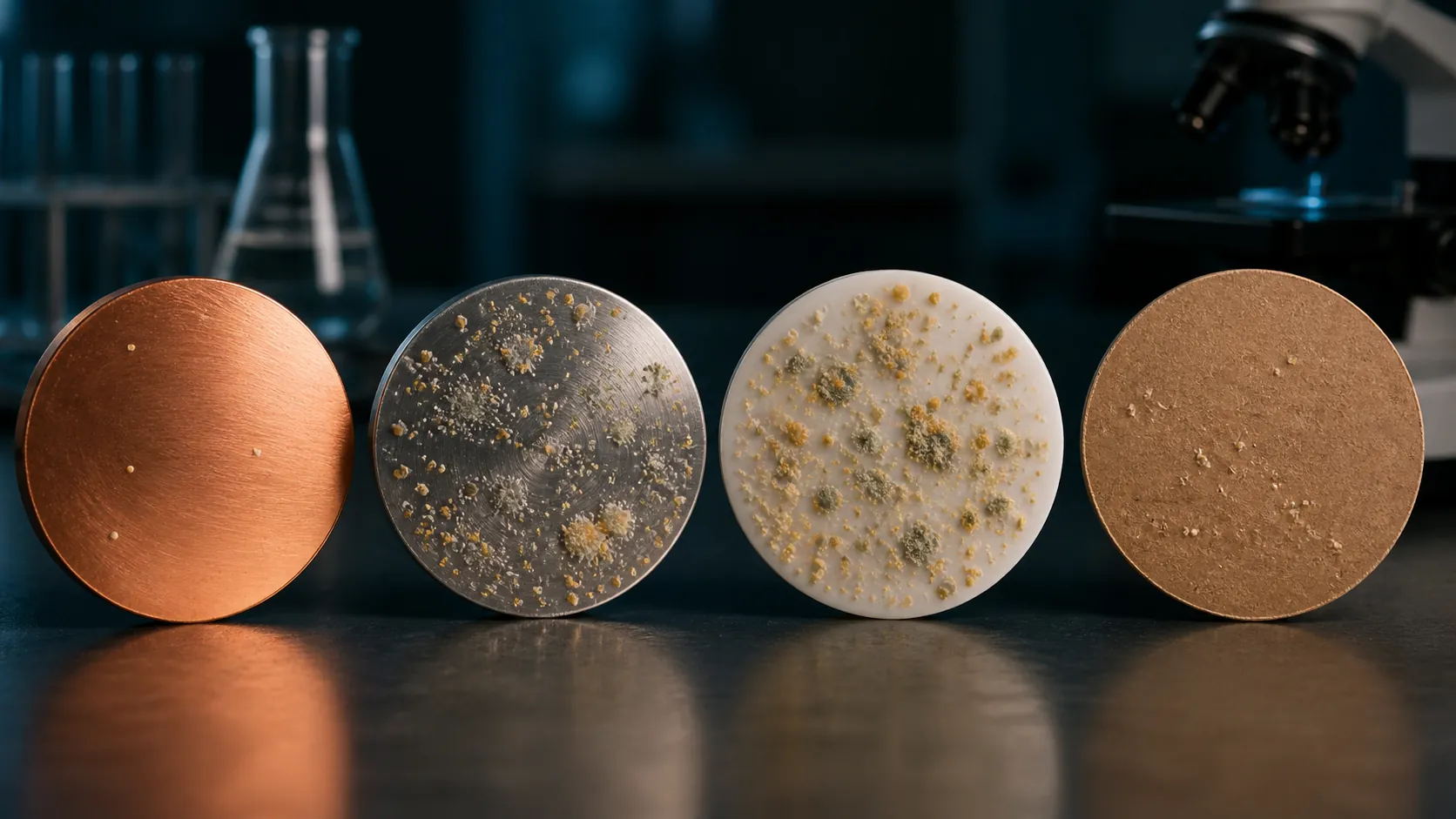
That is why a clean number like “SARS-CoV-2 survives 72 hours on plastic” has to stay attached to its method: van Doremalen et al. found viable SARS-CoV-2 up to 72 hours on plastic and stainless steel, up to 24 hours on cardboard, and no viable virus after about 4 hours on copper, under 21–23 °C and 40% relative humidity conditions.[1]
A survival table worth memorizing, with the method still attached
For MCAT study, this table is more useful than a pile of isolated factoids. Read it as a ranked pattern: hardy Gram-positive bacteria and spores last a long time; non-enveloped viruses tend to outlast enveloped viruses; copper alloys shorten survival dramatically; and every range is a recovery result under specified or reviewed conditions.
| Organism or group | MCAT-useful pattern | Source-labeled survival result | Method note to keep attached |
|---|---|---|---|
| S. aureus and enterococci-style Gram-positive bacteria | Often among the longest-persisting bacteria on dry surfaces | Wißmann et al. compiled S. aureus survival on plastics from 21 days to more than 3 years and on stainless steel from 6 hours to more than 6 weeks; Porter et al. reported S. aureus from less than 1 minute to 318 days.[2][3] | These are review ranges across different experiments, not one unified experiment. |
| C. difficile | Spore-forming biology makes long persistence unsurprising | Porter et al. reported C. difficile survival up to 140 days.[3] | Treat this as a spore/persistence pattern, not as a universal surface-cleaning clock. |
| E. coli, Salmonella, Klebsiella, Acinetobacter | Gram-negative bacteria are not automatically fragile; some persist for weeks or longer under favorable conditions | Wißmann et al. compiled E. coli on plastics from 24 hours to more than 300 days and Salmonella on stainless steel from less than 1 day to more than 6 weeks; Porter et al. reported E. coli up to 56 days, K. pneumoniae up to 600 days, and Acinetobacter up to 90 days.[2][3] | Wide ranges usually mean different inocula, surfaces, humidity, nutrients, and detection methods. |
| Norovirus and calicivirus surrogates | Non-enveloped viruses are structurally tougher than enveloped viruses | Barclay et al. state that norovirus may remain infectious on environmental surfaces for about 2 weeks; Wißmann et al. compiled calicivirus/norovirus surrogate survival on stainless steel from less than 1 day to more than 168 days.[2][4] | Human norovirus survival data are often surrogate-based because human norovirus has historically been difficult to culture in vitro. |
| Influenza A | Enveloped virus; lipid envelope makes it more environmentally fragile than non-enveloped viruses | Wißmann et al. compiled influenza A survival on stainless steel from 6 hours to 2 weeks.[2] | The upper end does not erase the envelope-fragility pattern; it points back to experimental conditions. |
| Copper, brass, and bronze antimicrobial surfaces | Surface material can collapse survival from days into hours or less | The Copper Development Association reports EPA-registered copper, brass, and bronze alloys kill more than 99.9% of MRSA, VRE, S. aureus, and E. coli O157:H7 within 2 hours; Grass et al. describe about a 7–8 log reduction per hour on copper.[5][6] | This is a surface-effect result. Do not generalize it to stainless steel, plastic, or cardboard. |
| SARS-CoV-2 | Enveloped virus, but reported surface survival varies sharply with the experimental setup | Van Doremalen et al. found viable virus up to 72 hours on plastic and stainless steel, up to 24 hours on cardboard, and no viable virus after about 4 hours on copper; Porter et al. reported a maximum of about 2 days; a Xu 2023 review discusses Riddell 2020 results reporting up to 28 days at 20 °C under high-titer conditions.[1][3][7] | This conflict is the lesson: temperature, inoculum, surface, humidity, and recovery method can change the answer. |
The table gives you a memory scaffold, not a household certainty. If an MCAT-style passage gives a survival graph, the safest first move is not to ask whether the number matches something you memorized. Ask what the number measured.
Why the pattern makes biological sense
Gram-positive bacteria such as S. aureus have a thick peptidoglycan cell wall, and many clinically important Gram-positive organisms tolerate drying better than a student might expect. That does not mean all Gram-positive bacteria behave identically, but it explains why S. aureus and enterococci belong near the top of the “could persist for days to months” mental category.
C. difficile deserves separate attention because spores change the question. A spore is not just a slightly tougher vegetative bacterial cell. It is a dormant survival form built to resist environmental stress. When a passage pairs “spore-forming” with long persistence, that is not trivia; it is structure-function reasoning.
The virus contrast is just as testable. Enveloped viruses, including influenza and SARS-CoV-2, carry a lipid envelope that helps with host-cell entry but is vulnerable outside the host. Non-enveloped viruses, including norovirus, lack that lipid envelope and are often more resistant to drying and environmental stress. That is why norovirus-style persistence belongs in a different mental bucket from influenza-style persistence.
Surface type matters because microbes are not sitting on an abstract plane. Stainless steel and plastic are non-porous surfaces where organisms can remain recoverable for long periods in many lab studies. Cardboard and other porous materials can reduce recoverable virus faster in some SARS-CoV-2 experiments, but Porter et al. also report cases where some pathogens survived longer on porous surfaces.[1][3] That is not a contradiction to memorize away. It is a warning that “porous versus non-porous” is a strong passage variable, not a law that always points in one direction.
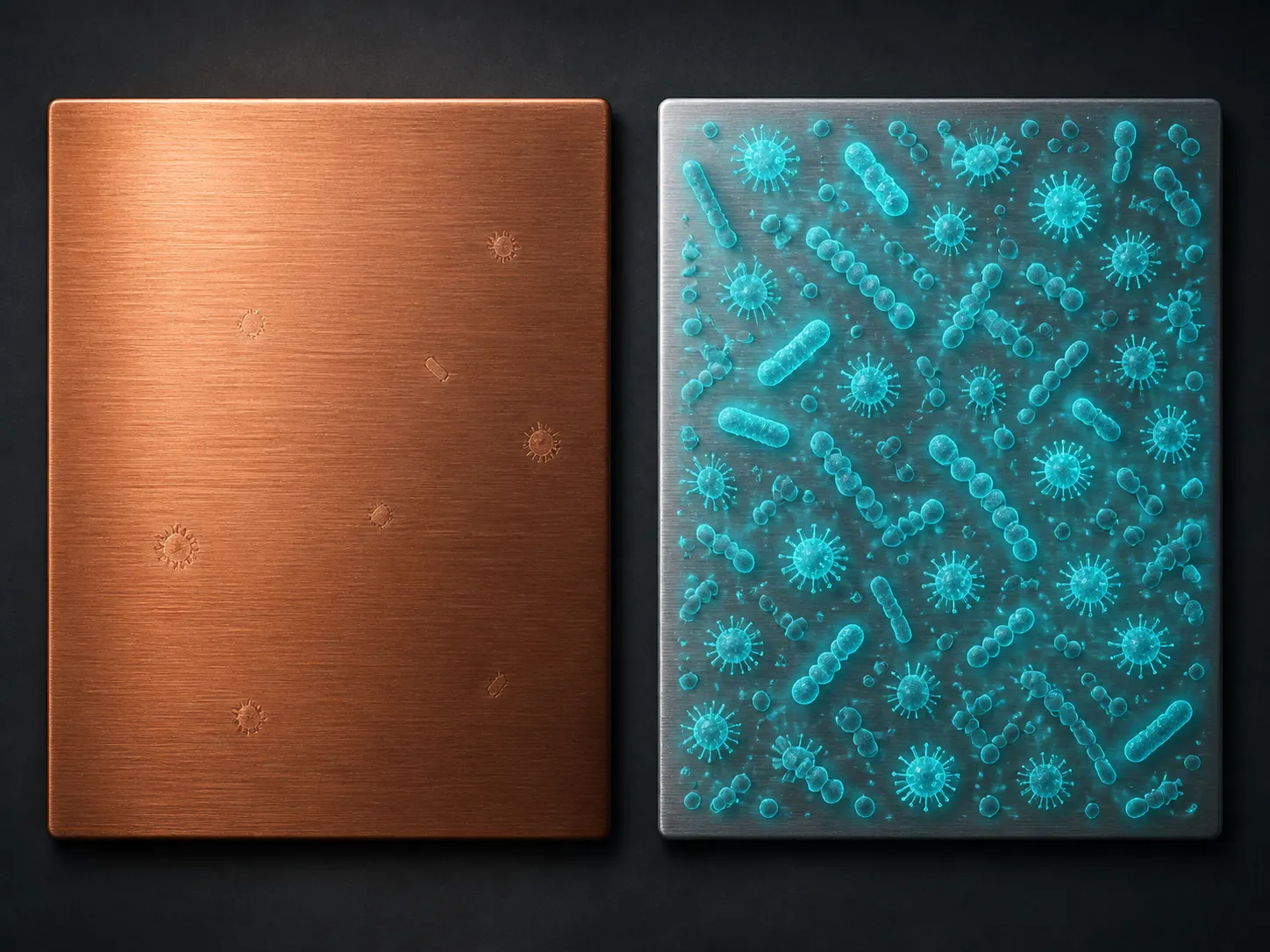
Copper is the cleanest surface-material contrast in the evidence here. Copper alloys are not just another dry surface; copper ions and reactive chemistry damage microbial membranes, proteins, and nucleic acids. For exam purposes, copper is the surface that should make you expect faster loss of viability, especially compared with stainless steel or plastic.
What an MCAT passage can actually test
The MCAT is unlikely to reward memorizing one unsupported survival time. The exam-relevant skills are the same ones used across microbiology, experimental design, and data interpretation: identify the independent variable, track the dependent variable, distinguish detection from viability, and notice whether a comparison is controlled.
If you are organizing this with other exam notes, connect it to the broader MCAT hub, the adjacent Bacillus cereus MCAT microbiology article, and the site’s survival-analysis concepts. Surface survival studies are, at their core, survival-curve studies.
In a van Doremalen-style setup, the passage might place virus on several surfaces, recover samples at time points, culture viable virus, and fit an exponential decay curve. A one-log reduction means a 90% reduction from the previous reference level; a two-log reduction means 99%; a three-log reduction means 99.9%. That arithmetic matters more than the brand name of the organism if the question asks which surface caused the steepest decline.
A good passage question can also ask whether two survival curves are comparable. If one experiment used a high starting titer at lower temperature and another used a lower inoculum under warmer or drier conditions, the longer survival time does not automatically mean the organism is intrinsically tougher. It may mean the experiment gave it more favorable conditions or started with more recoverable material.
Recovered signal is not the original surface load
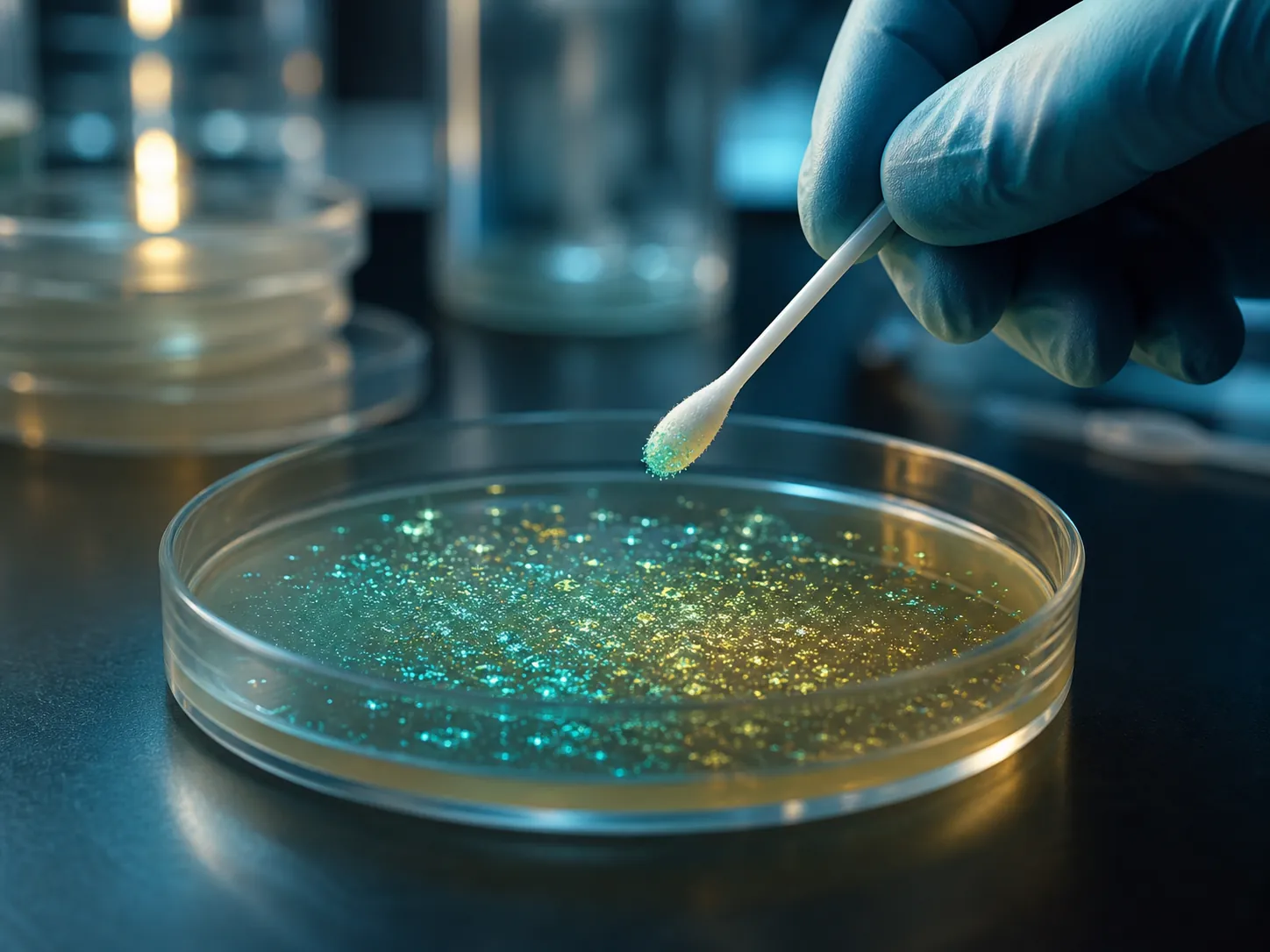
This is the caveat students miss when they quote survival numbers as if the lab recovered everything that was ever present. Castaño et al. reported that swab collection recovered only 16–38% of applied bovine coronavirus RNA and a median of about 40% for MS2.[8] That does not make the study useless. It tells you what the measured value is: recovered signal after a sampling method, not the true total amount originally on the surface.
That distinction can flip an answer choice. If a passage says a surface sample was negative after swabbing, the most careful conclusion is not always “no microbe was present.” It may be “no viable or detectable microbe was recovered by this method at this time point.” The wording is less dramatic, but it is experimentally honest.
The same logic shows up in other MCAT-style data passages. Ancient-DNA and contamination questions ask whether a signal reflects the original specimen or the recovery process; clinical-trial passages ask whether a negative result means no effect or insufficient evidence under the study design. If you want practice with that habit, use the site’s ancient-DNA data-interpretation examples, ancient-DNA study planner, and research-design passage on negative results.
How to store this in memory for test day
- Longest-persistence bacterial bucket: S. aureus, enterococci-style Gram-positive organisms, and especially spore-formers such as C. difficile.
- Do not assume Gram-negative means short-lived: E. coli, Salmonella, Klebsiella, and Acinetobacter can persist for long periods in some reviewed experiments.
- Virus structure matters: non-enveloped viruses such as norovirus are generally hardier than enveloped viruses such as influenza and SARS-CoV-2.
- Surface material matters: stainless steel and plastic often preserve recoverable organisms longer than copper; porous versus non-porous comparisons depend on the study.
- Copper and copper alloys are the fast-inactivation contrast: minutes to a few hours is the pattern to recognize, not a generic “metal surface” rule.
- Any surprising number should trigger method questions: starting inoculum, temperature, humidity, surface, sampling efficiency, detection method, and whether the study measured viable organisms or genetic material.
Transmission-route reasoning belongs nearby. A pathogen can persist on a surface without that surface being the dominant route of infection. Conversely, a short survival time under one lab condition does not prove surface transmission is impossible. For MCAT purposes, keep surface survival connected to organism structure, environmental stability, and transmission concepts, the same way you would in a passage on microbe transmission and disease biology.
So the answer to “how long bacteria live on surfaces” is not one number. The useful memory is a ranked pattern plus a measurement habit: long persistence points you toward organism structure, surface type, and environmental conditions; a dramatic survival claim should make you ask how much was applied, how it was recovered, whether it was still viable, and what the experiment could actually measure.
References
- Aerosol and Surface Stability of SARS-CoV-2 as Compared with SARS-CoV-1, New England Journal of Medicine, 2020
- Persistence of Pathogens on Inanimate Surfaces: A Narrative Review, Microorganisms, 2021
- How long do nosocomial pathogens persist on inanimate surfaces? A scoping review, Journal of Hospital Infection, 2024
- Infection control for norovirus, Clinical Microbiology and Infection, 2014
- Antimicrobial Copper, Copper Development Association
- Metallic Copper as an Antimicrobial Surface, Applied and Environmental Microbiology, 2011
- Survival of SARS-CoV-2 in the environment: A review, 2023
- Fomite transmission and disinfection strategies for SARS-CoV-2 and related viruses, 2021
Related exhibits & inventory
Verified outcomes
Planners
No planner filed for this exam yet
A downloadable timeline template for this exam hasn't been published yet.
Tool verdicts
Questions about this plan
Ask a question about a specific section, timeline, or citation in this plan — or flag something that needs correcting.
Comments
Join the discussion with an anonymous comment.