
MCAT Exam Hub
Forensic Genetics Case Studies for MCAT Students
The landmark DNA cases—Pitchfork, Dotson, and the Golden State Killer—map onto the MCAT genetics and biotechnology concepts they illustrate: RFLP, PCR, STR/CODIS analysis, and match probability. Use each case as a memory anchor and practice the passage-style reasoning these items demand.
- gre
- mcat
- asvab
- sat
- act
- digital-adaptive
- official-material
- section-strategy
- test-date-timeline
A forensic genetics case study for students is useful on the MCAT only if the story collapses into a testable move: identify the DNA method, notice the sample condition, read the profile correctly, and keep the probability claim in its lane. The dramatic detail is the hook. The content item is the score.
That matters because genetics is not a decorative side topic in Biological and Biochemical Foundations review. Princeton Review, as a third-party prep source rather than an AAMC statistic, frames genetics as roughly 10% of the MCAT B/B section, or about 5–6 questions [1]. Jack Westin’s AAMC-aligned content outline also places RFLP and STR analysis under practical applications of DNA technology and points students toward specific AAMC practice items involving those ideas [2]. Treat those as prep-map signals, not official section blueprints.
| Case or cue | MCAT content item | What the passage is likely testing | Limit to check |
|---|---|---|---|
| Colin Pitchfork | RFLP DNA profiling | Restriction digest and band-pattern comparison; DNA can exclude a suspect as well as implicate one. In the Pitchfork case, DNA testing first excluded the initial primary suspect before being used in the first DNA-profile conviction [3]. | RFLP depends on interpretable fragment patterns and is poorly suited to heavily degraded DNA. |
| Gary Dotson | PCR on degraded biological evidence | PCR’s biochemical advantage: amplifying a target sequence from an old or limited sample. Northwestern Law’s case profile describes Alec Jeffreys’ RFLP test failing on a decade-old degraded stain in April 1988, followed by Edward Blake’s PCR test excluding Dotson on August 15, 1988 [4]. | “DNA test” is too vague. Ask whether the method requires intact fragments or can amplify a small target. |
| STR/CODIS profile | Short tandem repeats, database matching, Hardy-Weinberg/product-rule probability | A profile is a set of alleles across loci. Nature Education’s older 13-STR CODIS example gives a profile frequency near 1 in 575 trillion for two unrelated Caucasians, while using only 4 loci changes the frequency to around 1 in 331 [5]. | That 13-locus figure is an older CODIS-context teaching example, not a current full-panel number. |
| Golden State Killer | SNP-based genetic genealogy | Public genealogy databases and family-tree inference. The Golden State Killer was identified in April 2018 using genetic genealogy rather than a standard CODIS STR match [6]. | A genealogy lead is not the same inference as a direct forensic STR database hit. |
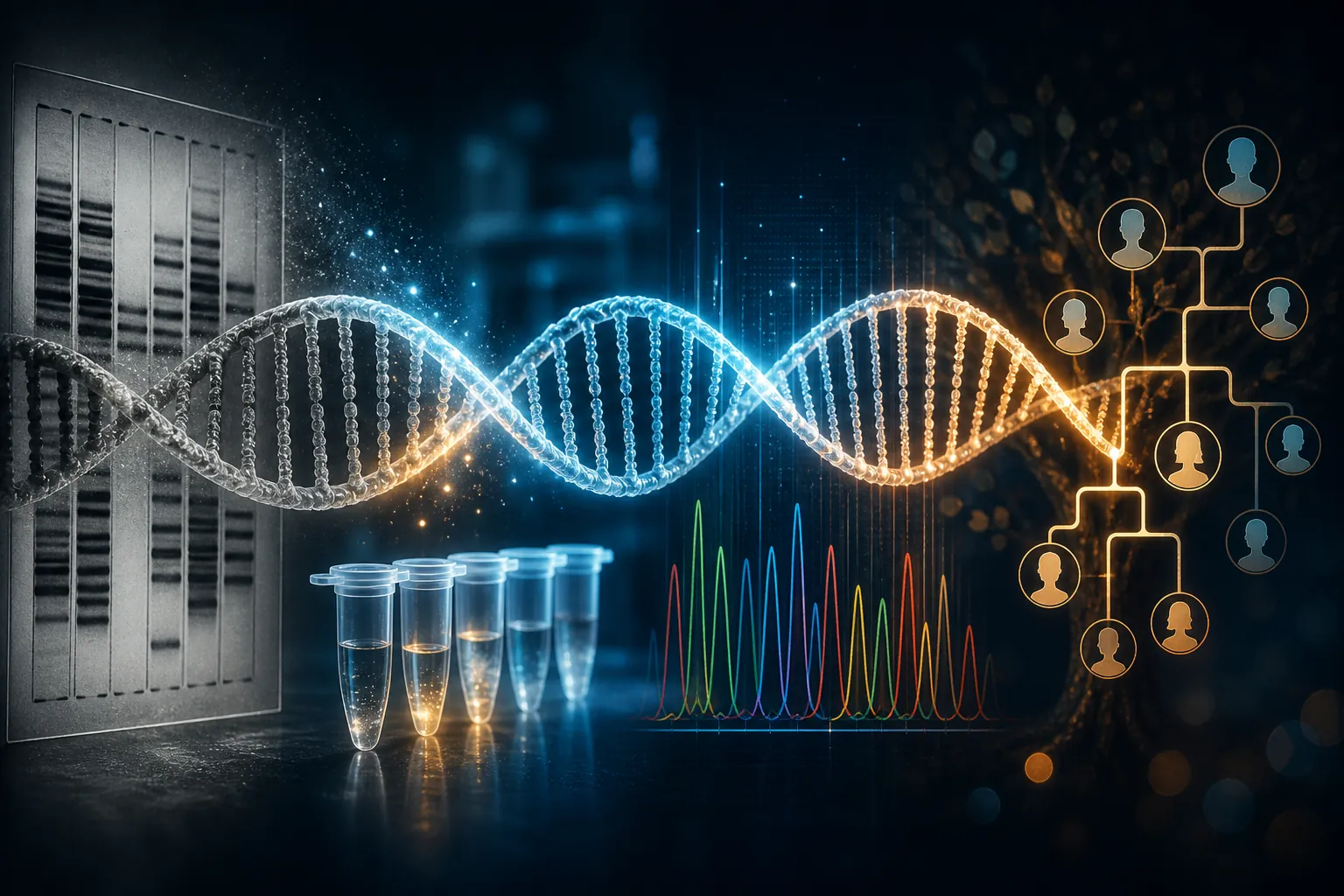
Keep that table in mind as the operating map. The cases are not four equally important crime stories. Pitchfork gives you the first DNA-profiling anchor. Dotson gives you the cleanest RFLP-versus-PCR contrast. STR/CODIS gives you the probability math. Golden State Killer gives you a boundary: genetic genealogy is related to forensic genetics, but it is not the same thing as CODIS matching.
Pitchfork: DNA profiling can exclude before it convicts
The Colin Pitchfork case is usually remembered as the first conviction obtained through DNA profiling, and that is a fair memory anchor. For MCAT use, the more valuable detail is that DNA testing first cleared the initial primary suspect. NLM’s account of Alec Jeffreys and the Pitchfork murder case describes DNA profiling being used to show that the person who had confessed was not the source of the biological evidence [3].

That is the first useful correction for students: a match is not the only meaningful DNA result. An exclusion can be just as decisive for a passage question. If the passage gives evidence DNA and a suspect sample and asks what conclusion follows, the answer may be “this suspect is excluded,” not “the test failed” or “the suspect is less likely.”
The technology cue is RFLP, or restriction fragment length polymorphism. In the simplified exam version, restriction enzymes cut DNA at particular sequences, variable regions produce fragments of different lengths, and the fragments are separated into a banding pattern that can be compared across samples. Nature Education’s overview of DNA fingerprinting and CODIS places RFLP in the earlier DNA-profiling toolkit before STR-based profiling became the standard teaching example for database matching [5].
The passage trigger is usually physical rather than legal: visible bands, restriction enzymes, fragment lengths, autoradiograph-style output, or an older DNA-profiling method. The limitation follows from the same mechanism. If the DNA is old and fragmented, a method that depends on interpretable long-fragment patterns is in trouble.
Dotson: the clean RFLP-versus-PCR contrast
Gary Dotson’s case is the one to slow down for. Northwestern Pritzker School of Law’s Center on Wrongful Convictions describes the testing sequence this way: in April 1988, Alec Jeffreys’ RFLP testing could not obtain a result from a decade-old degraded semen stain; on August 15, 1988, Edward Blake’s PCR testing excluded Dotson; on August 14, 1989, his conviction was vacated, making the case the first U.S. DNA exoneration in that account [4].
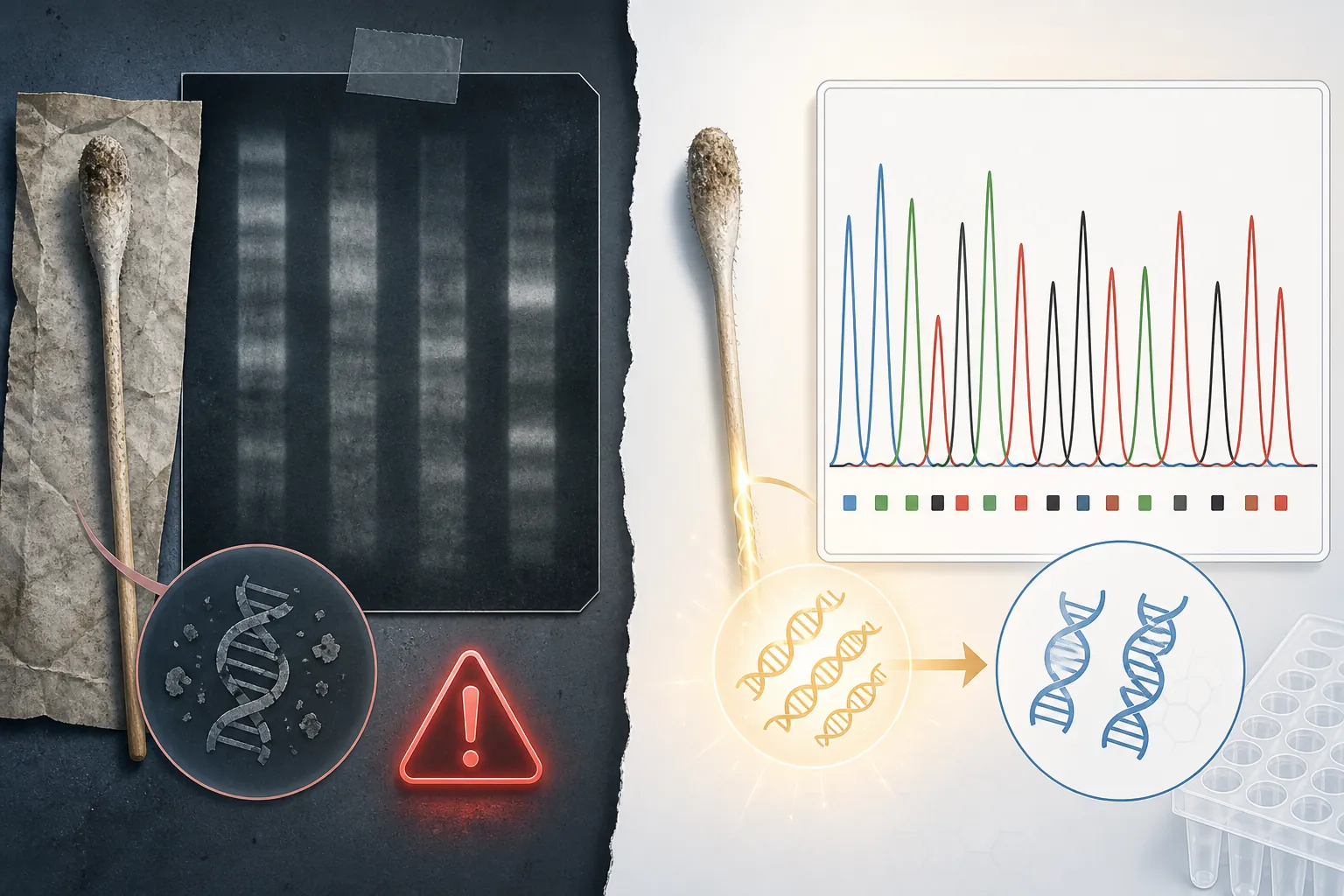
This is where “newer DNA method” is not a sufficient explanation. PCR changed the sample problem. RFLP asks whether the sample can still produce interpretable restriction-fragment patterns. PCR asks whether a chosen DNA target can be copied enough times to analyze. If the target region is present and the reaction conditions work, PCR can make many copies from a small amount of starting material.
Mechanistically, PCR cycles through denaturation, primer annealing, and extension. That is standard MCAT biotechnology material, but Dotson gives it a forensic reason to matter. The sample was old and degraded. A method requiring longer intact fragments failed. A method that amplified a target sequence could still produce an exclusion.
Do not overlearn the case into the wrong rule. PCR is not magic. A degraded sample can still be too damaged, too contaminated, or missing the target region needed for the assay. The lesson is narrower and more testable: when a passage emphasizes old, limited, or degraded DNA and then asks which technique improves analysis, PCR has a biochemical advantage because amplification changes the amount-of-template problem.
| Passage phrase | Better MCAT translation |
|---|---|
| “Decade-old biological stain” | Think sample degradation and limited intact DNA. |
| “Restriction fragments could not be interpreted” | Think RFLP limitation. |
| “Primers were used to amplify the target” | Think PCR mechanism, not just “DNA testing.” |
| “The suspect was excluded” | Think genotype/profile inconsistency with the evidence sample. |
STR/CODIS: the case work becomes probability work
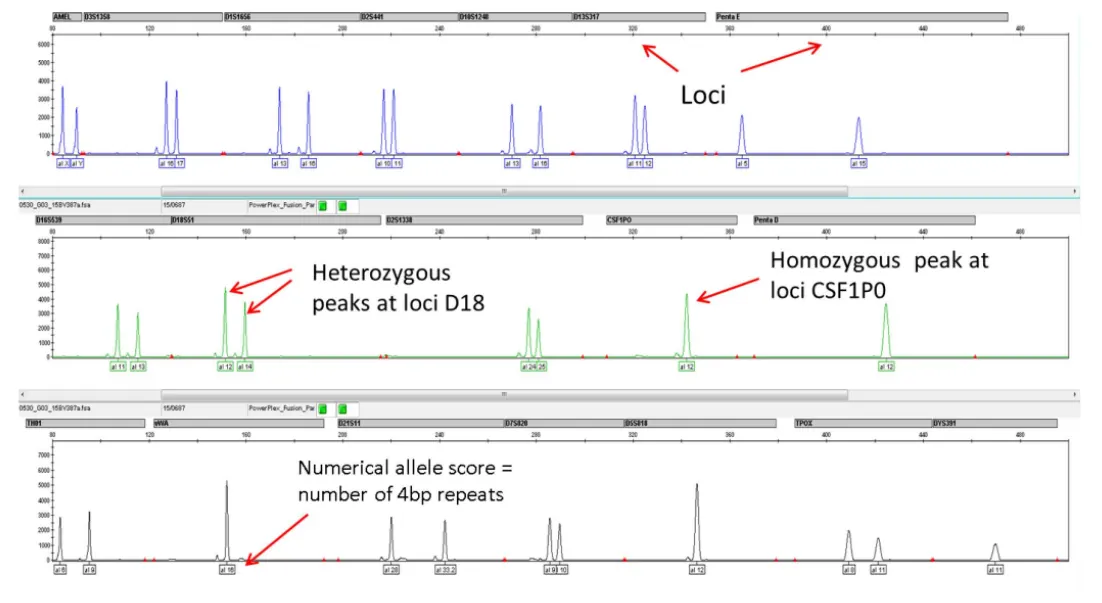
STR analysis is where many students lose the tested point because the words sound legal: database, hit, match, suspect. On the MCAT, the better translation is genetic markers plus probability. An STR locus contains a short repeated sequence, and people can differ in how many repeat units they carry at that locus. A forensic STR profile records alleles across multiple loci, then compares that profile to another sample or to a database profile.
Nature Education’s CODIS discussion is useful, but it needs a date label. It reports that, as of February 2007, CODIS had produced more than 45,400 hits assisting more than 46,300 investigations [5]. Those are historical adoption figures from that article, not current CODIS totals. Adoption tells you the method was widely used; it does not by itself tell you that every individual interpretation is simple.
The most MCAT-friendly part of the same source is the contrast between a full teaching-profile calculation and a small-locus calculation. Nature Education gives an older 13-STR profile frequency of about 1 in 575 trillion for two unrelated Caucasians, but warns that using only 4 loci changes the frequency dramatically to about 1 in 331 [5]. The numbers are memorable because they punish a common shortcut: “some loci matched” is not equivalent to “a highly discriminating profile matched.”
How to read the product-rule logic
At one locus, Hardy-Weinberg reasoning gives expected genotype frequencies from allele frequencies. If an allele has frequency p and another allele has frequency q, the expected heterozygote frequency is 2pq; a homozygote frequency is p². A profile across multiple independent loci is then handled by multiplying the relevant genotype frequencies across loci. That multiplication is the product rule.
Profile frequency ≈ (genotype frequency at locus 1)
                  × (genotype frequency at locus 2)
                  × (genotype frequency at locus 3)
                  × ...
                  × (genotype frequency at locus n)
That equation is why the number of loci matters so much. If each locus adds another independent comparison, the combined profile frequency can become very small. Remove most of the loci, and the combined profile becomes far less discriminating. The Nature Education contrast between 13 loci and 4 loci is not just trivia; it is a worked warning about multiplying too few terms [5].
Two limits are especially testable. First, the profile frequency is not the probability that the defendant is guilty. It is a statement about how common that profile is in a defined reference population under the assumptions of the calculation. Second, the population label matters. Nature Education’s example specifically states “two unrelated Caucasians,” so do not silently generalize the value to every population or every database context [5].
| Claim in a passage | What to verify before accepting the inference |
|---|---|
| “The profile is rare.” | Rare under which reference population and which loci? |
| “The suspect matched at several loci.” | How many loci, and were they the intended forensic panel? |
| “The random match probability is 1 in X.” | Is X a profile frequency, not a guilt probability? |
| “The database produced a hit.” | Is this a direct STR profile match or only an investigative lead? |
Golden State Killer: genealogy is not CODIS with a bigger database
The Golden State Killer case is useful precisely because it is easy to misfile. Forbes’ account describes the suspect being identified in April 2018 through genetic genealogy using public DNA databases [6]. That is not the same inferential path as a standard CODIS STR profile match.
In a CODIS-style STR question, the passage usually gives loci, alleles, electropherogram peaks, or a match statistic. In a genetic-genealogy question, the passage is more likely to talk about SNPs, distant relatives, public genealogy databases, and family-tree construction. The first is built for direct forensic profile comparison. The second uses shared inherited segments to generate investigative leads through related people.
That distinction is enough for MCAT purposes. Do not turn Golden State Killer into a whole separate true-crime unit. Use it as the boundary marker: if the passage says relatives and genealogy database, do not answer as though it is asking for the STR/CODIS product-rule calculation.
The limits are often the tested content
Forensic DNA evidence is powerful, but the MCAT loves the edge of the claim. Learn.Genetics’ forensic module frames DNA evidence as something that can support, challenge, or complicate a verdict rather than automatically producing one [7]. That is the correct posture for passage reasoning: read the data, then read the size of the inference.
- Exclusion is not a weak result. If the evidence profile and suspect profile are inconsistent at a required locus, the suspect can be excluded as the source of that sample.
- A match statistic is not a verdict statistic. A random match probability or profile frequency describes the expected rarity of a profile under stated assumptions.
- A database hit is not the same as final identification. It can be an investigative lead that still needs context and confirmation.
- Old CODIS numbers are old CODIS numbers. If an article gives 2007 hit totals or a 13-locus teaching calculation, use them for the concept, not as current administrative facts.
- A method’s advantage is conditional. PCR helps when an amplifiable target remains; it does not erase contamination, mixture, or interpretation problems.
Mixtures deserve one extra pause. NIST explains that DNA mixtures occur when a sample contains DNA from more than one person, which makes interpretation more complex than reading a single-source profile [8]. If a passage introduces multiple contributors, low-template DNA, or overlapping peaks, the tested issue may shift from “which profile matches?” to “what can be inferred from uncertain or mixed signal?”
Use the cases as passage triggers
A good case anchor should make the next step faster. When you see restriction enzymes and band patterns, think Pitchfork and RFLP. When you see an old degraded stain, think Dotson and PCR. When you see STR loci and a database match, think CODIS and product-rule probability. When you see public genealogy databases and relatives, think Golden State Killer and SNP-based genetic genealogy.
Then answer the actual question in front of you. A method question wants the technique. A sample-condition question wants the limitation. A probability question wants Hardy-Weinberg and multiplication across loci. An interpretation question wants the difference between source, profile frequency, match, exclusion, and guilt.
If this case-to-passage style helps, use the same reading pattern on other StudyMethod MCAT examples: the Chilean mummy smallpox DNA study for ancient-pathogen DNA reasoning and the Renaissance murder mystery SIRS practice passage for another example of turning a vivid case into a controlled B/B passage task.
For drilling, route back through the MCAT exam hub and use MCAT Study Tools in 2026 to choose question-bank practice. The goal is not to remember every case detail. It is to see the tested DNA method quickly, state the warranted inference, and catch the limitation before the answer choices do it for you.
References
- 15 Genetics Topics You Need to Know for the MCAT — Princeton Review.
- Practical Applications of DNA Technology — Jack Westin MCAT Content.
- Alec Jeffreys and the Pitchfork murder case — NLM Visible Proofs.
- First DNA Exoneration — Gary Dotson — Northwestern Pritzker School of Law.
- Forensics, DNA Fingerprinting, and CODIS — Nature Education/Scitable.
- How Genetic Genealogy Helped Catch The Golden State Killer — Forbes, June 30, 2020.
- Can DNA Demand a Verdict? — Learn.Genetics, University of Utah.
- DNA Mixtures: A Forensic Science Explainer — NIST.
Related exhibits & inventory
Verified outcomes
- not-score-proven → not-score-proven
When to Do HIIT for Better Memory and Exam Focus
- No baseline score reported → No verified final scoreLimited
Can NYT Strands Daily Actually Build Vocabulary?
- pre-final grades → 0.65 SD higher
A Sleep-First Routine to Stop Falling Asleep While Studying
- Not a score log → Not a score logModerate
Does Air Quality Affect Study Focus? Yes — by How Much?
Planners
Tool verdicts
A lesson substitute only for motivated adult beginners with MIDI keyboards focused on songs; otherwise a supplement.
Monthly $19.99; 6-month $83.94; annual ~$119.88-$120; checked 2026-08-27EvidenceModeratePixel 11 Pro is the cheaper study-app buy for flashcard-heavy students; iPhone 17 Pro only for notes-first Apple users.
$1,099/256GB each; AnkiMobile $24.99 iOS vs AnkiDroid free; checked 2026-08-26EvidenceModerateGalaxy S26 Ultra offers the more complete out-of-box exam-prep workflow; Pixel 11 Pro suits students who prefer assembling their own study stack.
Pricing not included in this workflow comparison (2026-08-26)EvidenceModerate
Questions about this plan
Ask a question about a specific section, timeline, or citation in this plan — or flag something that needs correcting.
Comments
Join the discussion with an anonymous comment.