
MCAT Exam Hub
How to Map the Chilean Mummy Smallpox DNA Study for MCAT
Practice reading a dense primary study like an MCAT science passage, using the new Chilean mummy smallpox DNA research as a worked example. You'll end with a repeatable drill for extracting hypothesis, evidence, and limitations under timed conditions.
- gre
- mcat
- asvab
- sat
- act
- digital-adaptive
- official-material
- section-strategy
- test-date-timeline
If you came here looking for “Chilean mummies smallpox DNA study notes,” the useful move is not to memorize a new smallpox story. The useful move is to practice mapping a dense paper before it maps you. MCAT science passages reward the same habit: find the claim, locate the experiment that bears the weight, keep the numbers attached to what they actually measure, and notice the limitation before an answer choice turns it into a trap. Jack Westin’s passage-reading advice frames this as prep strategy, not biology: the job is to locate key terms and relationships under pressure rather than treat the passage like a chapter you are expected to know in advance.[1]

The Chilean mummy paper is a good drill precisely because it is tempting. It has ancient DNA, colonization, calibrated dates, viral evolution, disputed interpretation, and human loss in the background. That is exactly the kind of material that can make a strong student spend four minutes “understanding the topic” while missing the two sentences that decide the question.
First-minute orientation: what this study is, and what it is not
| Field | What to write in your margin |
|---|---|
| Paper | Romero González et al., “The genomic identity of early smallpox in South America,” published in Science on July 30, 2026.[2] |
| Site | Camarones 9, an archaeological site in northern Chile.[2] |
| Samples | Thirteen bone samples screened; two femur samples were positive for variola virus DNA.[2] |
| Lineage name | CAM9.[2] |
| Basic claim | The authors report ancient smallpox genomes from South America and argue that the evidence supports introduction during European colonization, while keeping important limitations in view.[2] |
| How news coverage framed it | Nature described the work as the first genomic evidence pointing to Europeans in the question of how smallpox reached the Americas; other reporting similarly emphasized the apparent first ancient smallpox genomes from the Americas.[3][4] |
That table is enough. Do not expand it into a smallpox history review. The historical background matters, but for passage purposes it is not the same as evidence generated by this study. The paper cites historical literature estimating 3–4 million smallpox deaths in the Americas and about 300 million deaths in the 20th century; those figures are context, not measurements from the mummy DNA.[2]
There is also a research-integrity reason not to flatten the study into a clever exam exercise. The work concerns human remains from a history of epidemic disease and colonization, and the institutional release foregrounded comments from Constanza de la Fuente Castro about the care required in interpreting and communicating that evidence.[5] For MCAT practice, that means you can be efficient without being careless: narrow claims are not less interesting; they are more honest.
The passage map
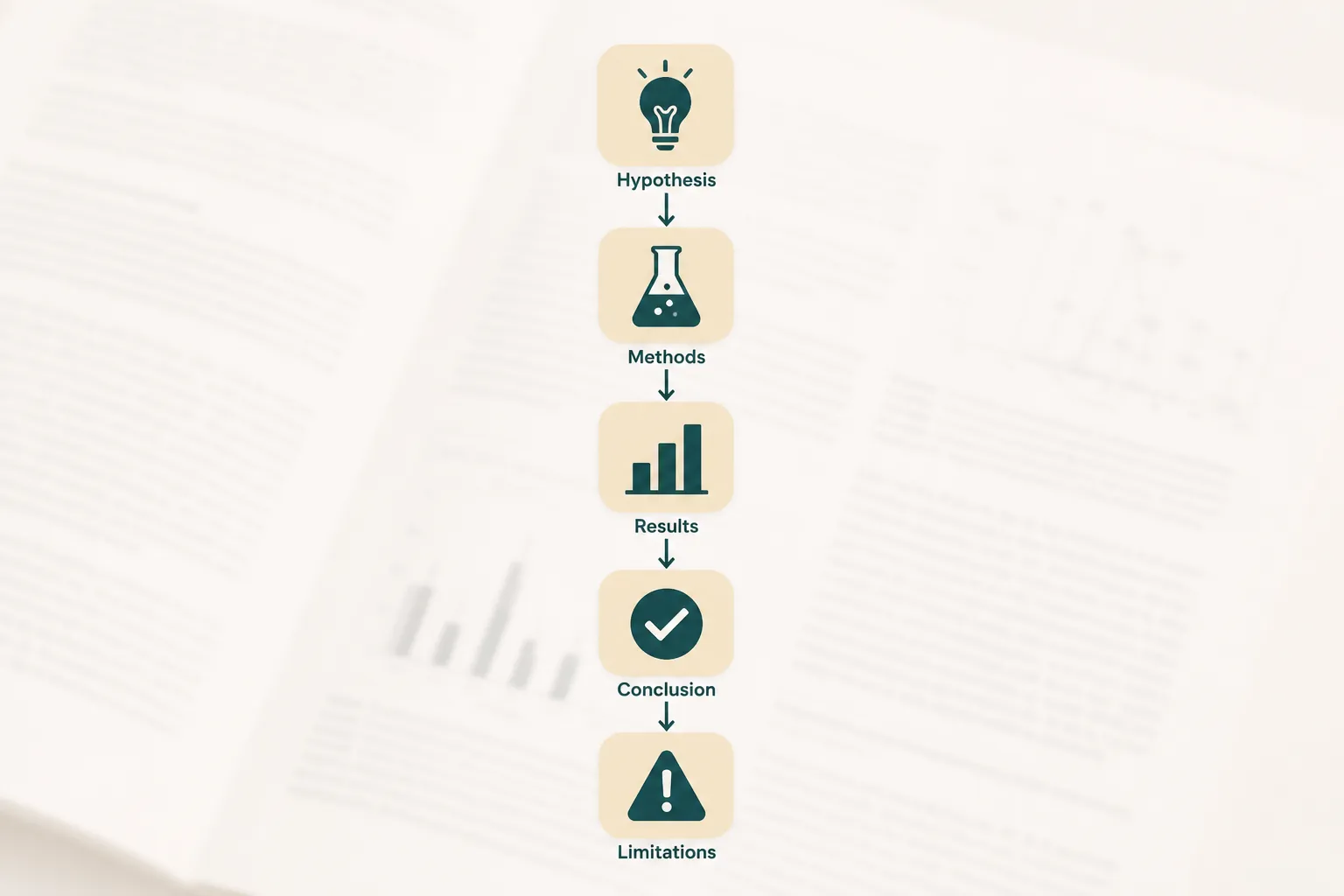
For a primary paper, the order you impose matters more than the order in which your curiosity fires. Use the same spine every time: hypothesis, methods, results, conclusion, limitations. If a paragraph does not fit one of those boxes, it may still be meaningful, but it is less likely to decide a data-based answer choice.
Hypothesis: smallpox arrived with European colonization
The study’s main historical hypothesis is not simply “smallpox devastated the Americas.” That broader statement sits in the background. The narrower testable claim is that the smallpox virus represented by these genomes reached the Americas in connection with European colonization.[2]
That wording matters. If an answer choice says the study proves the total mortality burden of smallpox in the Americas, it has already left the paper’s evidence. If it says the genomic findings are consistent with introduction after European contact, it is much closer to the actual support.
Methods: two positive femur samples carry the whole genomic argument
The authors screened 13 bone samples from the Camarones 9 site and detected variola virus DNA in two femur samples.[2] That is the first number to box because it controls the scope of every later inference. The study is not a broad prevalence survey of smallpox across South America. It is a genomic analysis built from two positive ancient samples.
The coverage contrast is the next load-bearing detail: one genome had 84.851x average coverage, while the other had 3.206x.[2] Those are not decorative technical values. In passage logic, they tell you that the two positives are not equally strong reconstructions. If a question asks why the authors had more confidence in one assembly than the other, coverage is where the answer lives.
The authors assembled an 188,890-base-pair variola genome and reported 49 inactivated genes.[2] For MCAT purposes, do not try to memorize the gene count as trivia. Mark what the number is doing: it characterizes the recovered viral genome and becomes relevant only if a question asks about genome identity, comparison, or functional interpretation.
Results: the dates, similarity, and ancestry analysis do the evidentiary work
The two recovered genomes were 99.912% identical.[2] That number supports the idea that the samples belong to the same local viral lineage rather than two unrelated detections. It does not, by itself, date the arrival of smallpox in the Americas.
The first load-bearing date is the calibrated death window for the two individuals: 1492–1631 CE.[2] That window overlaps the period after European arrival in the Americas. This is why the timing evidence supports a colonization-associated introduction. The answer-choice trap is to confuse the date of death with the date when the viral lineage first evolved.
The second load-bearing date is the estimated divergence of the CAM9 lineage: about 1296 CE, with a 95% highest posterior density interval of 1124–1460 CE.[2] That estimate places the lineage’s divergence before 1492, but the paper’s interpretation still depends on sampling, phylogenetic placement, and the absence of better comparative genomes from the right places and times. A pre-1492 divergence estimate is not the same thing as proof that smallpox was present in the Americas before 1492.
The ancestry analysis also has to be kept in its lane. The authors reported no detectable European ancestry by D-statistics in the two individuals, and the mitochondrial DNA haplogroups were A2+(64) and B2.[2] That supports the conclusion that the sampled individuals themselves did not show detectable European ancestry. It does not tell you who physically transmitted the virus, nor does it turn a genomic result into a complete social history of infection.
Conclusion: supported, but not unlimited
A careful passage answer would say that the CAM9 genomes support historical accounts that smallpox reached the Americas through European colonization. Lizzie Wade’s Science news coverage used that framing, Nature similarly emphasized the genomic evidence pointing to Europeans, and ScienceAlert leaned into the clarity of the ancient-DNA evidence for who brought smallpox to the Americas.[6][3][8] AP coverage also treated the mummy DNA as evidence bearing on how smallpox reached the Americas, not as a stand-alone history of every epidemic that followed.[4]
The paper’s own limitations are not a footnote; they are answer logic. The authors had only two ancient viral genomes, lacked Old World comparison data from the relevant period, and could not exclude the possibility that an ancestral lineage also reached the New World.[2] That last point is exactly the kind of caveat an MCAT passage would bury near the end and then test with a weaken question.
The “evolutionary pause” interpretation should be handled with particular care. The paper discusses a possible pause in smallpox evolution during the 16th to 18th centuries, but the Science news article reports that Hendrik Poinar of McMaster University disputed the idea, saying, “That’s not really how pathogens work.”[6] That does not make the paper useless, and it does not make the criticism automatically correct. It means the interpretation is contested and therefore excellent strengthen/weaken material.
The missing Old World comparison data are especially important because older variola genomes do exist from other contexts. Science News covered Viking-era variola findings in 2020, showing that ancient smallpox research is not confined to this Chilean dataset.[7] But having ancient genomes somewhere is not the same as having the right comparison genomes from the right time window to resolve the CAM9 lineage’s route with certainty.
MCAT-style answer logic from the CAM9 study
Do not turn this into flashcards that say “CAM9 = Chile = smallpox.” That would test memory of a news item. The better drill is to make yourself identify which evidence supports which conclusion.
| If the question asks... | The answer logic should point to... | Common trap |
|---|---|---|
| Which finding most directly supports colonization-era timing? | The calibrated death window of 1492–1631 CE for the two individuals, because that places the infections after European arrival in the Americas.[2] | Choosing the 1296 CE divergence estimate as if it were the infection date. |
| Why does n=2 matter? | Only two positive viral genomes were recovered, so the study can support a lineage-level genomic claim but not broad frequency claims about all populations or regions.[2] | Treating two positive samples as a map of continent-wide smallpox prevalence. |
| What would weaken the evolutionary-pause interpretation? | Additional relevant genomes showing continuous unsampled viral evolution during the proposed pause window, or Old World comparison data that change the lineage placement. | Saying the interpretation is false just because one scientist criticized it; the passage asks what evidence would weaken it. |
| Why does the lack of Old World comparison data limit the conclusion? | Without the right comparative genomes, the authors cannot fully exclude alternative routes or the possibility that an ancestral lineage also reached the New World.[2] | Assuming no comparison data means no conclusion can be drawn at all. |
| How should death-toll figures be used? | As historical context cited by the paper, not as genomic evidence produced by the CAM9 samples.[2] | Using mortality estimates to prove the specific timing or phylogeny of the recovered virus. |
| What does no detectable European ancestry show? | It supports a claim about the sampled individuals’ ancestry analysis, not a complete reconstruction of who transmitted the infection.[2] | Turning host ancestry into a direct measurement of the transmitter’s identity. |
Notice the pattern. The correct answers are not the most dramatic facts. They are the facts closest to the claim being tested. That is why the coverage values, date windows, sequence identity, and stated limitations are more useful than a general memory that smallpox was devastating.
A sample weaken question
Suppose a passage says: “The CAM9 lineage may reflect a pause in smallpox evolution during the 16th to 18th centuries.” Which new finding would most weaken that interpretation?
- A. Additional CAM9-like genomes are found in South America from the same archaeological site.
- B. Old World variola genomes from the relevant centuries reveal unsampled diversity and steady sequence change in lineages closely related to CAM9.
- C. The two CAM9 genomes are confirmed to be 99.912% identical.
- D. Historical documents describe severe smallpox outbreaks in colonial South America.
The best answer is B. It attacks the interpretation at the point where the limitation lives: missing comparison data. A might strengthen local persistence but does not address the broader evolutionary claim. C restates an existing result. D supports historical plausibility, not the molecular-rate interpretation.
A sample support question
Suppose a question asks which observation most supports the claim that the recovered viral genomes are from closely related infections within the same lineage. The answer should go to the 99.912% sequence identity between the two genomes, not to the mortality history, not to the broad fact of colonization, and not to the mitochondrial haplogroups.[2]
That is the small discipline most students skip. They know the paper’s “story,” then choose an answer that matches the story. The exam usually wants the narrower link: this result supports this claim.
The repeat drill for your next dense paper
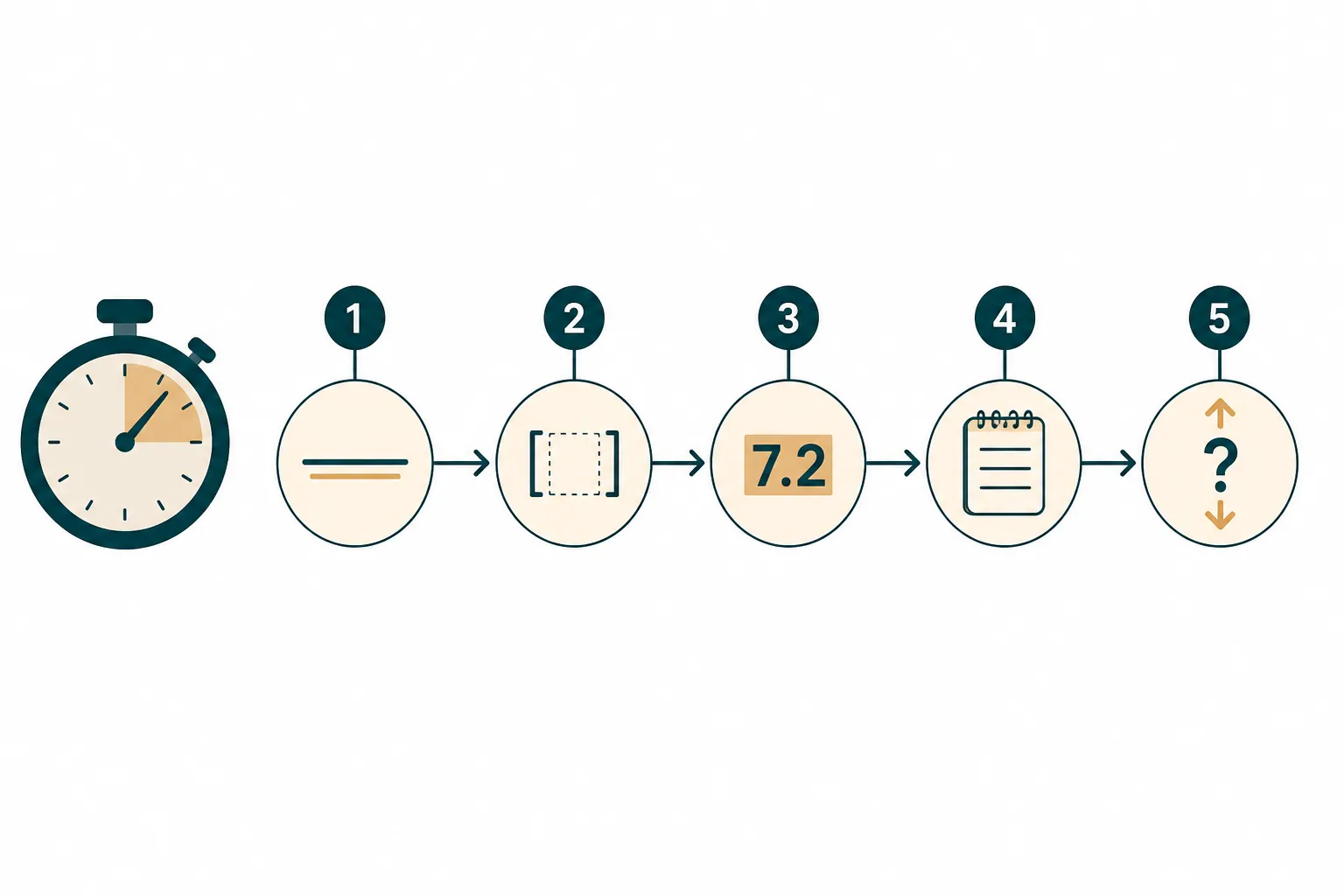
Use this on any fresh paper you are reading for MCAT practice. Set a short timer. You are not trying to become an expert on the topic. You are trying to produce a map that would survive answer choices.
- Skim for the main claim. Write it in one sentence, using the paper’s scope. For CAM9: two ancient variola genomes from northern Chile support a colonization-era introduction scenario.
- Box the methods. Mark sample size, sample type, comparison group, and measurement method. For CAM9: 13 bone samples screened, two femur positives, ancient viral DNA, genomic assembly, phylogenetic and ancestry analyses.
- Circle the load-bearing numbers. Not all numbers deserve equal attention. Here, the keepers are 84.851x versus 3.206x coverage, 99.912% sequence identity, 1492–1631 CE deaths, about 1296 CE divergence with 95% HPD 1124–1460 CE, and n=2.
- Write the limitation in plain English. For CAM9: two genomes can support a narrow lineage claim, but they cannot settle every route, frequency, or unsampled Old World comparison.
- Generate one strengthen/weaken or alternative-hypothesis question. If you cannot write one, you probably copied facts without finding the argument.
For another drill built around observation versus interpretation, use the Perseverance organic-carbon MCAT evidence case. If your bigger problem is scheduling enough repetitions, put this protocol inside a 12-week MCAT study plan. When a practice question exposes a recurring error, convert the error into a card using the MCAT Anki workflow, not a trivia card about the study.
The same mapping habit transfers to figures and study design. For visual data, try the NISAR L-band radar image drill. For evaluating causal claims and evidence strength, use the indoor CO2 and Alzheimer’s study-design case. Keep the same five marks: claim, method, numbers, limitation, question.
References
- “How to Read MCAT Science Passages”, Jack Westin.
- “The genomic identity of early smallpox in South America”, Science, July 30, 2026.
- “How smallpox reached the Americas: first genomic evidence points to Europeans”, Nature.
- “Smallpox virus, Chile, ancient mummy DNA”, AP News.
- “Ancient DNA reveals how smallpox spread to the Americas”, EurekAlert.
- “Ancient DNA confirms historical accounts of how smallpox got to the Americas”, Science.
- “Smallpox virus ancient DNA teeth Vikings Europeans”, Science News.
- “Clear Evidence: Ancient DNA From Chilean Mummies Reveals Who Brought Smallpox to The Americas”, ScienceAlert.
Related exhibits & inventory
Verified outcomes
Planners
No planner filed for this exam yet
A downloadable timeline template for this exam hasn't been published yet.
Tool verdicts
Questions about this plan
Ask a question about a specific section, timeline, or citation in this plan — or flag something that needs correcting.
Comments
Join the discussion with an anonymous comment.