
GRE Exam Hub
Agrivoltaics Study Guide for Environmental Science Exams
One citation-backed agrivoltaics study sheet for AP Environmental Science, DSST, and GRE Biology — the definitions and history you must know, the few data points examiners reward, a worked Land Equivalent Ratio calculation, and a conditional, evidence-based verdict on where agrivoltaics works, so you can answer FRQs and short-answer questions with citable evidence instead of vague praise.
- gre
- mcat
- asvab
- sat
- act
- digital-adaptive
- official-material
- section-strategy
- test-date-timeline
For AP Environmental Science, DSST Environmental Science, GRE Biology ecology, and college environmental-science exams, the safest agrivoltaics answer is not “solar panels help crops.” The point-earning version is: agrivoltaics can improve total land productivity when photovoltaic panels and agriculture are designed for the same parcel, especially where shade reduces heat or water stress, but the result depends on crop type, climate, panel layout, and cost. In APES terms, it sits between land and water use and solar-energy content; APES solar-energy review materials place solar energy in Unit 6.8, which is why agrivoltaics shows up naturally beside land-use tradeoff questions rather than as a stand-alone gadget topic [1].
The exam answer in one paragraph
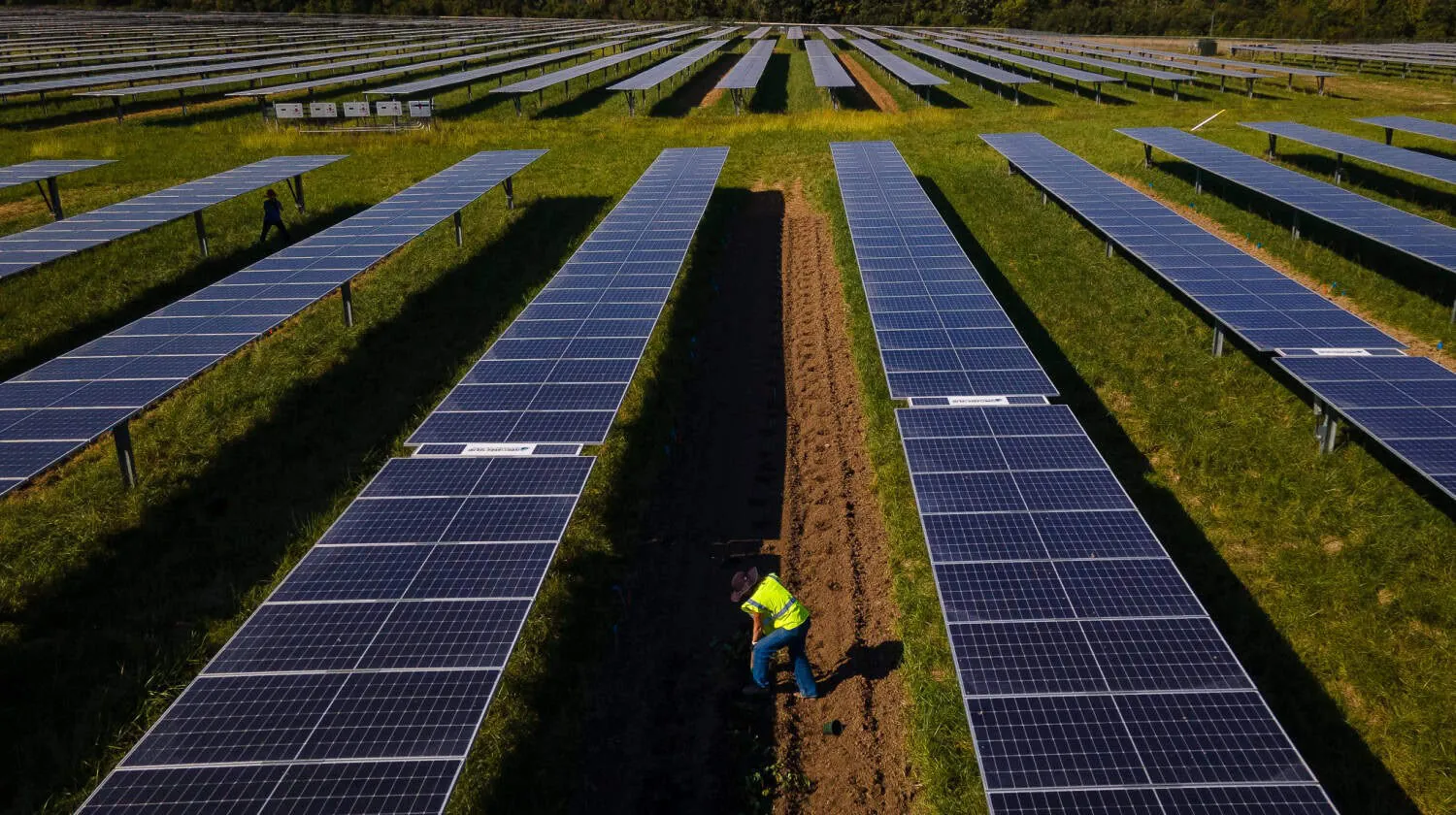
Agrivoltaics is the co-location of solar photovoltaic generation and agriculture on the same land parcel. In practice, that can mean elevated panels over crops, wider inter-row panel spacing that leaves machinery access, grazing under panels, or pollinator habitat around solar arrays [2]. The term “agrivoltaic” is usually traced to Dupraz et al. in 2011, while Japan’s related “solar sharing” history is often discussed separately [3]. A strong short answer names the mechanism: panels change the microclimate by reducing direct radiation, wind exposure, and evaporative demand, which may help crops or grasses under heat and water stress. A strong answer also names the limit: if the crop needs full light, if the climate is not water-stressed, or if elevated racking makes the system too expensive, the benefits may shrink or disappear.
What to memorize before the exam
| Fact | Use it for | Exam-safe wording |
|---|---|---|
| Definition | Any prompt asking what agrivoltaics is | Co-located solar PV and agriculture on one parcel; layouts include elevated panels, inter-row designs, grazing, and habitat-oriented solar sites [2][3]. |
| Arizona Biosphere 2 results | Mechanism: shade, water stress, microclimate | Under panels, chiltepin pepper fruit production was about 3x higher, tomato about 2x higher, jalapeño production was maintained with 65% less transpirational water loss, and soil moisture was about 15% higher [4]. |
| Oregon potato result | Crop-yield example in solar shade | A Northwest agrivoltaics example reported potato yield about 20% higher in solar shade; the same USDA Climate Hubs page reports an Oregon State estimate that converting less than 1% of U.S. agricultural land to agrivoltaics could meet about 20% of national energy need [5]. |
| Land-use context | Why environmental science cares | DOE Solar Futures context: ground-based solar could occupy about 0.5% of contiguous U.S. land by 2050, while agriculture already uses about 43% of lower-48 land; conventional solar is often summarized as needing about 5–10 acres per MW [6][7]. |
| Land Equivalent Ratio | Calculation or quantitative reasoning | LER = sum of intercrop yield divided by sole-crop yield for each product; LER > 1 means the combined system is more land-efficient than separate production [8]. |
| Shade-tolerant crop range | Crop-selection caveat | Shade-tolerant crops may tolerate roughly 35–50% less photosynthetically active radiation without major yield loss, but this is not a rule for all crops [9]. |
| Cost and land-efficiency caution | Benefits-vs-drawbacks judgment | A Stanford PH240 summary reports Fraunhofer APV-RESOLA LER values of 1.56–1.87 and an NREL cost premium of about $0.07–$0.80/WDC, or about 5–52% above a $1.53/WDC fixed-PV baseline; re-check these against the original Fraunhofer and NREL sources before using them in publication-quality work [7]. |
That is enough for most timed responses. If you want to study it the way you would study other high-yield environmental data sheets, keep each number attached to the claim it actually supports. The Arizona numbers support a water-stress and microclimate mechanism. The Oregon potato number supports a crop-specific yield example. The land-use numbers support why dual use matters. They do not prove that any crop under any panel layout will yield more.
Where it fits in environmental-science exams
| Exam context | What agrivoltaics connects to | Likely scoring angle |
|---|---|---|
| AP Environmental Science | Land and water use; solar energy; agricultural sustainability | Define the system, explain a microclimate mechanism, then give one conditional benefit and one limitation. |
| DSST Environmental Science | Renewable energy, land-use conflict, resource conservation | Compare dual-use land to separate solar and farming land uses without claiming universal yield gains. |
| GRE Biology ecology | Limiting resources, productivity, community and ecosystem interactions | Treat shade, water, and plant productivity as ecological variables, not as a clean-energy slogan. |
| College environmental science | Food-water-energy nexus; land-use planning; energy transitions | Use Land Equivalent Ratio and cost premium together: land efficiency can improve while economics remains site-specific. |
Evidence sheet: match each data point to the right claim
Arizona Biosphere 2: the cleanest water-stress example
The University of Arizona Biosphere 2 study is the easiest evidence set to use correctly because the crop, mechanism, and conditions line up. In that study, chiltepin pepper fruit production was about three times higher and tomato production about twice as high under the photovoltaic panels. Jalapeño production was maintained while transpirational water loss was 65% lower, and soil moisture was about 15% higher [4].
Notice the exam wording: “under arid, heat-stressed conditions, partial shade can reduce plant water loss and preserve soil moisture, which may maintain or increase yield for some crops.” That sentence earns more than “solar panels improve agriculture” because it names the mechanism and keeps the crop and climate conditions attached.
Oregon potatoes: useful, but still crop-specific
The Oregon potato example is a compact yield data point: a USDA Climate Hubs Northwest summary reports about 20% higher potato yield in solar shade [5]. Use it when the prompt asks for an example of agricultural production maintained or improved under panels. Do not turn it into a claim about wheat, corn, or every staple crop. Potato growth under a particular shade regime is not the same test as a full-sun grain crop under a poorly spaced array.
Land use: why dual use appears on exams at all
Agrivoltaics is testable because solar expansion and agriculture both occupy land. USDA Climate Hubs Northeast summarizes DOE Solar Futures context this way: ground-based solar could require about 0.5% of contiguous U.S. land by 2050, while agriculture already occupies about 43% of lower-48 land [6]. A separate Stanford PH240 coursework summary gives the common conventional-solar rule of thumb as about 5–10 acres per MW [7].
Those figures do not mean the United States is about to run out of land for solar. They explain why an environmental-science question might ask about land-use tradeoffs: even a small national percentage can become a local conflict if the parcel is productive farmland, wildlife habitat, or culturally important open space.
Costs: land efficiency is not the same as cheap electricity
Agrivoltaic systems can require taller racking, wider spacing, stronger foundations, more complicated wiring, and designs that preserve access for workers, livestock, or machinery. The Stanford PH240 page summarizes an NREL estimate of roughly $0.07–$0.80/WDC in added cost, equal to about 5–52% above a $1.53/WDC baseline fixed-PV farm [7]. Because that figure reaches this guide second-hand through the Stanford coursework page, it should be checked against the original NREL report before being used in formal publication.
For a timed exam, the cost point is simple: even if agrivoltaics raises total land output, the economics remain site-specific. A farmer, developer, or public agency still has to decide whether the extra structure and design complexity are justified by crop revenue, electricity revenue, water savings, land constraints, or policy incentives.
Land Equivalent Ratio: the calculation that turns “dual use” into a scoreable answer
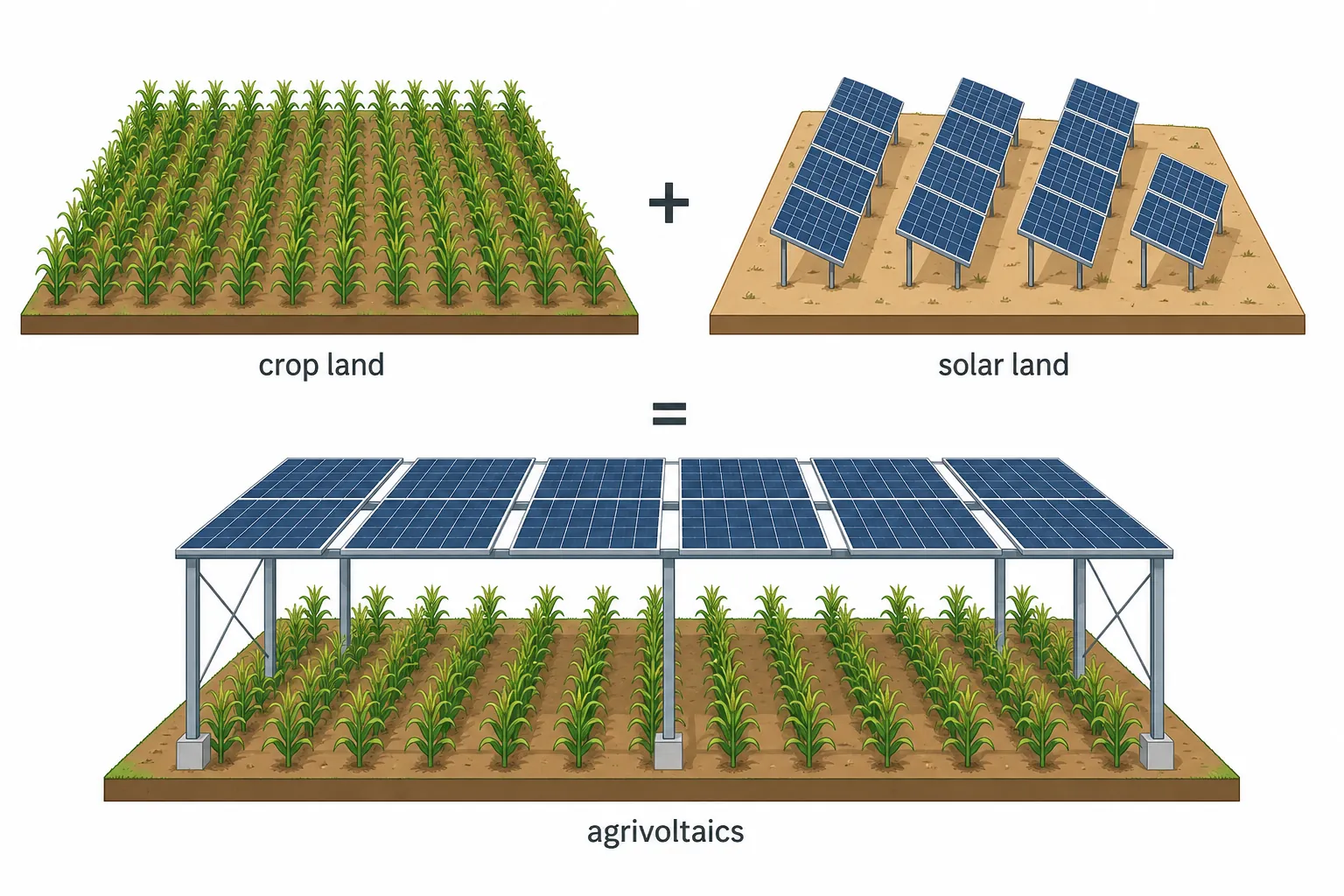
Land Equivalent Ratio, or LER, measures whether a combined land use produces more output per unit land than separate systems. The formula is commonly written as LER = Σ IYᵢ/SYᵢ, where IY is the yield of each product in the combined system and SY is the yield of that same product in a sole-use system. If LER is greater than 1, the combined system is more land-efficient than producing the same outputs separately [8].
For agrivoltaics, the two terms are usually crop output and electricity output. You compare the crop yield under panels with the crop yield from a crop-only field. Then you compare the electricity output from the agrivoltaic array with the electricity output from a solar-only array. Add the two ratios.
| Component | Hypothetical exam value | Meaning |
|---|---|---|
| Crop term | 0.8 | The agrivoltaic crop produces 80% as much as the crop-only field. |
| Solar term | 0.6 | The agrivoltaic solar array produces 60% as much as the solar-only array. |
| LER | 0.8 + 0.6 = 1.4 | The combined system produces the same total crop-plus-electricity output using less land than separate systems would require. |
The short-answer interpretation should be plain: “Because LER = 1.4 is greater than 1, the agrivoltaic system is more land-efficient than separate crop-only and solar-only production. However, the crop term below 1 shows that crop yield declined relative to the crop-only field, so the benefit comes from combined land efficiency, not from every output increasing.”
That last sentence matters. Students often see LER > 1 and write as if both crop yield and solar output rose. They do not have to. LER can exceed 1 even when one component declines, as long as the combined output per land area is better than separate land uses.
Fraunhofer’s APV-RESOLA project is often cited as a real-world land-efficiency example. The Stanford PH240 page reports Land Equivalent Ratios of 1.56–1.87 for potato, winter wheat, celeriac, and clover grass over 2017–2018 [7]. Treat those as promising but re-checkable numbers: they are useful for an exam study sheet, but the original Fraunhofer/Trommsdorff source is the better citation for a paper or article.
The crop and climate caveat is not optional
Partial shade helps only when shade relieves a real stress or when the crop can tolerate lower light. NCAT’s AgriSolar Clearinghouse summarizes shade-tolerant crops as able to tolerate about a 35–50% reduction in photosynthetically active radiation without major yield loss [9]. That range is good exam vocabulary because it keeps the answer biological: photosynthetically active radiation is a resource, and different plants have different light requirements.
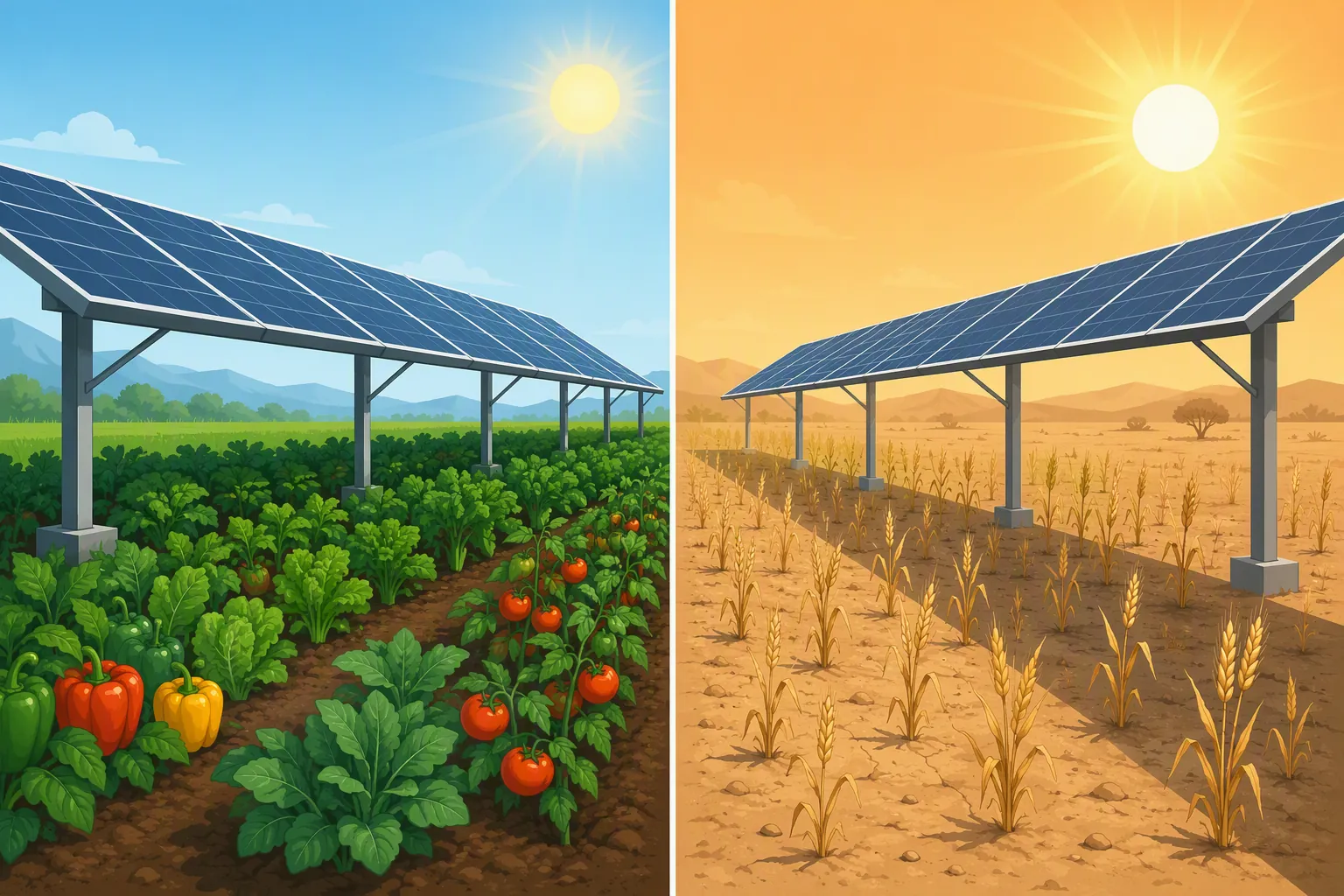
Use shade-tolerant vegetables, some forage systems, or dryland heat-stress examples when you are arguing for agrivoltaic benefits. Use light-demanding staples as the caution. If a prompt gives you a crop that needs high direct sunlight and a layout that heavily shades the field, the correct answer may be that electricity production increases total revenue or land efficiency while crop yield falls.
A Colorado State four-year semi-arid grassland study makes the same conditional point from the grazing/grassland side. In average and wet years, shaded grasses were slightly less productive, but in a dry year they were markedly more productive [10]. That is not proof that shade always increases biomass. It is evidence that water stress can change which treatment performs better.
Vocabulary and history that may appear in stems
You do not need a full history of agrivoltaics for most exams, but a few names help decode passages. The word “agrivoltaic” is commonly traced to Dupraz et al. in 2011 [3]. Japan’s “solar sharing” tradition is associated with Akira Nagashima’s 2004 prototypes; OpenEI’s Japan summary describes shading rates from 10–100%, with a median around 30–40%, and notes that adoption accelerated after Japan’s 2012 feed-in tariff [11].
For categories, the InSPIRE program organizes agrivoltaics into grazing, crop production, habitat, and greenhouse applications [12]. DOE describes related co-location configurations such as elevated systems, inter-row designs, livestock grazing, and pollinator habitat [2]. IEA-PVPS also treats agrivoltaics as a dual-land-use question, which is the right mental file for an environmental-science exam: the issue is not only electricity generation, but what happens to the land while electricity is generated [13].
Deployment numbers should be dated because they change. The Lincoln Institute reported that global agrivoltaics grew from about 5 MW in 2012 to about 14 GW in 2021, that Japan had more than 3,000 small systems, and that InSPIRE tracked more than 600 U.S. projects [14]. Those are useful for scale, not for proving effectiveness. Installed capacity says the idea is being tried; crop and water data say what happened under particular conditions.
How to write the benefits-vs-drawbacks judgment
A high-scoring answer usually has four moves: define the system, name the mechanism, support one benefit with a specific data point, and give one real limitation. The limitation should not be vague. “It is expensive” is weaker than “elevated or modified racking can add capital cost, so the economics depend on land value, crop value, electricity revenue, and water savings.”
| Prompt wording | Point-earning response |
|---|---|
| Explain one environmental benefit of agrivoltaics. | It can reduce land-use conflict by producing crops and solar electricity on the same parcel; LER > 1 indicates greater combined land efficiency than separate land uses [8]. |
| Explain one water-related benefit. | In arid settings, panel shade can lower transpiration and evaporation; in the Arizona Biosphere 2 study, jalapeño production was maintained with 65% less transpirational water loss and soil moisture was about 15% higher [4]. |
| Explain why benefits vary by crop. | Shade-tolerant crops may handle reduced photosynthetically active radiation, but light-demanding crops may lose yield if panels reduce sunlight too much [9]. |
| Identify one economic drawback. | Agrivoltaic designs can cost more than ordinary fixed-tilt solar because they may require taller structures, wider spacing, or farm-access modifications; one NREL estimate summarized by Stanford gives a roughly 5–52% premium over a fixed-PV baseline [7]. |
| Evaluate whether agrivoltaics works. | It works best as a conditional land-use strategy: strongest evidence appears where shade reduces heat or water stress and where crops tolerate partial shade; yield loss and racking cost limit universal adoption. |
For a timed FRQ, one polished version would be: “Agrivoltaics co-locates solar PV and agriculture on the same parcel. It can improve land-use efficiency because the land produces both electricity and crops; an LER above 1 means the combined system outperforms separate land uses. The benefit is most defensible in arid or shade-stressed systems: at Biosphere 2, jalapeños maintained production with 65% less transpirational water loss, and soil moisture was about 15% higher. However, the result depends on crop and design, because light-demanding crops may lose yield and elevated racking can raise costs.” [4][8]
That answer is short, but it does the necessary work: it defines the term, gives a mechanism, uses a number for the claim being made, and refuses to overgeneralize. That is the difference between an interesting topic and a point-earning environmental-science sentence.
References
- Solar Energy, Fiveable.
- Agrivoltaics: Solar and Agriculture Co-Location, U.S. Department of Energy.
- Agrivoltaics, Wikipedia.
- Agrivoltaics proves mutually beneficial across food, water, energy nexus, University of Arizona News, September 2019.
- Agrivoltaics: Pairing Solar Power and Agriculture in the Northwest, USDA Climate Hubs Northwest.
- Agrivoltaics: Coming Soon to a Farm Near You?, USDA Climate Hubs Northeast.
- Agrivoltaics, Stanford PH240, 2022.
- Land equivalent ratio, Wikipedia.
- Crops Uniquely Suited to Growth in Agrivoltaic Settings, NCAT.
- Solar panels’ shade helps boost Colorado grassland productivity in dry years, The Conversation.
- Evolution of Agrivoltaic Farms in Japan, OpenEI.
- InSPIRE, OpenEI.
- Dual Land Use for Agriculture and Solar Power Production, IEA-PVPS.
- City Tech: The Rise of Dual-Use Solar, Lincoln Institute of Land Policy.
Related exhibits & inventory
Verified outcomes
- not-score-proven → not-score-proven
When to Do HIIT for Better Memory and Exam Focus
- No baseline score reported → No verified final scoreLimited
Can NYT Strands Daily Actually Build Vocabulary?
- pre-final grades → 0.65 SD higher
A Sleep-First Routine to Stop Falling Asleep While Studying
- Not a score log → Not a score logModerate
Does Air Quality Affect Study Focus? Yes — by How Much?
Planners
Tool verdicts
A lesson substitute only for motivated adult beginners with MIDI keyboards focused on songs; otherwise a supplement.
Monthly $19.99; 6-month $83.94; annual ~$119.88-$120; checked 2026-08-27EvidenceModeratePixel 11 Pro is the cheaper study-app buy for flashcard-heavy students; iPhone 17 Pro only for notes-first Apple users.
$1,099/256GB each; AnkiMobile $24.99 iOS vs AnkiDroid free; checked 2026-08-26EvidenceModerateGalaxy S26 Ultra offers the more complete out-of-box exam-prep workflow; Pixel 11 Pro suits students who prefer assembling their own study stack.
Pricing not included in this workflow comparison (2026-08-26)EvidenceModerate
Questions about this plan
Ask a question about a specific section, timeline, or citation in this plan — or flag something that needs correcting.
Comments
Join the discussion with an anonymous comment.