
MCAT, GRE, ACT, SAT Exam Hub
Arctic Permafrost Carbon Storage for Climate Exams
A citation-labeled study sheet for climate exams: the 1,400–1,700 Gt of carbon stored in Arctic permafrost, current release rates, the CO2-vs-methane split, and the dated 2024 tundra sink-to-source shift — every figure a named-source range you can deploy in short answers and FRQs.
- gre
- mcat
- asvab
- sat
- act
- digital-adaptive
- official-material
- section-strategy
- test-date-timeline
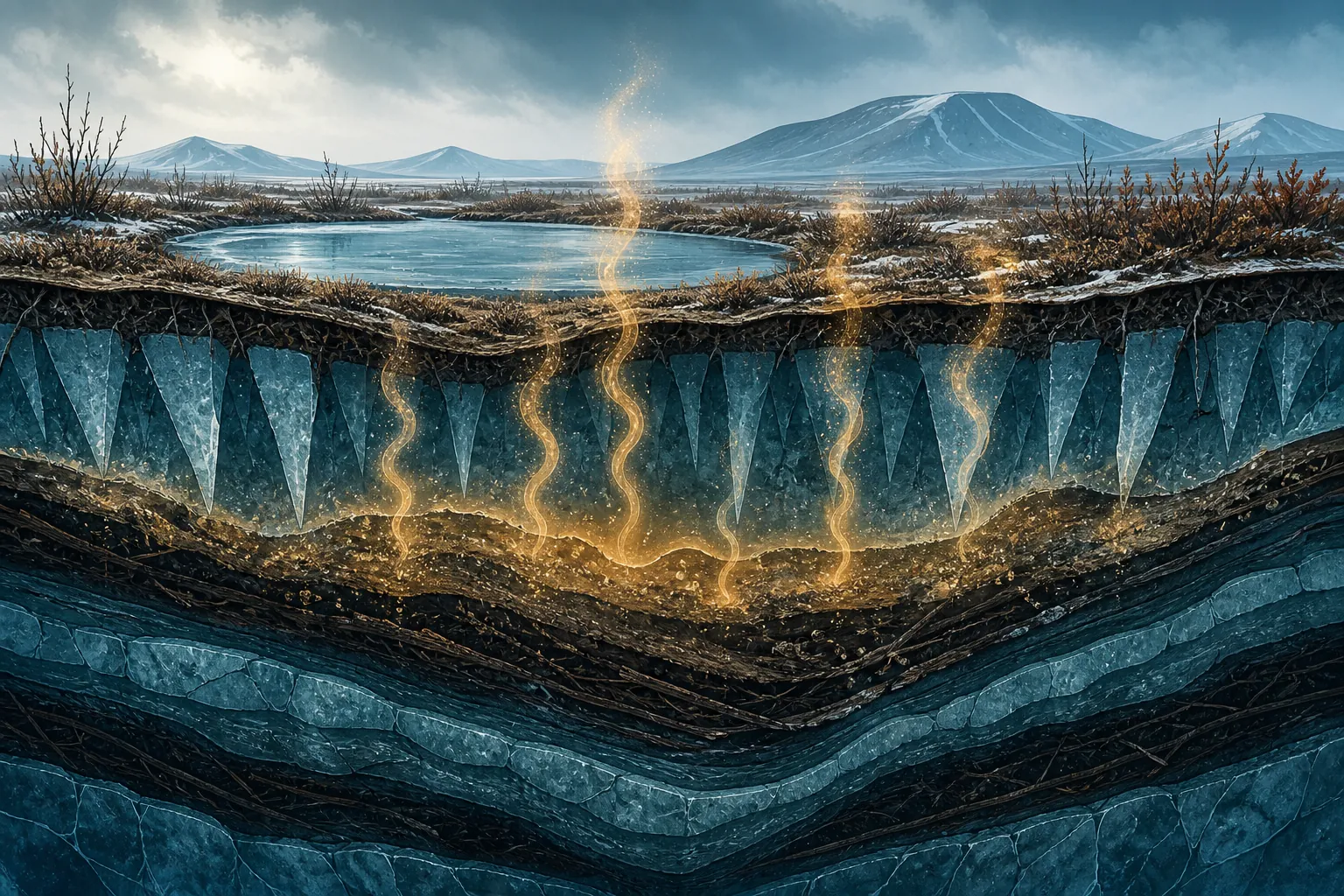
The fastest way to lose points on permafrost is to answer the sink/source question without a date. “The Arctic is a carbon sink” is an old-looking answer. “Permafrost will become a source” is safer than nothing, but it is still too vague for 2026. The exam-ready sequence is narrower and stronger: NOAA’s 2019 Arctic Report Card described observations suggesting the northern permafrost region was already releasing a net 0.3–0.6 Pg C per year, and NOAA’s 2024 Arctic Report Card reported that, including wildfire, Arctic tundra has shifted from a millennia-long CO₂ sink to a net CO₂ source.[1][2][3]
That does not mean every Arctic ecosystem is now behaving the same way. The 2024 budget for the broader pan-Arctic region over 2001–2020 was roughly CO₂-neutral at −24 ± 123 Tg C per year; boreal forest remained a sink, while tundra was a small source.[1] So the clean test answer is not “the Arctic is now a source” in every context. It is: date the claim, name the region, and separate tundra, boreal forest, wildfire, CO₂, and methane.
Start with the dated sink/source answer
For a short-answer climate question, the safest first sentence is a dated one:
- 2019 NOAA Arctic Report Card: northern permafrost-region soils were estimated to store 1,460–1,600 Pg organic carbon, and observations suggested a net release of 0.3–0.6 Pg C per year.[3]
- 2024 NOAA Arctic Report Card: including wildfire, Arctic tundra has shifted from a long-term CO₂ sink to a net CO₂ source.[1][2]
- 2001–2020 pan-Arctic budget: roughly CO₂-neutral at −24 ± 123 Tg C per year, with boreal forest still a sink and tundra a small source.[1]
- Methane is separate: the pan-Arctic region is a consistent CH₄ source of 15–39 Tg CH₄-C per year.[1]
Notice the unit switch. Pg C and Gt C are equivalent units for carbon mass; Tg is smaller. An answer that mixes Pg, Gt, Tg, carbon, CO₂, and CO₂-equivalent without saying which is which can make a correct idea look sloppy. That is why this topic belongs on a number sheet, not just in a feedback-loop paragraph.
Figure bank: the numbers worth memorizing
Do not force the permafrost-carbon total into one magic number. Authoritative sources cluster around the same scale, but they do not use identical boundaries, soil depths, or presentation choices. On an exam, a named range is better than a fake-perfect single value.
| Exam fact | Defensible wording | What not to write |
|---|---|---|
| Stored carbon | Arctic/northern permafrost stores roughly 1,400–1,700 Gt C; NOAA 2019 gives 1,460–1,600 Pg organic carbon for northern permafrost-region soils.[3][4][5][6] | “Permafrost stores 1,500 Gt” with no source, no range, and no indication that other authoritative totals exist. |
| Atmospheric comparison | That storage is about 2–2.5 times the roughly 850 Gt C currently in the atmosphere, depending on source framing.[3][4][5][6] | “Permafrost has twice the atmosphere” as if the multiplier were exact. |
| Land extent | Permafrost underlies about 15% of Northern Hemisphere land; permafrost-affected soils cover about 9% of Earth’s land area and store an estimated 25–50% of global soil organic carbon.[4][7] | “Permafrost is most of Earth’s land” or “permafrost carbon is only an Arctic issue.” |
| Soil-carbon share | NSIDC states that the Arctic holds nearly one-third of Earth’s stored soil carbon.[5] | A percentage with no boundary: Arctic? permafrost? global soils? all carbon? |
| Current net-release signal | NOAA 2019 summarized observations suggesting net release of 0.3–0.6 Pg C per year from the northern permafrost region; non-summer CO₂ release was estimated at 2–3 times earlier figures.[3] | “Permafrost releases greenhouse gases” without magnitude, season, or date. |
| 2024 tundra CO₂ status | NOAA 2024: including wildfire, Arctic tundra has shifted from a millennia-long CO₂ sink to a net CO₂ source.[1][2] | “The whole Arctic is now a CO₂ source” without distinguishing tundra from boreal forest. |
| Wildfire contribution | Circumpolar wildfire emissions averaged 207 Mt C per year since 2003, and 2024 was the second-highest fire-emissions year north of the Arctic Circle in the NOAA 2024 update.[1][2] | Treating wildfire emissions and microbial permafrost emissions as the same pathway. |
| Methane source | The pan-Arctic region is a consistent CH₄ source of 15–39 Tg CH₄-C per year.[1] | Using the CO₂ sink/source answer as if it automatically answered methane. |
| Methane warming strength | Methane’s global warming potential is about 28–36 times CO₂ over 100 years in the EPA range cited by NSIDC, and about 80 times over 20 years in the synthesis cited in the research literature.[5][7] | “Methane is worse than CO₂” with no time horizon. |
| Permafrost feedback size | IPCC AR6 estimates permafrost-released CO₂ plus CH₄ could equal 14–175 billion tonnes CO₂-equivalent per 1°C of warming.[7] | A feedback number with no unit or temperature basis. |
| Abrupt thaw | Abrupt thaw and thermokarst processes are modeled to raise 21st-century permafrost carbon emissions by about 125–190% compared with gradual thaw alone, adding 60–100 Gt C by 2300.[7] | Assuming all thaw is slow, uniform surface deepening. |
If you remember only one storage line, use this: Arctic permafrost stores roughly 1,400–1,700 Gt C, about 2–2.5 times atmospheric carbon, but that is storage, not annual release. The last clause matters. Storage magnitude tells you why the feedback is important; it does not tell you how fast the carbon is entering the air.
CO₂ or methane: use the oxygen rule
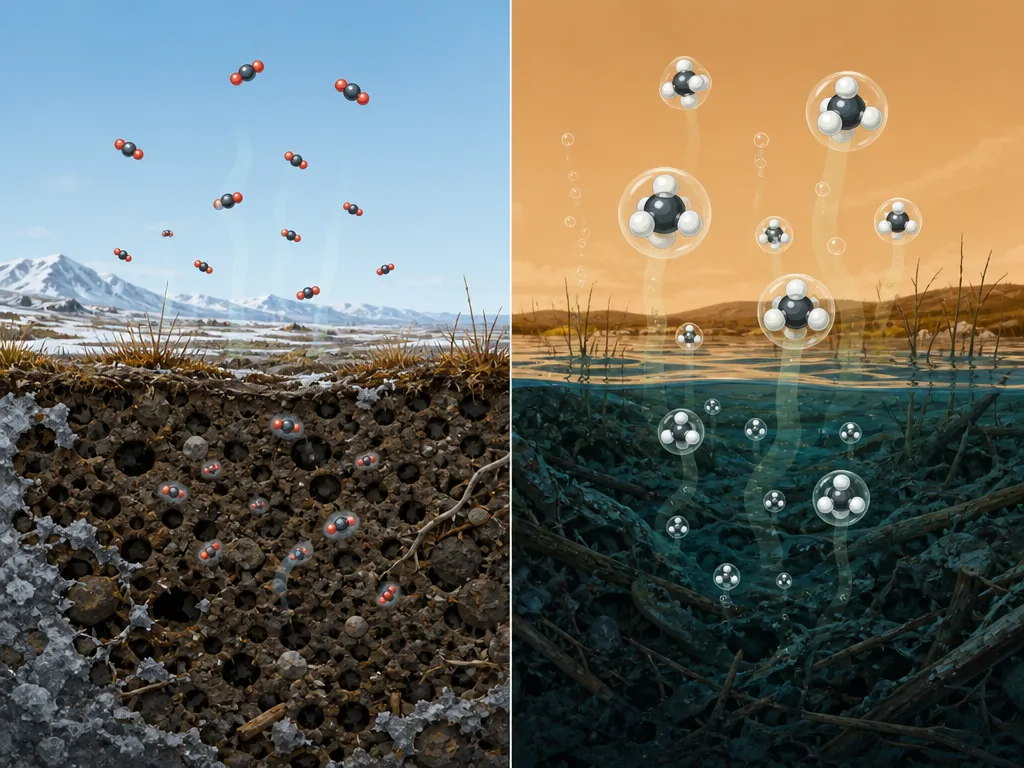
The mechanism is simple enough for an FRQ, but it needs one condition: oxygen. Thaw exposes previously frozen organic carbon. Microbes decompose that organic matter. In oxygen-rich, aerated soil, decomposition mainly produces CO₂. In oxygen-poor, waterlogged settings such as saturated tundra soils and thermokarst lakes, methanogens can produce CH₄.[8][9]
| Thaw setting | Microbial pathway | Main gas to name | Exam consequence |
|---|---|---|---|
| Aerated, better-drained thawed soil | Aerobic decomposition | CO₂ | Use this when a graph or passage shows exposed, oxygenated soil. |
| Waterlogged tundra, saturated soil, thermokarst lake | Anaerobic decomposition by methanogens | CH₄ | Use this when the question emphasizes standing water, low oxygen, or lake formation. |
Methane is the common trap because students know it is powerful and then write as if all permafrost thaw makes methane. It does not. The better sentence is conditional: aerobic thaw favors CO₂, while anaerobic waterlogged thaw favors CH₄, which has a much higher warming potential over both 20-year and 100-year horizons. Then attach the time horizon if a number is needed: about 28–36 times CO₂ over 100 years, or about 80 times over 20 years.[5][7]
The mechanism chain that earns the point
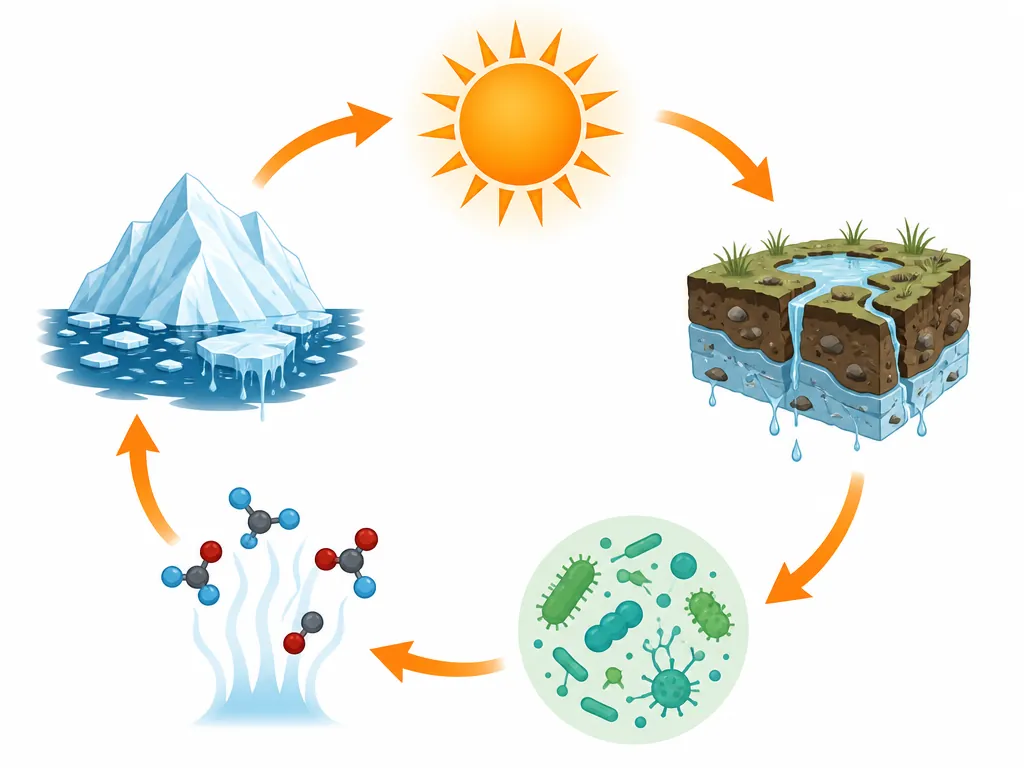
Commercial AP Environmental Science review sites often teach permafrost as a short feedback chain, which is useful pedagogy even though it should not be treated as an official College Board wording requirement.[10][11] The chain is:
- Warming thaws permafrost.
- Thaw exposes old frozen organic carbon.
- Microbes decompose the organic matter.
- Aerobic conditions release mainly CO₂; anaerobic waterlogged conditions can release CH₄.
- CO₂ and CH₄ increase greenhouse forcing.
- More warming accelerates further thaw.
The word “old” is not decoration. The carbon pool is a legacy pool accumulated over long periods and kept frozen; radiocarbon evidence shows that thaw can expose carbon thousands of years old.[3][9] That is why an answer about fresh plant litter is not enough. New plant growth can take up CO₂ in some places, but the exam issue is whether thawed, previously frozen carbon is being added to the active carbon cycle faster than ecosystems remove it.
Also be careful with “re-freeze.” Seasonal surface freezing does not mean the long-term carbon problem disappears. Carbon Brief’s summary of permafrost science notes that once deeper ground thaws, it may not return to its former frozen state for centuries.[9] For exam purposes, that supports the feedback logic without needing to claim that every thawed patch releases the same amount of carbon on the same schedule.
Timing: future-risk language is now incomplete
Older study materials often say permafrost “may become a net carbon source by 2100.” That wording comes from a real line of expert judgment, not from nowhere: NSIDC cites a 2016 survey of 98 permafrost scientists predicting that the permafrost region would become a net source by 2100.[5] But a 2100 prediction is not the same as the 2024 NOAA tundra finding. They are different dates, scopes, and evidence types.
| Claim type | Date | Scope | How to write it |
|---|---|---|---|
| Expert expectation | 2016 survey cited by NSIDC | Permafrost region by 2100 | A survey of 98 permafrost scientists expected the region to become a net source by 2100.[5] |
| Observed net-release signal | NOAA Arctic Report Card 2019 | Northern permafrost-region soils | Observations suggested net release of 0.3–0.6 Pg C per year.[3] |
| Updated tundra sink/source status | NOAA Arctic Report Card 2024 | Arctic tundra, including wildfire | Including wildfire, Arctic tundra has shifted from a millennia-long CO₂ sink to a net CO₂ source.[1][2] |
| Broader regional CO₂ budget | 2001–2020 budget in NOAA 2024 | Pan-Arctic region | The pan-Arctic region was roughly CO₂-neutral, while boreal forest remained a sink and tundra was a small source.[1] |
That table is the antidote to the “contradiction” panic. A future-source statement, a 2019 net-release signal, and a 2024 tundra-source update can all be true if they refer to different measurements, regions, gases, and dates.
Feedback magnitude: say what the number measures
Feedback estimates are where vague writing gets especially dangerous. A storage number such as 1,400–1,700 Gt C is not a release forecast. A release estimate in carbon is not the same as CO₂-equivalent. A methane number depends on the time horizon used for global warming potential.
The compact feedback number to know is the IPCC AR6 estimate, summarized in the permafrost-carbon literature, that permafrost-released CO₂ plus CH₄ could equal 14–175 billion tonnes CO₂-equivalent per 1°C of warming.[7] That is a wide range, and the width is part of the answer. It signals uncertainty in thaw rate, microbial response, hydrology, vegetation uptake, and methane-versus-CO₂ pathways.
Abrupt thaw is the other timing term worth recognizing. Gradual thaw is the familiar deepening of the active layer. Abrupt thaw includes collapse, thermokarst, and lake-forming processes that can expose deeper frozen carbon faster. Modeling summarized in the research literature estimates that including abrupt thaw raises 21st-century permafrost carbon emissions by about 125–190% compared with gradual thaw alone and adds 60–100 Gt C by 2300.[7]
How to deploy the numbers on exam day
Use the same discipline you would use for a graph-heavy climate passage: one verified fact core, then format-specific execution. If you have used the climate change and wildfires study guide, this is the same exam habit with a different evidence set: define the system, attach the number, and avoid overclaiming beyond the data.
| Exam format | What the permafrost answer should do | Sentence that would survive grading |
|---|---|---|
| APES-style FRQ | Give the mechanism chain and one dated number. Commercial prep sources are useful for practicing this chain, but the numbers should come from scientific or institutional sources.[10][11] | Thaw exposes frozen organic carbon; microbes decompose it to CO₂ under aerobic conditions or CH₄ under anaerobic waterlogged conditions, and NOAA 2019 reported a 0.3–0.6 Pg C/yr net-release signal from northern permafrost-region soils.[3][8] |
| MCAT science passage | Track variables and conditions: oxygen, waterlogging, microbial metabolism, greenhouse forcing, and feedback. Do not turn the passage into a memorized climate essay. | If the passage describes saturated thermokarst conditions, CH₄ is more plausible than CO₂ because anaerobic methanogens dominate in low-oxygen settings.[8][9] |
| GRE verbal science passage | Watch for scope shifts. A passage may distinguish tundra from boreal forest, CO₂ from CH₄, or storage from flux. | A broad pan-Arctic CO₂ budget being roughly neutral over 2001–2020 does not contradict the narrower finding that tundra was a small source while boreal forest remained a sink.[1] |
| ACT Science | Read units before trends. Graphs may switch from Tg CH₄-C/yr to Pg C/yr, or from carbon mass to CO₂-equivalent. | A methane flux of 15–39 Tg CH₄-C/yr is not directly comparable to a CO₂-equivalent feedback estimate unless the unit conversion and GWP time horizon are specified.[1][5][7] |
| SAT evidence question | Choose the quote or data line that proves the exact claim, not the one that sounds most dramatic. | For the claim that Arctic tundra has shifted to a net CO₂ source, the best evidence is the 2024 NOAA tundra finding, not a general statement that permafrost stores a large carbon pool.[1][2] |
For ecosystem-feedback practice, the reasoning pattern is close to the one used in the MCAT whitefish ecology case study: do not memorize the organism or landscape as trivia; track the causal chain. For compact environmental-science memorization, the same “number first, mnemonic second” habit appears in the air quality index study guide.
Sentence templates that do not overclaim
- Storage: “Arctic permafrost stores roughly 1,400–1,700 Gt C, about 2–2.5 times the carbon currently in the atmosphere, depending on source boundaries.”[3][4][5][6]
- Current release: “NOAA 2019 reported observations suggesting a 0.3–0.6 Pg C/yr net release from northern permafrost-region soils.”[3]
- Sink/source: “NOAA 2024 reported that, including wildfire, Arctic tundra has shifted from a long-term CO₂ sink to a net CO₂ source, while the broader pan-Arctic CO₂ budget over 2001–2020 was roughly neutral.”[1][2]
- Gas split: “Aerobic thaw favors CO₂ release, while anaerobic waterlogged thaw favors methane production.”[8][9]
- Methane strength: “Methane’s GWP is about 28–36 times CO₂ over 100 years, and about 80 times over 20 years, so the time horizon must be stated.”[5][7]
- Feedback: “IPCC AR6 estimates permafrost CO₂ plus CH₄ emissions at 14–175 billion tonnes CO₂-equivalent per 1°C of warming.”[7]
Mnemonics after the figures
Mnemonics are useful only if they preserve the data, not if they replace it. Put the numbers on the card first; then use the memory hook.
| Memory hook | What it protects |
|---|---|
| Date before debate | Write 2019 net-release signal before 2024 tundra-source update; do not answer sink/source without a year. |
| Store ≠ release | 1,400–1,700 Gt C is the stored pool; 0.3–0.6 Pg C/yr is the 2019 net-release signal. |
| Air makes CO₂; water makes methane | Aerobic conditions favor CO₂; anaerobic waterlogged conditions favor CH₄. |
| Methane needs a clock | Use the 100-year range when the question says long-term GWP; use the 20-year value only when the time horizon is short. |
| Region before result | Tundra, boreal forest, pan-Arctic region, and wildfire-inclusive budgets can have different answers. |
Compact source/date audit table
| If the prompt asks… | Use this answer shape | Source/date |
|---|---|---|
| How much carbon is stored? | Roughly 1,400–1,700 Gt C in Arctic/northern permafrost; NOAA 2019 gives 1,460–1,600 Pg organic carbon for northern permafrost-region soils. | NOAA Arctic Report Card 2019; MIT Climate Portal; NSIDC; Miner et al. 2022[3][4][5][6] |
| How does that compare with the atmosphere? | About 2–2.5 times the roughly 850 Gt C currently in the atmosphere. | MIT Climate Portal; NSIDC; NOAA 2019; Miner et al. 2022[3][4][5][6] |
| Is Arctic tundra a sink or source? | As of the 2024 NOAA update, including wildfire, Arctic tundra has shifted from a long-term CO₂ sink to a net CO₂ source. | NOAA Arctic Report Card 2024; NOAA news release[1][2] |
| Is the whole pan-Arctic region a CO₂ source? | Not as a blanket statement: over 2001–2020, the pan-Arctic CO₂ budget was roughly neutral at −24 ± 123 Tg C/yr; boreal forest remained a sink and tundra was a small source. | NOAA Arctic Report Card 2024[1] |
| How much is being released now? | NOAA 2019 reported observations suggesting a 0.3–0.6 Pg C/yr net release from northern permafrost-region soils. | NOAA Arctic Report Card 2019[3] |
| What about methane? | The pan-Arctic region is a consistent CH₄ source of 15–39 Tg CH₄-C/yr; methane’s warming impact must be tied to a 20-year or 100-year GWP. | NOAA Arctic Report Card 2024; NSIDC; permafrost-carbon synthesis[1][5][7] |
| What mechanism should I write? | Thaw exposes old organic carbon; microbes decompose it; oxygen-rich conditions favor CO₂, oxygen-poor waterlogged conditions favor CH₄; greenhouse forcing increases warming and accelerates thaw. | SERC EarthLabs; Carbon Brief; NOAA 2019[3][8][9] |
| How large could the feedback be? | IPCC AR6 estimate: 14–175 billion tonnes CO₂-equivalent per 1°C of warming; abrupt thaw can substantially increase emissions compared with gradual thaw alone. | Permafrost-carbon synthesis of IPCC AR6 and abrupt-thaw studies[7] |
References
- Arctic Terrestrial Carbon Cycling, NOAA Arctic Report Card, 2024.
- Arctic tundra becoming source of carbon dioxide emissions, NOAA, 2024.
- Permafrost and the Global Carbon Cycle, NOAA Arctic Report Card, 2019.
- Permafrost, MIT Climate Portal.
- Why Frozen Ground Matters, National Snow and Ice Data Center.
- Permafrost carbon emissions in a changing Arctic, Nature Reviews Earth & Environment, 2022.
- Permafrost carbon cycle, Wikipedia.
- EarthLabs 5B: Permafrost, SERC Carleton.
- Guest post: How climate change is driving dangerous permafrost thaw, Carbon Brief.
- Permafrost and Climate Change, Albert.io.
- Permafrost, Fiveable.
Related exhibits & inventory
Verified outcomes
No verified outcomes on file for this exam yet
See Methodology for how outcome evidence is disclosed once logged.
Planners
No planner filed for this exam yet
A downloadable timeline template for this exam hasn't been published yet.
Tool verdicts
AI-tool cautions
No AI tools tested for this exam yet
No hands-on AI-accuracy logs have been filed for this exam.
Questions about this plan
Ask a question about a specific section, timeline, or citation in this plan — or flag something that needs correcting.
Comments
Join the discussion with an anonymous comment.