
SAT
A complete guide to SAT Math practice in 2026 covering the digital adaptive format, content domains, score benchmarks, free official resources, Desmos strategies, common mistakes, and a 4-week study plan.
Updated:
SAT Math practice in 2026 starts in a different place than it did on the old paper test. The Math section is digital, adaptive, split into two 35-minute modules, and has 44 questions total. The built-in Desmos graphing calculator is available throughout the section, not just on a separate calculator portion.[1]
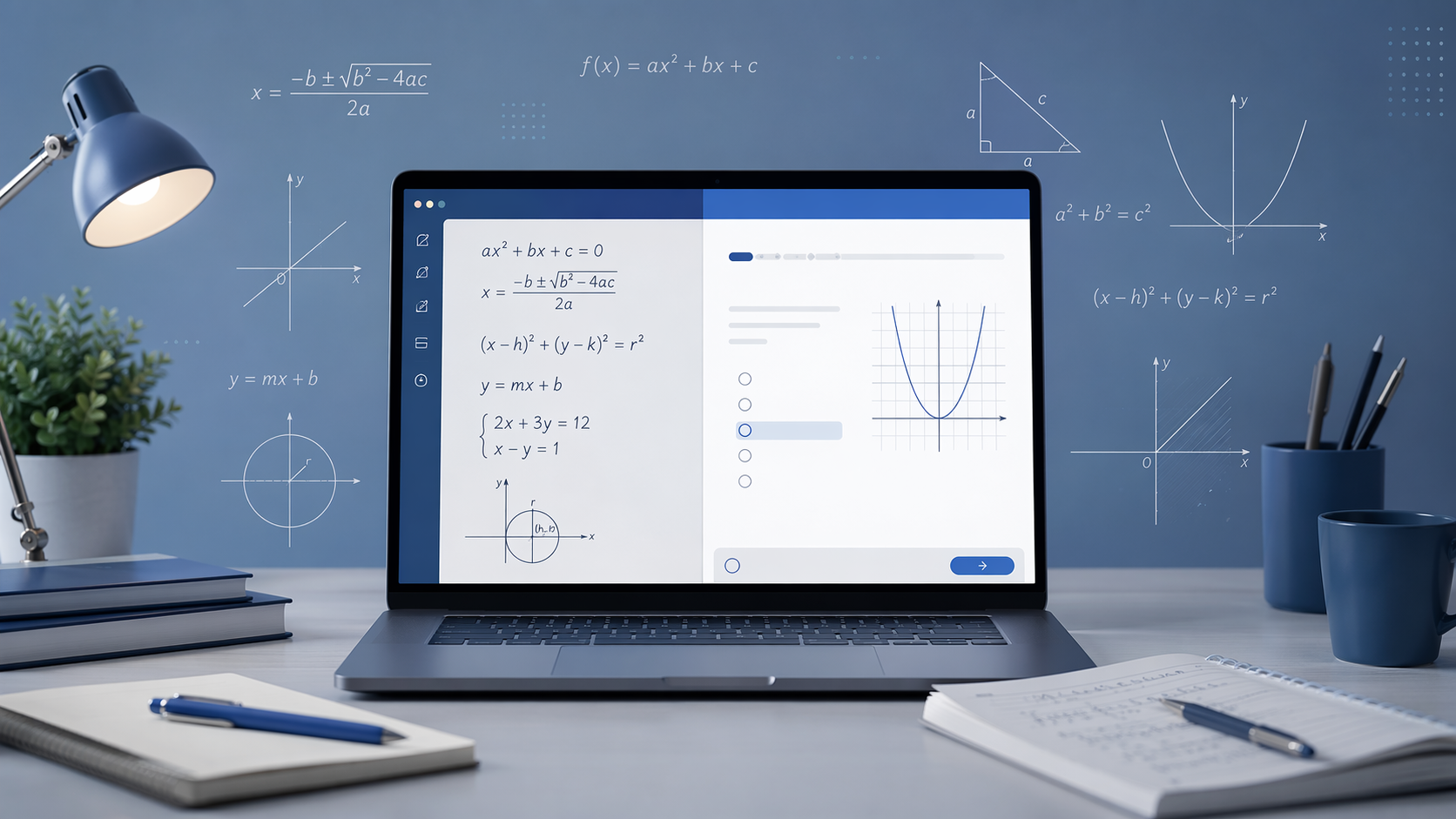
That structure changes what “practice more” should mean. A student who can solve a system on paper but burns three minutes doing it may still lose ground. A student who knows Desmos well but graphs every small arithmetic check may also lose ground. And a student who treats Module 1 like a warm-up can make the rest of the section harder to recover, because Module 1 performance determines the difficulty path for Module 2.[1]
So effective sat math practice is not a giant pile of random questions. It is a weekly system: protect Module 1 accuracy, spend the most time on the most-tested domains, use official resources first, decide when Desmos is actually faster, and turn every missed question into a pattern you can fix.
Start With the Digital SAT Math Format
The SAT Math section has two modules. Each module gives you 35 minutes, and together they contain 44 questions.[1] That works out to a little under two minutes per question on average, but the average is not the plan. Some questions should take 20 seconds. Some deserve two minutes. A few are better marked, skipped, and returned to after easier points are secure.
| Feature | What it means for practice |
|---|---|
| Two 35-minute modules | Practice pacing by module, not only by total section time. |
| 44 total questions | Review each miss carefully; every question has real weight. |
| Adaptive Module 2 | Module 1 accuracy matters because it affects the second-module path. |
| Desmos available throughout | Learn calculator decisions, not just calculator buttons. |
The adaptive part is the piece many students underestimate. Module 1 is not a place to “get settled.” It is the gatekeeper. Tutor guidance commonly treats roughly 85% or higher accuracy on Module 1 as an important working benchmark for students trying to unlock the stronger second-module path, though that is not an official College Board cutoff.[2]
That does not mean panic over one missed question. It means your first practice priority is boring and powerful: get the medium questions right without rushing. If you miss a hard question in Module 2, that may be a content gap. If you miss two straightforward Module 1 questions because you solved for x when the question asked for 2x, that is a practice-system problem.
Practice the Domains in the Weight They Actually Appear
The SAT Math section is organized around four content areas: Algebra, Advanced Math, Problem-Solving and Data Analysis, and Geometry and Trigonometry. College Board’s published ranges show Algebra at 13–15 questions, Advanced Math at 13–15 questions, Problem-Solving and Data Analysis at 5–7 questions, and Geometry and Trigonometry at 5–7 questions.[3]
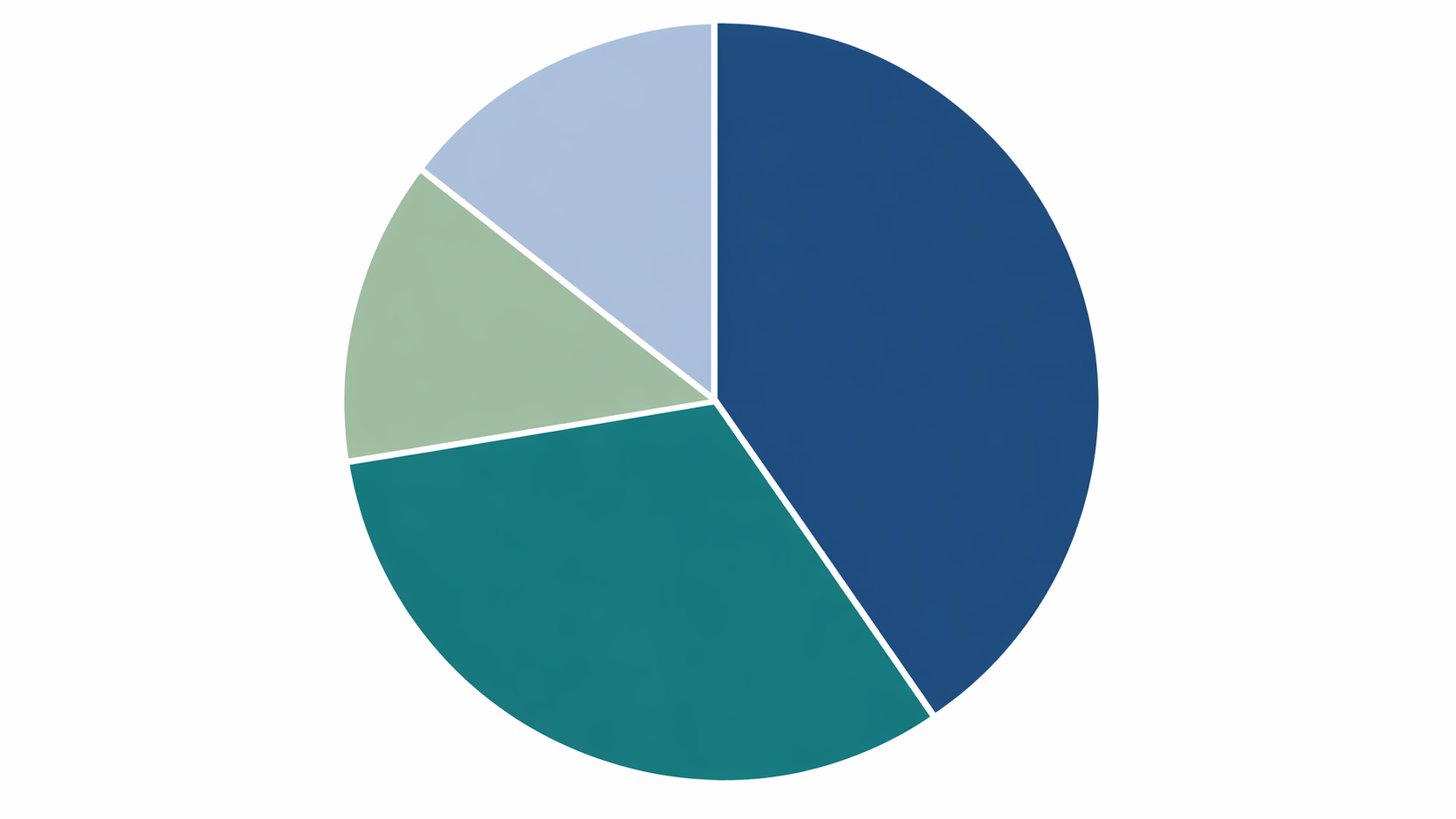
Because Algebra and Advanced Math together usually make up about 70% of the section, they should take the largest share of practice time.[3] This is where many students accidentally study backward. They spend a whole evening on a tricky circle problem because it feels memorable, then avoid linear equations, functions, or quadratics because those topics feel familiar. Familiar is not the same as automatic.
| Domain | Approximate question count | Practice priority |
|---|---|---|
| Algebra | 13–15 questions | Highest priority: linear equations, systems, inequalities, expressions |
| Advanced Math | 13–15 questions | Highest priority: functions, quadratics, nonlinear equations, equivalent forms |
| Problem-Solving and Data Analysis | 5–7 questions | Medium priority: ratios, percentages, units, tables, scatterplots, probability |
| Geometry and Trigonometry | 5–7 questions | Medium priority: area, volume, angles, triangles, circles, basic trig |
For a deeper topic-by-topic map, use The 4 Domains of SAT Math Questions and How to Master Them after you understand the basic weight of each domain. Domain study should answer one practical question: if you have 45 minutes tonight, which weakness is most likely to cost you points on the real test?
Algebra: the first place to stabilize
Algebra practice should make linear work reliable under time pressure. That includes one-variable equations, systems, inequalities, interpreting slope and intercepts, rewriting expressions, and translating words into equations. On the digital SAT, algebra questions often look short. That is part of the trap. A short question can still ask for a specific expression, a constant, a coefficient, or a value that is one step away from the variable you solved.
Good Algebra practice is not just “Can I solve it?” It is “Can I identify what the question wants, choose paper or Desmos quickly, and stop before I answer the wrong value?”
Advanced Math: where equivalent forms matter
Advanced Math is the other high-leverage area. It includes nonlinear equations, functions, quadratics, polynomial expressions, and questions where changing form is the whole point.[3] Students often know a quadratic formula or factoring method but miss the reason a rewritten form is useful. On SAT Math, the answer may depend on seeing a vertex, a zero, a y-intercept, a coefficient, or a parameter relationship.
This is also where Desmos can be extremely helpful, especially for checking intersections, graph behavior, and equivalent expressions. But the best students still know what the graph is showing. They are not just copying a point from the screen and hoping it matches the question.
Data, Geometry, and Trig: smaller does not mean optional
Problem-Solving and Data Analysis and Geometry and Trigonometry appear in smaller ranges, but together they can still account for a meaningful chunk of the section.[3] The mistake is giving them either too much time or no time at all. Practice them after Algebra and Advanced Math are moving, then keep them in mixed review so formulas, units, and visual reasoning do not go stale.
If you want domain-specific tactics beyond this guide, use A Domain-by-Domain Guide to SAT Math Problems once your first diagnostic tells you which domain is actually dragging your score down.
Use Score Goals Carefully
A target score helps you decide how much precision you need. A general tutor benchmark places 500–550 around open-access college readiness, 600–650 around many competitive state-school goals, and 720+ around highly selective STEM or Ivy-level expectations, but individual colleges vary and admissions policies change.[4]
Percentiles also move as score distributions update. One 2026 SAT trends summary places a 700+ Math score near the 90th percentile, but that should be treated as an approximate benchmark rather than a permanent cutoff.[5] The safer use of a score goal is not “I need exactly this number.” It is “What kinds of mistakes can I still afford?”
| Current goal | Practice implication |
|---|---|
| Trying to reach 550 | Prioritize Algebra accuracy, common formulas, and avoiding blank or rushed questions. |
| Trying to reach 650 | Add stronger Advanced Math, data interpretation, and cleaner pacing across both modules. |
| Trying to reach 720+ | Reduce careless errors, handle harder Module 2 questions, and review missed questions at a deeper pattern level. |
Choose Official Resources Before Buying More
A student with one month does not need twenty tabs of SAT Math material. The free official resources already cover the most important jobs: realistic tests, concept repair, and targeted question practice. Paid or third-party material can help later, but only after you have used the official tools well.
| Resource | Best use | How to use it |
|---|---|---|
| Bluebook practice tests | Realistic digital practice | Take full timed sections, then review misses by domain and mistake type. |
| Khan Academy | Concept repair | Use lessons when a missed question reveals a weak skill, not as endless passive review. |
| College Board Question Bank | Targeted filtering | Filter by domain, skill, and difficulty after your diagnostic. |
| Error tracker | Pattern review | Log missed questions by cause, not just by topic. |
| Third-party tests | Extra volume | Use after official materials, and expect some differences from the real test. |
Bluebook should anchor your practice because it matches the digital testing environment. College Board provides full-length practice tests in Bluebook, and the Math section uses the same digital structure students need to learn before test day.[1] For a deeper workflow, use How to Take SAT Practice Tests with Bluebook and Khan Academy.
Khan Academy is strongest when it is used for repair. It is officially partnered with College Board for SAT practice, and College Board points students toward building a study plan rather than only taking repeated tests.[6] If your diagnostic shows weak systems of equations, spend a focused session on that skill. If your diagnostic shows you misread one word problem, do not spend three days watching unrelated lessons.
The College Board Question Bank is useful after you know what you are looking for. Filter for Algebra if Algebra is weak. Filter for harder Advanced Math if you are already near the top of your target range. Random question sets feel productive, but targeted sets are easier to learn from because the pattern is visible.
Some tutors recommend prioritizing newer Bluebook tests first. One 2026 Strategic Test Prep guide suggests the order Test 11, then Test 7, then Tests 5–6, then Tests 8–10, then Test 4, based on perceived recency and match to current difficulty.[7] That is practical tutor guidance, not an official College Board ranking.
If you are comparing free test options, use Best Free SAT Math Practice Tests in 2026. If you are deciding whether Khan Academy is enough, use What Khan Academy SAT Prep Does and Doesn't Give You.
Use Desmos as a Decision Tool
Desmos is one of the biggest changes in SAT Math practice. It can help solve systems, check intersections, test equivalent expressions, work with regressions, use sliders, and analyze data displays, according to current SAT-focused Desmos guides.[8][9] For many students, that is good news. It gives visual thinkers another way into problems that used to feel locked behind formal algebra.
But Desmos is not automatically the faster path. If a question asks for 3x + 2 when x = 4, opening the calculator is just a delay. If a system is already lined up for elimination, paper may win. If a graph has five equations typed with no labels and no zoom control, the calculator has become clutter, not strategy.
| Use Desmos when... | Avoid or delay Desmos when... |
|---|---|
| A system or graph intersection is faster visually | The arithmetic is simple enough to do mentally or on scratch paper |
| You need to compare equivalent expressions | You already have a clean algebraic path |
| A regression, table, or data pattern is involved | Typing the setup will take longer than solving |
| A slider can reveal how a parameter changes a graph | You do not understand what the question is asking yet |
A clean Desmos routine matters. Label expressions when helpful. Delete old lines. Check the window. Make sure the point you found answers the question being asked. Students lose points not because Desmos cannot solve the math, but because they copy the wrong coordinate, forget a domain restriction, or answer x when the problem asks for y.
For a fuller set of calculator choices, use The Desmos Decision Framework. In this guide, the main rule is simple enough: use Desmos when it reduces steps or reduces risk. Do not use it as a ceremony before every calculation.
Review Mistakes by Pattern, Not by Shame
The review session after practice is where score improvement usually starts. A missed question is not just “wrong.” It has a cause. Common SAT Math mistake categories include skipping written algebraic steps, forgetting formulas not provided on the reference sheet, solving for the wrong value, rushing, mishandling calculator work, panicking at unfamiliar formats, and pacing poorly for the target score.[2][10]
A useful error log has fewer columns than students expect. You do not need a spreadsheet that becomes a second homework assignment. You need enough information to know what to do next.
| Log this | Why it matters |
|---|---|
| Domain | Shows whether Algebra, Advanced Math, Data, or Geometry/Trig is the recurring issue. |
| Skill | Turns a vague miss into a practice target, such as systems, quadratics, or percentages. |
| Mistake type | Separates content gaps from careless errors, pacing issues, and calculator problems. |
| Fix | Forces one concrete next action instead of “study more.” |
Here is a hypothetical review entry: “Advanced Math — quadratic form — solved correctly but answered the x-value instead of the requested expression — fix: underline the requested quantity before solving.” That entry is useful because it changes Tuesday’s practice. The student does not need twenty more random quadratic questions. They need five questions where the answer is not the first variable they solve.
Another hypothetical entry: “Algebra — system of equations — Desmos graph was messy — fix: type equations in standard form, label lines, and verify the coordinate before answering.” That is not a lecture about trying harder. It is a behavior to repeat.
If your review currently stops at checking the correct answer, use How to Use SAT Practice Questions to Actually Raise Your Score before adding more question volume.
The Common Mistakes That Make Practice Look Better Than It Is
Students often say a practice session went well because they completed many questions. That can be true. It can also hide the same weak habit repeated thirty times. These are the mistakes worth watching because they change scores even when the student “knows the math.”
- Rushing Module 1: treating the first module as easier practice instead of the path-setter for Module 2.
- Solving for the wrong value: finding x when the question asks for x + 3, 2x, y, a coefficient, or a constant.
- Skipping written algebra: doing too much mentally, then being unable to find where the sign or distribution error happened.
- Forgetting formulas not supplied: assuming the reference sheet covers every algebra, coordinate geometry, or statistics fact needed.
- Using Desmos messily: typing without labels, leaving old expressions visible, or trusting an unverified graph window.
- Practicing only comfortable topics: raising confidence without changing the weakest score-limiting skills.
The fix is not to become slow. The fix is to become deliberate at the moments where errors usually enter. Underline the requested value. Write one line of algebra before jumping to the calculator. Keep Module 1 steady. Review the wrong answers you least want to look at.
A 4-Week SAT Math Practice Plan
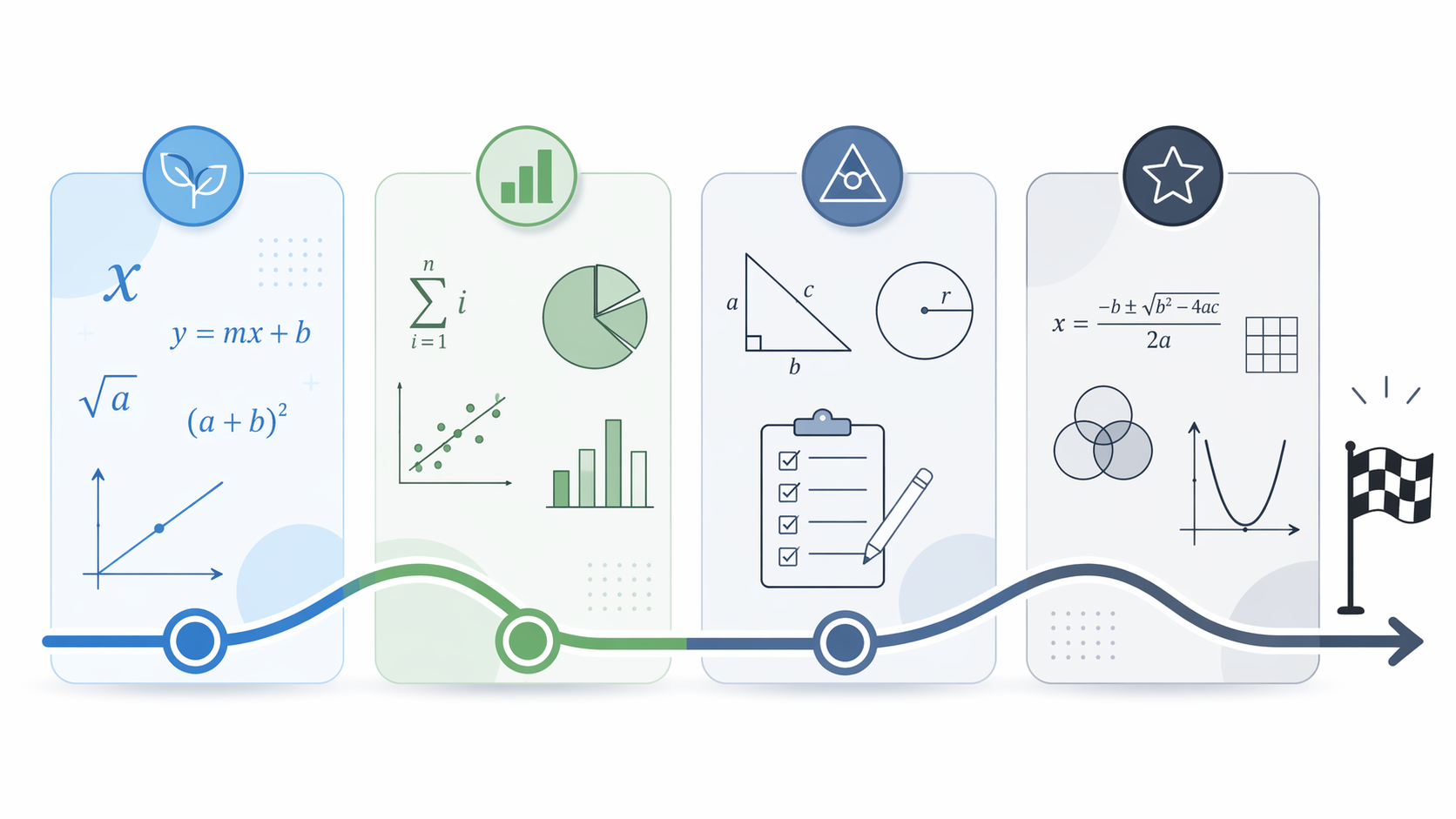
A four-week plan works only if it is honest about time. The framework below assumes regular practice of about 45–90 minutes on study days. Some prep guidance recommends roughly 10–20 hours per week for students preparing intensively, but actual score gains depend on baseline, consistency, and the quality of review.[4]
| Week | Main job | Core resources |
|---|---|---|
| Week 1 | Baseline diagnostic and Algebra foundation | Bluebook, error tracker, Khan Academy |
| Week 2 | Advanced Math plus Data Analysis | Question Bank, Khan Academy, Desmos drills |
| Week 3 | Geometry/Trig and second practice test | Bluebook, Question Bank, error tracker |
| Week 4 | Mixed review, Desmos decisions, final pacing | Bluebook review, targeted sets, formula review |
Week 1: baseline, Module 1 habits, and Algebra
Start with a timed Bluebook Math section or a full practice test if you can handle the full sitting. Do not pause, look up formulas, or give yourself a paper-test version of the digital test. The point of the baseline is not to feel good. It is to find the first three patterns that deserve your attention.
- Day 1: take the diagnostic and record every missed or guessed Math question.
- Day 2: sort misses by domain and mistake type.
- Days 3–5: repair Algebra weaknesses, especially linear equations, systems, inequalities, and expression rewriting.
- Day 6: do a timed Algebra-focused set and review it the same day.
- Day 7: light review or rest, with a short formula and error-log check.
This week should make Module 1 feel less slippery. If you are missing medium Algebra questions, do not race into the hardest Advanced Math material yet. Stabilize the points that are supposed to be yours.
Week 2: Advanced Math and Data Analysis
Week 2 moves into functions, quadratics, nonlinear equations, and data. This is where many students benefit from alternating concept repair with targeted official questions. If a Khan Academy lesson helps you understand vertex form, follow it with College Board-style questions before the idea fades into “I watched the video, so I know it.”
- Practice equivalent forms: factored form, expanded form, vertex form, and what each one reveals.
- Use Desmos for selected systems, intersections, and graph checks, then write down when it saved time.
- Add data questions involving percentages, ratios, units, scatterplots, and tables.
- Review wrong answers by cause, especially wrong-value answers and messy calculator work.
By the end of Week 2, your tracker should show whether the main problem is content, pacing, or question interpretation. Those require different fixes. A content gap needs lessons and targeted practice. A pacing problem needs timed sets. A question-interpretation problem needs slower reading at the start, not more frantic solving at the end.
Week 3: Geometry, Trig, and a second test
Week 3 brings in Geometry and Trigonometry without letting them take over the whole plan. Review area, volume, angles, triangles, circles, coordinate geometry, and basic trigonometric relationships. Make a short list of formulas you keep forgetting, especially those not supplied directly on the test interface.
Then take a second timed Bluebook test or Math section. The second test has a specific job: compare your pattern list, not just your score. Did Module 1 accuracy improve? Did Algebra misses decrease? Did Desmos help on the problems where you planned to use it? Did any old mistake return under time pressure?
For a more detailed test-taking routine, use The Right Way to Take SAT Practice Tests. If your test date is farther away than one month, switch to Digital SAT Practice Schedule 2026: A Structured 90-Day Plan instead of trying to stretch this plan unnaturally.
Week 4: mixed review and final decisions
The last week is not the time to open five new resources. Use your error log. Build mixed sets from the domains and skills that still show up. Keep sessions timed often enough that pacing stays real, but leave enough review time to fix what happened.
- Do short mixed sets that combine Algebra, Advanced Math, Data, and Geometry/Trig.
- Run Desmos drills for systems, graph intersections, regressions, and expression checks.
- Review your top five recurring mistake types and write the fix for each one.
- Practice Module 1 pacing with the goal of clean accuracy, not heroic speed.
- Stop heavy new learning close to test day and shift to review, sleep, and familiar routines.
The final version of your SAT Math practice system should be smaller than the internet makes it look: Bluebook for realism, Khan Academy for repair, Question Bank for targeting, Desmos for selected problems, and an error log that tells you what Tuesday night is for. If you need the broader test-prep picture beyond Math, use the SAT Exam Prep Guide.
References
- The Math Section: Overview, College Board.
- 9 SAT Math Tips To Boost Your Score In 2026, MentoMind.
- Types of Math Tested, College Board.
- What Math Is on the SAT in 2026, HillRock Tutors.
- Understanding SAT Trends, EdisonOS.
- Build Your Study Plan, College Board.
- 10 Free SAT Prep Tools to Help You Score Over 1500 in 2026, Strategic Test Prep.
- 6 Desmos Hacks to Boost Your SAT Math Score, Strategic Test Prep.
- Eight Most Important Desmos Features, Resolve Prep.
- 7 Most Common SAT Math Mistakes, PrepScholar.
Supporting Resources
- Know Every SAT Prep Question Type on the Digital SAT →
A complete catalog of all 21 question types on the 2026 digital SAT, with per-type frequency counts, example stems, and strategy tips so you can focus your practice where it counts.
- A Complete Guide to Kaplan SAT Prep Plans for 2026 →
A detailed breakdown of every Kaplan SAT prep plan for 2026, including On Demand, Live Online, Bootcamp, Unlimited Prep, and Private Tutoring, with honest pricing, features, and limitations to help you decide which plan is worth your money.
- These 25 SAT Example Questions Trip Up Most Students →
Discover the 25 hardest SAT example questions across Math and Reading & Writing, with the exact patterns and traps that separate 700+ scorers from the rest. Learn how mastering these multi-concept problems can close the gap to a top score.
Comments
Join the discussion with an anonymous comment.