
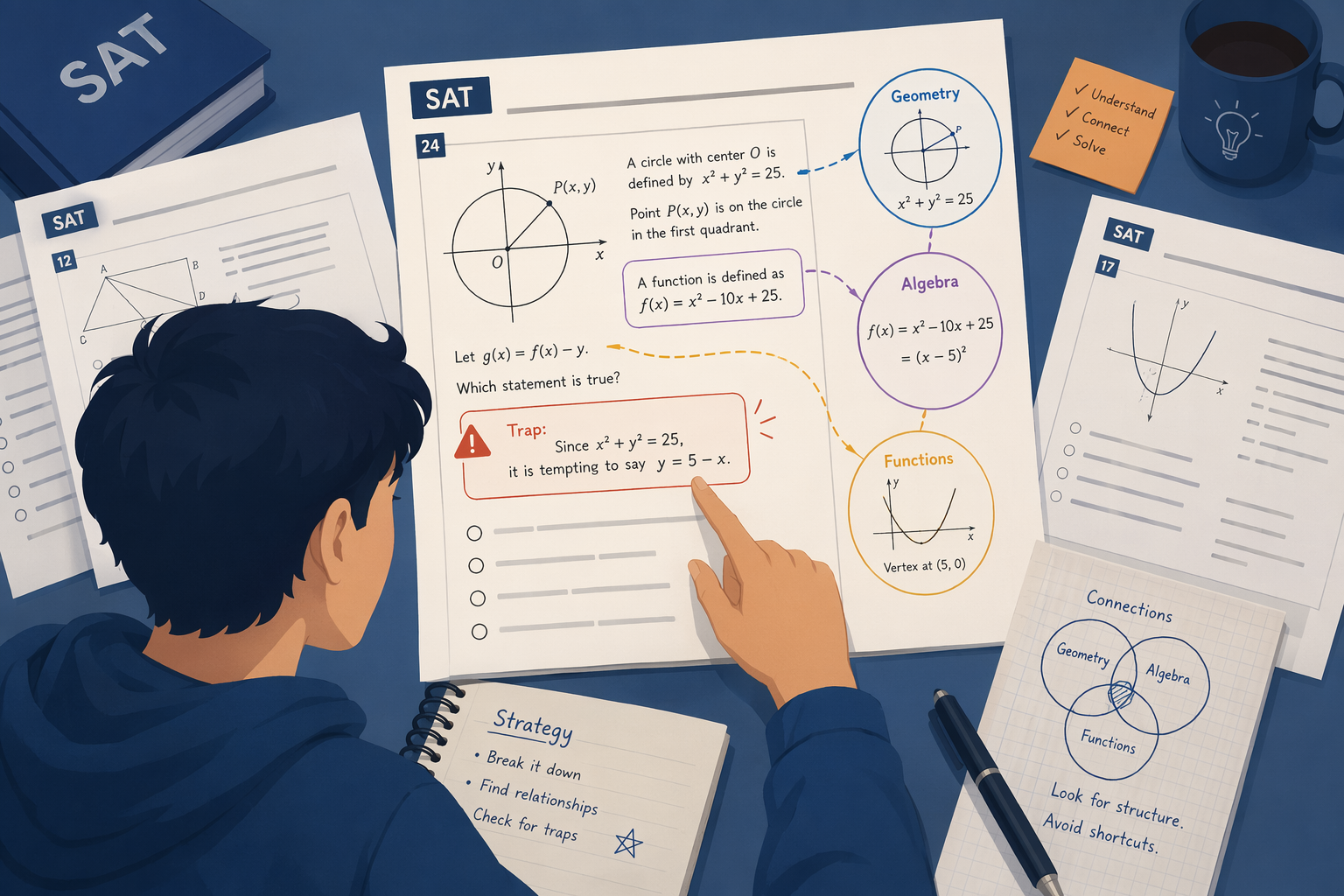
These 25 SAT Example Questions Trip Up Most Students
Discover the 25 hardest SAT example questions across Math and Reading & Writing, with the exact patterns and traps that separate 700+ scorers from the rest. Learn how mastering these multi-concept problems can close the gap to a top score.
Updated:
At some point, more SAT example questions stop telling a strong student anything new. A 680-720 scorer can usually solve the obvious algebra, spot the main idea, and finish most medium questions without drama. The remaining misses are stranger: a geometry problem that never needed geometry, a familiar word used in its less familiar sense, an inference answer that feels intelligent but reaches one sentence beyond the passage.
That is why the hardest SAT questions are not a side quest. To score 750+ on SAT Math, a student can miss only about 2-3 of 44 questions, according to PrepMaven's discussion of high-score benchmarks using IPEDS data from Ivy League schools, Caltech, and MIT; those score ranges are useful context, not an admissions guarantee for 2026 applicants.[1] At that margin, the last few errors are not decorative. They are the score.
There is one catch before we touch the hard stuff: the digital SAT is adaptive. Each Math module has 22 questions, and College Board describes the Math section as moving through questions of varying difficulty within the module; for high performers, the hardest Math problems tend to appear late in the second module route.[2] A student who practices only the most brutal questions but drops easy or medium ones in Module 1 can damage the route before the final hard questions even arrive.
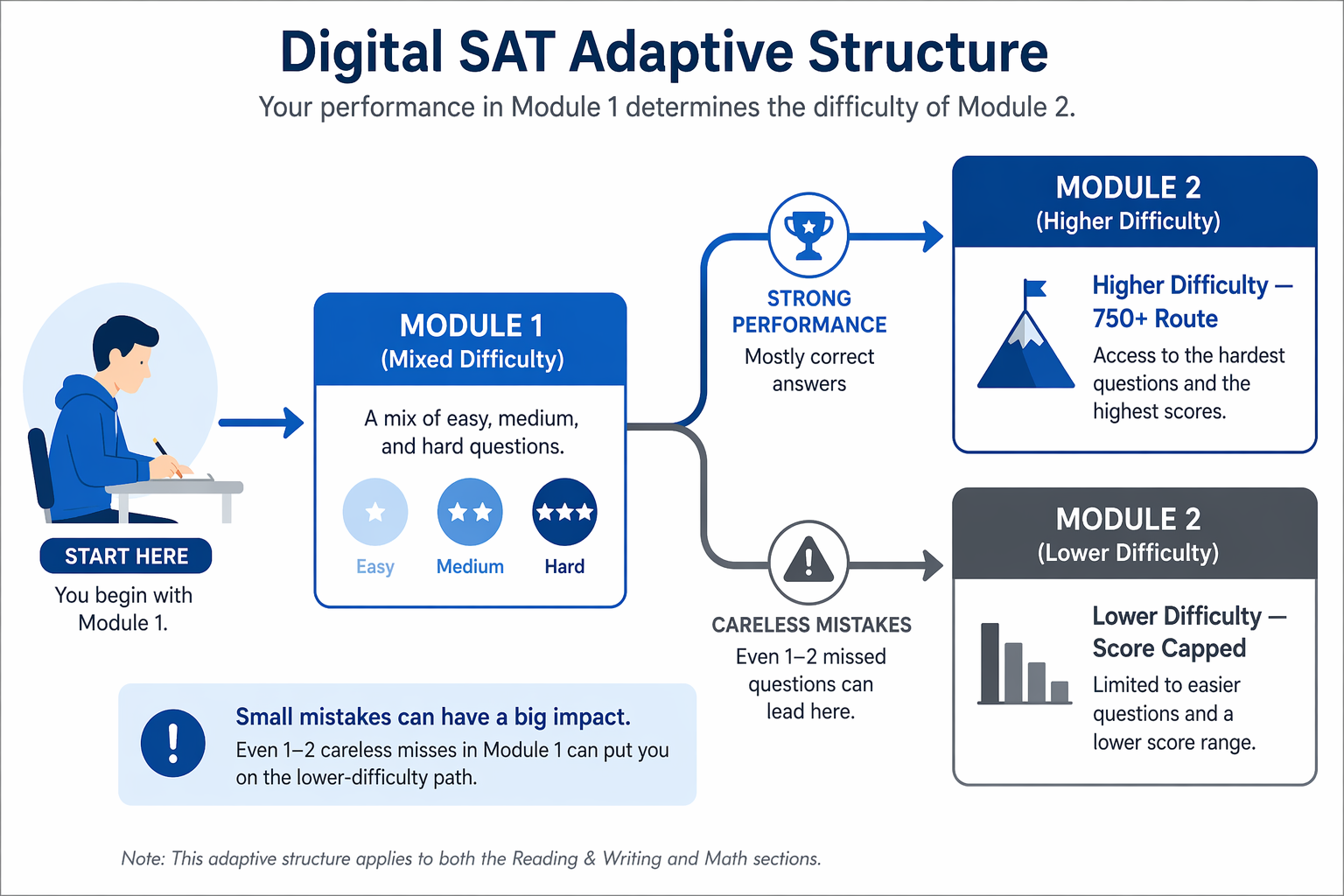
So this is not a case for skipping fundamentals. It is a case for sharper targeting once medium-difficulty accuracy is already stable. If you still need the full landscape first, start with the digital SAT question-type guide or the SAT Math domain breakdown. If you are already getting most of those questions right, the useful question becomes narrower: which traps keep surviving your review?
The 25 hard-question patterns worth practicing
The examples below are original, digital-SAT-compatible practice items written to illustrate patterns, not copied official questions. That distinction matters. College Board's Educator Question Bank contains more than 3,500 filterable questions and is the better place to confirm official wording and difficulty once you know what pattern you are hunting.[6]
| Questions | Trap pattern | What the hard question is really testing |
|---|---|---|
| 1-3 | Geometry that turns into algebra | Equations, substitution, completing the square |
| 4-6 | Polynomials and hidden structure | Remainders, difference of squares, factoring choices |
| 7-9 | Functions inside functions | Input translation before calculation |
| 10-12 | Word problems with extra translation | Units, constraints, and equation setup |
| 13-15 | Hard quantitative comparison | Parameters, equivalent forms, and non-obvious shortcuts |
| 16-18 | Logical inference | Choosing the supported answer, not the interesting answer |
| 19-20 | Command of evidence | Matching a claim to the exact data or sentence |
| 21-22 | Subtle transitions | Tracking the relationship between ideas |
| 23-25 | Words in context | Secondary meanings of familiar words |
PrepScholar flags remainder theorem, completing the square for circle equations, and difference of squares as recurring families among especially hard SAT Math problems.[5] Princeton Review groups hard Reading and Writing questions around logical inference, command of evidence, subtle transitions, and words-in-context with secondary meanings.[4] Those are the families that deserve the most attention here because they explain why the question is hard, not just which topic label it wears.
Math questions where the topic label is the bait
1. Circle equation that wants completing the square
Example: A circle in the xy-plane has equation x^2 + y^2 - 10x + 6y + 18 = 0. What is its radius?
The trap is treating this like a visual geometry problem. Complete the square: x^2 - 10x becomes (x - 5)^2 - 25, and y^2 + 6y becomes (y + 3)^2 - 9. The equation becomes (x - 5)^2 + (y + 3)^2 = 16, so the radius is 4. The hard part is not circle vocabulary; it is algebraic cleanup under pressure.
2. Triangle area hiding a quadratic
Example: A right triangle has legs with lengths 2x + 1 and x + 5. Its area is 36. What is the value of x if x is positive?
Students often start sketching, then stop. The area equation is (1/2)(2x + 1)(x + 5) = 36, so (2x + 1)(x + 5) = 72. Expand: 2x^2 + 11x + 5 = 72, or 2x^2 + 11x - 67 = 0. The positive solution is (-11 + 3sqrt(73))/4. The setup is the score-relevant skill.
3. Coordinate geometry that becomes slope logic
Example: Line m passes through (2, 7) and (8, 19). Line n is perpendicular to line m and passes through (8, 19). What is the y-intercept of line n?
The slope of m is (19 - 7)/(8 - 2) = 2, so the slope of n is -1/2. Use y = mx + b with (8, 19): 19 = (-1/2)(8) + b, so b = 23. The common mistake is to compute the first slope correctly and then reuse it instead of taking the negative reciprocal.
4. Remainder theorem without long division
Example: When p(x) = 2x^3 - 5x^2 + kx + 9 is divided by x - 3, the remainder is 12. What is k?
The remainder theorem says p(3) = 12. Substitute: 54 - 45 + 3k + 9 = 12. That simplifies to 18 + 3k = 12, so k = -2. The hard version of this question rarely asks, 'Do you know the theorem?' It asks whether you recognize that division by x - a is an input problem.
5. Difference of squares hidden inside a larger expression
Example: If a - b = 7 and a + b = 11, what is the value of a^2 - b^2?
Do not solve for a and b unless you need to. Since a^2 - b^2 = (a - b)(a + b), the value is 7 x 11 = 77. Hard SAT Math often rewards seeing the expression as a structure rather than a command to calculate every variable.
6. Factoring a parameter expression
Example: For all x, x^2 + cx + 36 = (x + d)^2. If d is positive, what is c?
Expand the right side: (x + d)^2 = x^2 + 2dx + d^2. Since d^2 = 36 and d is positive, d = 6. Therefore c = 2d = 12. The trap is answering 6 because the constant term is loud; the coefficient of x is what the question asks for.
7. Function composition with nested input
Example: If f(x) = 3x - 4 and g(x) = x^2 + 1, what is f(g(2))?
First find g(2) = 5. Then f(5) = 11. The miss usually comes from doing g(f(2)) instead. On hard function questions, write the inside input first; the notation is not decoration.
8. Function equation asking for a parameter
Example: h(x) = ax + 5. If h(h(2)) = 29 and a is positive, what is a?
h(2) = 2a + 5, so h(h(2)) = a(2a + 5) + 5 = 29. That gives 2a^2 + 5a - 24 = 0, which factors as (2a - 3)(a + 8) = 0. Since a is positive, a = 3/2. The second function layer changes a linear-looking problem into a quadratic.
9. Table-defined function with a missing value
| x | 1 | 2 | 3 | 4 |
|---|---|---|---|---|
| q(x) | 5 | 9 | 13 | 17 |
Example: The table shows values of linear function q. If r(x) = q(x) - 2x, what is r(4)?
Use the table first: q(4) = 17. Then r(4) = 17 - 8 = 9. The SAT likes this move because the table looks like the whole problem, but the actual question asks for a new function built from it.
10. Percent change with the wrong base
Example: A value increases by 20% and then decreases by 20%. What is the final value as a percent of the original?
Let the original be 100. After a 20% increase, it is 120. A 20% decrease from 120 gives 96. The final value is 96% of the original. The trap is assuming opposite percent changes cancel; they do not because the second percent uses a different base.
11. Rate problem with units that do not match
Example: A machine fills 3/5 of a tank in 12 minutes. At that rate, how many minutes does it take to fill the entire tank?
If 3/5 of the tank takes 12 minutes, then 1/5 takes 4 minutes, so 5/5 takes 20 minutes. Many wrong solutions divide 12 by 5 or multiply by 3 because the fraction is visible. The unit you want is minutes per whole tank.
12. Constraint problem where one sentence changes the equation
Example: A club sells adult tickets for $12 and student tickets for $8. It sells 90 tickets and collects $880. How many student tickets were sold?
Let s be student tickets. Then adult tickets are 90 - s. The revenue equation is 8s + 12(90 - s) = 880. This gives 8s + 1080 - 12s = 880, so -4s = -200 and s = 50. The hard part is not arithmetic; it is refusing to create two unrelated variables when one constraint already links them.
13. Equivalent expression with a non-obvious target
Example: If 4x - 3y = 18, what is the value of 8x - 6y + 5?
Double the given expression: 8x - 6y = 36. Add 5 to get 41. This is a classic precision gap. A competent student can solve systems; a precise student notices when no system is necessary.
14. Quadratic vertex from completed square form
Example: The function f is defined by f(x) = (x - 4)^2 - 9. What is the minimum value of f(x)?
Because (x - 4)^2 is never negative, its smallest value is 0. The minimum of f is -9. The tempting wrong answer is 4, the x-coordinate of the vertex. Read whether the question asks for the input or the output.
15. Linear model where the intercept is not the answer
Example: A plant is 14 centimeters tall when it is first measured. It grows at a constant rate of 3 centimeters per week. Which expression gives its height, in centimeters, t days after the first measurement?
Three centimeters per week is 3/7 centimeters per day, so the expression is 14 + (3/7)t. The SAT often hides the difficulty in the unit conversion, not in the linear model itself.
For more domain-specific Math practice after these patterns, use a domain-by-domain SAT Math guide rather than another random mixed set. Mixed sets are useful for stamina; targeted sets are better for diagnosis.
Reading and Writing questions where the wrong answer sounds better than the right one
College Board describes the Reading and Writing section as measuring comprehension, rhetoric, and language use through short passages and associated questions.[3] The hardest items usually do not punish students for missing a basic grammar rule. They punish a habit that strong readers often have: filling in the passage with a smarter, broader, or more dramatic idea than the text actually supports.
16. Logical inference that must stay small
Example: A passage says that a city expanded protected bike lanes in several neighborhoods. After the expansion, survey respondents in those neighborhoods reported feeling safer while cycling. Which conclusion is best supported?
The supported answer is narrow: some surveyed cyclists in those neighborhoods felt safer after the bike-lane expansion. A tempting wrong answer would claim the lanes reduced collisions, increased cycling citywide, or proved that protected lanes are the best safety policy. None of that appears in the evidence. Hard inference questions reward restraint.
17. Inference with correlation mistaken for cause
Example: A passage says that students who used a campus writing center more often tended to submit longer essays. Which inference is most justified?
The safe inference is that writing-center use and essay length were associated in the described group. The unsafe inference is that the writing center caused students to write longer essays. Unless the passage describes an experiment or rules out other explanations, causation is too strong.
18. Inference where the answer repeats the passage too aggressively
Example: A passage says that a poet's early work received little public attention, though several later critics admired its technical control. Which conclusion is best supported?
A supported answer might say that the poet's early work was more appreciated by some later critics than by the poet's original public audience. A wrong answer might say the poet was ignored because the work was too technically advanced. That explanation is interesting. It is also invented.
19. Evidence question that asks for the exact match, not the strongest sentence
Example: A student claims that a new exhibit increased museum attendance among local residents. Which finding would most directly support the claim?
The best evidence would compare local-resident attendance before and after the exhibit. Evidence that total ticket revenue rose is weaker because prices or tourist attendance could explain it. Evidence that visitors liked the exhibit is also weaker because satisfaction is not attendance.
20. Data support where the denominator changes
Example: A table shows that School A had 40 students join a robotics club, while School B had 30. The passage asks which claim is supported about participation rates.
You cannot compare participation rates from raw counts unless you know the total number of students at each school. The hard version of this question offers a confident-sounding answer about School A's higher rate. The number 40 is larger than 30, but a rate needs a denominator.
21. Transition where both choices sound fluent
Example: Sentence 1 says a scientist expected a material to become brittle at low temperatures. Sentence 2 says later tests showed the material remained flexible. Which transition best begins Sentence 2?
A contrast transition such as 'However' fits. 'Similarly' may sound smooth, but it reverses the relationship. On hard transition questions, do not choose the word with the nicest rhythm. Name the relationship first: contrast, continuation, cause, result, example, or concession.
22. Transition where the second sentence narrows the first
Example: Sentence 1 says many animals use sound to communicate. Sentence 2 focuses specifically on how elephants use low-frequency calls. Which transition best connects them?
The second sentence is an example or specification, so a phrase like 'For instance' fits. A contrast word would create a conflict that the ideas do not have. The question is easy only if you track the job of the second sentence, not just its topic.
23. Words in context: "marked"
Example: 'The committee noted a marked improvement in the archive's cataloging system.' In context, what does 'marked' most nearly mean?
Here, 'marked' means noticeable or significant, not physically labeled. The familiar definition is the bait. The sentence is about degree of improvement, not an object with writing on it.
24. Words in context: "qualified"
Example: 'The historian offered qualified praise for the biography, admiring its research but questioning its conclusions.' In context, what does 'qualified' most nearly mean?
It means limited or conditional, not certified. The clue is the split judgment: admiration plus criticism. Hard vocabulary questions often use common words in academic senses.
25. Words in context: "maintain"
Example: 'Some researchers maintain that the pattern reflects short-term adaptation rather than permanent change.' In context, what does 'maintain' most nearly mean?
It means assert or argue, not preserve. If you read only the common physical meaning, you miss the sentence's argumentative structure. The researchers are taking a position.
How to practice these without wrecking the adaptive foundation
Hard-question practice works best after your medium questions are boringly reliable. If you are still missing routine linear equations, basic punctuation, or direct evidence questions, move down a difficulty tier first. A difficulty-based SAT practice guide will do more for you than a heroic pile of final-module monsters.
- Sort misses by trap, not topic: 'circle equation' is less useful than 'forgot to complete the square.'
- Keep a separate log for careless Module 1 errors; those are route-threatening, not merely annoying.
- Redo hard questions after 3-5 days without looking at the explanation; recognition has to survive a delay.
- Pair hard sets with mixed medium sets so your accuracy does not become specialized and fragile.
- For R&W, write the one sentence in the passage that proves the answer; if you cannot point to it, the answer is probably too broad.
A useful review cycle is not 'do more, check score, repeat.' It is closer to: attempt, classify, explain the trap, redo, then test the same pattern in a new context. If you want that process spelled out, use a practice-question review system rather than relying on answer explanations you skim once.
The better question is not whether you can survive one impossible-looking item. It is whether you can recognize the move when it appears with different clothing: a circle that wants algebra, a polynomial that wants substitution, a passage that wants restraint, a vocabulary word that wants its second meaning.
Once the medium layer is stable, targeted review of multi-concept and pattern-recognition problems is the smarter path from roughly 650-700 toward 750+ than high-volume random practice. Put that work into a schedule, such as a structured digital SAT practice plan, and the final misses become easier to name. That is usually when they become easier to remove.
References
- 25 of the Hardest SAT Math Problems in 2026-27 — PrepMaven
- The Math Section: Overview — College Board
- The Reading and Writing Section — College Board
- Hardest SAT English Questions: Examples & Strategies — The Princeton Review
- The 15 Hardest SAT Math Questions Ever — PrepScholar
- Educator Question Bank — College Board
Comments
Join the discussion with an anonymous comment.