
SAT
Many students still think Khan Academy hosts SAT practice tests. This guide clarifies the two-platform system: take full-length adaptive tests in College Board's Bluebook app, then use Khan Academy for personalized skill lessons linked to your results.
Updated:
If you searched for “khan academy sat practice tests,” the clean answer in 2026 is this: do not look for full-length SAT practice tests inside Khan Academy. Take the full-length adaptive Digital SAT practice tests in College Board’s Bluebook app, then use Khan Academy to review missed questions and rebuild the skills behind them.
That split has been in place since January 2024, when full-length SAT practice tests moved out of Khan Academy and into Bluebook.[1] As of mid-2026, College Board’s public practice-test page shows the current Bluebook set after earlier tests were retired: Tests 1–3 were retired in February 2025, with Tests 4–10 remaining, which means students should think of the supply as roughly 6–7 full-length adaptive tests depending on current College Board availability.[2] That count can change when College Board releases or retires tests, so the safest habit is to check Bluebook itself before planning every Saturday around a test number.
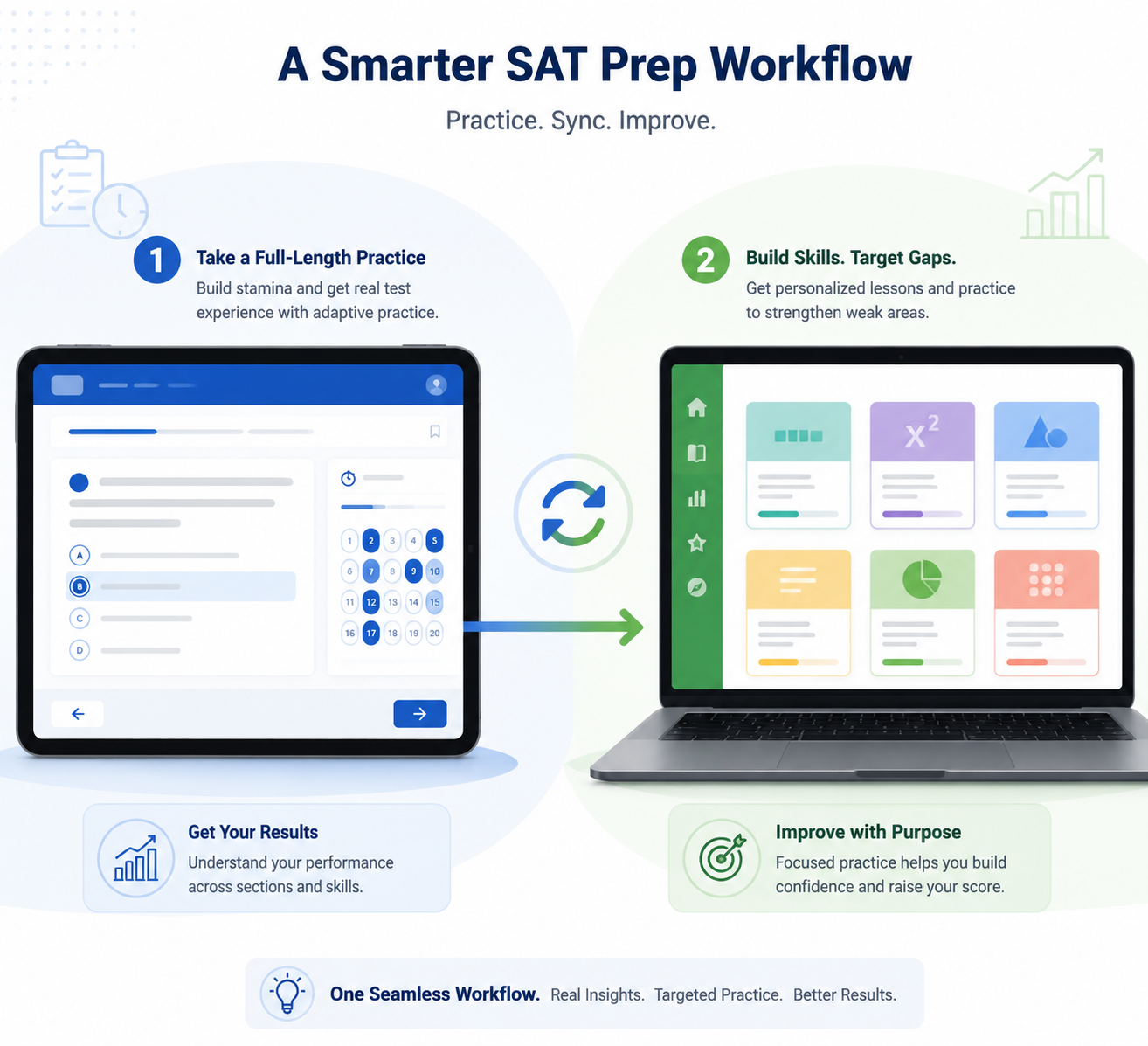
The Two-Platform Answer
Bluebook and Khan Academy are not competing places to take the same test. They now do different jobs in the official practice system.
| What you need to do | Where it happens | Why it matters |
|---|---|---|
| Take a realistic full-length adaptive SAT practice test | Bluebook | It matches the digital testing app students use for official SAT administration. |
| Review your practice-test results | My Practice | It shows your performance after the Bluebook test and connects the next step. |
| Open targeted review from your missed questions | Practice on Khan Academy | It sends you to walkthroughs and lessons tied to the skills you missed. |
| Rebuild weak Reading and Writing or Math skills | Khan Academy | It gives official free skill practice instead of asking you to guess what to study next. |
The workflow is official, not a workaround. College Board describes the post-test path this way: after a Bluebook practice test, students go to My Practice and use “Practice on Khan Academy” to get walkthrough videos for missed questions and links to related skill lessons.[3] That is the part many older guides blur. Khan Academy is still useful, but it is no longer the place where the full-length adaptive tests live.
How to Take the Practice Test Without Losing the Trail
Start in Bluebook. Download or open the app, sign in with the account you use for College Board, and choose a full-length SAT practice test. Treat that test as the scarce resource it is: sit somewhere quiet, use the built-in timing, and do not pause every few minutes to check notes. If the goal is to learn how you perform on the Digital SAT, the app conditions matter.
This is also where students can accidentally damage the value of an official test. Taking one section at lunch, finishing the rest after practice, or using outside calculators and tabs may feel efficient, but it gives you a noisy score report. If setup mistakes are already a concern, read common Bluebook Digital SAT practice mistakes before burning through another official test.
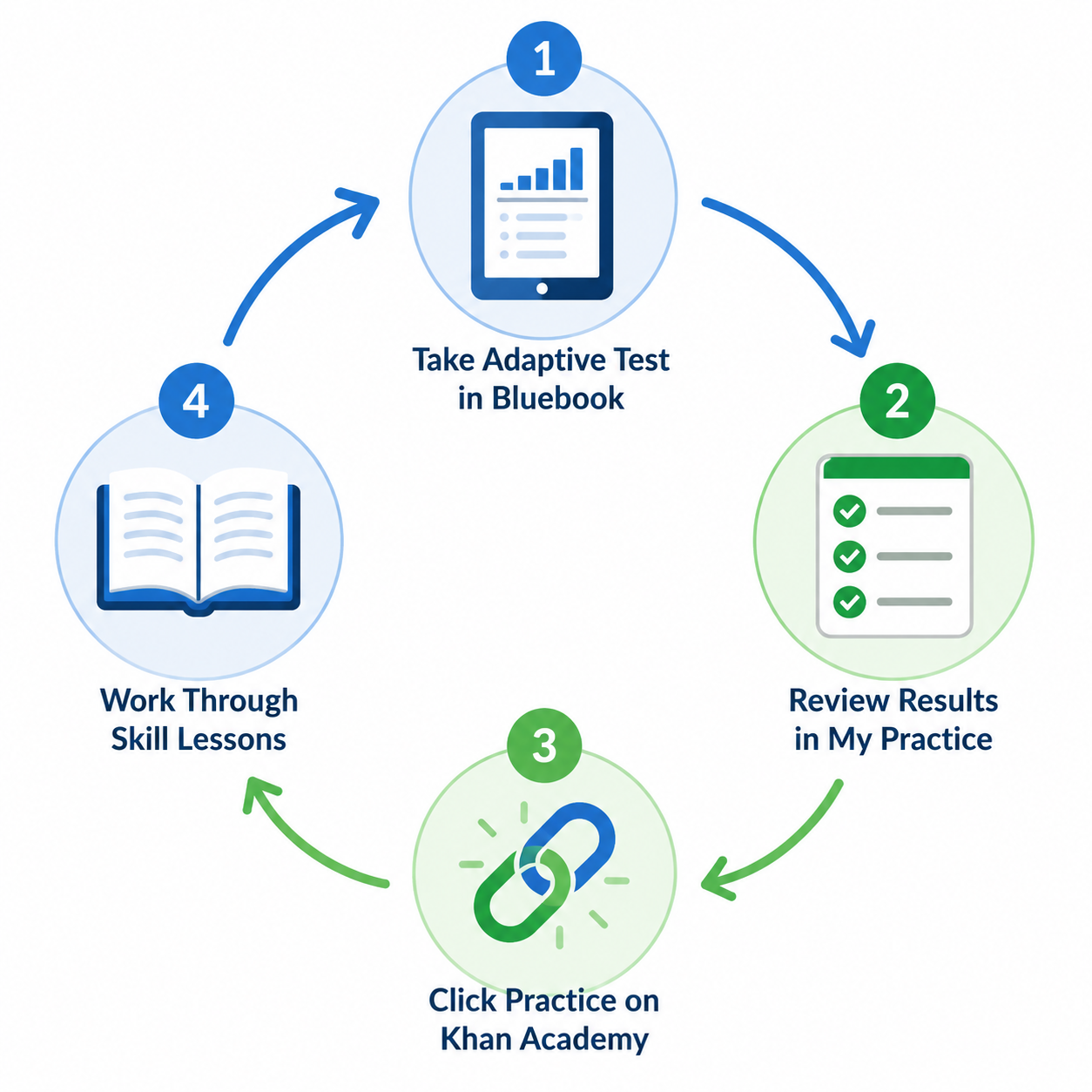
After the test, do not jump straight into another one. Go to My Practice, look at the results, and use the Khan Academy connection from there. The useful sequence is boring in the best possible way:
- Take one full-length adaptive SAT practice test in Bluebook.
- Open your results in My Practice.
- Click “Practice on Khan Academy.”
- Watch or read the walkthroughs for questions you missed.
- Complete the linked Khan Academy skill lessons and practice sets.
- Wait until you have actually corrected patterns before taking the next Bluebook test.
What Khan Academy Still Does After the Test
Khan Academy’s value is not that it imitates the full test. Its value is that it breaks the score report into teachable pieces. For Math, the Digital SAT course covers 37 skills across 12 units. For Reading and Writing, the expanded course has 11 skills across 11 units, with three difficulty levels for each skill.[4] That structure matters because “I got a 620” is not a study plan. “I keep missing medium and hard questions on linear equations” is.
The post-test review is where Khan Academy is at its best. A missed Bluebook question becomes a reason to inspect the underlying skill, not just the answer choice. In Math, that might mean moving from a missed systems question into a focused lesson and practice set. In Reading and Writing, it might mean realizing that several wrong answers came from the same grammar or rhetorical-synthesis skill rather than from “careless reading” in general.
The official partnership is also worth naming plainly. Khan Academy’s SAT prep is developed in collaboration with College Board, the maker of the SAT, and College Board describes it as the official free SAT prep resource.[5] That does not make every lesson thrilling. It does make the material unusually safe as a first stop, especially for students who are trying to avoid a stack of paid resources before they know what their actual weak spots are.
Use Missed Questions as Directions, Not as a Shame List
A good review session should produce a short work order. Do not write down every missed question number and call that review. Sort the misses into patterns you can act on: concept gap, timing pressure, misread question, wrong strategy, or unfamiliar digital-tool behavior. Then choose the Khan Academy lesson or practice set that matches the pattern.
For example, if a student misses two similar Math questions because they set up the equation incorrectly, the next move is not another full test. The next move is the linked algebra skill work, followed by a few fresh questions at the appropriate difficulty level. If a student misses Reading and Writing questions because they keep choosing answers that sound good but do not satisfy the stated task, the next move is targeted practice in that question type, not rereading an entire grammar guide from page one.
How Often to Use Bluebook Tests
Because the official Bluebook tests are limited, they should anchor your prep instead of filling every study block. A reasonable rhythm is to take a full Bluebook test, spend several study sessions repairing the clearest weaknesses in Khan Academy, and then take another full test only when you have changed something meaningful about your performance.
That rhythm is especially important in the last few months before a test date. If you want a week-by-week version, use a structured 90-day Digital SAT practice schedule rather than improvising with one full-length test after another. The main rule is simple: Bluebook measures and simulates; Khan Academy teaches and repairs.
Families sometimes ask whether free prep is “enough” to take seriously. Older evidence suggests it can be. A 2017 College Board analysis of about 250,000 students found that 20 hours of Official SAT Practice on Khan Academy was associated with an average 115-point score gain, while 6–8 hours was associated with a 90-point gain.[6] That was from the paper-SAT era, and association is not a promise that 20 hours will produce the same result for a Digital SAT student now. Still, it is a useful warning against dismissing official free practice as filler.
When Khan Academy May Not Be Enough
Khan Academy is not a live tutor. It does not watch a student solve a problem, interrupt a bad habit, or hold office hours after a discouraging practice test. Some students also find the videos plain; one Test Prep Insight review describes parts of the lesson experience as resembling outdated PowerPoint presentations and notes the lack of live classes or office hours.[7] That criticism is useful when it is about teaching style and support. It is less useful when it implies Khan Academy’s current role can be judged by counting full-length tests inside Khan alone, because the full tests are now in Bluebook.
A student who can self-correct from explanations may be well served by the official Bluebook-plus-Khan routine for a long time. A student who repeatedly misses the same category after doing the linked lessons may need another layer: a teacher, tutor, class, AI tutor, or more specialized strategy resource. If you are comparing those options, start with Khan Academy vs. AI SAT tutors or a broader SAT prep toolkit instead of buying the first program that promises a score jump.
A Usable Routine for 2026
Here is the routine that solves the original search problem. Do not search Khan Academy for full-length SAT practice tests. Open Bluebook for the realistic adaptive test. Review the result in My Practice. Use “Practice on Khan Academy” for missed-question walkthroughs and linked skill lessons. Then do enough targeted work that the next Bluebook test measures new behavior, not the same old confusion.
For the broader testing ecosystem, keep a Digital SAT prep guide nearby. For this specific question, the path is already set: Bluebook for full-length practice tests, Khan Academy for official free remediation, repeated in a test-review-skill-work cycle.
References
- Help Center community post, Khan Academy Help Center, 2024.
- SAT Practice Tests, College Board.
- How to Use Khan Academy, College Board.
- Introducing Khan Academy’s Expanded Digital SAT Reading & Writing Course, Khan Academy Blog.
- College Board Khan Academy for Better SAT Prep, College Board Blog.
- New Data Links 20 Hours of Personalized Official SAT Practice on Khan Academy to 115-Point Average Score Gains on Redesigned SAT, College Board Newsroom, 2017.
- Khan Academy SAT Prep Review, Test Prep Insight.
Supporting Resources
- LSAT Prep App Comparison 2026: Find the Best Fit for Your Study Style →
Compare the top LSAT prep apps of 2026 across question volume, mobile access, live classes, AI analytics, and pricing to find the platform that matches your study preferences and budget.
- How to Build a Daily GRE Vocabulary Flashcard Habit That Actually Works →
A practical guide for GRE test-takers who struggle with consistency. Learn the daily system that 160+ Verbal scorers use: a structured blend of spaced-repetition flashcards, contextual reading, and active recall testing that compounds over 6–8 weeks.
- GRE Prep by the Numbers: Cost, Time & Score Data to Build Your Personal Prep Plan →
Break down GRE prep with hard numbers: costs from free to premium, required study hours per score band, score improvement guarantees, practice test benchmarks, and cost-per-point analysis. Make an informed, math-backed decision on your prep path.
Comments
Join the discussion with an anonymous comment.