
Digital SAT
This 90-day digital SAT practice schedule breaks your prep into three focused phases — foundation, targeted practice, and test-day simulation — so you know exactly what to study each week leading up to your fall 2026 exam date. Learn how to structure daily sessions around Bluebook tests, Desmos calculator drills, and error-log analysis to maximize your score gain.
Updated:
A digital SAT practice schedule for 2026 has to answer a boring but important question: what do you do after school today, when the test is coming this fall and you have about 45 minutes before homework takes over?
The answer is not “review math” or “work on reading.” That is how students lose three weeks feeling busy. A useful 90-day plan tells you when to take Bluebook tests, when to drill, when to review mistakes, and when to stop burning through full-length exams. College Board reports that 6–8 hours of Official SAT Practice is associated with a 90-point gain, and 20 hours is associated with a 115-point gain; that is correlation, not a guarantee, but it is enough reason to treat official practice as the backbone of the schedule rather than an optional add-on.[1]
This plan is built for students who can study 45–60 minutes a day, 5–6 days per week. If that is not your life right now, use the same order of priorities and stretch the timeline. The mistake is not needing more time. The mistake is doing random prep and calling it a plan.
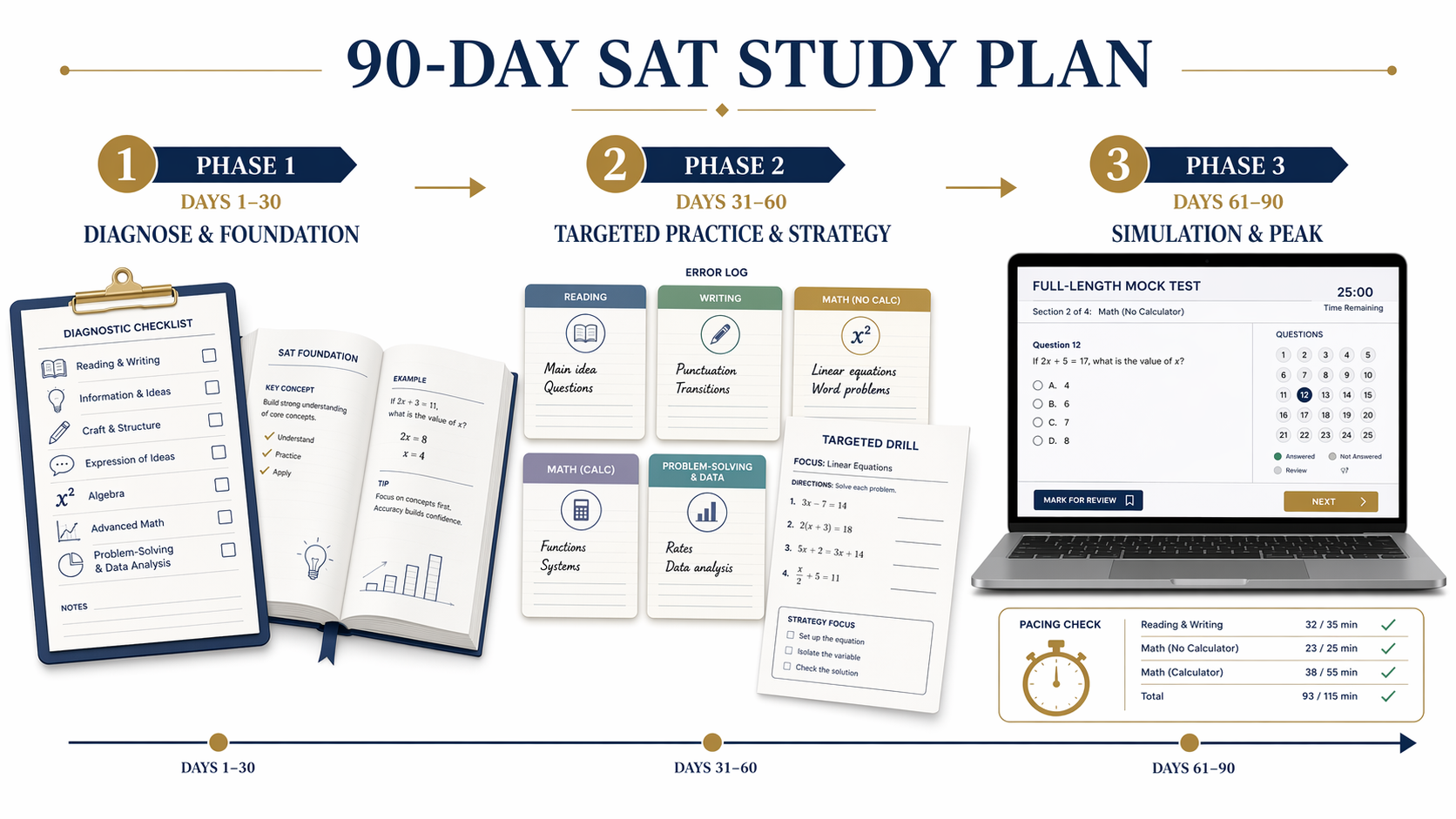
The 90-Day Digital SAT Schedule at a Glance
| Days | Phase | Main job | Weekly rhythm | Bluebook placement |
|---|---|---|---|---|
| 1–30 | Diagnose and Foundation | Find your baseline, learn the digital format, build the first error log, and fix the most obvious content gaps. | 4 skill days, 1 mixed practice day, 1 review or catch-up day, 1 lighter day or rest day. | Take 1 full-length Bluebook test near the beginning, then use shorter official practice sets before the next full test. |
| 31–60 | Targeted Practice and Strategy | Turn recurring mistakes into weekly drills and pacing changes. | 2 Reading and Writing days, 2 Math days with Desmos, 1 mixed timed day, 1 error-log review day. | Take 1 full-length Bluebook test around the middle of this phase, at least about 2 weeks after the first. |
| 61–90 | Test-Day Simulation and Peak Performance | Practice full-test stamina, module pacing, and final weak spots without exhausting yourself. | 1 full or half simulation week when scheduled, 3 targeted drill days, 1 review day, 1 light accuracy day. | Use 2–4 more Bluebook tests, spaced out, ending with enough time to review instead of cramming. |
Across the full 90 days, plan on 4–6 full-length Bluebook tests total. More is not automatically better. Bluebook tests are limited, and several prep sources recommend spacing them rather than taking them back-to-back; the exact number available has been described inconsistently across sources, likely because releases have changed over time.[4][5]
You should also keep a daily 15-minute Desmos habit on math days. That does not mean opening the calculator once and admiring it. It means solving linear systems, graphing quadratics, checking intersections, using tables, and learning when Desmos is faster than hand algebra. Tutree identifies at least 15 minutes of daily Desmos mastery as a high-leverage math strategy for digital SAT prep.[3]
Why Module 1 Accuracy Changes the Schedule
The digital SAT is adaptive by section. Your performance on Module 1 affects the difficulty of Module 2. Test Ninjas describes an estimated score threshold around 570–600 per section for reaching the harder, higher-scoring second module, though this threshold is not officially confirmed by College Board and may shift.[2]
That matters because early-module mistakes are not just “one wrong question.” A careless miss on an easier Module 1 question can cost more than the point in front of you if it keeps you out of the harder Module 2 path. So the first month of this schedule does not chase the hardest questions first. It builds clean accuracy on the questions you are supposed to get right.
If you already score high, you will still need hard-question practice. But if your Module 1 work is messy, the schedule starts there. No student should spend all week wrestling with the nastiest advanced math problem while still dropping points on linear equations, punctuation boundaries, or words-in-context questions under time.
Your Weekly Rhythm
Most students do better with a repeating week than with a perfect calendar. A repeating week survives a club meeting, a bad chemistry test, or a missed Thursday. Here is the default rhythm for a normal non-Bluebook week:
| Day | Main work | What the session should produce |
|---|---|---|
| Day 1 | Reading and Writing accuracy | A small set of timed questions plus 3–5 logged mistakes or confirmations. |
| Day 2 | Math accuracy with 15 minutes of Desmos | A focused drill on one math category and notes on which problems Desmos made faster. |
| Day 3 | Reading and Writing timing | Timed practice by question type, then review of wrong and slow questions. |
| Day 4 | Math timing with 15 minutes of Desmos | Timed module-style work, with pacing notes. |
| Day 5 | Mixed timed practice | A short digital-format set that forces section switching and time awareness. |
| Day 6 | Error-log review and redo day | Redone missed questions, one new drill list, and one adjustment for next week. |
| Day 7 | Rest or light review | No new heavy work unless you missed a day. |
On weeks with a full-length Bluebook test, the test replaces the mixed timed day and part of the review day. Do not add a full test on top of a normal week and then wonder why everything feels terrible.
If you need help choosing tools before you start, use the diagnostic and budget framework in How to Build Your SAT Prep Toolkit. This schedule assumes you have at least Bluebook, official practice access, a notebook or spreadsheet error log, and a way to do timed question sets.
The 45-Minute Daily Session Template
A tired student needs a session that starts quickly. Do not spend the first 12 minutes deciding what to study. Pick the category the night before, open the timer, and work.
| Time | Task | What to avoid |
|---|---|---|
| 5 minutes | Review the last 2–3 relevant error-log entries. | Rereading every old note. |
| 20 minutes | Do a timed question set in one narrow category. | Mixing too many skills and learning nothing from the result. |
| 10 minutes | Review every wrong, guessed, and slow question. | Only checking the answer key. |
| 10 minutes | Log the pattern and choose the next drill. | Writing “be careful” as if that is a strategy. |
On math days, insert the 15-minute Desmos block into the 20-minute timed practice or add it as the first part of the session. Desmos work should be attached to real SAT-style questions whenever possible. Separate calculator play is fine for learning buttons, but score gains come from knowing when the tool changes the fastest path through a problem.
Phase 1: Days 1–30 — Diagnose, Then Build a Foundation
Start with a full-length Bluebook test in the first few days if you can. Take it under realistic conditions: one sitting, proper breaks, no phone, no pausing to look up formulas. The point is not to judge your future score. The point is to stop guessing what your problems are.
After that diagnostic, do not immediately take another full test. Spend the rest of the first week pulling the score apart. Separate Reading and Writing from Math. Then separate each section into question types, timing problems, and careless errors. A diagnostic that becomes one number is almost useless. A diagnostic that becomes next week’s drill list is worth taking.
- For Reading and Writing, track grammar boundaries, transitions, words in context, command of evidence, rhetorical synthesis, and questions where you narrowed to two choices but chose the wrong one.
- For Math, track linear equations, systems, functions, quadratics, data analysis, geometry, advanced math, and whether Desmos would have shortened the solution.
- For timing, mark whether you were slow because you did not know the content, used an inefficient method, reread too much, or froze after a hard question.
- For careless errors, write the actual behavior: copied the wrong value, answered the wrong question, missed “except,” rounded too early, or picked a grammatically possible answer that did not fit the sentence.
During Phase 1, your goal is clean work on accessible questions. That usually means shorter timed sets, not heroic marathon sessions. A student who fixes 10 recurring easy and medium misses in Month 1 is in better shape than a student who watches 20 videos and cannot name what changed.
A Phase 1 Week
| Day | Work |
|---|---|
| Monday | Reading and Writing: one grammar or transition category, timed, then reviewed. |
| Tuesday | Math: linear equations or systems, including 15 minutes of Desmos graphing and solving. |
| Wednesday | Reading and Writing: words in context or evidence questions, with notes on wrong answer traps. |
| Thursday | Math: functions or quadratics, including Desmos tables, graphs, and intersections. |
| Friday | Short mixed timed set from both sections. |
| Saturday | Error-log review, redo missed questions, and choose next week’s two weakest categories. |
| Sunday | Rest or 20 minutes of light formula, grammar, or vocabulary review. |
If you are also using the broader SAT Exam Prep Guide, treat this article as the day-to-day schedule and the guide as the parent map for test format, registration, and bigger prep decisions.
The Error Log Is the Plan
An error log is not a punishment notebook. It is the only way to know whether your prep is changing anything. Tutree and Test Ninjas describe a useful method: categorize misses as content gaps, careless errors, or timing issues, and look for the few recurring error types that account for most lost points; they estimate that 3–5 error types typically account for about 80% of lost points.[3][2]
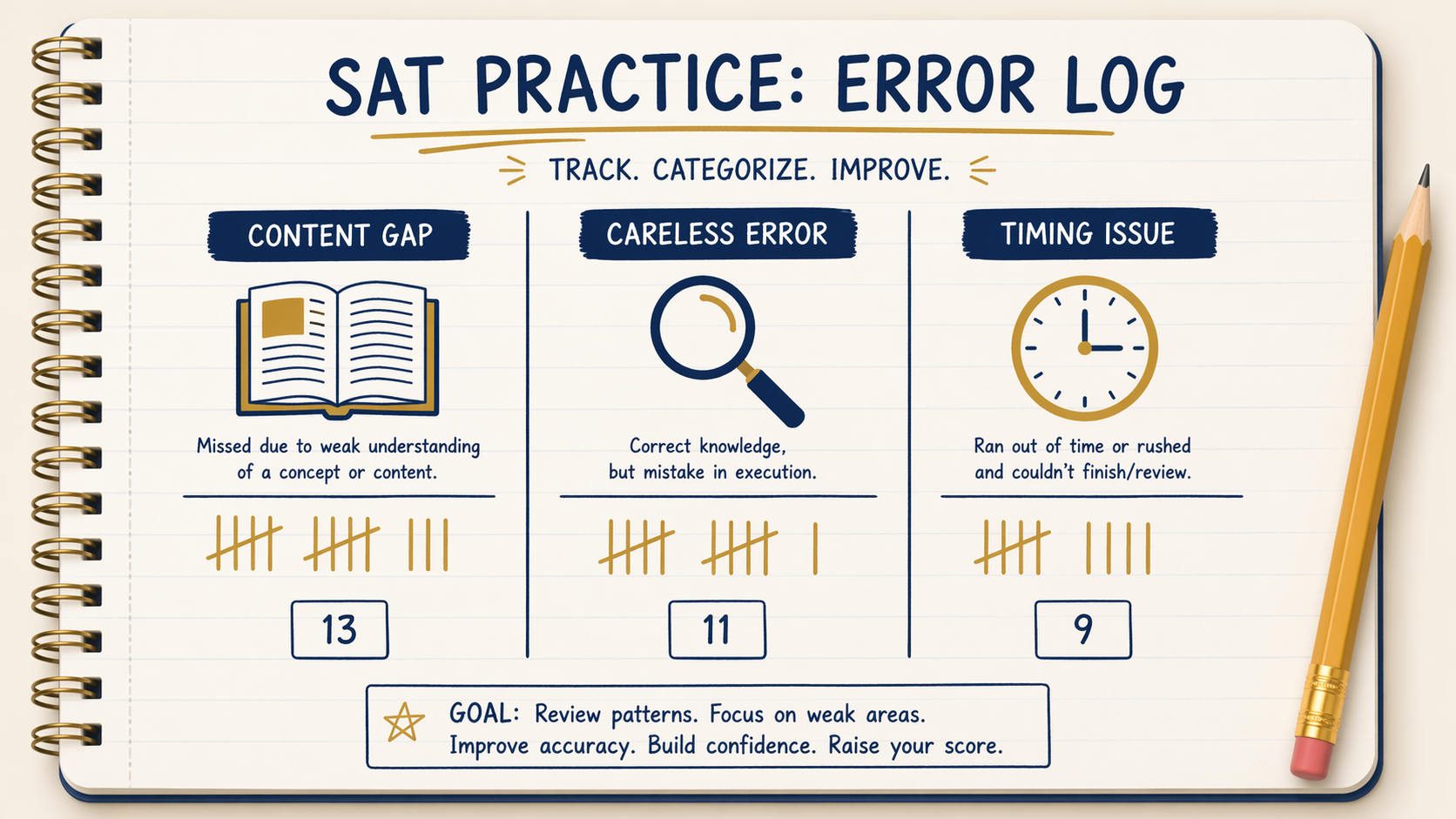
Keep the log simple enough that you will actually use it. A spreadsheet works. A notebook works. A messy document works if it gets reviewed. The minimum useful columns are:
| Column | What to write |
|---|---|
| Date | When you missed or struggled with the question. |
| Section | Reading and Writing or Math. |
| Question type | The narrowest useful label, such as transitions, systems, or function notation. |
| Error category | Content gap, careless error, timing issue, or strategy choice. |
| Actual reason | One sentence explaining what happened. |
| Fix | The next drill, rule, Desmos method, or pacing adjustment. |
| Redo date | When you will retry the question or a similar one. |
The “actual reason” column is where most students try to escape. “I got it wrong” is not a reason. “I solved for x but the question asked for x + 3” is a reason. “I knew the grammar rule but ignored the comma before the transition” is a reason. “I spent 2 minutes doing algebra that Desmos could graph in 20 seconds” is a reason.
Phase 2: Days 31–60 — Turn Mistakes Into Drills
Phase 2 is where most of the score movement should be earned. You have enough data to stop studying everything equally. Each week should begin with the error log and end with a short verdict: which error type decreased, which one stayed stubborn, and what changes next week?
This is also where you take your second full-length Bluebook test, usually around the middle of the phase, spaced at least about 2 weeks from the previous full test. The score matters, but the review matters more. A 30-point dip after a harder week is not a crisis. Repeating the same preventable errors from the diagnostic is a problem.
How to Convert an Error Pattern Into a Week
Suppose your log shows repeated misses on transition questions, systems of equations, and Math timing. That does not mean “study English and math.” It means the week should be built around those three patterns.
| Pattern | Drill | Review question |
|---|---|---|
| Transition misses | Do a timed set of transition questions only. | Did I identify the relationship before looking at the choices? |
| Systems of equations | Solve systems by elimination, substitution, and Desmos graphing. | Which method was fastest and least error-prone? |
| Math timing issue | Run a short timed set with a skip rule. | Which question should I have left and returned to? |
The review question is not decoration. It tells tomorrow’s version of you what to do differently. If the answer is vague, the drill was too vague.
Reading and Writing in Phase 2
Reading and Writing practice should be narrow before it becomes mixed. If you miss transitions, drill transitions. If you miss rhetorical synthesis, drill synthesis. If words-in-context questions are slow, practice predicting the meaning before checking the choices. Mixed practice is useful only after you know what behavior you are trying to test.
For grammar questions, write rules in plain language. “Independent clauses need correct punctuation” is useful. A copied paragraph from a grammar website is less useful at 9:15 p.m. when you are trying to decide between a comma and a semicolon.
Math in Phase 2
Math practice should include two tracks: skill repair and method choice. Skill repair means you relearn the content you genuinely do not know. Method choice means you compare hand solving, substitution, graphing, tables, and Desmos features so you stop using the slowest correct method by default.
- For linear equations and systems, practice solving by hand and checking with graphs or intersections.
- For quadratics, practice factoring when obvious, then use graphing and tables to inspect roots, intercepts, and vertex behavior.
- For function questions, use tables to test inputs and outputs instead of relying only on symbolic manipulation.
- For word problems, translate first, calculate second, and mark whether the error came from setup or arithmetic.
The daily Desmos block belongs here even if you are “not a calculator person.” The digital SAT gives you the tool. Refusing to get fluent with it is not a personality trait; it is giving up time.
Phase 3: Days 61–90 — Simulate the Test Without Wasting the Tests
Phase 3 is not 30 days of full-length tests. That sounds serious and usually produces tired, shallow review. Use the remaining Bluebook tests carefully. A typical student only needs 2–4 more full-length tests in this phase, depending on how many were used earlier, for a total of 4–6 across the full plan.
A full test should create two review days: one for Reading and Writing, one for Math. If you take a test on Saturday and never review it properly, you did not complete the test. You just donated a morning to a score report.
A Phase 3 Bluebook Week
| Day | Work |
|---|---|
| Monday | Light targeted drill from last week’s error log. |
| Tuesday | Math practice with 15 minutes of Desmos, focused on one recurring issue. |
| Wednesday | Reading and Writing timed set, focused on accuracy before speed. |
| Thursday | Short mixed review and pacing plan for the practice test. |
| Friday | Rest or very light formula and grammar review. |
| Saturday | Full-length Bluebook test under realistic conditions. |
| Sunday | Review the test enough to label mistakes, then finish deeper review on Monday if needed. |
In the final two weeks, protect sleep and review quality. You can still drill. You can still improve decisions. But starting a huge new content project right before the test usually creates more noise than benefit.
How to Adjust When Real Life Interrupts
A schedule that collapses after one missed day is not a schedule. It is a guilt machine. Use these rules instead.
- If you miss one weekday, do not double the next day. Move the missed skill to your review or catch-up day.
- If you miss three or more days, restart with the error log, not with a panic full-length test.
- If a practice-test score drops, compare error types before changing the whole plan.
- If Math improves but Reading and Writing stalls, shift one mixed day into a narrow Reading and Writing drill day for two weeks.
- If timing improves but accuracy falls, slow down the first module and rebuild clean work before chasing speed again.
Students often want to change resources when scores wobble. Sometimes that is necessary. More often, the problem is that they have not reviewed deeply enough to know what changed. Before buying anything new, check whether your last two weeks of errors are actually labeled and whether the same mistakes are being redone correctly.
What a Realistic Score Gain Looks Like
A 100–200 point improvement over 90 days is a realistic possibility for a student who starts with room to grow, studies consistently, uses official practice, reviews errors honestly, and fixes the patterns that keep repeating. It is not a promise. Commercial prep sources often report gains from motivated or self-selected students, so treat the range as a planning target rather than a contract.
The better readiness standard is behavioral. By the final weeks, you should be able to name your top recurring error types without checking your notes. You should know when Desmos helps and when it slows you down. You should have taken spaced Bluebook tests, not a pile of rushed exams. You should have a Module 1 accuracy plan, because early mistakes can affect the rest of the section.
That is higher-quality prep than “studying SAT content” for three months. It gives you something to do today, something to measure this week, and something to adjust before the fall 2026 test arrives.
References
- How much time should my child study on Official SAT Practice? — College Board
- 12 Week Study Plan — Test Ninjas
- Digital SAT 2026: Ultimate Guide, Prep Strategies & 90-Day Plan — Tutree
- How to Prepare for SAT — McMillan Education
- SAT Prep Schedule — EduAvenues
Supporting Resources
- The Trap of Anki for the MCAT: When Flashcards Hurt More Than Help (and How to Avoid It) →
For premed students already using Anki who feel stuck or burnt out, this critical guide exposes when Anki can become a productivity trap — replacing deeper learning with pattern recognition — and provides evidence-backed guardrails to use it effectively without wasting time.
- MCAT Study Prep Hub: How to Integrate Anki, UWorld, and AAMC Into One Workflow →
Most pre-med students use 4–6 MCAT tools but lack a system to connect them. This guide shows how to build a feedback loop that turns flashcards, question banks, practice exams, and planners into a single, score-boosting workflow.
- MCAT Study Prep Guide: Best Tools, Timelines, and a Phase-by-Phase Plan →
A comprehensive hub for pre-med students planning MCAT preparation — covers how the exam is structured, how to set a realistic study timeline based on your content baseline, and which free and paid tools to use at each phase of prep from content review through full-length simulation.
Comments
Join the discussion with an anonymous comment.