

A Complete Guide to Kaplan SAT Prep Plans for 2026
A detailed breakdown of every Kaplan SAT prep plan for 2026, including On Demand, Live Online, Bootcamp, Unlimited Prep, and Private Tutoring, with honest pricing, features, and limitations to help you decide which plan is worth your money.
Updated:
Kaplan SAT prep is worth buying in 2026 only if the paid structure solves a real problem for the student. If a junior needs scheduled classes, polished explanations, reminders to keep moving, and adults in the room who can answer questions live, Kaplan’s Live Online plan is the clearest value. If the student mainly needs more practice questions, Kaplan is harder to defend: its question volume is thin for the price, and much of the basic SAT practice workflow can start with free official tools.
The short version: I would look first at Live Online, hesitate before buying On Demand, and treat Unlimited Prep or tutoring as specialty purchases. Kaplan is not a bad SAT prep company. It is a polished one with a few unusually good supports and a few gaps that matter more than the brand name.
Pricing changes often because Kaplan runs frequent promotions, and official checkout prices may shift. Treat the table as a Q2–Q3 2026 snapshot from third-party reviews, not a promise that the checkout page will match on the day you buy. Reviewers report regular 10–20% discounts, and Live Online appears at both $799 and $899 depending on timing and source.[1][2][3][4]
| Kaplan SAT prep plan | Reported 2026 price | What the student gets | Best fit | Main caution |
|---|---|---|---|---|
| On Demand | $199 | Self-paced digital SAT lessons, practice questions, practice tests, 6-month access | Disciplined students who want a guided video course at the lowest Kaplan price | Overlaps heavily with free official practice; no live accountability |
| Live Online | $799–$899 | Scheduled online classes, two-instructor live model, hardcopy prep books, Qbank, practice tests, 6-month access | Students who need structure, pacing, and live help | Costs much more than self-study while still offering limited practice volume |
| Bootcamp | About $800 | Short, intensive prep format focused near test day | Students with little time before an upcoming SAT | Too compressed for students who need months of skill-building |
| Unlimited Prep | $1,999–$3,500 | Extended access through senior year and broader standardized-test prep access | Students planning multiple SAT/ACT attempts or several tests over a longer runway | Overpriced if the student only needs one SAT prep cycle |
| Private Tutoring | 10 hours for $1,999; 40 hours for $4,599 | One-on-one tutoring plus Kaplan course resources | Students who need individualized accountability or targeted repair | High price, with instructor credentials not clearly published |
| Premium Tutoring | Higher rate than standard tutoring | Higher-tier tutoring package with more individualized support | Families seeking maximum personal attention | Hard to justify without a clear tutor-match reason |
What Kaplan Gets Right
Kaplan’s best feature is not that it is famous. It is that the lessons are easier to sit through than most commercial SAT prep. Reviewers consistently describe Kaplan’s video lessons as unusually strong: short, often around 10–12 minutes, conversational, visually clear, and better produced than the norm in test prep.[1][2][4]
That matters more than families sometimes realize. A student can own the thickest prep book in the world and still learn very little if every explanation feels like someone reading a worksheet aloud. Kaplan’s better videos reduce one common failure point: the student opens the course, hits a confusing math or grammar explanation, and quietly stops using it.
The other genuine advantage is the Live Online classroom. Kaplan’s live sessions use a dual-instructor model: one instructor teaches while another monitors chat and questions.[1][3] That is not just a nice production trick. In a normal online class, a teacher has to choose between keeping the lesson moving and stopping for the student who is lost. With a second person watching the chat, small confusions have a better chance of being caught before they turn into a week of wrong practice.
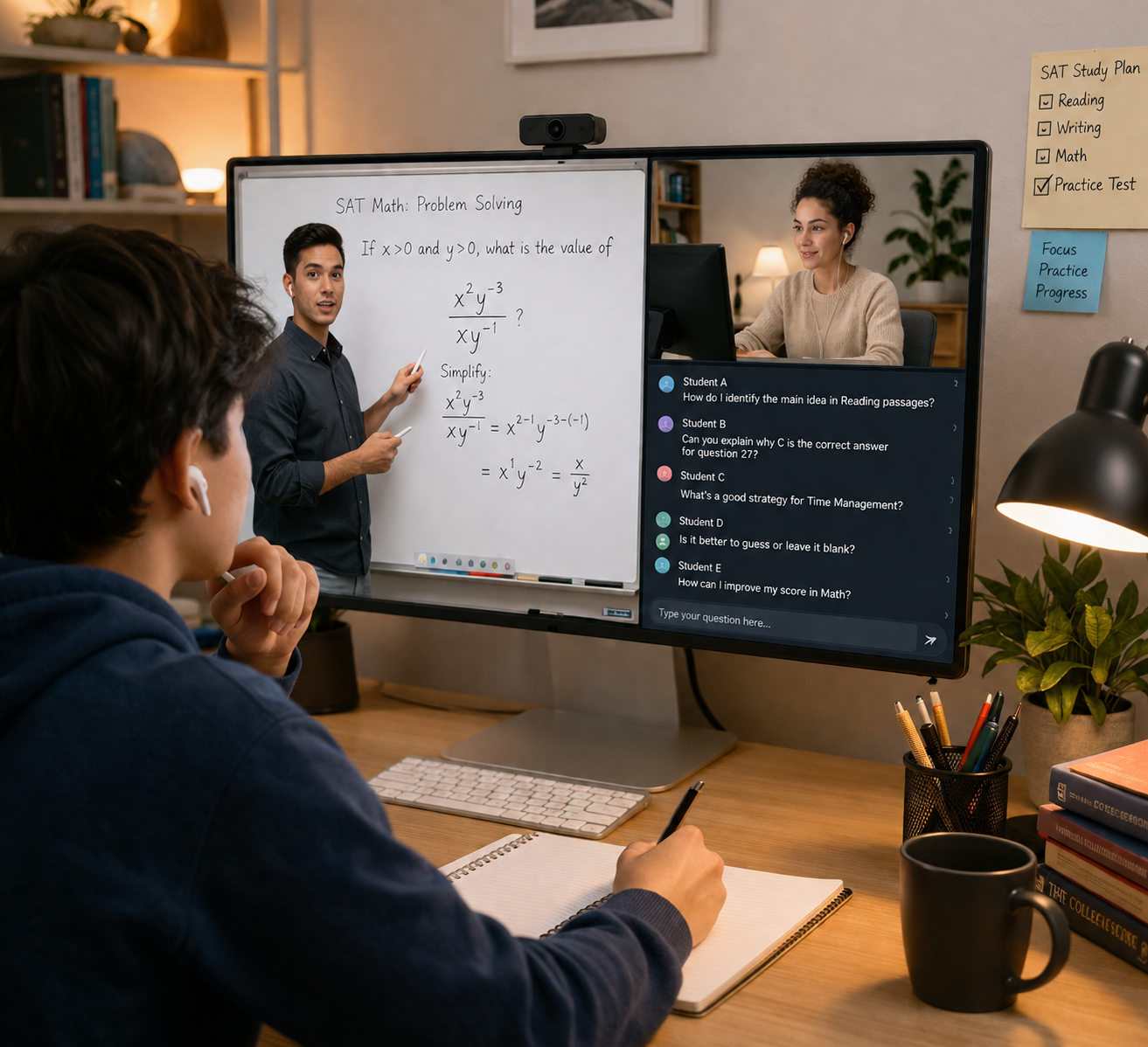
Live Online and higher tiers also include hardcopy Kaplan SAT prep books, while On Demand is digital-only.[2] I do not think paper books magically raise scores, but they do make a difference for some teenagers. A physical book on the desk is harder to ignore than another browser tab, and it gives students a place to mark patterns: missed linear equations, punctuation traps, rushed transitions, weak evidence questions.
For families still deciding how paid prep should fit into a broader SAT plan, Kaplan should sit inside a timeline, not replace one. A paid course works better when the student has already mapped test dates, school workload, and practice-test weekends. Our Digital SAT practice schedule can help with that part before anyone pays for a course.
Where the Value Starts to Break Down
The biggest weakness is practice volume. Kaplan offers 500+ Qbank questions across plans and 4 full-length practice tests.[1][2] That is not nothing, but it is modest compared with other paid SAT prep ecosystems: reviewers list Princeton Review at 2,000+ questions and PrepScholar at 4,100+.[5][6]
This is where price and pedagogy collide. SAT improvement does not come from watching good explanations once. It comes from doing enough problems to expose the same weakness repeatedly, then reviewing those misses until the student can name the trap before falling into it again. A polished lesson on transitions is helpful; a student still needs enough transition questions afterward to prove the habit changed.
Kaplan’s Qbank also lacks video solutions for most items, according to reviews.[1][2] Written explanations can be perfectly fine for students who already know what went wrong. They are less helpful for the student who needs someone to model the thought process: why answer choice B was tempting, where the wording shifted, or why the math shortcut was legal.
The platform is web-only, with no mobile app. Test Prep Insight notes that Princeton Review and PrepScholar offer mobile apps, while Kaplan does not.[1] I would not build an SAT program around phone practice, especially for full-length digital tests, but mobile access can make small review tasks more likely to happen: ten vocabulary-in-context questions after practice, a few math drills during a study hall, or reviewing missed-question notes away from the laptop.
Access length is another quiet issue. On Demand and Live Online expire after 6 months, while Unlimited Prep extends through senior year.[1] Six months is workable for a student starting in winter or spring of junior year with one or two test dates in mind. It is less forgiving for a student who wants to begin early, pause during finals, test in spring, and retest in the fall.
The score guarantee should be read carefully. Kaplan’s Higher Score Guarantee is conditional: students must complete assigned work, attend live sessions where applicable, and take the test within the access period. Reviewers also describe the remedy as typically a credit or repeat course rather than a straightforward cash refund, and the guarantee is not a specific point-increase promise like PrepScholar’s advertised 160+ point guarantee.[1][3]
Instructor credentials are also less transparent than the price suggests. Kaplan does not publicly specify or verify instructor SAT scores. Multiple reviewers and competitor analyses report an informal 90th-percentile threshold, roughly around a 1350 SAT, but that should not be treated as official Kaplan policy. PrepScholar and Princeton Review advertise 99th-percentile instructors, which makes Kaplan’s lack of public criteria more noticeable at tutoring prices.[2][6]
On Demand: Cheap for Kaplan, Not Always Cheap for SAT Prep
Kaplan On Demand is the plan I would consider only for a student who is already self-directed. At $199, it is the lowest-cost Kaplan option, and it gives access to Kaplan’s video instruction without live classes.[1][2] For the right student, that can be enough: watch the lesson, do the assigned practice, review mistakes, take a full-length test, repeat.
The problem is that On Demand competes most directly with free official practice. Khan Academy and Bluebook already give students a serious starting point for the digital SAT, and our guide to Bluebook and Khan Academy SAT practice tests explains how to turn that free material into timed tests and review sessions.
I would not buy On Demand just because it feels safer than free prep. Buy it if the student specifically benefits from Kaplan’s cleaner video explanations and a single commercial dashboard. Do not buy it if the real issue is procrastination. A self-paced paid course does not become accountability just because a credit card was used.
Live Online: The Kaplan Plan That Makes the Most Sense
Live Online is the plan I would start with for most families who are seriously considering Kaplan SAT prep. The reported $799–$899 price is not small, but this is where Kaplan’s best features show up together: scheduled classes, live pacing, two instructors, hardcopy books, Kaplan’s lesson library, Qbank access, and practice tests.[1][2][3]
The value is not that the student receives secret SAT information. The value is that the course removes several decisions a teenager may not make reliably alone: what to study this week, when to show up, which mistakes need attention, and when to move from lesson to practice. For a student with six months before the SAT, that structure can matter as much as the content.
The dual-instructor format is the feature I would pay attention to during any free trial, sample class, or refund window. Watch whether the second instructor actually answers questions in a useful way. A strong chat monitor can rescue a student who is embarrassed to interrupt. A weak one simply becomes decoration. Reviewers praise the model, but they also note that live instructor quality can vary.[1][3]
Live Online is especially reasonable for students who have tried free tools and stalled. If a student has not completed official practice, has not reviewed missed questions, and has no study rhythm, a structured class can be a rational purchase. If the student has already built a strong routine and only needs thousands of extra questions, Kaplan is not the cleanest buy.
Families comparing online and local options may also want to read whether SAT prep near you really matters for the digital SAT. For many students, a strong online class with responsive support beats a nearby class chosen only because it is nearby.
Bootcamp: Useful When Time Is the Constraint
Kaplan’s Bootcamp sits near the Live Online price range, around $800 in reviewer snapshots.[1][3] I would treat it as a short, intensive option for students close to a test date, not as the default way to prepare for the SAT.
A bootcamp can help a student organize final review, sharpen timing, and patch a few predictable weaknesses. It is less appropriate for a student who needs to rebuild algebra fluency, learn grammar rules from scratch, or develop endurance across full digital practice tests. Compressed prep rewards students who already have a foundation.
Unlimited Prep: Worth Considering Only for a Longer Testing Plan
Unlimited Prep is the plan that sounds reassuring to anxious families because it promises more time and broader access. Reported pricing runs from $1,999 to $3,500, and the key practical advantage is extended access through senior year.[1][2]
That senior-year access can matter. A student who starts SAT prep in junior year, takes the SAT in spring, considers the ACT, and then retests in fall may outgrow a 6-month course window. For that student, Unlimited Prep may prevent the family from buying separate courses in separate bursts.
But the plan needs an actual use case. If the student is taking one SAT in August or October and does not need ACT prep, Unlimited Prep is probably more access than value. The question is not whether more months sound comforting. It is whether the student will attend more instruction, complete more practice, and review more mistakes because of those months.
Private Tutoring: High Price, Higher Need for Due Diligence
Kaplan private tutoring starts high: reviewer snapshots list 10 hours at $1,999 and 40 hours at $4,599, with Premium Tutoring priced higher.[1][2] At that level, I would not buy tutoring because the brand is familiar. I would buy only after understanding who the tutor is, how the student will be matched, what diagnostic work comes first, and how progress will be tracked.
Tutoring can be the right tool for a student with a specific problem: a strong reader who repeatedly misses advanced math, a high scorer stuck near a target scholarship cutoff, a student with attention issues who needs weekly accountability, or a senior with only one realistic test date left. It is an expensive tool when the problem is general uneasiness.
The credential uncertainty matters most here. In a live class, a polished curriculum and second instructor can compensate for some variation. In one-on-one tutoring, the individual tutor is the product. Since Kaplan does not publicly specify instructor score requirements, families should ask direct questions before paying tutoring-level prices.[2][6]
- Ask whether the tutor has recent digital SAT experience, not just legacy SAT experience.
- Ask how the tutor diagnoses weaknesses before assigning practice.
- Ask how often the student will take full-length practice tests.
- Ask what happens if the tutor match is not working after the first session.
- Ask whether missed-question review is built into tutoring time or assigned separately.
Kaplan Compared With Free and Cheaper SAT Prep
Kaplan’s main free competitor is not another company. It is the official practice ecosystem students can already use before buying anything. A student who has not taken a Bluebook practice test, reviewed mistakes, or worked through Khan Academy practice should usually start there. Our broader SAT exam prep guide lays out how those tools fit with section strategy and study planning.
Khan Academy is the strongest pressure on Kaplan’s On Demand value. Free official practice has enough substance that a disciplined student can make real progress without paying for a commercial course. Newer free and low-cost tools also keep expanding; for example, students comparing official practice with emerging AI support can read our Khan Academy vs AI SAT tutors guide, and students who want another free diagnostic-style option can try the Google Gemini free SAT practice test walkthrough.
Princeton Review and PrepScholar matter mainly as benchmarks. Princeton Review is reported at 2,000+ practice questions, and PrepScholar at 4,100+, which makes Kaplan’s 500+ question bank look limited.[5][6] PrepScholar also advertises a specific 160+ point guarantee, while Kaplan’s Higher Score Guarantee is conditional and less specific.[3] Those comparisons do not mean Kaplan is automatically worse. They mean Kaplan has to earn its price through class structure and lesson quality rather than sheer practice volume.
Which Kaplan SAT Prep Plan Should You Choose?
Choose On Demand if the student is disciplined, wants Kaplan’s video lessons, and can already keep a study schedule without a parent rebuilding it every Sunday night. It is the cheapest Kaplan plan, but it is not the cheapest SAT prep path because free official practice exists.
Choose Live Online if the student needs structure, pacing, and a real class appointment. This is the Kaplan plan I would recommend most often because it combines the company’s strongest assets: good videos, live instruction, a second instructor monitoring questions, and physical books. The price is high enough to require use, not just enrollment.
Choose Bootcamp only when the test date is close and the student already has enough foundation to benefit from concentrated review. It is not a substitute for months of steady practice.
Choose Unlimited Prep if the student’s testing plan genuinely extends across multiple exams, multiple attempts, or junior spring through senior fall. Do not choose it because more access feels safer.
Choose private tutoring only when the student needs individualized diagnosis or accountability that a class cannot provide. At Kaplan’s tutoring prices, the tutor match matters more than the logo, so ask about the individual tutor before buying.
For most families, the decision comes down to this: pay for Kaplan Live Online if polished instruction and external structure are worth the money; use free or cheaper tools if the main need is simply more official practice; reserve premium Kaplan tiers for students whose testing timeline or support needs clearly justify the extra cost.
References
- Kaplan SAT Prep Review (2026): Pricing, Pros & Verdict — Test Prep Insight.
- Kaplan SAT Prep Review: Rating All of Kaplan's SAT Prep Options — PrepMaven.
- Kaplan SAT Review: Is it the Best SAT Prep Course? — ExamsTutor.
- Kaplan Digital SAT Prep Review – Is It Worth It In 2026? — Sojourning Scholar.
- 12 Best SAT Prep Courses for 2026 (32 Courses Reviewed) — PrepMaven.
- SAT Prep Course Comparison: Kaplan vs PrepScholar vs Catalyst (2025) — Catalyst Test Prep, 2025.
Comments
Join the discussion with an anonymous comment.