
SAT
Learn how to structure your SAT practice tests for maximum score improvement — from choosing the right Bluebook tests to categorizing every mistake and drilling specific weaknesses with the College Board Question Bank.
Updated:
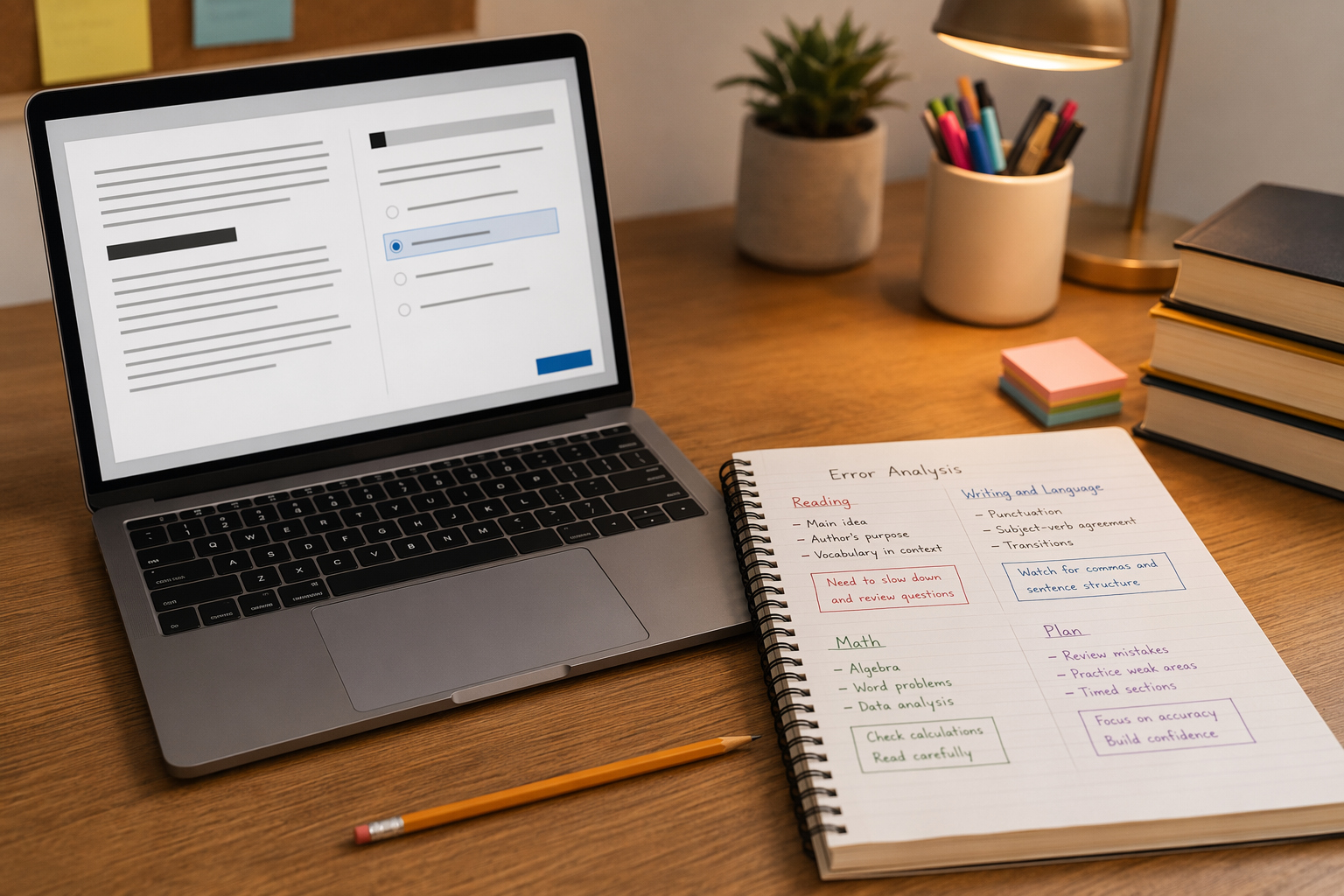
If your SAT exam practice has turned into a cycle of full-length tests, quick score checks, and vague disappointment, the problem is probably not effort. It is the missing step after the test. A practice test is only a diagnostic. The score tells you where you landed that day; the review tells you what to change before next Tuesday.
That distinction matters because more testing is not automatically more learning. PrepScholar, EduShaale, and North American Tutors all point to the same practical conclusion: three practice tests with full wrong-answer review are more valuable than six practice tests taken without serious review.[1][2][3] The exact number is less important than the pattern. Students improve when each test produces decisions, not just a new score.
Start With the Right Kind of Practice Test
Use official Bluebook tests as your main full-length practice source. As of July 2026, the current Bluebook landscape includes eight official adaptive practice tests, numbered Tests 4 through 11.[4] That does not mean every test should be used the same way.
| Bluebook test | Best use |
|---|---|
| Test 11 | Save for a late-stage benchmark because it has the freshest question pool. |
| Test 7 | Treat as especially useful because it contains all-new material. |
| Tests 8-10 | Use with some caution; Strategic Test Prep notes recycled retired-test questions and easier math that may not fully reflect current difficulty. |
| Tests 4-6 | Use earlier in prep, especially while you are still learning how to review. |
The point is not to turn test selection into a ranking hobby. If you have not yet learned how to review one test properly, saving Test 11 will not solve much. But test order does matter enough to avoid wasting the freshest official material on a cold attempt that you barely analyze afterward.
For most students, a reasonable pattern is to take one full practice test every two to four weeks during the middle of prep, then two or three tests in the final month. North American Tutors recommends more volume for students targeting 1500+, often in the range of eight to ten tests, but only when each test is thoroughly reviewed; beyond that, returns drop sharply.[3]
Take the Test So the Score Means Something
A practice score is only useful if the conditions are close enough to the real test to reveal your actual habits. You do not need a theatrical simulation, but you do need clean data: take the test in one sitting, use the official timing, put your phone away, and do not pause to look up formulas, grammar rules, or answer explanations.
If you split a test over three school nights, answer messages between modules, or give yourself a few “almost finished” extra minutes, write that down. The score may still tell you something, but it is no longer a clean benchmark. It becomes a study exercise, not a full diagnostic.
Right after the test, resist the urge to start another one. The next job is not to prove you can endure more SAT questions. The next job is to find the repeatable reasons points disappeared.
Build an Error Log Before You Study Anything Else
An error log does not need to be pretty. A spreadsheet, notebook, or tracker template can all work. Strategic Test Prep offers a Google Sheets tracker as one possible model, but the format matters less than whether you are honest and specific.[4]
For every missed question, every guessed-correct question, and every question that took too long, record enough information to make the mistake usable later.
| Log field | What to write |
|---|---|
| Test and module | Example: Bluebook Test 6, Reading and Writing Module 2 |
| Question type or skill | Use the clearest label you can: transitions, linear equations, function notation, main idea, punctuation, data inference. |
| Your answer and correct answer | Do not stop at “wrong.” Record the choice you made. |
| Why you chose it | Write the reason you had at the time, even if it now looks weak. |
| Real cause | Classify the mistake as a content gap, misread, timing problem, or careless execution. |
| Fix | Name the next action: relearn a rule, drill a skill, slow down on graphs, change skipping strategy. |
The “why you chose it” column is the part students most often skip, and it is usually the part that reveals the most. If you only write “stupid mistake,” you have learned almost nothing. If you write “I picked the answer that matched one phrase in the passage but did not check the author’s actual claim,” you have a fixable pattern.
Classify the Cause, Not Just the Topic
A topic label tells you where the mistake happened. A cause label tells you what to do about it. Those are not the same thing.
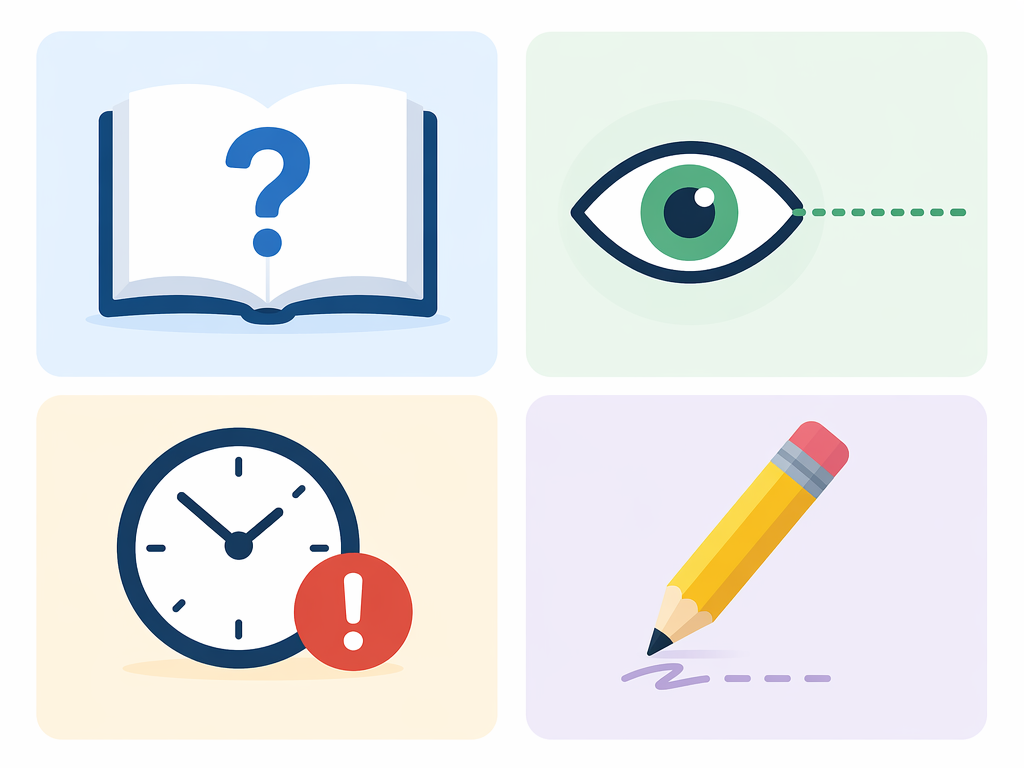
Use four main categories.
- Content gap: You did not know the rule, concept, vocabulary, formula behavior, or question type well enough.
- Misread: You knew the skill but missed a word, condition, comparison, graph label, or passage claim.
- Timing problem: You could solve it, but not efficiently enough under test conditions.
- Careless execution: You understood the question and method but made an avoidable slip in arithmetic, bubbling, sign handling, answer selection, or final checking.
This separation keeps you from prescribing the wrong cure. A student who misses a punctuation question because they do not know how semicolons work needs instruction and targeted practice. A student who knows semicolons but ignores the sentence before the blank needs a reading habit. A student who can do the question in review but spent ninety seconds too long earlier in the module needs a timing decision. Calling all three “grammar mistakes” hides the actual problem.
EduShaale reports from its coaching experience that roughly 80% of SAT score losses come from strategy, format, and process mistakes rather than content gaps.[2] That is not an independent academic finding, so it should not be treated like a law of nature. Still, it matches what many tutors see: students often know more math and grammar than their score shows. The useful move is not to assume every error is careless. The useful move is to check.
What a Real Classification Sounds Like
Suppose a student misses a math question involving a linear equation. “Linear equations” is the topic. The cause could be very different depending on what happened.
| What happened | Likely cause | Next action |
|---|---|---|
| The student did not know how to isolate the variable. | Content gap | Review the algebra skill, then drill similar easy and medium questions. |
| The student solved for x when the question asked for 2x. | Misread | Underline or restate the target before solving. |
| The student solved correctly in review but spent too long during the test. | Timing problem | Practice a faster setup or learn when to skip and return. |
| The student distributed a negative sign incorrectly. | Careless execution | Add a one-line check step for signs and substitution. |
The same topic can create four different study plans. That is why reviewing only the answer explanation is not enough. The explanation shows how the problem works. Your log has to show why your version of the problem broke.
Find the Two Weakest Content Priorities
After logging the whole test, do not try to fix everything at once. Look for the two weakest content areas or skill clusters that cost you the most points and are likely to appear again. Two is usually enough. Five turns into a wish list.
Good priority labels are small enough to drill. “Math” is useless. “Advanced math” is still too broad for most students. “Quadratic equations in standard and factored form” is better. In Reading and Writing, “grammar” is too broad; “boundaries between independent clauses” gives you something to practice.
Use the score report and your error log together. The score report can point toward domains and skills. The log tells you whether the issue is knowledge, reading, pacing, or execution. If the report says a skill is weak but your log shows mostly misreads, the next week should not be a marathon of content videos. It should include targeted questions plus a stricter reading routine.
Use the College Board Question Bank Between Tests
The full-length test shows the pattern. The College Board Student Question Bank is where you attack it. College Board describes the Question Bank as an official source of thousands of questions, updated in August 2025, filterable by assessment, domain, skill, and difficulty level.[5]
That filtering is the reason the Question Bank belongs at the center of your between-test work. If your log says you missed punctuation questions involving independent clauses, do not spend the next week doing random Reading and Writing sets. Filter for the relevant domain and skill. Start with easier or medium questions if the rule itself is shaky. Move to harder questions once the rule is automatic.
A useful between-test loop looks like this:
- Choose two priority weaknesses from the error log.
- Review the rule, concept, or strategy only as much as needed to attempt questions.
- Use the Question Bank to create a focused set for one skill and difficulty range.
- Do the set under light timing pressure, not leisurely homework conditions.
- Log misses from the drill the same way you logged misses from the full test.
- Repeat until the mistake pattern changes, then move to the next priority.
The Question Bank is not just extra practice. It is the bridge between diagnosis and the next full-length test. Without that bridge, the next practice test is often just a repeat measurement of the same weaknesses.
How Many Questions Are Enough?
There is no honest universal number. A small skill gap may change after a short focused set and review. A deeper algebra weakness or repeated reading misinterpretation may need several rounds. The better test is behavioral: when you see a similar question, do you now recognize the setup, choose a method faster, and avoid the old trap?
If the answer is no, taking another full Bluebook test will probably confirm what you already know. Keep drilling. If the answer is yes across your two priorities, the next full practice test has a reason to exist.
Treat Correct Guesses as Unfinished Business
Wrong answers are not the only questions worth reviewing. Correct guesses, rushed correct answers, and questions you solved through an awkward method all belong in the log. They are early warnings.
A correct guess can hide a content gap. A correct but slow math solution can become a timing problem on a harder module. A correct Reading and Writing answer chosen by “vibe” may not survive a similar question with closer answer choices. If you only review red Xs, you miss the weak spots that have not cost you points yet.
When to Take the Next Full Practice Test
Do not schedule the next test just because a week has passed. Schedule it when the last test has done its job.
| Before the next test, you should have | Why it matters |
|---|---|
| A completed error log | You know what went wrong beyond the raw score. |
| Cause labels for every miss and serious guess | You can separate content, reading, timing, and execution problems. |
| Two priority weaknesses | Your study plan is narrow enough to act on. |
| Targeted official drilling | You have practiced the skills that the last test exposed. |
| A note on process changes | You know what to do differently during the next test. |
For many students, that means waiting two to four weeks between practice tests during the main prep period. In the final month, two or three tests can make sense if the review cycle stays intact.[3] A high scorer pushing for the last few points may need more full tests because small timing and accuracy patterns are harder to expose in short drills. Even then, the rule does not change: test volume is useful only when review remains the controlling discipline.
A Complete SAT Practice Cycle
Put the pieces together, and a productive SAT exam practice cycle looks like this:
- Choose an official Bluebook test intentionally, saving the freshest material for when it will give you cleaner information.
- Take the test under realistic timing and without interruptions.
- Review every missed, guessed, rushed, or uncertain question.
- Classify each issue as a content gap, misread, timing problem, or careless execution.
- Identify the two weakest repeatable skill areas.
- Use the College Board Student Question Bank to drill those skills by domain, skill, and difficulty.
- Take the next full test only after the previous test has produced a real change in practice.
If your last test produced a reviewed error log, two priority weaknesses, and targeted official drilling, take the next one on schedule. If it did not, another full test is just another expensive diagnostic of the same problem.
References
- SAT Practice Tests: How to Reflect and Get the Most Out of Them, PrepScholar, 2026 update
- SAT mistakes post, EduShaale
- How Many SAT Practice Tests Do You Really Need?, North American Tutors
- The Best Bluebook SAT Practice Tests Ranked (2026 Update), Strategic Test Prep
- How to Use the Student Question Bank, College Board, August 2025
Supporting Resources
- Your Guide to Princeton Review SAT Prep Courses in 2026 →
A detailed breakdown of Princeton Review's four SAT prep tiers for 2026, including pricing, features, score guarantees, and a decision framework to help you choose the right course based on your baseline score, budget, and study habits.
- GRE Vocabulary Flashcards That Actually Stick: A Science-Backed Study System →
Struggling to retain GRE vocabulary? This guide explains why rote memorization fails and how to build a daily study system using spaced repetition, active recall, and multi-link memory hooks — backed by cognitive science and proven by top GRE tutors.
- The Trap of Anki for the MCAT: When Flashcards Hurt More Than Help (and How to Avoid It) →
For premed students already using Anki who feel stuck or burnt out, this critical guide exposes when Anki can become a productivity trap — replacing deeper learning with pattern recognition — and provides evidence-backed guardrails to use it effectively without wasting time.
Comments
Join the discussion with an anonymous comment.