

Know Every SAT Prep Question Type on the Digital SAT
A complete catalog of all 21 question types on the 2026 digital SAT, with per-type frequency counts, example stems, and strategy tips so you can focus your practice where it counts.
Updated:
Before you practice SAT prep questions, you need to know what you are practicing for. The digital SAT is not one long blur of English and math. It is 98 questions: 54 Reading and Writing questions in two 32-minute modules, and 44 Math questions in two 35-minute modules, for a total testing time of 2 hours and 14 minutes. Module 2 is adaptive, meaning its difficulty depends on how you performed in Module 1.[1]
That structure matters because students often waste time in the wrong proportions. A student who spends a full weekend on a rare Reading and Writing type may feel productive, but that work does not have the same payoff as learning to handle the question types that appear again and again. The goal is not to memorize a taxonomy for its own sake. The goal is to turn your next practice session into a better decision.
The Full 21-Type Map
The Reading and Writing side has 11 practical question types across four domains. The Math side is better treated as 10 skill families across four domains, because Math questions can vary in surface form while testing the same underlying move. The Reading and Writing frequencies below come from Magoosh’s synthesis of the College Board digital SAT framework, so treat them as approximate planning numbers, not fixed official counts for every test form.[2]
| Question type | Section / domain | Approximate frequency | What it tests | Typical task or stem |
|---|---|---|---|---|
| Words in Context | Reading & Writing / Craft and Structure | ~11 questions | Choosing the best meaning or word based on nearby context | Which choice completes the text with the most logical and precise word or phrase? |
| Text Structure and Purpose | Reading & Writing / Craft and Structure | ~3 questions | Identifying what a part of the passage does or why the author included it | Which choice best describes the function of the underlined sentence? |
| Cross-Text Connections | Reading & Writing / Craft and Structure | ~1 question | Comparing how two short texts relate | How would the author of Text 2 most likely respond to the claim in Text 1? |
| Central Ideas and Details | Reading & Writing / Information and Ideas | ~4 questions | Finding the main point or an explicitly supported detail | Which choice best states the main idea of the text? |
| Command of Evidence - Textual | Reading & Writing / Information and Ideas | ~4 questions | Selecting the claim or conclusion best supported by the passage | Which choice best describes data or information from the text? |
| Command of Evidence - Quantitative | Reading & Writing / Information and Ideas | ~4 questions | Connecting a graph, table, or data display to a claim | Which choice best uses data from the table to complete the statement? |
| Inferences | Reading & Writing / Information and Ideas | ~4 questions | Drawing a supported conclusion that is not stated word-for-word | Which choice most logically completes the text? |
| Boundaries | Reading & Writing / Standard English Conventions | ~6-7 questions | Punctuation, sentence boundaries, and clause connections | Which choice completes the text so that it conforms to the conventions of Standard English? |
| Form, Structure, and Sense | Reading & Writing / Standard English Conventions | ~8 questions | Grammar choices such as verb form, agreement, pronoun use, and modifiers | Which choice completes the text so that it conforms to the conventions of Standard English? |
| Transitions | Reading & Writing / Expression of Ideas | ~5 questions | Choosing the logical relationship between ideas | Which choice completes the text with the most logical transition? |
| Rhetorical Synthesis | Reading & Writing / Expression of Ideas | ~6 questions | Using notes to achieve a specific writing goal | The student wants to emphasize a similarity. Which choice most effectively uses relevant information from the notes? |
| Linear Equations | Math / Algebra | Part of 13-15 Algebra questions | Solving one-variable and two-variable linear equations | Solve for x or interpret a linear equation in context |
| Linear Functions | Math / Algebra | Part of 13-15 Algebra questions | Slope, intercepts, function notation, and linear change | Choose or interpret an equation for a line |
| Systems of Equations | Math / Algebra | Part of 13-15 Algebra questions | Solving and interpreting two linear equations together | Find the solution or determine how many solutions a system has |
| Linear Inequalities | Math / Algebra | Part of 13-15 Algebra questions | Inequality notation, solution sets, and constraints | Identify which value or graph satisfies an inequality |
| Nonlinear Equations | Math / Advanced Math | Part of 13-15 Advanced Math questions | Quadratic, exponential, and other nonlinear relationships | Solve a quadratic or interpret a nonlinear equation |
| Quadratic and Exponential Functions | Math / Advanced Math | Part of 13-15 Advanced Math questions | Function behavior, zeros, vertex form, growth, and decay | Match an equation, graph, or description of a function |
| Equivalent Expressions and Polynomial Operations | Math / Advanced Math | Part of 13-15 Advanced Math questions | Rewriting, factoring, expanding, and simplifying expressions | Which expression is equivalent to the given expression? |
| Ratios, Rates, Percentages, and Units | Math / Problem-Solving and Data Analysis | Part of 5-7 PSDA questions | Proportional reasoning and real-world quantities | Calculate a percent change, unit rate, or converted quantity |
| Data, Statistics, and Probability | Math / Problem-Solving and Data Analysis | Part of 5-7 PSDA questions | Interpreting tables, samples, mean/median, and probability | Use data from a table or sample to answer a question |
| Geometry and Trigonometry | Math / Geometry and Trigonometry | 5-7 questions | Area, volume, angles, triangles, circles, and right-triangle trig | Find a length, angle, area, volume, or trigonometric value |
Reading and Writing: 11 Types, Uneven Payoff
Reading and Writing has 54 questions, and the four domains are not equally easy to see when you are moving fast. Craft and Structure accounts for about 13-15 questions, Information and Ideas for about 12-14, Standard English Conventions for about 11-15, and Expression of Ideas for about 8-12.[2] If you are using SAT English practice tests, tag missed questions by type before you decide what to drill next.
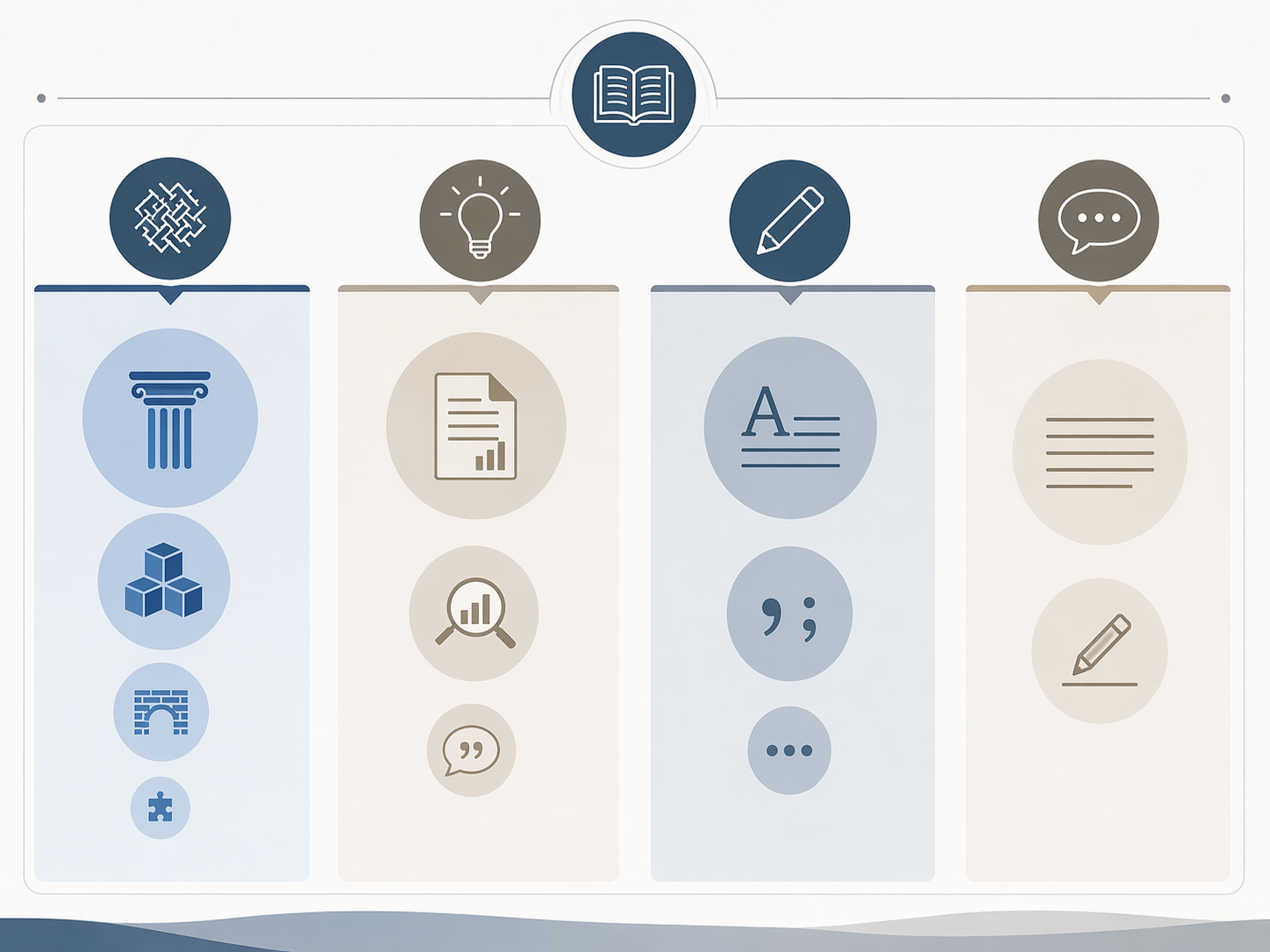
Craft and Structure
Words in Context is the workhorse here. These questions ask for the word or phrase that best fits the sentence and surrounding logic, and Magoosh estimates about 11 of them per Reading and Writing section.[2] That does not mean vocabulary is irrelevant. It means vocabulary memorization alone is too blunt. A strong answer usually respects tone, contrast words, cause-and-effect language, and the actual job the blank is doing in the sentence.
For example, if the sentence says a researcher’s conclusion was “tentative” because the sample was limited, the missing word probably needs to express caution, not excitement or certainty. A student making cards for every unfamiliar word can still miss that move. If you use SAT vocab flashcards, pair them with sentence-level practice so you learn how the test uses words, not just what dictionary entries say.
Text Structure and Purpose questions are less frequent, around 3 questions, but they are easy to misread because the answer choices often sound like literary commentary.[2] Stay practical: ask what the sentence or passage is doing. Is it introducing a claim, giving an example, qualifying a previous statement, presenting a contrast, or explaining a consequence?
Cross-Text Connections usually deserves a short, specific drill, not a takeover of your study plan. It appears at about 1 question, and the task is to compare Text 1 and Text 2.[2] The safest routine is to write a quick mental label for each text: “Text 1 argues X,” “Text 2 complicates X,” or “Text 2 gives evidence against X.” Then choose the answer that captures the relationship, not the answer that merely repeats a topic word from one passage.
Information and Ideas
Central Ideas and Details, Command of Evidence, Quantitative Evidence, and Inferences each appear around 4 times, according to Magoosh’s synthesis.[2] That makes this domain one of the best places to stop treating Reading as a vague talent and start treating it as a set of repeatable tasks.
| Type | First move | Common trap |
|---|---|---|
| Central Ideas and Details | State the main claim or locate the relevant detail before checking choices | Choosing a true detail that is too narrow to be the main idea |
| Command of Evidence - Textual | Match the answer to what the passage directly supports | Choosing a claim that sounds reasonable but goes beyond the text |
| Command of Evidence - Quantitative | Read the chart title, labels, and units before the answer choices | Comparing the wrong rows, columns, or categories |
| Inferences | Finish the author’s logic in the smallest supported step | Making a broad real-world conclusion instead of a text-based conclusion |
Command of Evidence questions are where students often reveal whether they are reading or recognizing. The right answer has to be tied to a specific claim, line of reasoning, or data point. PrepMaven’s Reading and Writing strategy guide makes the same practical distinction: different question types reward different approaches, and evidence questions require pairing an answer choice to support in the passage rather than relying on general impression.[3]
Quantitative Evidence questions deserve special attention because they can feel like Math has wandered into English. It has not. The computation is usually secondary to interpretation: which number supports the sentence, which comparison is actually being made, and whether the answer choice says “more,” “less,” “highest,” “lowest,” or “changed by” accurately.
Standard English Conventions
Standard English Conventions is where small rules carry a lot of points. Boundaries appears about 6-7 times, and Form, Structure, and Sense appears about 8 times.[2] These are not the questions to “feel out” forever. If you miss them, you need names for the problem: comma splice, semicolon use, colon use, subject-verb agreement, verb tense, pronoun clarity, modifier placement, or sentence fragment.
- For Boundaries, first decide whether the parts on both sides of the punctuation can stand as complete sentences.
- For commas, check whether the phrase is extra information, part of a list, or part of a necessary structure.
- For semicolons, look for two complete sentences with a close relationship.
- For colons, check whether the second part explains, defines, or illustrates the first part.
- For Form, Structure, and Sense, identify the subject, verb, and time frame before comparing answer choices.
The reason conventions questions are so valuable in practice is that many wrong answers are wrong for a clear reason. Once you diagnose the rule, you can build a short targeted set instead of doing another mixed Reading and Writing module and hoping the pattern fixes itself.
Expression of Ideas
Transitions questions appear around 5 times and ask for the logical relationship between sentences or clauses.[2] The fastest students do not start by admiring the answer choices. They cover the choices, decide the relationship, and then look for the word that matches: continuation, contrast, cause, result, example, emphasis, or sequence.
Rhetorical Synthesis appears around 6 times and looks different from the rest of the section because it gives notes and a writing goal.[2] The goal is the filter. If the question says the student wants to emphasize a difference, an answer that accurately states a similarity is still wrong. If the student wants to introduce a researcher, an answer that jumps to a narrow finding may be accurate but poorly matched.
- Read the goal first.
- Underline the required action: introduce, compare, emphasize, illustrate, or support.
- Use only the notes needed for that goal.
- Eliminate answers that are true but irrelevant to the requested task.
Math: 10 Skill Families, Not 10 Costume Changes
Math has 44 questions across two 35-minute modules.[1] College Board groups the content into four domains: Algebra; Advanced Math; Problem-Solving and Data Analysis; and Geometry and Trigonometry. Algebra and Advanced Math each make up about 35% of the Math section, while Problem-Solving and Data Analysis and Geometry and Trigonometry each make up about 15%.[4]
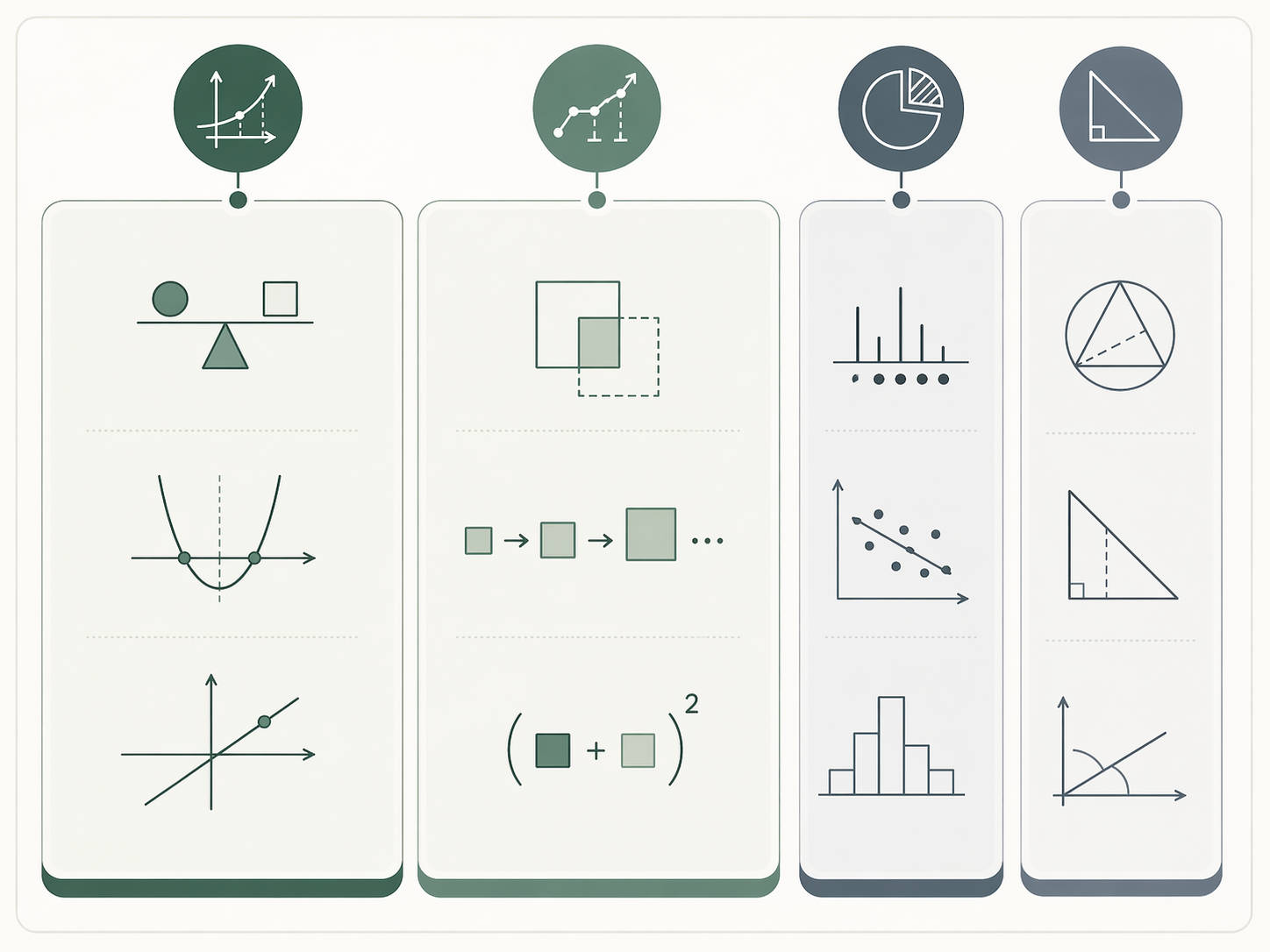
That distribution should shape your practice calendar. If your Math plan gives the same number of days to circles as to linear equations, the plan is probably neat-looking rather than proportional. Use SAT Math practice questions to diagnose by domain and skill family, then decide whether the issue is setup, algebraic execution, calculator strategy, or reading the question.
Algebra: linear work you cannot afford to half-know
Algebra includes linear equations, linear functions, systems of equations, and linear inequalities.[4] These questions are common enough that “I usually get the idea” is not a safe standard. You need to know how to solve directly, how to interpret slope and intercepts in context, how to recognize equivalent forms, and how to tell when a system has one solution, no solution, or infinitely many solutions.
| Skill family | What to practice | When Desmos may help |
|---|---|---|
| Linear equations | Isolating variables, distributing, combining like terms, interpreting constants | Checking a solution or solving a messy equation quickly |
| Linear functions | Slope, y-intercept, function notation, rate of change | Graphing to compare lines or verify an intercept |
| Systems of equations | Substitution, elimination, solution meaning | Finding intersections or confirming number of solutions |
| Linear inequalities | Solution sets, boundary values, constraints | Testing answer choices or visualizing feasible regions |
The calculator decision is part of the skill, not a separate trick. Desmos can be excellent for graphing, intersections, and checking answer choices, but some questions are faster by hand if the algebra is clean. A Desmos Decision Framework is useful only if you still understand what the equation represents.
Advanced Math: where form is often the question
Advanced Math includes nonlinear equations, quadratic and exponential functions, equivalent expressions, and polynomial operations.[4] These questions often test whether you can choose the most useful form of an expression. Expanded form, factored form, vertex form, and function notation are not decorative. They reveal different information.
- Use factored form when zeros or solutions matter.
- Use vertex form when maximum, minimum, or turning point matters.
- Use expanded form when comparing coefficients or combining expressions.
- Use exponential form when the question is about repeated growth or decay.
For high scorers, this is also where small precision losses become expensive. PrepMaven notes that Math questions are grouped by domain within modules and ordered from easiest to hardest, with the last 2-3 Math questions per module typically being the most difficult and especially important for students targeting 700+.[5] That does not mean every student should begin with the hardest problems. It means that once your basics are stable, your review should include the end-of-module style: less obvious setup, more constraints, and fewer wasted moves.
Problem-Solving and Data Analysis: slow down before the arithmetic
Problem-Solving and Data Analysis covers ratios, proportions, percentages, unit rates, data inference, statistics, and probability.[4] The content is not always algebraically hard, but the questions punish students who calculate before they know what the number should mean.
| If the question involves | Check first |
|---|---|
| Percent change | Original value versus new value |
| Unit rates | Units in the numerator and denominator |
| Ratios | Part-to-part versus part-to-whole |
| Tables or charts | Labels, categories, and whether the question asks for a count, percent, or comparison |
| Probability | The total possible outcomes and the condition being imposed |
Geometry and Trigonometry: fewer questions, still real points
Geometry and Trigonometry includes area and volume, lines and angles, triangles, circles, and right-triangle trigonometry.[4] It is a smaller share of the Math section than Algebra or Advanced Math, but it is also one of the easiest places to lose points from forgotten formulas or diagram assumptions.
Do not practice geometry as if every problem is a brand-new puzzle. Separate the work into formulas you must retrieve, relationships you must recognize, and equations you must build. A circle problem may be mostly about radius and area. A triangle problem may be mostly about similar triangles. A trigonometry problem may be mostly about choosing sine, cosine, or tangent from the sides given.
How to Turn the Map Into a Practice Plan
A question-type map is only useful if it changes what you do next. Start with one full practice set or practice test, then label every miss by type. College Board’s Student Question Bank can help students find practice questions by skill, and full official-style practice is available through Bluebook and Khan Academy workflows.[6]
- Mark each missed question by type, not just by section.
- Separate careless errors from skill errors; they need different fixes.
- Give more drill time to frequent types such as Words in Context, conventions, Algebra, and Advanced Math.
- Give rare types, such as Cross-Text Connections, enough practice to recognize the task without letting them dominate your week.
- Return to mixed modules so you can prove the skill holds when the question type is not announced.
The transition back to mixed work matters. Isolated drills are where you repair a weakness; full sections are where you find out whether the repair survived timing, fatigue, and adaptive difficulty. Use a SAT practice-test strategy once you have done enough type-specific work to make the next test diagnostic instead of merely discouraging. If you need a platform walkthrough, use a guide to Bluebook and Khan Academy SAT practice rather than guessing your way through the tools.
A proportional plan might look uneven on purpose. A student weak in punctuation and linear functions may spend several sessions on those two areas before touching a rare Reading type or a low-frequency geometry topic. Another student already scoring high in Math may reserve time for the last 2-3 questions in each module because that is where their remaining upside lives.[5] The map does not give every student the same plan. It prevents every student from treating all misses as equally important.
For materials, start with official and official-style sources when possible. College Board’s Student Question Bank, Bluebook practice, Khan Academy, and carefully chosen free SAT practice test resources are most useful when you know which question type you are trying to improve. If you are still choosing between apps, books, banks, and analytics tools, a broader guide to SAT study tools in 2026 can help you match the tool to the task.
Last reviewed: July 9, 2026. The digital SAT format and broad domains are stable for current prep planning, but exact question-type counts can vary by form. Use the numbers here as a practice-allocation guide, then keep checking your work inside full, timed practice.
References
- How the SAT Is Structured, College Board
- SAT Question Types (2024), Magoosh
- Strategies for Every SAT Reading & Writing Question Type, PrepMaven
- Types of Math Tested, College Board
- 25 of the Hardest SAT Math Problems, PrepMaven
- How to Use the Student Question Bank, College Board
Comments
Join the discussion with an anonymous comment.