
SAT
Learn where to find the best SAT practice questions, how many to do per week, and how to use a structured review cycle to turn practice into score improvement.
Updated:
If you are staring at a folder of SAT practice questions and wondering which ones are actually worth doing, start with a hierarchy: official College Board questions first, carefully chosen support resources second, random extra volume last. The digital SAT is too specific in wording, pacing, and adaptive structure for every question bank to count the same.
That does not mean you need to buy a course or disappear into prep for six hours a day. It means your practice has to close the loop: take a real Bluebook test, find the exact skills costing you points, drill official questions in those skills, then use the next Bluebook test to check whether the weakness actually moved.

The SAT Practice Question Map: What to Use First
The main mistake is treating all SAT practice questions as interchangeable. They are not. A full official Bluebook test, a Student Question Bank algebra item, a Khan Academy lesson question, a third-party PDF question, and an AI-generated full-length test can all be useful in different situations. They should not all have the same job.
| Priority | Source | Best use | Main caution |
|---|---|---|---|
| 1 | Bluebook full-length practice tests | Baseline testing and score verification | Limited supply, so do not burn through them without review |
| 2 | College Board Student Question Bank | Daily targeted practice by domain, skill, and difficulty | Use filters; do not treat it as a random question pile |
| 3 | Khan Academy | Skill lessons and extra practice connected to official SAT prep | Best as support after you know what skill you are fixing |
| 4 | Official paper linear tests and Question of the Day | Extra official exposure and light daily practice | Paper tests are not adaptive, so they are not perfect simulations |
| 5 | Third-party banks, PDFs, platforms, and generated tests | Additional volume after official weak-skill work | Wording, difficulty, and adaptive behavior may not match the real test |
Bluebook is where full-test practice belongs. College Board’s SAT practice page lists Bluebook practice tests, paper practice options, the Student Question Bank, and other official prep resources; for digital SAT practice, Bluebook is the closest available match to the test-day interface and adaptive experience.[1]
The Student Question Bank is where most daily practice should happen. College Board describes it as a tool with thousands of official questions that can be filtered by assessment, test section, domain, skill, and difficulty.[2] That filtering is the difference between “I did 40 math questions” and “I practiced medium and hard nonlinear equations because my last test showed that exact gap.”
There is also a larger official question ecosystem behind the scenes. EdisonOS’s May 2026 analysis of College Board’s question library reported about 2,017 total questions, including about 1,079 Reading and Writing questions and 938 Math questions, with about 1,447 unique questions not appearing in official practice tests.[3] Those counts can change as College Board updates materials, but the practical point is stable: official targeted practice is not limited to the full-length tests.
Protect Your Bluebook Tests
A Bluebook test should answer a question you cannot answer with a worksheet: how you perform across the whole digital SAT under test-like pressure. It is too valuable to use as a nightly anxiety blanket.
Most students should take one full Bluebook practice test every 2–3 weeks, not every few days. That spacing gives you time to do the work the test assigned you. If you take a test on Saturday, glance at the score, feel bad for ten minutes, and then take another test on Tuesday, the second test is mostly measuring the same student with the same gaps.
For a deeper test-day routine, use a dedicated guide to SAT practice tests. Here, the rule is simpler: full tests diagnose and verify; question banks do the daily repair work.
The Loop That Turns Questions Into Score Movement
The best SAT practice system is not complicated. It is just less emotionally satisfying than opening a fresh test and pretending the last one never happened.
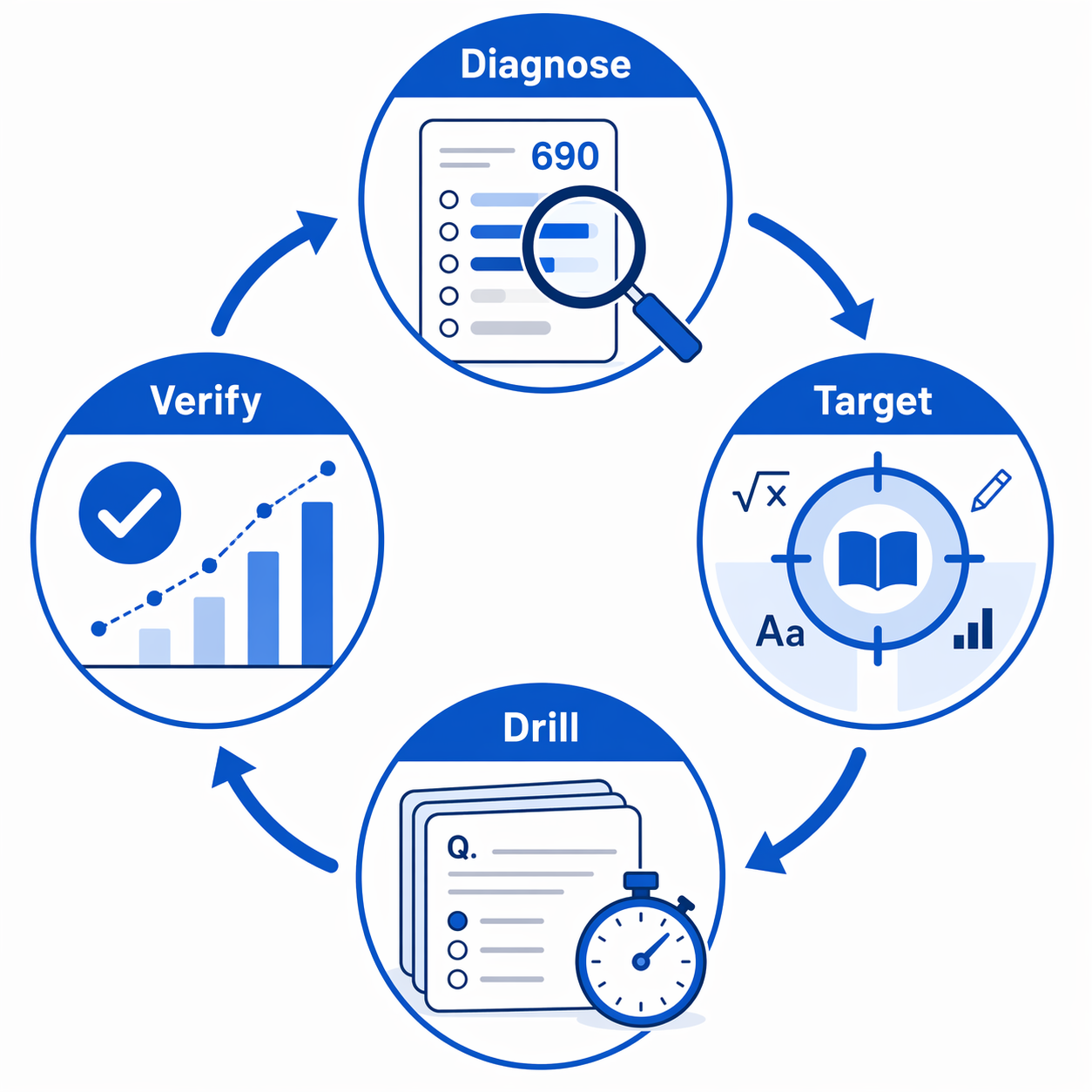
| Stage | What you do | What you produce |
|---|---|---|
| Diagnose | Take a full Bluebook test or review a recent official score report | A short list of weak domains, skills, and question types |
| Target | Choose one or two weak skills to focus on first | A narrow practice plan instead of a giant to-do list |
| Drill | Use Student Question Bank filters to build timed sets | Evidence that the skill is getting cleaner under pressure |
| Verify | Take the next Bluebook test after enough targeted work | A check on whether your practice transferred to the full test |
Diagnose: Start With a Full Official Test
Your first Bluebook test is not a verdict. It is a sorting tool. After you finish it, do not stop at the section scores. Look for the places where points disappeared: Standard English Conventions, Information and Ideas, Advanced Math, Problem-Solving and Data Analysis, geometry, command of evidence, transitions, or whatever your score report and missed questions reveal.
A useful answer log can be plain. You need the question source, section, skill, difficulty if available, your answer, the correct answer, the reason you missed it, and the next action. If the tracker does not change what you practice next, it is decoration.
| Column | Example entry |
|---|---|
| Source | Bluebook Test 7 |
| Section | Math |
| Skill | Nonlinear equations |
| Difficulty | Hard |
| Miss reason | Set up equation correctly, then lost a negative sign |
| Next action | Do 12 medium/hard official questions on the same skill |
Target: Pick the Weak Skill, Not the Vague Feeling
“I’m bad at math” is too wide to practice. “I keep missing hard questions involving equivalent forms, nonlinear equations, and function notation” is usable. “Reading is my problem” is vague. “I lose time on paired evidence and inference questions when the passage is dense” gives you a place to start.
This is where the Student Question Bank earns its place. Filter by section, domain, skill, and difficulty, then build a set that matches the weakness. If you missed mostly medium questions, start there. If you are already solid on medium questions and aiming for a high section score, move into hard questions earlier.
Drill: Use Timed Sets Small Enough to Review
A good drill set is not huge. Ten to twenty targeted questions can be enough if you actually review them. For Reading and Writing, that might mean a set of transition questions, then a set of command-of-evidence questions. For Math, it might mean a set of medium linear equations, followed by a harder set on functions or nonlinear expressions.
Time the set lightly at first, then more strictly once the method is stable. If you cannot explain why the correct answer is correct and why your wrong answer was tempting, you have not finished the question. You have only revealed it.
- For careless errors, write the exact operation or reading move that failed.
- For concept gaps, return to a lesson before adding more questions.
- For timing problems, separate “I knew it but was slow” from “I guessed because I did not know the method.”
- For repeated misses in the same skill, lower the difficulty briefly, fix the method, then climb back up.
Verify: Make the Next Test Answer a Specific Question
The next Bluebook test should not just ask, “Did my score go up?” It should ask something narrower: Did I lose fewer points in Advanced Math? Did Standard English Conventions become automatic? Did I reach the hard second module more reliably? Did my timing hold when the questions were mixed again?
If the answer is yes, keep the skill warm and move to the next bottleneck. If the answer is no, do not panic-switch resources. Check whether the drill was too easy, too untimed, too broad, or not reviewed carefully enough.
How Many SAT Practice Questions Should You Do Per Week?
For most students, a realistic target is about 100–150 targeted SAT practice questions per week across both sections. That is enough volume to create patterns without turning review into a rushed apology. The number can move up or down depending on your timeline, school workload, and score goal.
| Prep timeline | Weekly question target | Full-test rhythm | Best use of practice time |
|---|---|---|---|
| About 1 month | Around 200 targeted questions per week | One Bluebook test every 1–2 weeks if you have official tests left | Intensive review of the highest-value weak skills |
| About 3 months | Around 100–120 targeted questions per week | One Bluebook test every 2–3 weeks | Steady diagnose-target-drill-verify cycles |
| About 6 months | Around 50–75 targeted questions per week at first, then more closer to test day | Less frequent early, then every 2–3 weeks later | Foundation building without exhausting official tests |
The weekly number matters less than the mix. A student doing 120 questions matched to last week’s missed skills is usually practicing more intelligently than a student doing 300 easy questions from a random PDF. If your accuracy is high and your review notes are thin, raise the difficulty. If your accuracy is chaotic and every explanation feels new, slow down and rebuild the skill.
A sustainable week might look like this:
| Day | Practice |
|---|---|
| Sunday | Review the last Bluebook test and choose two focus skills |
| Monday | 15–20 Reading and Writing questions from one weak skill |
| Tuesday | 15–20 Math questions from one weak skill |
| Wednesday | Review missed questions, redo similar official questions |
| Thursday | Mixed timed set across the two focus skills |
| Friday | Light review, formula or grammar cleanup, no giant new test |
| Saturday | Full Bluebook test if it is a test week; otherwise a longer mixed official set |
If you want this turned into a longer calendar, a 90-day digital SAT practice schedule is a better next step than adding more disconnected question sources.
Why Targeted Practice Matters More on the Digital SAT
The digital SAT is section-adaptive. Your performance in the first module affects which second module you see. That is why early-module accuracy and hard-question readiness both matter: you need enough control to reach the more difficult module, then enough skill to earn points once you are there.
College Board does not publish a simple universal cutoff for the harder second module. Test-prep analysts estimate that students may need roughly 13 of 22 correct on the first Math module, about 60%, and roughly 19 of 27 correct on the first Reading and Writing module, about 70%, to reach the harder second module, depending on the form.[4] Treat those numbers as industry estimates, not promises.
EdisonOS’s analysis also estimates that an easier second Math module may cap around 650, while the harder second module can reach 800; the same analysis notes that scoring above 750 on Math usually leaves room for only about 2–3 missed questions across both modules.[4] Whether the exact thresholds shift or not, the consequence is clear enough: if your goal is a high score, endless easy practice is not a serious plan.
This is also why your practice sets should change over time. Early prep may include more medium questions because you are stabilizing the skills that get you through Module 1. Later prep should include more hard official questions, especially in the domains where your score still leaks.
Where Khan Academy and Third-Party Questions Fit
Khan Academy is the easiest supplement to recommend because it is free, built around SAT skill practice, and connected to the official prep ecosystem. Use it when your answer log shows that you do not just need another question; you need the lesson behind the question. For students building a full Khan-and-Bluebook routine, a Khan Academy SAT study plan can help keep the tools from competing with each other.
Free third-party materials can help when you have already used the official filters well and still need more repetitions. Strategic Test Prep’s 2026 free-tool roundup lists options such as Princeton Review sample questions, Manhattan Review and Strategic Test Prep workbook PDFs, platform-based tools including EdisonOS, ScoreSmart, and BluPrep, and Google Gemini/Princeton Review generated tests launched in January 2026.[5]
That does not mean every third-party question is bad. It means third-party questions rarely reproduce the exact wording, difficulty calibration, and adaptive structure of official College Board material. That makes them better for extra volume, concept reinforcement, and stamina than for final score prediction.
AI-generated full-length tests deserve the same caution. They may be useful when you need more practice passages or math setups, but they should not replace Bluebook tests, and their scores should not be treated as official forecasts.
If your main problem is finding no-cost materials, use a ranked guide to free SAT practice tests rather than collecting every PDF you see. More sources create more decisions, and more decisions are not the same as better prep.
Common Practice Mistakes That Waste Good Questions
UWorld’s list of common SAT mistakes emphasizes several habits that show up constantly in self-study: poor time management, skipping careful review, weak content foundations, and practicing without a clear strategy.[6] In question-bank terms, those mistakes usually look like four specific patterns.
Doing Too Many Easy Questions
Easy questions have a job. They confirm foundations and rebuild shaky methods. But if you are already answering them correctly, staying there can become a very polite way to avoid the questions that decide your score range. Move up to medium and hard questions once the basic method is stable.
Taking Full Tests Without Review
A full test with no review is mostly a three-hour receipt. You spent the time; now you know the total. The score may be useful, but the missed questions are the part that tells you what to do next. Review before you test again.
Letting Third-Party Banks Become the Main Course
Third-party banks are most helpful after official diagnosis. If a platform gives you extra practice on a weak grammar rule or math topic, use it. If it becomes your main source while official Student Question Bank filters sit untouched, the order is backward.
Ignoring the Filters
The Student Question Bank is not just valuable because it has official questions. It is valuable because it lets you narrow the question set. Domain, skill, and difficulty filters turn a broad score problem into a practice assignment. If you skip that step, you are giving up the main advantage of the tool.
A Practical Weekly System
Here is the simplest version that works for most students:
- Take a Bluebook test to establish your baseline.
- Log every missed or guessed question by section, domain, skill, difficulty, and miss reason.
- Choose one or two weak skills for the week.
- Use the Student Question Bank to filter official questions for those skills.
- Complete about 100–150 targeted questions across the week, adjusting up or down for your timeline.
- Review missed questions before adding new ones.
- Take the next Bluebook test after 2–3 weeks to verify whether the targeted work transferred.
Students who need section-specific work can narrow the system. If Math is the bottleneck, use a SAT math practice questions guide instead of splitting attention evenly. If the whole exam still feels blurry, start with a broader SAT prep guide before building a detailed question plan.
The point is not to make prep look tidy. The point is to make next week obvious. If your last test showed weak punctuation and hard linear-equation misses, you should know what to open on Monday. If you cannot tell whether the plan is working two or three weeks later, the loop is not closed yet.
References
- SAT Suite | Practice and Preparation — College Board. link
- How to Use the Student Question Bank — College Board. link
- How to Create Digital SAT Tests with College Board's Question Library — EdisonOS. link
- Digital SAT Format — EdisonOS. link
- 10 Free SAT Prep Tools to Help You Score Over 1500 in 2026 — Strategic Test Prep. link
- Common SAT Mistakes and How to Avoid Them — UWorld. link
Supporting Resources
- How Kaplan SAT Prep Compares to Princeton Review and Others →
Compare Kaplan SAT prep against Princeton Review, PrepScholar, Magoosh, and Khan Academy based on practice volume, adaptivity, live instruction, and price. Learn which provider best fits your budget, timeline, and learning style in 2026.
- SAT Sample Questions: The 11 Types and Their Frequencies →
Struggling with the digital SAT Reading & Writing section? This guide breaks down all 11 question types, reveals how often each appears based on official practice tests, and shows you how to use that frequency data to target your practice for the fastest score gains.
- GRE Vocabulary Flashcards That Actually Stick: A Science-Backed Study System →
Struggling to retain GRE vocabulary? This guide explains why rote memorization fails and how to build a daily study system using spaced repetition, active recall, and multi-link memory hooks — backed by cognitive science and proven by top GRE tutors.
Comments
Join the discussion with an anonymous comment.