
SAT Exam Hub
How to Turn NYT Connections Into SAT Vocabulary Practice
SAT test-takers can use the NYT Connections game as a vocabulary study method by creating custom puzzles from high-frequency word lists — the daily NYT puzzle alone isn't enough. This approach trains the semantic recognition skills tested in the digital SAT's Words in Context questions.
- SAT
- ACT
- GRE
- MCAT
- ASVAB
- digital-sat
- adaptive-testing
- registration-fee
- content-outline
- score-target
If you already open the NYT Connections game before homework, you do not have to delete the habit. You do have to stop pretending the daily puzzle, by itself, is SAT vocabulary practice. The useful version is more deliberate: take SAT-specific words, build your own Connections-style grid, solve it, then review the relationships you missed.
That distinction matters because the digital SAT does not mainly reward memorizing rare words in isolation. Its Reading and Writing section includes Craft and Structure questions, including Words in Context, that ask students to use surrounding text to judge meaning, function, and word choice. PrepScholar’s breakdown describes Craft and Structure as about 13–15 questions, or roughly 28% of the Reading and Writing section, based on College Board information.[1]
So the evidence label here is moderate, not magical. The mechanism is real enough to be worth using: Connections asks players to sort 16 words into four groups by noticing semantic relationships. Researchers writing in The Conversation explain the game through semantic memory, the organized network of word knowledge and associations people use when they recognize relationships among concepts.[2] But there is no direct study showing that playing Connections raises SAT scores. Northeastern researchers have made a similar caution about NYT games more broadly: they have not been studied specifically for cognitive improvement, even though challenging activities can be beneficial for cognition.[3]
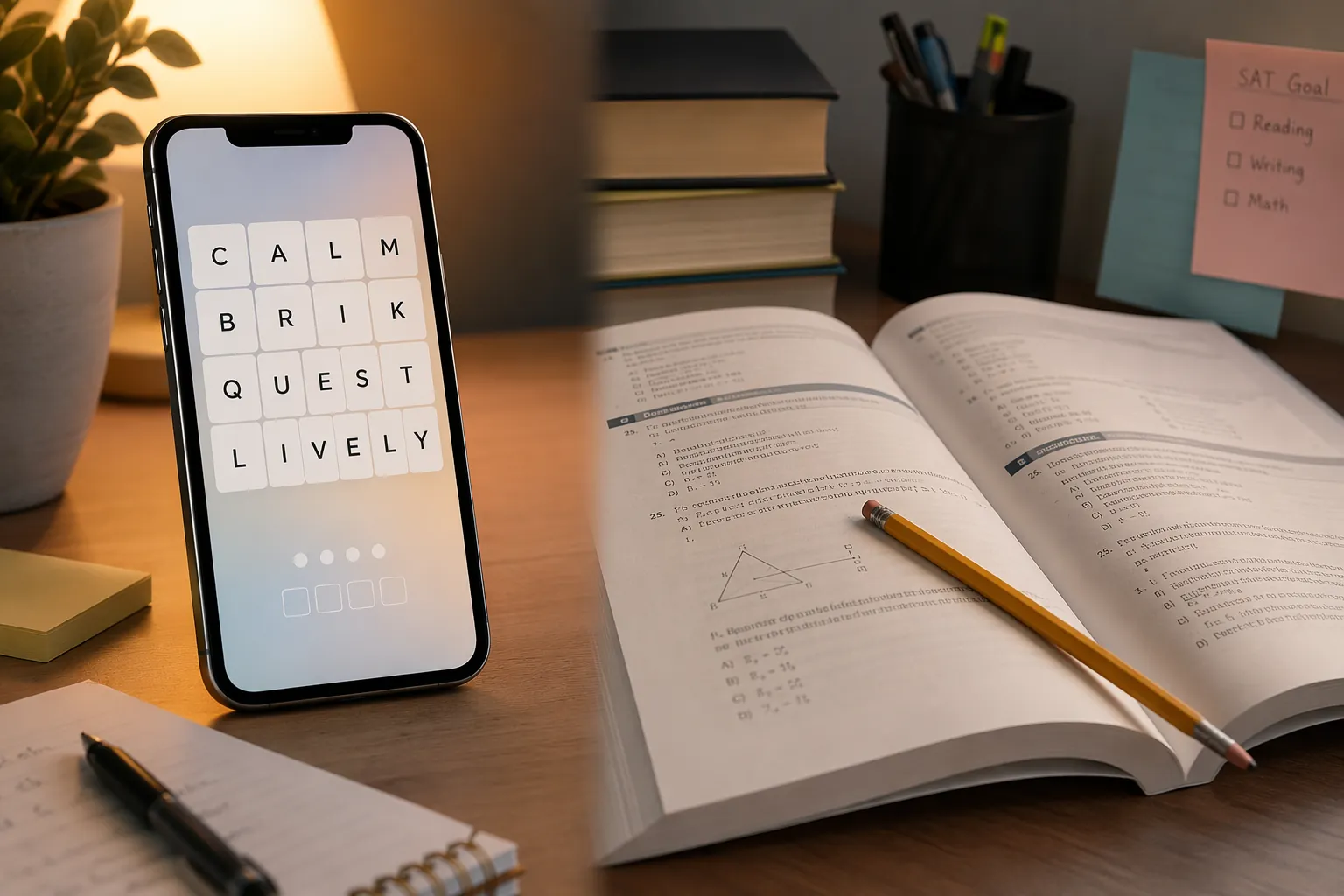
The Daily Puzzle Is a Warm-Up, Not the Study Plan
The daily NYT puzzle can still be useful. It gets students looking for patterns, testing synonyms, catching false leads, and defending why one word belongs with three others. That is better than scrolling through random content for ten minutes, and the game is familiar enough that students do not need much onboarding. Connections recorded 2.3 billion plays in 2023, which explains why so many students already know the format before anyone turns it into a study method.[3]
But the daily puzzle is built for a broad audience, not for your SAT date. Its categories can lean on pop culture, wordplay, brand names, sports references, or tricks that have little to do with academic vocabulary. Solving that puzzle may improve your general comfort with language games, but it does not guarantee you practiced words likely to appear in a digital SAT passage.
Use the daily game as a warm-up if you enjoy it. If you want a more systematic solving process for the regular puzzle, this guide to solving NYT Connections with a systematic process can help. For SAT vocabulary, though, the input words have to change.
Why Connections-Style Sorting Fits Words in Context
A Words in Context question is rarely asking, “Have you seen this exact flashcard?” More often, it asks you to notice how a word behaves inside a sentence or passage. Is the word close to “restrain,” “limit,” or “express”? Does it describe a hidden quality, a developing trend, or a stated claim? Which answer choice fits the author’s logic rather than just sounding familiar?
Connections-style grouping trains that middle layer between raw definition and passage-level judgment. When students place “latent” with “dormant,” “inactive,” and “undeveloped,” they are not just reciting one definition. They are building a small semantic neighborhood. That matters because a test question may not use the same phrasing a vocabulary list used.
The game also punishes shallow recognition. A student who knows that “novel” can mean “new” may still misgroup it if the puzzle uses “novel,” “original,” “innovative,” and “fresh” as one set while another tempting set contains books or genres. That pressure to compare meanings is the useful part. For a deeper explanation of the cognitive side, see How to Solve Connections Puzzles Using Semantic Memory.
Build the Puzzle From SAT Words, Not From Vibes
The study method starts before the grid exists. Choose a third-party SAT vocabulary list, then build a 16-word puzzle from it. PrepScholar publishes a 384-word SAT vocabulary list drawn from official practice tests, Test Innovators has a digital SAT vocabulary list with 200+ words from Bluebook tests, and Acely offers a shorter 92-word SAT vocabulary list.[4][5][6] These are not official College Board guarantee lists. Treat them as practical study pools, not predictions.
| Source type | Best use | Coach’s caution |
|---|---|---|
| Long third-party list | Build many puzzles across several weeks | Do not assume every word is equally likely or equally useful |
| Shorter third-party list | Start quickly or review before a near test date | Shorter is easier to finish, but less comprehensive |
| Your missed words | Turn real errors into targeted puzzles | Only works if you record why you missed the word |
Flashcards still have a job here. If a word is completely unfamiliar, a flashcard is usually the faster first pass. Connections-style grouping is better after that first exposure, when you need to strengthen relationships: synonym clusters, contrast sets, tone words, degree words, and words that share a function in academic writing. If you are choosing a flashcard tool, use this SAT vocab flash card comparison as the recall layer, then add custom Connections puzzles as the relationship layer.
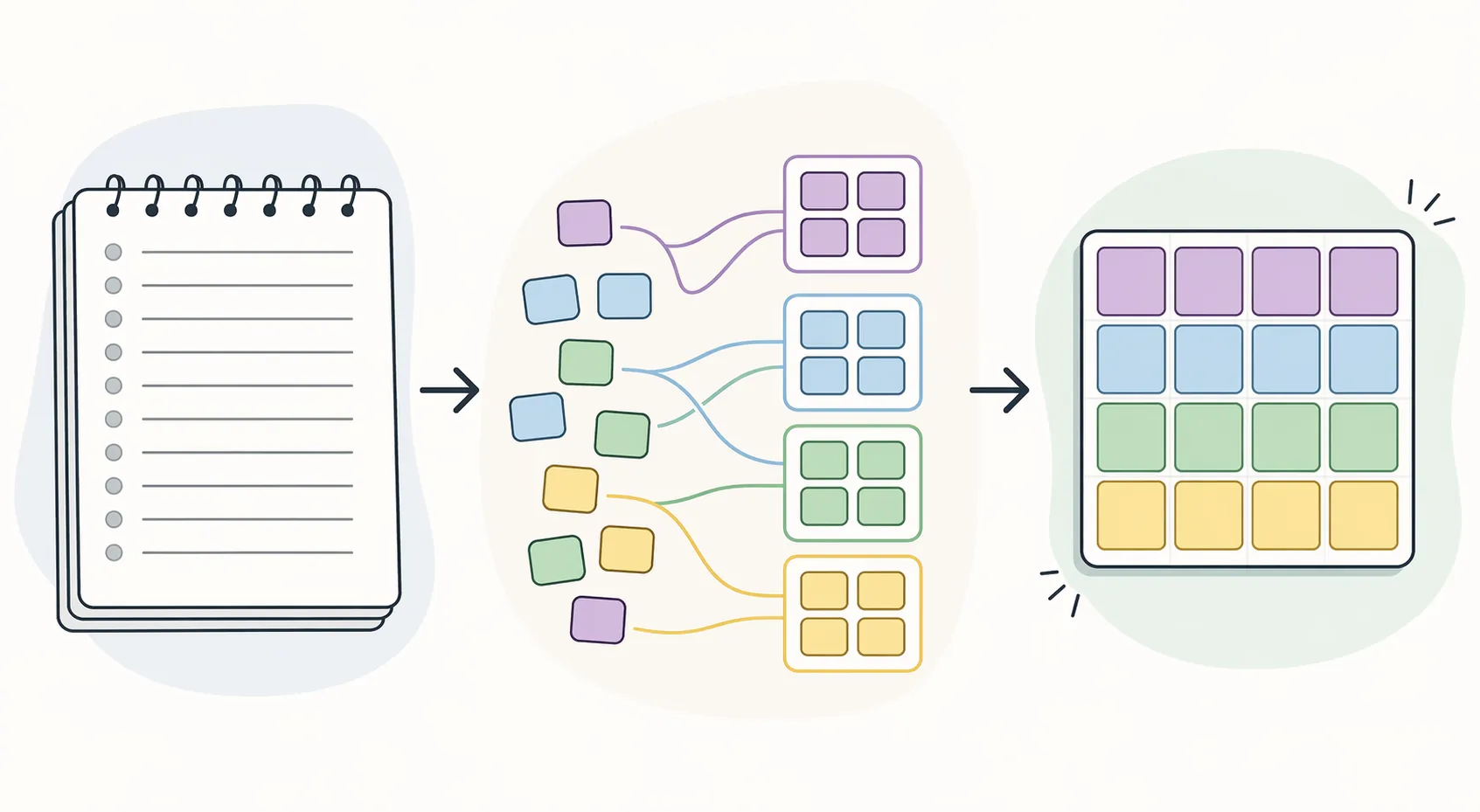
A Repeatable Custom Connections Workflow
Here is the version I would actually let a junior count as SAT prep. It takes a familiar 16-word grid and makes the practice targeted enough to matter.
- Pick one SAT-specific word list or a set of words you personally missed.
- Choose 16 words, not 40. The limit forces cleaner decisions.
- Sort the words into four defensible semantic groups.
- Write the category logic before anyone solves the puzzle.
- Have someone else solve it, or solve a classmate’s puzzle.
- Review every wrong guess by relationship, not by isolated definition.
1. Choose words with a reason
Start with words that belong in SAT prep. A general “hard words” list can drift into trivia; a daily puzzle can drift into entertainment. A third-party SAT list at least keeps the pool closer to academic reading. Better still, use words from your own missed practice questions, because those already exposed a gap.
Do not choose only words you already like. Students tend to build puzzles from words they half-know because that feels smooth. The stronger set includes some words you can define, some you can recognize but not explain, and a few that confuse you when they appear near similar answer choices.
2. Sort by relationships the SAT might care about
The weakest custom puzzles use categories like “words I studied Monday” or “words from page two.” Those are filing labels, not semantic practice. The category has to make the solver compare meaning.
| Useful group logic | What it trains |
|---|---|
| Near synonyms | Choosing the closest meaning when answer choices overlap |
| Opposites or contrast pairs | Recognizing shifts in argument or tone |
| Words with shared academic function | Seeing whether a word introduces doubt, support, restraint, emphasis, or change |
| Degree or intensity groups | Distinguishing mild, moderate, and strong versions of an idea |
| Commonly confused words | Separating words that look or sound related but behave differently |
A hypothetical group might put “restrain,” “curb,” “inhibit,” and “constrain” together because they all involve limiting action. Another might group “ambiguous,” “equivocal,” “unclear,” and “indeterminate” because they point toward uncertainty. The exact words matter less than the reason a solver can defend.
3. Write the answer key before you generate the puzzle
If you cannot write a category name and a one-sentence explanation, the group is probably too loose. “Academic words” is not enough. “Words that describe hidden or inactive potential” is usable. “Negative tone words” may be usable, but only if all four words share a tone closely enough that a solver is not guessing what you had in mind.
This is where the creator gets most of the learning. Building a fair puzzle requires checking definitions, comparing connotations, and deciding whether two words are close enough to belong together. That is slower than clicking four tiles in the daily game, but it is also closer to the work the SAT asks you to do under pressure.
4. Use a simple custom puzzle maker
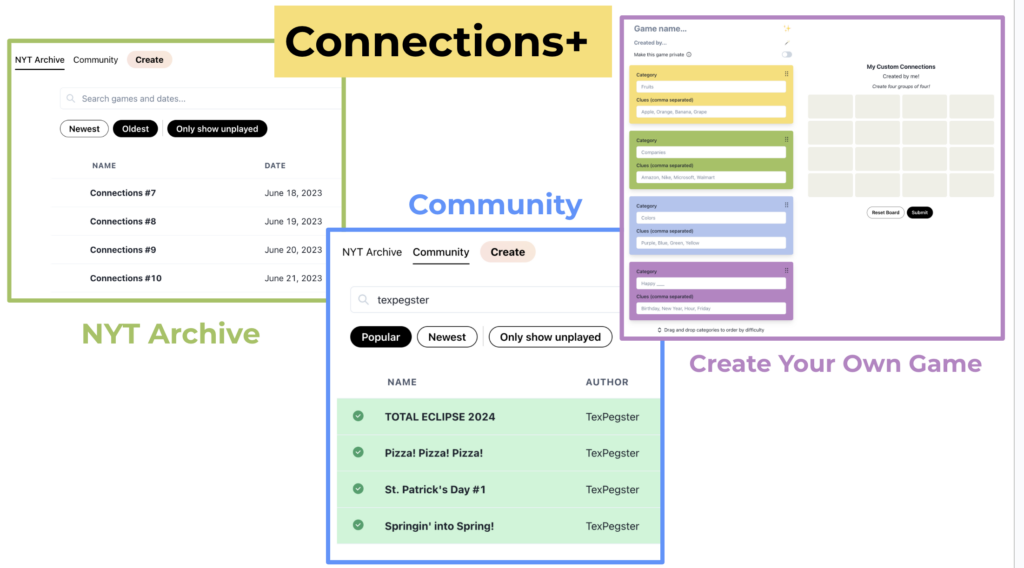
Swellgarfo is the easiest starting point: it lets you enter four categories and 16 answers to generate a playable custom Connections-style puzzle. Connections+ is useful if you care more about sharing puzzles or solving community-made ones. Custom Connections is another free option. These are third-party tools, not NYT products, and each lets students create a custom puzzle without paying or making an account.[7][8][9]
Teachers have also adapted custom Connections puzzles for classroom use. TCEA TechNotes describes using custom Connections-style activities in education, and Laura Randazzo has shared a classroom implementation of the format.[10][11] That does not prove SAT score gains, but it does show the format is practical outside the NYT app.
5. Solve, swap, and make wrong guesses useful
Solving your own puzzle is less valuable than solving someone else’s, because you already know the intended logic. If you are studying with a friend, each person should build one puzzle from the same word list, then swap. If you are studying alone, make the puzzle one day and solve it the next, after the category logic is no longer fresh.
The review is the difference between play and prep. Do not write only “got it wrong.” Write the relationship you missed. For example: “I grouped ‘subtle’ with negative tone words, but in this set it belonged with words meaning not obvious.” That note is much more useful than copying a dictionary definition.
| If you missed because... | Review this |
|---|---|
| Two words felt similar | The boundary between their meanings |
| You knew the word but not the category | Its function in a sentence or argument |
| You fell for a surface clue | The deeper semantic link among the correct four |
| You had never seen the word | First-pass definition, then a new group later |
How Often to Use This Before the SAT
A reasonable routine is small: one custom puzzle two or three times a week, plus quick review of the missed relationships. That is enough to make the habit repeatable without letting it swallow practice test review, grammar work, math, or full Reading and Writing sections.
For a student with a test date close enough to feel real, I would not spend an hour decorating puzzle titles or hunting for clever traps. Use that hour to build one clean grid, solve another, and record the five to ten relationships that actually changed what you know. The puzzle is a tool, not the assignment.
This method also belongs inside a broader SAT plan. Use the SAT Exam Hub for the full exam structure, and connect vocabulary work to a score-based plan like Study for the SAT in 2026 Using the Score-Gap Method. If you are comparing apps, books, and practice systems, the complete guide to SAT study tools in 2026 is the better place to make those choices.
Guardrails That Keep the Game Honest
- Do not count the daily NYT puzzle as targeted SAT vocabulary unless the words themselves came from your SAT prep.
- Do not build categories from trivia, spelling patterns, or private jokes when the goal is Words in Context practice.
- Do not replace flashcards completely if you still lack first-pass definitions.
- Do not assume third-party SAT lists are official College Board coverage lists.
- Do not spend more time making the puzzle look clever than reviewing the semantic mistakes it revealed.
A related example of turning Connections categorization into a study protocol appears in The Study Method Hidden in the Connections Mushrooms Puzzle. The useful move is the same: stop treating the puzzle as a streak and start treating it as a way to expose how you connect ideas.
NYT Connections becomes SAT vocabulary practice only when you control the word bank and review the links you missed. Play the daily puzzle if you enjoy it. For actual prep, build custom 16-word grids from SAT vocabulary sources, sort by defensible semantic relationships, and keep a short record of the distinctions that fooled you.
References
- The Digital SAT Reading and Writing Section: What You Need to Know, PrepScholar.
- What makes the New York Times game Connections so addictive?, The Conversation, 2024.
- Can games like Wordle and Connections improve your brain health?, Northeastern Global News, 2024.
- The Best SAT Vocabulary Words You Must Know, PrepScholar.
- Digital SAT Vocabulary, Test Innovators.
- SAT Vocabulary Words, Acely.
- Custom Connections, Swellgarfo.
- Connections+, Connections+.
- Custom Connections, Custom Connections.
- Custom Connections: A Fun Way to Review, TCEA TechNotes Blog, 2024.
- Connections, Laura Randazzo, 2024.
Related exhibits & inventory
Verified outcomes
- Method article → Method articleLimited
The Study Habit That Won Hong Wang the Fields Medal
- 0 → 502Limited
How Howard Unenrolled 502 Freshmen Over Financial Aid Timing
- 0 → 502Limited
A Financial Aid System Failure Unenrolled 502 Howard Freshmen
- 0 → 0Limited
What Howard's unenrollment teaches SAT and ACT students
Planners
Tool verdicts
Questions about this plan
Ask a question about a specific section, timeline, or citation in this plan — or flag something that needs correcting.
Comments
Join the discussion with an anonymous comment.