
What Howard's unenrollment teaches SAT and ACT students
The unsettling part of the Howard University unenrollment story is not that a college expected students to settle their accounts before arriving. Colleges do that. The problem is the gap between the date families could see, the date students say was enforced, and the moment when the consequence arrived.
Incoming first-time students were preparing to move in when they received unenrollment notices tied to a financial deadline, with reports placing the notices 13 days before move-in and describing a July 10 internal requirement that students pay 50% of their balance to keep their place.[1][2] Howard’s public Office of the Bursar page, however, lists the Fall 2026 payment due date as August 3.[3] That discrepancy is the lesson for SAT and ACT students: admission is not the same thing as secured enrollment.

A strong SAT or ACT score can help open the door. A compelling application can win the offer. But between acceptance and move-in, a different system takes over: bursar balances, loan timing, scholarship posting, third-party payments, housing clearance, and office-by-office interpretation of what counts as “paid enough.” Howard’s case is a hard example of how a student can do the academic work, make the college list, get admitted, and still be stopped by a financial-administrative rule they did not understand in time.
The deadline problem was the center of the damage
Howard did issue a July 23 statement titled “First-Time-In-College Enrollment Updates,” confirming that an enrollment action had occurred.[4] What the public record still does not give families is an official affected-student count or a clean reconciliation of the two dates at the center of the dispute: the publicly posted August 3 Fall 2026 payment due date and the July 10 50%-payment deadline reported by students and Kin+.[1][3][4]
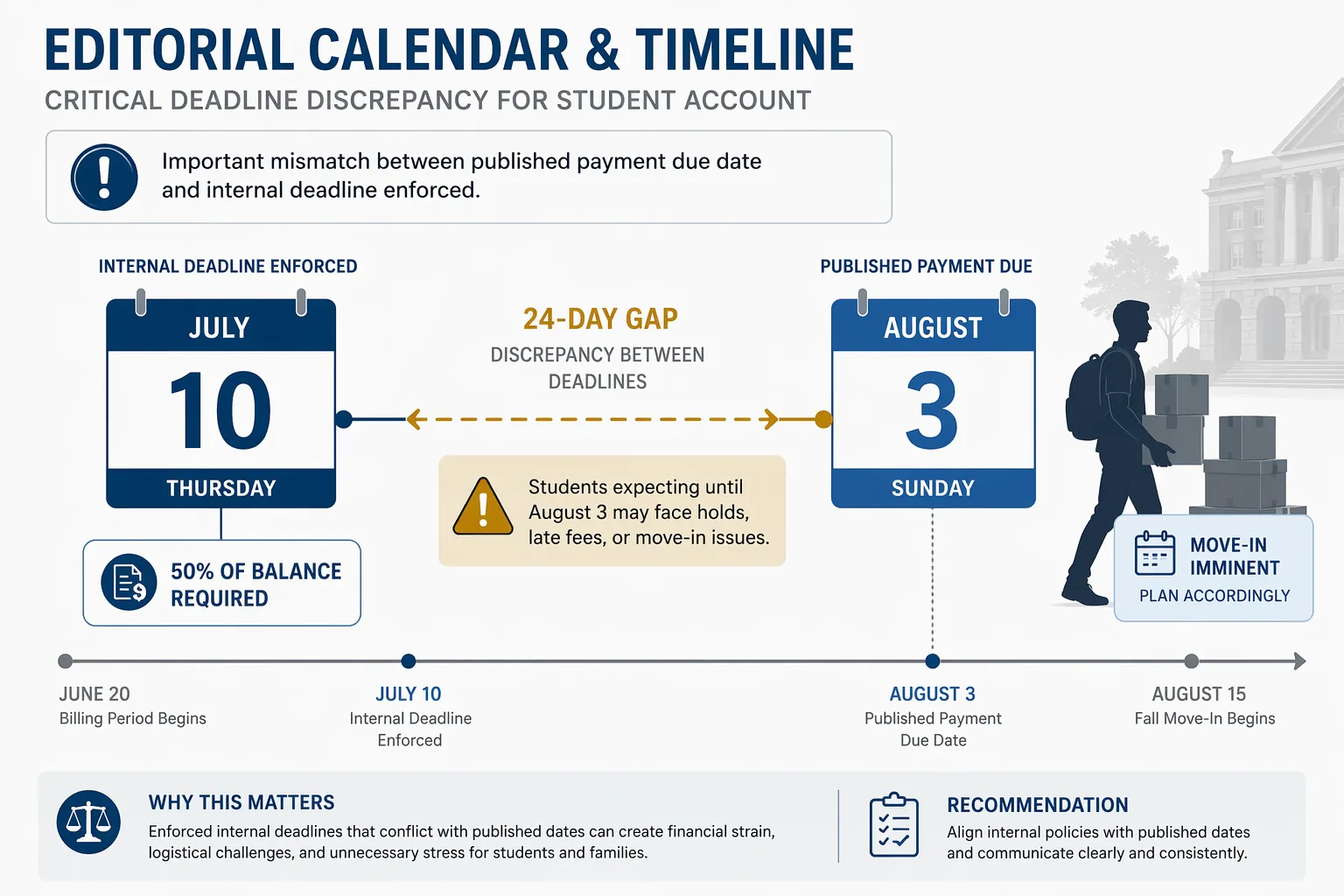
That distinction matters. If a university publishes one payment due date but also uses an earlier internal threshold to decide whether an admitted student remains enrolled, the earlier threshold is the operational deadline. It is the date that decides whether the student keeps the seat, even if the later date is the one a family can more easily find on a public bursar page.
The contested facts should stay contested. The July 10 requirement has been reported by students and Kin+, not confirmed in Howard’s statement.[1][4] A Change.org petition launched July 23 said “over a hundred” students were affected and had more than 4,466 signatures as of July 23, while social-media claims around 500 affected students remain unverified.[6] Howard has not released an official count.[4]
For a student building a college plan around test scores, this is not a side story. It changes what “done” means. You are not done when the score report is sent. You are not done when the acceptance arrives. You are not even necessarily done when financial aid appears in a portal as pending.
What the sequence likely felt like for an admitted student
The practical sequence is what makes the case so painful. A student earns admission. The family begins acting like college is real: housing, travel, packing, maybe turning down other offers. A balance appears, but so does expected aid: loans, scholarships, veterans benefits, an outside payment, or some combination of those. The student contacts offices for guidance. According to affected students cited in the Kin+ reporting, some were told that pending aid or balances under $5,000 would not trigger removal, guidance that students say conflicted with the later unenrollment action.[1]
Then the notice arrives close to move-in. At that point, the harm is not only financial. A family may already have arranged transportation. A student may have told relatives, coaches, employers, and friends that they are leaving. Another college option may have expired. The administrative decision lands after the student has psychologically and logistically crossed into the next stage of life.
None of that proves every student report as institutional fact. It does show why deadline visibility is not a minor customer-service issue. When a deadline determines whether an admitted student remains enrolled, it has to be findable, consistent, and matched to the way aid actually reaches accounts.
Pending aid is not the same as money posted to the account
This is the mechanism SAT and ACT students are most likely to miss. “I have aid” can be true while “my account is paid” is still false. A loan can be approved but not disbursed. A scholarship can be awarded but not posted. A third-party payment can be in process but not yet credited. A veterans benefit can be expected but not yet counted in the student account.
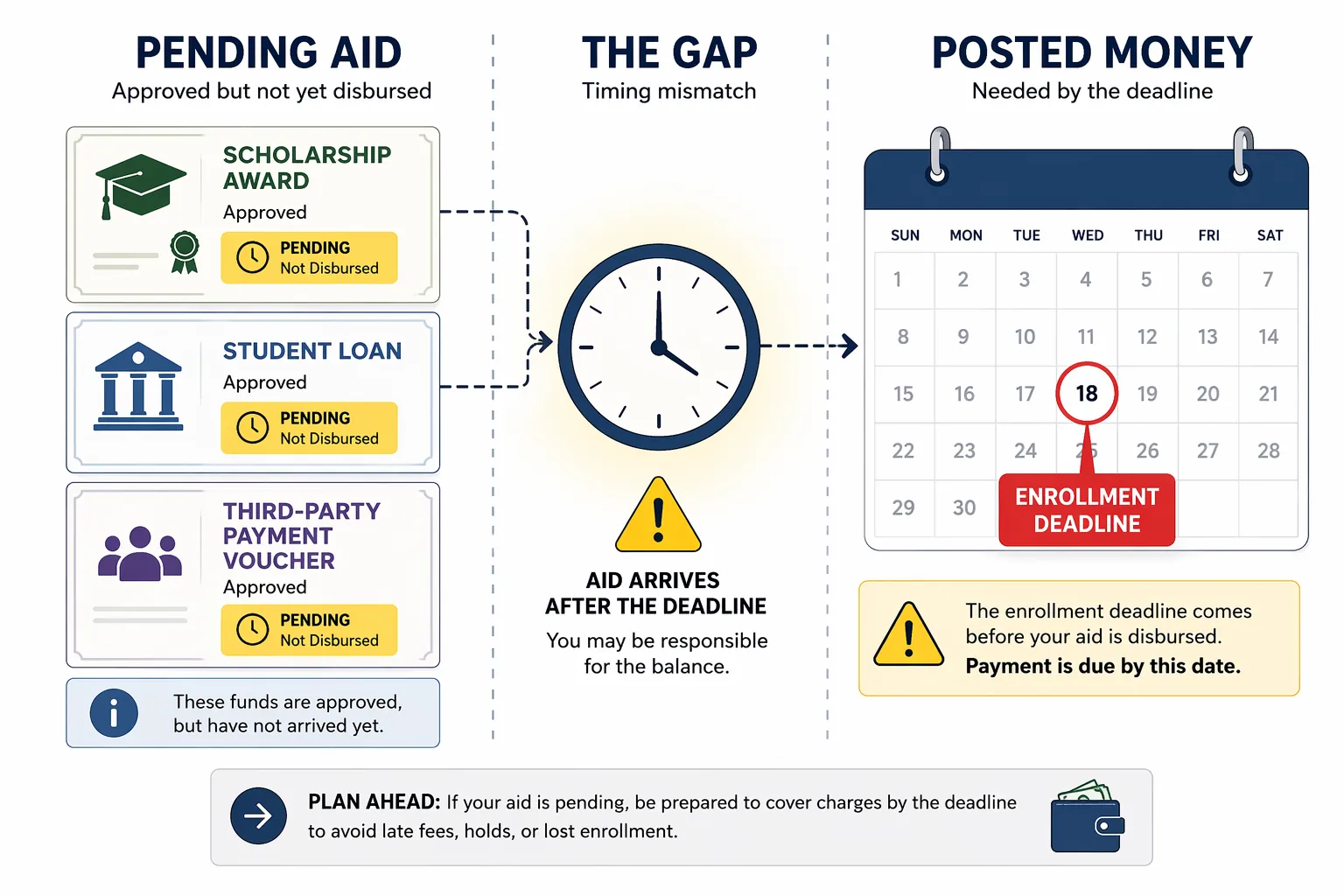
Howard’s own Financial Aid Terms and Conditions say the first Direct Loan disbursement for first-time borrowers occurs 30 days after classes begin.[5] That means a first-time borrower could have legitimate federal loan funding in motion and still not have that money posted before a July 10 internal threshold — or even before an August 3 bursar due date, depending on the academic calendar and account rules.[3][5]
That timing trap is not a technicality. If the enrollment system judges a student by posted money, pending money may not protect the seat. If the system gives credit for pending aid, the student needs to know which types count, who verifies them, and by what date. Kin+ reported that Howard did not answer 11 specific questions, including whether veterans benefits or third-party payments were counted before a student’s place was released.[1]
For a high school senior, the important distinction is simple enough to write down:
| What a student may see | What the school may require |
|---|---|
| An aid offer or loan approval | Money actually disbursed to the student account |
| A scholarship letter | Scholarship funds posted or formally accepted as pending credit |
| A public payment due date | An earlier internal clearance deadline for enrollment, housing, or move-in |
| A balance that seems manageable after aid | A required percentage of the current balance paid by a specific date |
| Verbal reassurance from an office | Written confirmation tied to the exact account, deadline, and aid type |
The systems history makes the ambiguity harder to dismiss
Howard’s 2026 unenrollment dispute did not emerge in a vacuum. In July 2025, the university said its BisonHub/BisonWeb transition had delayed approximately 1,000 student-account updates between January and June 2025.[7] That earlier statement does not prove the same cause in the 2026 unenrollment action. It does show that account-status problems at scale were already part of the recent institutional record.
For students, the practical takeaway is not to become suspicious of every portal. It is to treat portals as systems that can lag, misclassify, or fail to reflect a conversation you had with an office. If your enrollment depends on whether an account is cleared, the portal status, the written policy, and the office guidance all need to match. When they do not, the mismatch itself becomes the problem to solve.
Why selective-college applicants should care before senior spring
Students preparing for selective admissions often build a clean mental sequence: raise the SAT or ACT score, apply well, get admitted, choose the best offer, move in. The Howard case interrupts that sequence after the offer. It shows that the outcome attached to test prep is not only an admission letter. The real outcome is arriving on campus with the account, aid, housing, and enrollment status all cleared.
That does not make test prep less important. It makes the rest of the path visible. A higher score can still expand options, improve competitiveness, and make merit aid more realistic at some schools. But a score cannot override a bursar rule. It cannot make a pending loan disburse earlier. It cannot preserve a seat after an internal clearance deadline has passed.
If you are still building your testing plan, use resources like the SAT exam prep guide or a SAT/ACT decision guide for the academic side. Just do not let the testing calendar become the only calendar you trust. By the time you are choosing between colleges, you need the financial calendar with the same level of seriousness.
Financial pressure raises the stakes, but it does not replace the deadline lesson
Howard serves many students for whom timing gaps are not easily solved with a family payment. More than 70% of Howard students demonstrate high financial need, and more than 40% are Pell-eligible, according to figures cited in the reporting around the unenrollment dispute.[1] When a large share of students relies on aid, loans, and outside funding, the difference between pending and posted money becomes more than a paperwork issue.
There is also broader financial pressure around the institution. Bloomberg reported in February 2026 that Howard’s sharp growth had reversed in a 5% enrollment drop, and the research record around the case notes that Fitch lowered Howard’s credit outlook to negative that month amid slowed enrollment growth and increased expenses.[8] Cost of attendance rose from about $51,000 in 2021–22 to about $64,700 in 2025–26, and loan volume increased 17% year over year, from 5,882 to 6,905.[1]
Those facts help explain why enrollment, payment, and aid systems are high-stakes. They do not prove a motive for Howard’s July 2026 decisions. The safer conclusion is narrower and more useful for applicants: when a university is managing tight capacity, high need, rising costs, and complicated aid flows, students cannot assume that admission alone protects them from account-status enforcement.
What to verify before you treat an acceptance as secure
A disciplined college-entry plan has to include a post-admission checklist. This is especially true if your family cannot simply pay a large balance while waiting for aid to arrive.
- Find the real clearance deadline. Do not stop at the public tuition due date. Ask whether there is an earlier deadline for enrollment confirmation, housing, course registration, or move-in eligibility.
- Ask whether a percentage of the balance must be paid. A school may not only ask whether the full bill is paid; it may ask whether a minimum portion is paid by a specific date.
- Separate pending aid from posted aid. For every scholarship, loan, grant, veterans benefit, payment plan, or outside payment, ask whether it counts toward clearance before it appears on the student account.
- Confirm loan disbursement timing. First-time borrowers should be especially careful, because loan approval and loan disbursement may happen on different timelines.
- Get office guidance in writing when possible. If one office says your account is safe because aid is pending, ask for confirmation that includes the balance, deadline, aid type, and consequence for nonpayment.
- Check whether move-in depends on account status. Housing assignment, arrival permission, and enrollment status can be connected to the bursar account even after admission.
- Keep a dated record. Save emails, portal screenshots, payment confirmations, aid letters, and call notes. If offices give conflicting answers, the record helps you escalate before the deadline rather than after the notice.
Students who are comparing aid packages should also read beyond the award amount. The most generous-looking package can still create a cash-flow problem if the money arrives after the school’s clearance deadline. If loans are part of the plan, pair your admissions strategy with borrowing research, including how policy changes may affect repayment; StudyMethod’s guide to 2026 student loan rulings is one place to start.
The habit is not panic. It is verification. Before you say, “I’m set,” know the date that actually protects your seat, know what the school counts as payment, and know whether your aid will arrive before the system makes its decision.
References
- DEVELOPING: Howard University Confirms Enrollment Action, Leaves Deadline Questions Unanswered — Kin+, July 23, 2026
- Fall Move-In — Howard University Student Affairs
- Important Deadlines — Office of the Bursar, Fall 2026
- First-Time-In-College Enrollment Updates — Howard University, July 23, 2026
- Financial Aid Terms and Conditions — Howard University
- Petition: Pressure Howard University to Resolve Student Unenrollment Issues — Change.org, started July 23, 2026
- Howard University Works to Support Students Facing Financial Aid and Account Challenges Ahead of Fall Semester — Howard University, July 25, 2025
- Howard University's Sharp Growth Reverses in 5% Enrollment Drop — Bloomberg, February 4, 2026
Related case links
How Houthi Attacks Affect Oil Prices: An Economics AD-AS Study Guide
- Study Advice That Actually Works for Gen Z Career Readiness
- A Graduate Study Plan for John Pardon's Symplectic Geometry
Compare each planner's length against this plan's 0-week duration manually.
Did a similar plan work for you?
Share whether a comparable timeline and starting point produced a similar result — this is verification discussion, not general commentary.
Comments
Join the discussion with an anonymous comment.