
Method
The Study Method Hidden in the Connections Mushrooms Puzzle
The NYT Connections 'mushrooms' category is more than a puzzle answer—it's a direct application of a semantic categorization strategy that research shows can boost free recall by nearly 40%. This article explains how to turn the game's grouping mechanic into an active study protocol.
Evidence panel
- Evidence level
- pending review
- Primary citation
- citation pending review
If you came here for the Connections mushrooms category answer, the clean version is this: KINDS OF MUSHROOMS was BUTTON, MOREL, OYSTER, and TRUMPET. The useful part is not that those four words name mushrooms. It is the little mental click that happens when four separate tiles stop being four separate facts and become one structure.
That is the basic engine of NYT Connections: 16 items, 4 groups, and a hidden category label for each group. Sometimes the link is straightforward, as in KINDS OF MUSHROOMS. Sometimes the mushroom word is a distractor inside a different structure, as in THEY HAVE CAPS, where MUSHROOM belongs with BASEBALL PLAYER, CAMERA LENS, and PEN. Sometimes it is part of a phrase, as in MAGIC ___, where MUSHROOM sits beside CARPET, KINGDOM, and MARKER.
That shift—from isolated words to a named relationship—is exactly the part worth stealing for studying. Not because a puzzle app secretly raises grades. Because deliberate semantic categorization is a real memory strategy, and Connections gives students a familiar shape for practicing it.
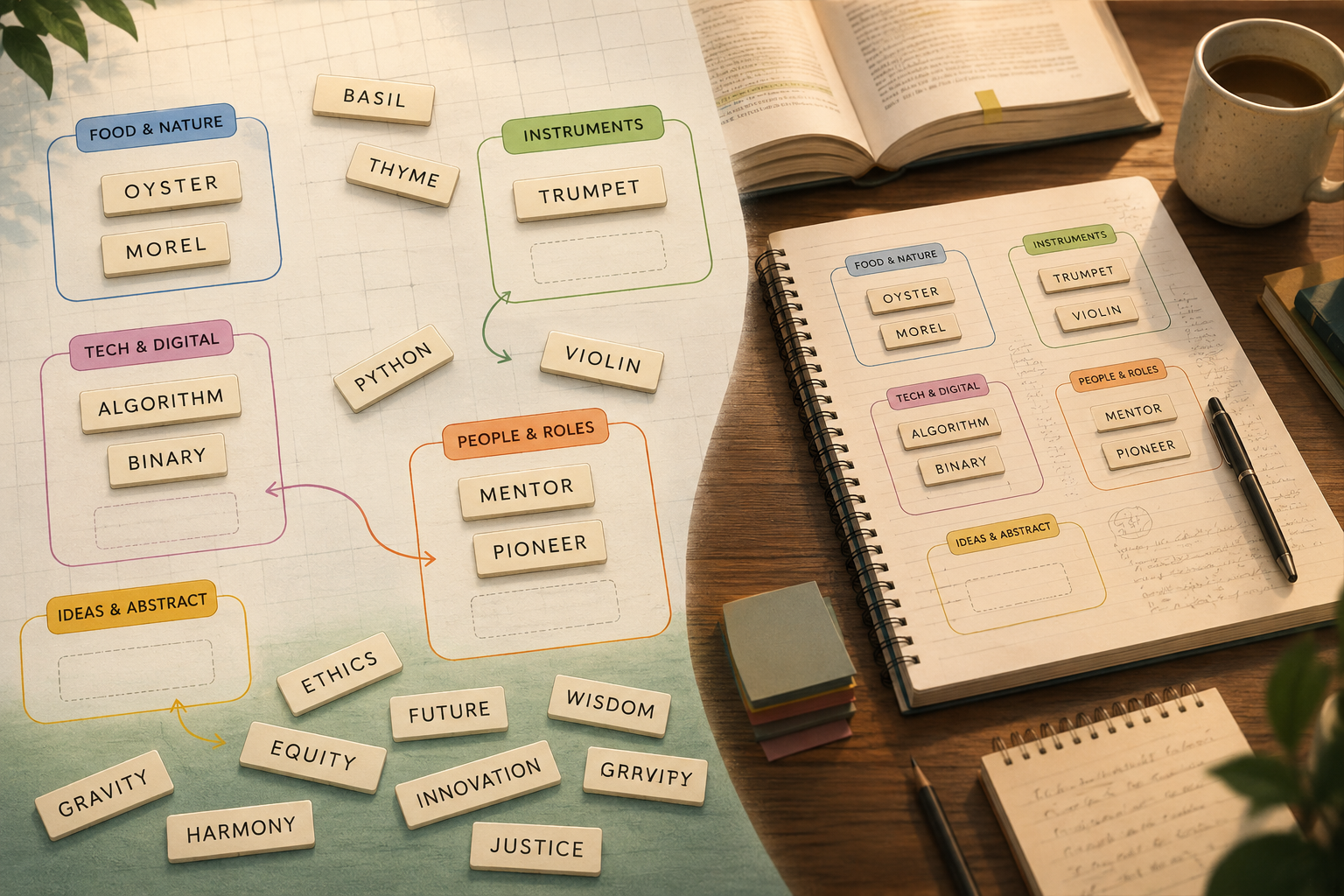
The puzzle move is semantic categorization
Semantic categorization means grouping information by meaning. In a puzzle, BUTTON, MOREL, OYSTER, and TRUMPET are no longer just four entries on a grid; they become examples of one category. In a biology unit, mitochondria, chloroplast, ribosome, and Golgi apparatus might become “cell structures with specialized functions.” In a history course, four events might belong together because they all intensified a conflict, not because they sound alike or sit next to each other in the textbook.
The Conversation’s explainer on Connections describes the game as a test of flexible access to semantic memory: players have to move between meanings, phrases, shared features, and associations rather than retrieve one fixed definition at a time.[2] That is also why the game can feel elegant when it works. The answer is not stored as a single flashcard. It has to be organized.
Studying often fails at this exact point. A student blocks out an hour, opens the notes, rereads the highlighted parts, and feels busy. The planner was real; the study action inside it was weak. Scheduling a study block can help protect time, but the block still needs a task that changes what the brain is doing. Categorizing terms forces one of those changes.
The research is stronger than a cute analogy
The best reason to take this seriously is a 2020 PLOS ONE study by Miotto and colleagues on semantic categorization strategy training in children and adolescents. In the adolescent group, free recall improved from about 11.2 words to 15.5 words after the categorization training—nearly a 38% increase, with p=0.001.[1]
The practice-effect control matters. The study did not merely show that people got better after seeing a memory task twice. Adolescents who repeated the task without categorization training improved only marginally, and that gain was not significant.[1] That makes the grouping strategy the interesting ingredient.
There are limits. The sample was small, with 25 Brazilian Portuguese-speaking participants ages 7 to 18, and the task involved word-list memory rather than a full chemistry chapter or a political theory exam.[1] Children under 12 also showed negligible improvement, moving from 7.67 to 7.83 words recalled, which was not significant.[1] So the fair conclusion is not “play Connections and your grades rise.” The fair conclusion is narrower and more useful: adolescents and older students can improve verbal recall when they deliberately practice organizing words by meaning.
The same study also reported fMRI changes after training, including increased activation in right prefrontal areas and deactivation in default mode network areas, patterns the authors connect with more efficient memory encoding.[1] That brain-imaging detail is interesting, but it should not outrank the behavioral result. For a student, the main point is still plain: after training in semantic categorization, adolescents recalled more words.
Turn a Connections grid into a study routine
The study version should feel familiar, but it cannot stay at the level of puzzle guessing. You are building categories on purpose, then using them to retrieve material later.
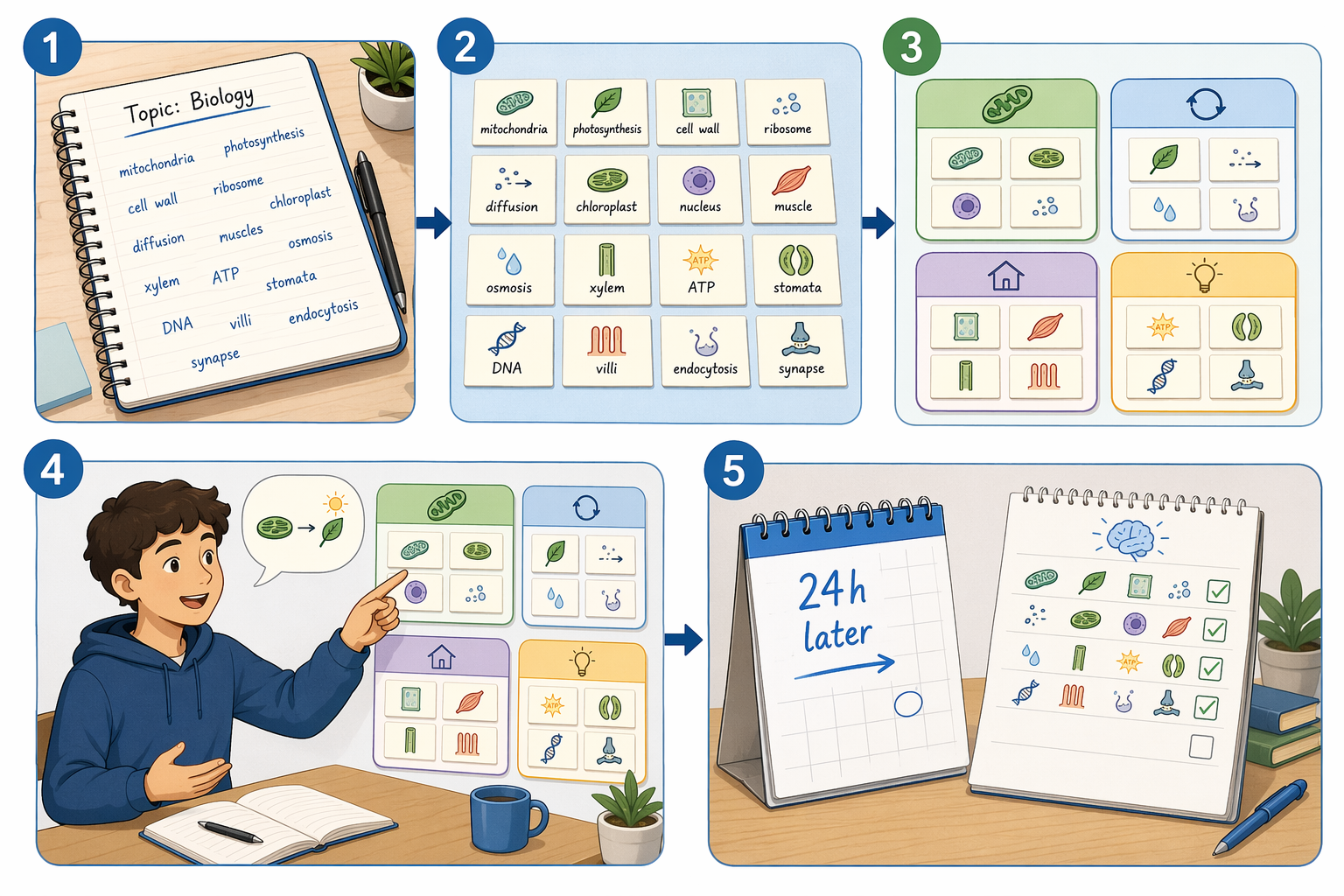
| Move | What to do |
|---|---|
| Choose the topic | Use one current course topic, not an entire unit. |
| Pull 16 items | Write 16 terms, concepts, events, formulas, people, cases, or claims. |
| Make 4 categories | Group by shared meaning: theme, time, cause, function, feature, method, or consequence. |
| Sort the items | Place each item into one group and leave room for revision. |
| Explain the groups | Say why every item belongs and why a tempting wrong item does not. |
| Test later | After 24 hours, recall the 16 items from the category labels first. |
| Add a hard group | Use a “purple category” only when the basic version is working. |
Start smaller than your exam
Pick a topic that can actually fit into 16 items. “Cell biology” is too large. “Organelles and their functions” is usable. “The French Revolution” is too large. “Causes of revolutionary instability” is usable. The point is to create pressure, not sprawl. A Connections grid works partly because it gives you boundaries.
The 16 items should come from your actual notes, textbook, slides, problem sets, or review guide. Do not choose only the terms you already know. If every tile is comfortable, the grid becomes decoration.
Categories do not have to be synonyms
This is where students often make the method too shallow. In Connections, a category can be mushrooms, things with caps, or words that follow “magic.” Those are different kinds of relationships. Study categories can be just as varied.
- Thematic: four ideas that express the same underlying concept.
- Chronological: four events that belong to the same phase of a process.
- Cause-effect: four factors that produce, intensify, or prevent an outcome.
- Feature-based: four items that share a property, function, structure, or constraint.
- Method-based: four problems solved by the same procedure or formula.
For a literature class, four characters might belong together because they all misread a social situation. For economics, four graphs might belong together because the same shock shifts the same curve. For anatomy, four terms might belong together because they all participate in one pathway. The category label should make the relationship easier to retrieve, not merely make the page look organized.
The explaining step does most of the work
Sorting is useful, but explaining is the point at which this stops being a matching game. Once you place four terms in a group, say the category aloud and justify each member. Then name one item that almost fit but did not.
A weak explanation sounds like: “These go together because they were all in the same lecture.” That is usually just location memory. A stronger explanation sounds like: “These four policies all increased central authority, but this other policy belongs elsewhere because it mainly changed local enforcement.” The second version forces meaning, boundary, and contrast.
If you cannot explain why an item belongs, do not pretend the category is finished. Look back at the source material, revise the label, or move the item. The friction is not a sign the method failed. It is the method showing you where your knowledge is still vague.
Use the 24-hour test as retrieval, not review
The next day, do not start by rereading the grid. Write the four category labels from memory. Then try to reconstruct the four items under each label. Only after that should you check the original grid.
Mark three things: items you recalled correctly, items you placed in the wrong category, and items you forgot completely. Wrong-category errors are especially useful because they show which distinctions need sharper labels. A forgotten term may need repetition; a misplaced term usually needs a better relationship.
Save the “purple category” for later
Connections players know the purple group is often the one with the strangest angle: wordplay, hidden phrases, a less obvious shared feature. In studying, the equivalent is a category that requires transfer. Instead of grouping four terms by chapter heading, you group four cases that use the same principle even though they appear in different units.
Do this after the basic categories are stable. If the first version of your grid is already messy, adding a clever lateral group usually turns studying into puzzle cosplay. The harder group should deepen retrieval, not hide confusion.
What this method can and cannot claim
NYT games are enormously popular; Northeastern reported that Connections was played 2.3 billion times in 2023.[3] Popularity, though, is not the same thing as transfer to schoolwork. Cognitive scientist Susanne Jaeggi cautioned that these games are designed as entertainment first, even though they engage executive functions.[3]
That boundary is worth keeping. Playing Connections while eating breakfast may be fun, and it may exercise flexible word knowledge in the moment. It is not the same as building a category grid from your exam material, explaining the relationships, and testing recall the next day.
The evidence supports the deliberate version more than the passive one. Miotto and colleagues studied semantic categorization training, not casual gameplay.[1] The training asked participants to use a strategy for memory. If you want the study benefit, you have to do the strategy part.
A simple example of the study grid
Here is a hypothetical version for a biology student reviewing cellular respiration. The exact terms would depend on the course, but the structure shows the method.
| Category label | Four study items |
|---|---|
| Inputs and outputs | Glucose; oxygen; carbon dioxide; water |
| Energy carriers | ATP; NADH; FADH2; electrons |
| Major stages | Glycolysis; pyruvate oxidation; citric acid cycle; oxidative phosphorylation |
| Places where steps occur | Cytosol; mitochondrial matrix; inner mitochondrial membrane; intermembrane space |
The grid is only the draft. The student still has to explain it: why oxygen is an input, why carbon dioxide is an output, why NADH is grouped with energy carriers rather than stages, and why glycolysis belongs in the stage group even though it also has a location. That explanation is where retrieval paths start to form.
The next day, the student should cover the right column and rebuild it from the category labels. If “energy carriers” brings back ATP and NADH but not FADH2, that is a specific repair job. If “major stages” comes back in the wrong order, the category may need a chronological layer. The method gives feedback that rereading usually hides.
Use the mushroom answer, then move past it
BUTTON, MOREL, OYSTER, and TRUMPET are a neat little group. They are also a reminder that memory improves when the material is not left as a pile of separate tiles. For schoolwork, the useful habit is to build the group yourself, name the relationship, defend the membership, and retrieve it later without looking.
Connections can inspire a strong study method. It just does not do the studying for you.
References
- Semantic categorization strategy training in children and adolescents: A study of behavioral and neural effects on verbal episodic memory, PLOS ONE, 2020.
- NYT ‘Connections’: Tips to improve your game through the science of semantic memory, The Conversation, 2024.
- Can Connections and Wordle make you smarter? Northeastern experts explain the science behind the viral NYT games, Northeastern Global News, April 30, 2024.
Applies to
Exam applicability isn't specified for this technique yet. See all exam hubs.
Comments
Join the discussion with an anonymous comment.