The Study Habit That Won Hong Wang the Fields Medal
The useful part of Hong Wang’s story starts before the medal, before the research fame, and before anyone is tempted to turn her into a motivational poster. As a child, Wang reportedly got extra math books from her father and solved every problem in them before the school term began; another account says she consistently finished all textbook exercises before teachers introduced the material in class.[1][2]
That habit is why people asking about “hong wang study habits that won the fields medal” should look less at the word “genius” and more at the sequence of work. The Fields Medal explains the attention: Quanta reported Wang’s 2026 Fields Medal win and described her as the third woman ever to receive it.[1] But the transferable study move is smaller, plainer, and more mechanical: meet the problems before someone tells you what they are supposed to mean.

The reports also matter because they do not describe a polished private pipeline. VnExpress wrote that Wang did not attend math competition training camps and traveled to a library in a neighboring county to borrow books when local resources were limited.[3] That does not make her path ordinary. It does make one piece of it less mysterious: she repeatedly put herself in front of unfamiliar material early, without waiting for a teacher, tutor, or formal sequence to unlock it.
The habit was solving ahead, not reading ahead
There is a quiet but important difference between opening tomorrow’s chapter and trying tomorrow’s exercises. Most students have been told to preview. They skim headings, underline definitions, maybe watch a video. That can help with orientation, but it does not force the mind to choose a path.
Wang’s reported pattern was more demanding. The accounts emphasize doing exercises before instruction, not merely becoming familiar with the chapter names.[1][2] In exam prep, that difference is the whole method.
| Approach | What the student does | What it usually produces |
|---|---|---|
| Reading ahead | Skims the lesson, watches an explanation, copies definitions, feels less lost later. | Recognition without much pressure to retrieve or decide. |
| Cramming ahead | Rushes through large amounts of content before class or before a prep course catches up. | Coverage, often with weak retention and little error diagnosis. |
| Solving ahead | Attempts problems before full instruction, marks what failed, then returns after learning the rule. | Early pattern exposure, stronger questions during instruction, and a clearer review target. |
Solving ahead is uncomfortable because it exposes ignorance early. That is also its value. A student who tries an SAT algebra question cold and gets stuck at the setup has learned something more useful than “I need to review algebra.” She has learned that translating the sentence into an equation is the break point. A GRE student who misses a quantitative comparison item before reviewing inequalities has found the exact place where a rule is likely to matter later. An MCAT student who cannot even choose which biology concept applies has discovered that the issue is recognition, not memorization alone.
This is why Wang’s childhood habit should not be flattened into “study more” or “start early.” Starting early with passive material is still passive. Solving ahead creates a record of collisions: problem types you almost recognized, rules you misused, steps you skipped, and traps you did not know were traps.
Why cold problems make later instruction lighter
A cold attempt changes what happens when the explanation finally arrives. Without that attempt, the lesson has to do everything at once: introduce the concept, define the symbols, show the setup, demonstrate the steps, and warn against mistakes. With a prior attempt, part of the lesson lands on a prepared surface. The student is no longer hearing a rule in the abstract; she is matching it to a problem that already resisted her.
That is the practical side of cognitive load. A new problem feels heavy when every piece is unfamiliar at the same time. Pre-exposure does not make the content easy. It makes some pieces less new. The second pass can then carry more useful work: “That’s why I needed to isolate the variable first,” “That’s why the answer choice was tempting,” or “That’s why this passage question was asking for function, not detail.”
The mistake is to confuse this with guessing and moving on. A cold attempt is not a performance event. It is a setup for a better second encounter. If the student never returns, the cold attempt becomes another way to collect wrong answers. If the student returns with a rule, a redo, and later mixed practice, the same wrong answer becomes a landmark.
An exam-prep version of Wang’s pre-exposure loop
Wang did not publish an hour-by-hour SAT, GRE, MCAT, or ASVAB plan. The standardized-test version below is an adaptation of the reported habit, not a claim that Wang endorsed this as an exam strategy. The useful transfer is the order of contact: problem first, instruction second, structured return third.
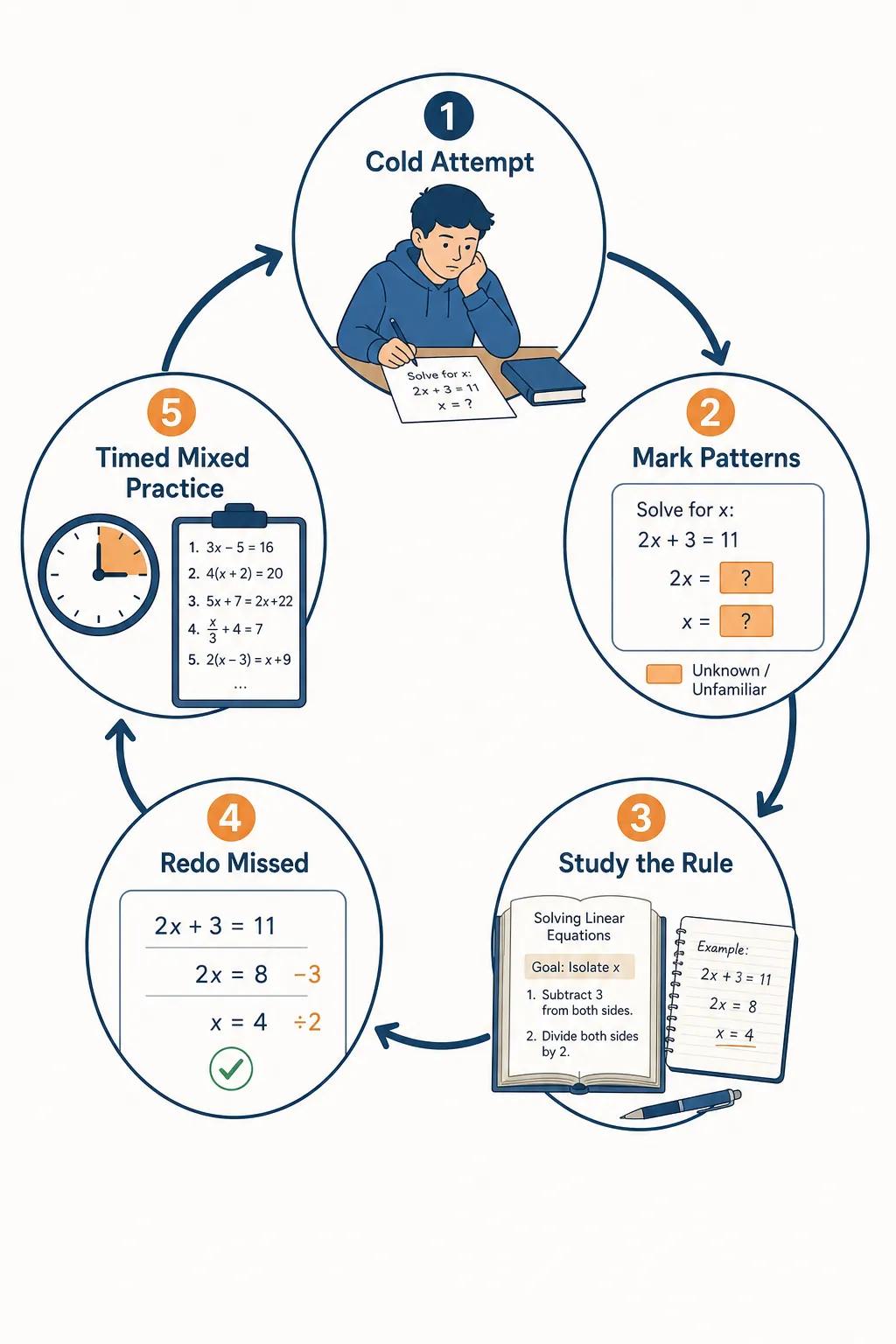
- Make a cold attempt at official-style questions before reviewing the lesson.
- Mark the unknown pattern, not just the right answer.
- Study the underlying rule, concept, or passage move.
- Redo the missed problem without looking at the explanation.
- Fold the pattern into timed mixed practice so it has to compete with other skills.
1. Cold attempt
The cold attempt should be small enough to review properly. Ten to fifteen official-style questions in one skill area usually teaches more than a heroic pile of untouched errors. For SAT math, that might mean linear equations, functions, or systems. For GRE quant, it might be ratios, inequalities, or data interpretation. For MCAT, it may be a short passage set tied to a content area you have not yet reviewed. For ASVAB, it could be one subtest cluster such as Arithmetic Reasoning or Mechanical Comprehension.
The key is to attempt before comfort arrives. Do not watch three explanations first. Do not read the whole chapter and then call the question cold. Let the first attempt show what your mind does when it has to choose without a model sitting beside it.
2. Mark the pattern that beat you
A wrong-answer log that says “careless” is usually too lazy to be useful. Mark the pattern. Was the error about setup, vocabulary, formula selection, graph reading, passage function, answer-choice trap, unit conversion, or timing?
This is where many students lose the benefit of pre-exposure. They do the brave part—trying before being taught—then skip the diagnostic part. The score report later says the same thing the notebook could have said weeks earlier: the weakness was not the whole subject, but a repeated move inside it.
For a deeper review structure, the same logic appears in the guide on how to use SAT practice questions to actually raise your score, especially if your current habit is to check the answer, nod at the explanation, and move on.
3. Study the rule after the problem has made you want it
Instruction is more efficient after a real miss. The rule now has a job. A grammar rule fixes a sentence you actually mishandled. A probability rule explains why your first setup counted the wrong cases. A chemistry concept clarifies why two answer choices looked equally plausible.
This is not an argument against lessons, books, teachers, tutors, or prep tools. Wang’s reported habit depended on books; the difference was that the book was not used only as an explanation source.[1][3] It was also a source of early resistance. The exercises came forward, before the classroom made them safe.
4. Redo the missed problem until the path is retrievable
A redo is not rereading the explanation. It means covering the solution and rebuilding the path. If the problem still fails, the student has not finished the learning cycle. If it succeeds only while the explanation is fresh, it needs a delayed redo. If it succeeds later in mixed practice, the pattern is finally becoming portable.
Students with fixed test dates should put these redo points on the calendar, not trust them to good intentions. A countdown structure such as an exam countdown study planner template is useful because pre-exposure has to happen early enough for return visits. If the exam is close, a shorter schedule like these midterm study schedule templates can keep the loop from expanding beyond the time you actually have.
5. Move the pattern into timed mixed practice
Blocked practice can flatter you. If every question in a set is about the same rule, half the work has been done by the page title. Standardized tests rarely provide that courtesy. The final step is to mix the pattern with older topics, easier questions, harder questions, and time pressure.
This is where the method turns from preparation into test readiness. The question is no longer “Can I do this after a lesson?” It is “Can I recognize this when nothing announces it?”
How the same loop changes by exam
The pre-exposure habit transfers best when it respects the exam in front of you. SAT, GRE, MCAT, and ASVAB prep do not punish the same weaknesses, so the cold attempt should not look identical.
| Exam | Best use of pre-exposure | What to watch during review |
|---|---|---|
| SAT | Try a small set of official-style math or reading questions before reviewing the skill. | Separate concept gaps from question-type traps. In reading, mark whether you missed evidence, function, inference, or wording. |
| GRE | Use cold sets for quant topics and verbal question types before studying strategies. | For quant, track setup errors. For verbal, track whether the miss came from vocabulary, sentence logic, or answer elimination. |
| MCAT | Attempt passage-based questions before content review in a narrow topic area. | Distinguish missing content from failing to apply known content under passage pressure. |
| ASVAB | Pre-expose one subtest at a time, especially where school memory may be rusty. | Track whether the failure is content knowledge, procedure, reading of the prompt, or speed. |
For SAT students, pre-exposure pairs naturally with a diagnostic-first plan. If you already know your target and current score, the SAT score-gap method can decide which question families deserve cold attempts first. The broader SAT exam prep guide is the better next stop if you still need to map the whole test.
For GRE students, the cold attempt should be deliberately split. GRE quant rewards recognizing the mathematical structure quickly; GRE verbal rewards seeing sentence logic and answer-choice behavior. A general GRE prep hub can help sort which side of the exam needs earlier exposure.
For MCAT students, the danger is pretending that pre-exposure can replace content review. It cannot. The MCAT has too much underlying science for random guessing to become a strategy. Use cold passage attempts to reveal where content, application, and passage interpretation separate. Then choose review tools with that distinction in mind; the MCAT study tools comparison is a practical place to match the weakness to the tool.
For ASVAB students, pre-exposure is useful because the test spans different kinds of knowledge. Do not treat “ASVAB prep” as one pile. Try a small subtest set cold, mark the pattern, then review only what the attempt exposed. The ASVAB exam prep guide can help keep those subtests from blurring together.
What the reports do not prove
The evidence for Wang’s early study habit is consistent across multiple accounts, but it is still reported biography, not a controlled study of exam preparation. Quanta describes the childhood math books and Wang’s later deep work; The Standard describes her finishing textbook exercises before instruction; VnExpress describes self-study without competition camps and the trips to borrow books.[1][2][3]
Those accounts support a narrow conclusion: Wang repeatedly exposed herself to mathematical problems before formal teaching and followed that exposure with sustained study. They do not give us a daily schedule. They do not prove that solving ahead causes elite mathematical outcomes. They do not show that a student can skip instruction, feedback, or long-term review.
That caveat matters because elite biographies are often stripped for parts. A student with an exam date does not need an invented version of Wang’s childhood. She needs a study sequence that survives next Tuesday’s practice set, the next score report, and the next review block.
The part worth borrowing
The replicable part of Wang’s habit is not the medal, not the prodigy label, and not a fantasy schedule no source provides. It is the decision to face problems before being taught, then return to them with enough structure that the second encounter is different from the first.
For test-takers, that means cold attempts should be early, limited, and reviewed hard. Meet the problem. Mark the pattern. Learn the rule. Redo the miss. Mix it under time. Pre-exposure by itself is only contact. The gain comes when that contact makes later learning lighter to carry under test conditions.
References
- Hong Wang Wins 2026 Fields Medal, the Third Woman Ever — Quanta Magazine, July 23, 2026.
- Once-in-a-century breakthrough powers rise of Chinese math star — The Standard HK, August 2025.
- Meet Wang Hong, Chinese math star tipped for 2026 Fields Medal — VnExpress International, March 2026.
Related case links
No matching exam hub found
Browse the exam hubs directory to find the study plan for this exam.
Did a similar plan work for you?
Share whether a comparable timeline and starting point produced a similar result — this is verification discussion, not general commentary.
Comments
Join the discussion with an anonymous comment.