
Why Microsoft Exchange Email Delays Undermine Student Communication
Accuracy Warning — Microsoft Exchange Online
Microsoft Exchange Online has documented delays and failures that undermine student communication during exam season.
- Accuracy:
- Limited
- Tested:
- Student email communication during exam preparation
- Last tested:
- 2026-06-02
The student who keeps refreshing a university inbox before an exam is not usually asking for much. They are waiting to see whether the study group moved rooms, whether the professor clarified which chapters are fair game, whether an advisor confirmed a registration detail, or whether a deadline reminder has arrived before the cutoff. When Microsoft Exchange Online email delays enter that moment, the problem is not simply that a message is late. The problem is that the student no longer knows which part of the communication loop failed.
That is the practical answer: Microsoft Exchange email delays turn ordinary academic coordination into uncertainty. The message may still be in transit. It may have been delivered but overlooked. It may have failed without the sender realizing it. During exam preparation, each of those possibilities pushes a student into a different decision, and the inbox offers no obvious way to tell which one is true.

The Fragile Response Loop Students Depend On
Email works for students because it appears calm. It does not demand an instant reply in the way a text message might, but it carries enough institutional weight that students treat it as the official place where answers arrive. In a 2022 study of 253 pharmacy students at the University of Mississippi, 98% of respondents preferred email for non-time-sensitive information from faculty, 62% expected faculty to respond within 24 hours, and 77% said response time affected their perception of being valued as individuals.[1]
Those numbers should not be stretched beyond what they measure. The sample came from one pharmacy program, not from every college student preparing for the GRE, MCAT, ASVAB, SAT, or ACT. Still, the study captures something recognizable: students do not experience response time as a purely technical variable. They read it socially. A delayed answer can feel like a sign that their question did not matter, even when the real cause is a mail-flow problem between servers.
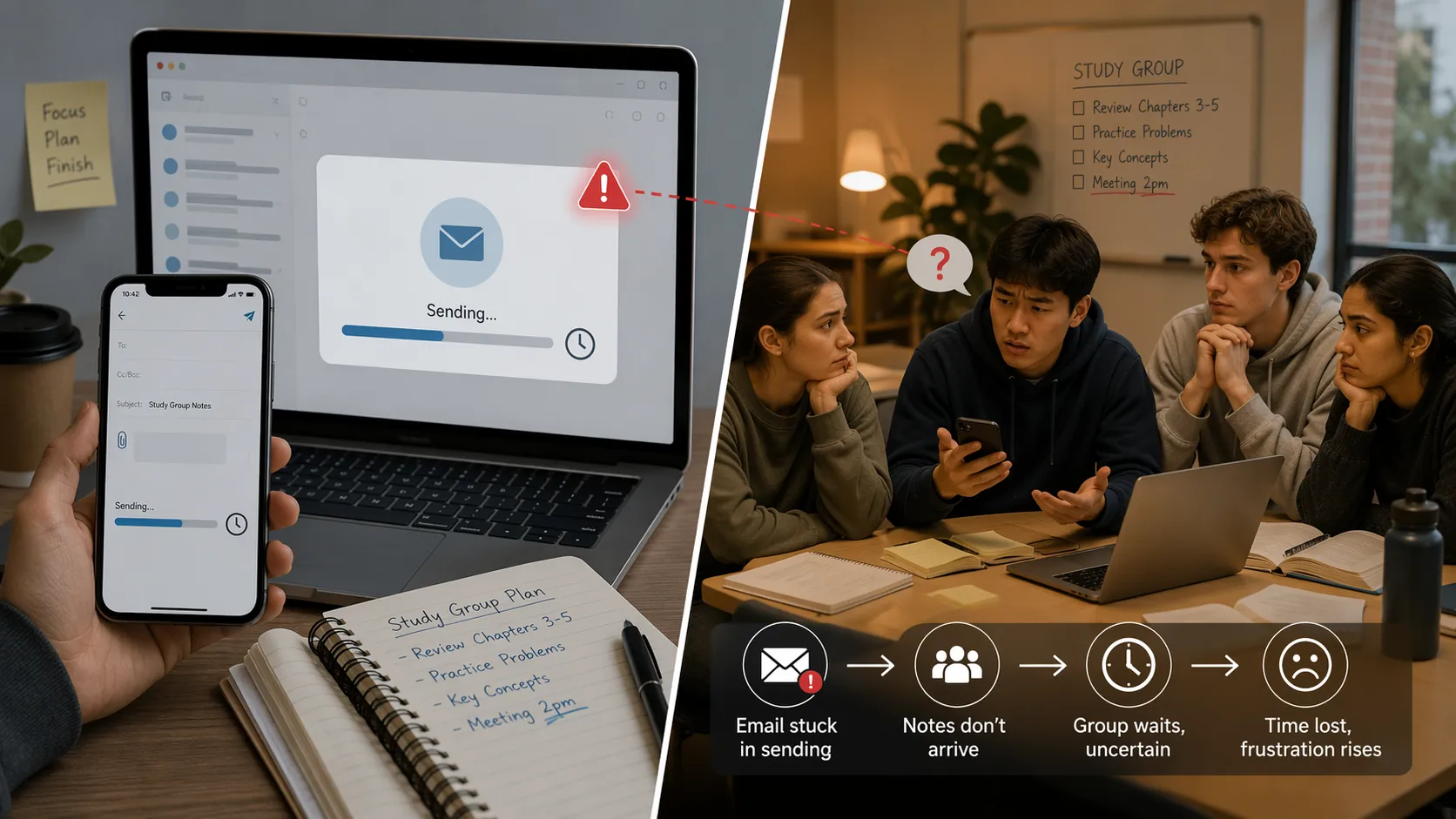
The loop is simple until it breaks. A student sends a professor a question about an exam topic. The student assumes the email was received. While waiting, they decide whether to keep reviewing that topic, ask someone else, change the study plan, or stop worrying about it. The professor’s reply, or the absence of one, becomes part of the student’s next action.
The same loop runs through group coordination. One person proposes a review session. Another asks whether the meeting is in person or online. Someone forwards a reminder. If one email stalls, the group does not always get an error message; it may just drift. One student shows up, another assumes the meeting was canceled, and a third waits for a reply that was never visible when it mattered.
What Exchange Delays Change During Exam Prep
Exchange Online is the Microsoft-hosted email layer many universities use inside Microsoft 365. Students rarely think about it by that name. They see an Outlook inbox, a campus address, and a set of assumptions: this is where official messages go, this is where professors reply, this is where deadline notices should appear.
When Exchange delays mail, three things can happen at once. First, the sender loses confidence that the message left. Second, the recipient loses the chance to answer within the expected window. Third, everyone downstream makes plans based on silence. That last part is the most damaging during exam season, because students are not waiting in a vacuum. They are choosing what to study tonight, whether to attend a review session, whether to ask for accommodation clarification, or whether to submit a form before a deadline.
| Student action | What a delay can do |
|---|---|
| Emailing a professor about exam scope | Pushes the student to guess, over-study, or under-prioritize a topic |
| Coordinating a study group | Leaves members acting on different versions of the plan |
| Waiting for registration or deadline reminders | Creates uncertainty about whether the reminder was late, missing, or never sent |
| Contacting an advisor | Compresses the time available to correct an administrative problem |
| Confirming exam logistics | Turns a simple confirmation into repeated checking across platforms |
The harm is not that email is the only possible communication channel. Most students have phones, messaging apps, learning management systems, and group chats. The harm is that university email often remains the official channel of record. It is the place where a student expects the durable answer, the documented permission, or the formal reminder. A backup message in a group chat may help, but it does not always replace the institutional email a student needs to trust.
The 2025–2026 Incidents Were Not Just Abstract Service Problems
The documented Exchange Online problems in 2025 and 2026 matter because they resemble the exact failure mode students struggle to interpret: messages delayed, mail flow slowed, and in some cases email reported as undelivered. On June 2, 2026, BleepingComputer reported a Microsoft Exchange Online outage that caused email delays and failures, with some users receiving non-delivery reports after messages could not be delivered for more than an hour.[2]
For a campus user, “more than an hour” is not a neutral unit of time. It can be the difference between seeing a same-day review session announcement and checking the room after people have left. It can also be the difference between asking a professor a narrow question while office hours are still open and receiving the answer after the student has already built the night’s study plan around a guess.
A separate January 22, 2026 Microsoft 365 incident, identified as MO1221364 in reporting on the outage, affected Exchange Online mail flow for multiple hours and prompted university-facing notices from institutions including Drake University and the University of North Carolina Greensboro.[3]
Drake University’s notice is useful because it shows what recovery looks like from the student side. The university told users that Microsoft was investigating an issue affecting email delivery and pointed students, faculty, and staff to its emergency text alert channel, including the 226787 SMS line, for updates.[4] That kind of parallel channel matters. If the inbox itself is delayed, the notice explaining the delay cannot safely rely only on the inbox.
The pattern was not limited to one bad day. BleepingComputer also documented earlier Exchange Online mail-flow incidents, including March 2025 delays that persisted for days and April 2 and May 2025 incidents affecting users in multiple regions.[2] Cybersecurity News separately reported Microsoft investigations into Exchange Online delays affecting Australian users, showing that some disruptions were geographically specific rather than universal.[5]
That distinction matters for students comparing notes. If one student’s inbox works and another’s does not, the student with the delayed mail can look careless rather than affected. A professor may not see a campus-wide outage banner. A study partner in another region may receive messages normally. The student experiencing the delay is left with the burden of proving a problem that may not be visible to everyone else.
The Quietest Failures Are Often the Hardest to Act On
A clean outage notice at least gives students a name for what is happening. The harder case is mail that feels wrong before anyone officially labels it. In a Microsoft Answers thread, administrators described significant Exchange Online mail-flow delays without a corresponding service incident being reported at the time.[6]
That kind of gap is exactly where student communication suffers. If a professor does not reply, the student cannot tell whether the professor missed the email, the email is delayed, or the answer is still coming. If a study group thread goes quiet, members may assume the plan fell apart. If a deadline reminder does not arrive, a student may not know whether to search a portal, email an office, or keep waiting.
This is why “degraded service” can sound too gentle. From an infrastructure view, the service may be partially available. From a student’s view, partial availability can be indistinguishable from social silence. The student does not see packet routes or queue behavior. They see an unanswered question at 11:43 p.m. and a test calendar that has not moved.
Anxiety Is a Reasonable Response to Missing Confirmation
The clearest peer-reviewed evidence here is about communication expectations, not Exchange-specific anxiety. The Pate et al. study shows that many students attach meaning to faculty response time, but it does not prove that Microsoft email delays cause a measurable drop in exam performance.[1] That line should stay clear.
A related infrastructure example points in the same direction without proving the same thing. During a May 15, 2026 Canvas outage affecting U.S. college exams, AcademicJobs.com reported that more than 60% of affected students described increased anxiety in student government surveys.[7] The figure is useful as a warning about how academic platform failures feel during exams, but it is not peer-reviewed research, and the reporting does not provide enough methodology to treat it as a precise estimate for Exchange users.
Even with that caution, the comparison is fair in one respect: exam-season infrastructure failures do not stay inside the software. They move into attention. A student waiting for a delayed email is also spending energy deciding whether to refresh, resend, message another channel, apologize preemptively, or assume the answer will not arrive. That is study time converted into monitoring time.
What the Evidence Does Not Prove
There is no published evidence in the sources cited here proving that Exchange Online email delays lower GRE, MCAT, ASVAB, SAT, or ACT scores. It would be easy to imply that, because the story feels plausible: a delayed email leads to missed guidance, which leads to worse preparation, which leads to a lower score. But that chain has not been demonstrated with score data in these sources.
The stronger claim is narrower and more defensible. Exchange delays disrupt the conditions students use to prepare: timely clarification, group coordination, deadline awareness, and perceived support. Those conditions matter because exam preparation is not only the private act of reading notes. It is also the shared work of confirming requirements, dividing attention, and trusting that important messages will arrive while they can still be acted on.
That narrower claim is enough. A student does not need a randomized trial on standardized test scores to know that a missing advisor reply two hours before a registration deadline creates a real problem. The evidence supports calling that problem a communication disruption, not merely an inconvenience.
Treat Email as Important, Not Sufficient
The practical lesson is not to abandon university email. Students still need it because professors, advisors, testing offices, and campus systems often treat it as the official channel. The lesson is to avoid making one inbox carry every high-stakes communication risk during exam season.
- For study groups, confirm the fallback channel before the week gets busy: text thread, calendar invite, learning platform message, or shared document.
- For professor or advisor questions, send earlier than the last decision point and note the deadline in the message.
- For deadline reminders, check the source portal directly instead of relying only on an inbox notification.
- For campus incidents, learn whether the university uses SMS alerts or another out-of-band status channel, as Drake’s January 2026 notice illustrated.
Students already make similar adjustments for other infrastructure failures. StudyMethod’s coverage of Microsoft MFA outages and student exam access looks at another Microsoft-dependent failure point, while storm-proofing exam prep applies the same basic principle to power and connectivity disruptions. The common thread is not panic. It is refusing to let one fragile system decide whether preparation keeps moving.
The waiting student at the laptop is not being dramatic. They are caught in a system that depends on timely confirmation and gives little feedback when that confirmation stalls. Microsoft Exchange email delays matter because they insert silence into a process where silence has consequences: plans pause, groups misalign, deadlines feel less certain, and students are left trying to interpret an empty inbox when they should be studying.
References
- Student Preferences for Faculty Communication in a Doctor of Pharmacy Program, Pharmacy, 2022
- Microsoft Exchange Online outage causes email delays, failures, BleepingComputer, June 2, 2026
- Microsoft 365 Outage in January 2026, Spambrella, January 2026
- Microsoft outage affecting email, Drake University, January 22, 2026
- Microsoft Investigates Exchange Online Email Delays Impacting Australian Users, Cybersecurity News
- Significant mail flow delays in Exchange Online with no service incident reported, Microsoft Answers
- Canvas Outage Disrupts US College Exams, AcademicJobs.com, May 15, 2026
Authoritative source
For the authoritative version of this contentHow Houthi Attacks Affect Oil Prices: An Economics AD-AS Study Guide
Report an error in this tool's output
Found something this tool got wrong beyond what's documented above? Report it so the accuracy log stays current.
Comments
Join the discussion with an anonymous comment.