
How Howard Unenrolled 502 Freshmen Over Financial Aid Timing
The hard part was supposed to be over. Howard University had already admitted these incoming freshmen. Some had financial aid packages, scholarships, deposits paid, housing plans, and families who believed the account balance had been handled. Then, in late July 2026, 502 first-time freshmen were unenrolled weeks before the fall semester, even though Howard’s public Student Financial Services calendar listed August 3, 2026, as the Fall payment deadline.[1][2]
That is why searches about Howard University, mistaken unenrollment, freshmen, and financial aid have spread so quickly among families watching the case. The central problem is not that colleges have payment deadlines. They do. The problem is that students appear to have been judged against an earlier first-year enrollment-confirmation deadline—July 10—that was not the same as the public university-wide billing date families could see on the regular deadline calendar.[2]
For a family that has just survived applications, test scores, FAFSA paperwork, scholarship forms, and deposit deadlines, that difference is not clerical. It is the difference between “covered” and “not enrolled.”
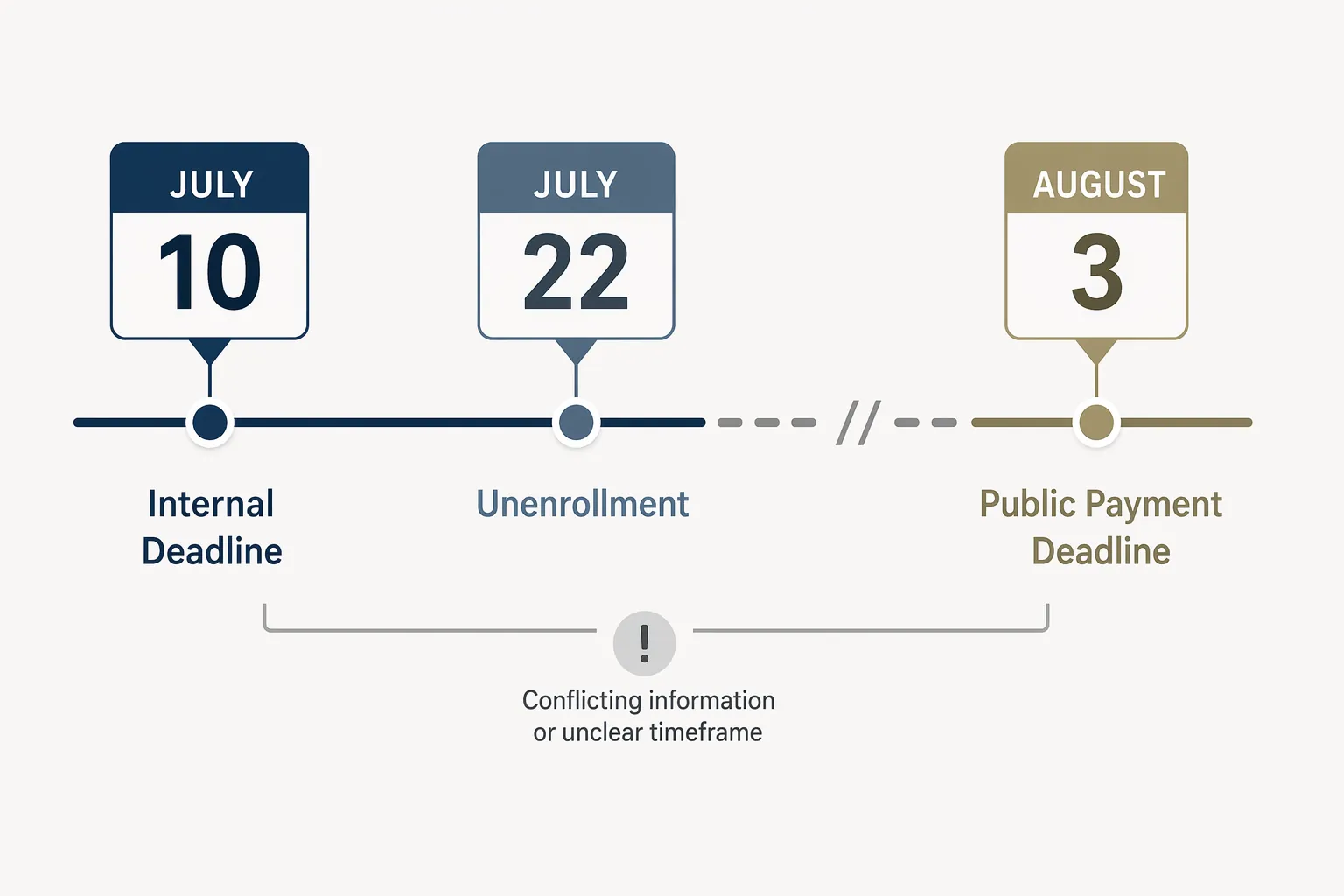
The deadline gap that made aid look valid in one place and insufficient in another
Howard’s published Student Financial Services “Important Deadlines” page listed August 3, 2026, as the Fall payment deadline.[1] A family reading that page could reasonably think the account had until August 3 to be settled through payment, anticipated aid, scholarships, or some documented combination of those sources.
But reporting on the unenrollment described a separate July 10 internal deadline for first-year students. That July 10 date, according to Welcome Home Kin’s deadline analysis, was not published on the university-wide billing calendar in the same way as the August 3 payment deadline.[2] Once the university evaluated freshmen against that earlier date, students whose aid was still pending could be treated as unconfirmed even if their overall award picture suggested they would not owe an out-of-pocket balance by the public payment deadline.
| Date or rule | What families could understand | Why it mattered |
|---|---|---|
| July 10, 2026 internal first-year deadline | Reported as an earlier enrollment-confirmation deadline for incoming freshmen | Students could be removed before the public Fall payment deadline if their accounts were not considered confirmed |
| August 3, 2026 public Fall payment deadline | Published on Howard’s Student Financial Services deadline page | Families could read this as the main date for settling Fall charges |
| Federal Direct Loan first-disbursement timing for first-time borrowers | Some legitimate loan aid cannot physically disburse before the required waiting period | A student could have approved or anticipated aid that had not posted by July 10 |
The loan timing matters because some aid is real before it is visible as posted cash. For first-time borrowers, Federal Direct Loan first disbursement can occur 30 days after classes begin, which means that aid can be legitimate and still unable to post before a July 10 internal deadline.[2] If a university’s enrollment system requires a posted or fully resolved balance by July 10, while the aid rules themselves prevent certain funds from posting by then, families are left trying to satisfy two systems that do not line up.
This is the procedural trap. A student can be financially covered in the sense families usually mean—awards, loans, scholarships, or anticipated credits exceeding charges—and still fail a narrower internal confirmation test if the institution does not make that test explicit, account-specific, and early enough to act on.
“No out-of-pocket payment” is not the same as “your seat is safe”
One of the most important contradictions in this case is Howard’s own student-facing payment language. The bursar FAQ states that no out-of-pocket payment is due when anticipated aid exceeds charges.[2] That is exactly the kind of sentence a careful family remembers. It sounds like an answer. In ordinary life, it should be an answer.
But the unenrollment reports suggest that “anticipated aid exceeds charges” did not necessarily protect a freshman from being removed if the account did not meet the July 10 confirmation requirement.[2] The result is a narrow but serious distinction: a student may not owe money under the bursar’s anticipated-aid logic, yet may still be considered not enrolled under an internal first-year deadline process.
That distinction is hard enough for college administrators to explain after the fact. It is much harder for a first-generation family to infer before the deadline, especially if the public calendar points to August 3 and a representative has already said the account is covered.

The student accounts show the same timing problem from different angles
The reported student cases should be read carefully. Howard has not publicly verified every individual account described by students and families, so the details remain student-reported unless the university confirms them. Still, the accounts are useful because they point to the same mechanism: students believed aid, scholarships, or representative guidance had satisfied the visible financial requirement, only to learn that a different rule controlled enrollment.
Yahoo News reported the case of Isabella Williams, an incoming student with a $27,000 scholarship who was among the students affected by the unenrollment.[3] A scholarship of that size is not a vague hope that money might appear later. It is the kind of award families organize their entire college decision around. If the institution needs a separate step to make that award count toward enrollment confirmation by an earlier internal date, that step has to be impossible to miss.
Another reported case, MarLae’ Coffield, is even more direct. According to Yahoo News, Coffield’s account showed a negative balance as of July 11, meaning the account appeared to show that Howard owed her money, yet she was still unenrolled.[3] If that account display is accurate, it captures the precise failure families fear: the portal can look financially safe while the enrollment status is already in danger.
WJLA and Fox 5 DC also reported that students and families said bursar representatives told them in early July that they were covered or should ignore portal balances, including reports of guidance given on July 2 and July 8.[4][5] Those dates matter. A student who asks before July 10 and is told the account is covered is not procrastinating in the ordinary sense. That student is trying to verify the requirement before the deadline that later matters.
Families also reported losing nonrefundable enrollment and housing deposits totaling $800.[3][4] For some households, raising that deposit required outside help, including crowdfunding.[3] Losing a nonrefundable deposit is not the same injury as losing an enrollment seat, but it makes the administrative damage concrete. The family did not just misunderstand an abstract policy. They paid into a process that later told them they were not in it.
Howard’s July 23 statement acknowledges part of the problem, but not the whole outcome
Howard’s official response is important because it did not simply deny that timing problems could have affected students. In a July 23, 2026 statement, the university said some students with pending outside scholarships may have been impacted and that it was reviewing accounts for possible “adjustments or reinstatement.”[6]
That is a meaningful acknowledgement. It leaves open the possibility that some students were removed despite aid that should have counted, or despite documentation that required a different review. It also means the July 22–24 reporting window was not the final resolution. Reinstatements, corrections, or account-by-account decisions may change the number of students ultimately affected.
At the same time, an institutional review is not the same thing as a settled answer for a family that has already lost housing plans, travel plans, or another college option. The review may repair individual accounts. It does not erase the timing gap that put those accounts at risk in the first place.
This was not the same as the 2025 BisonHub account-hold incident
Howard had a separate 2025 BisonHub transition problem involving account holds for roughly 1,000 continuing students.[2] That earlier incident belongs in the background only as a warning about financial-system implementation and student account visibility. It should not be collapsed into the 2026 freshman unenrollment.
The 2026 case involved 502 incoming freshmen, a reported first-year July 10 deadline, a public August 3 Fall payment deadline, and students who had not yet begun their first semester.[1][2] The mechanics are different. Conflating the two makes it easier to turn the story into a vague complaint about campus systems and harder to see the specific enrollment-confirmation failure that families need to understand.
What SAT and ACT families should take from the Howard case
For students chasing selective admissions, the Howard case is a hard reminder that the visible race is not the whole race. A strong SAT or ACT score can help earn admission. Admission can unlock scholarships. Scholarships and loans can make the bill appear covered. None of those steps automatically proves the institution has marked the student as enrolled under every internal rule that applies to that account.
Before treating enrollment as secure, families need account-specific confirmation in writing. Not a general FAQ. Not a public payment calendar by itself. Not a phone reassurance that disappears the moment a portal status changes. The confirmation should answer the exact questions that decide whether the seat is protected:
- Is there any enrollment-confirmation deadline earlier than the public payment deadline?
- Does pending financial aid count toward that earlier deadline, or must it be posted?
- How are outside scholarships treated if the check, roster, or award letter has not been processed yet?
- Do Federal Direct Loans for first-time borrowers satisfy the account requirement before disbursement?
- Are enrollment and housing deposits refundable if the university later removes the student over account timing?
- Who has authority to confirm, in writing, that the student will not be unenrolled while aid is pending?
That confirmation should be timestamped and saved: emails, portal screenshots, chat transcripts, names of representatives, dates of calls, and copies of award letters. Families should not have to build a legal file just to attend college, but this case shows why a clean documentation trail can become the difference between a correctable account issue and a lost seat.
A companion warning for test-prep families is available here: What Howard’s unenrollment teaches SAT and ACT students. The practical lesson does not depend on whether Howard ultimately reinstates some, many, or most of the 502 freshmen. The lesson is already visible in the gap between July 10 and August 3: scores, admission, aid, and deposits are not the final outcome until the university confirms how those pieces satisfy the enrollment rule for that specific student.
References
- Important Deadlines, Howard University Student Financial Services
- Confirmation of 502 students and deadline analysis, Welcome Home Kin, July 23–24, 2026
- What happened to Truth and Service?, Yahoo News, July 22, 2026
- Hundreds of Howard University freshman unenrolled weeks before Fall semester, WJLA 7 News, July 22, 2026
- Howard University freshmen say they were mistakenly unenrolled, Fox 5 DC, July 22, 2026
- First-Time-In-College Enrollment Updates, Howard University, July 23, 2026
Related case links
No matching exam hub found
Browse the exam hubs directory to find the study plan for this exam.
Did a similar plan work for you?
Share whether a comparable timeline and starting point produced a similar result — this is verification discussion, not general commentary.
Comments
Join the discussion with an anonymous comment.