
A Financial Aid System Failure Unenrolled 502 Howard Freshmen
Howard University’s July 2026 unenrollment crisis began with a number precise enough to look administrative: 502 first-time-in-college students were removed from fall enrollment on July 22, 13 days before scheduled move-in, after the university said they had not satisfied financial clearance requirements.[1] For a family with boxes half-packed and travel plans already made, that was not an abstract billing status. It was an email that changed whether a student still had a seat.
The obvious answer to why Howard students were unenrolled is unpaid balances. Howard’s public explanation centered on students who had not covered enough of their accounts to remain enrolled. But that answer is incomplete unless it also asks what the family could see, when the balance became visible, whether aid and scholarships were pending or posted, and which deadline the student was supposed to treat as real.

That distinction matters because some affected students said they had contacted bursar representatives and were told scholarships, grants, military benefits, or other aid would cover their accounts before they later received unenrollment notices.[2][3] Those accounts do not prove every student was incorrectly removed. They do show why “balance unpaid” is not, by itself, a fair explanation for what happened.
The Deadline Families Saw Was Not the Deadline Howard Enforced
The central contradiction was simple enough to fit on one line: Howard enforced a July 10 internal requirement that students have 50% of their balance covered, while a published university payment date listed August 3.[3][4] For an institution, those may be two separate dates in a financial-clearance sequence. For a family reading the available instructions, they can look like one deadline being replaced by another after the penalty has already arrived.
A reasonable family does not usually read an admitted-student portal like a compliance manual. They look for the date by which money must be paid, aid must be accepted, or a payment plan must be active. If one university page points to August 3 and an internal process treats July 10 as the decisive clearance date, the risk is not merely confusion. The risk is that enrollment becomes conditional on a rule the family did not understand in time to fix.
Howard later described support efforts for students facing financial aid and account challenges ahead of the fall semester, including outreach to help students resolve balances and complete financial steps.[7] That matters. A university trying to rework accounts after a mass notice is not the same as a university doing nothing. But after July 22, the work shifted from prevention to rescue, and rescue is a harsher place for a family to negotiate from.
The July Email Sat on Top of an Older Platform Problem
The 2026 unenrollment did not appear out of nowhere. In 2025, Howard students reported unexpected charges after the university moved from BisonWeb to BisonHub. NBC Washington reported that the transition caused account-update delays for roughly 1,000 of Howard’s 14,500 students between January and June 2025, with some students discovering balances only after collection notices arrived.[5]
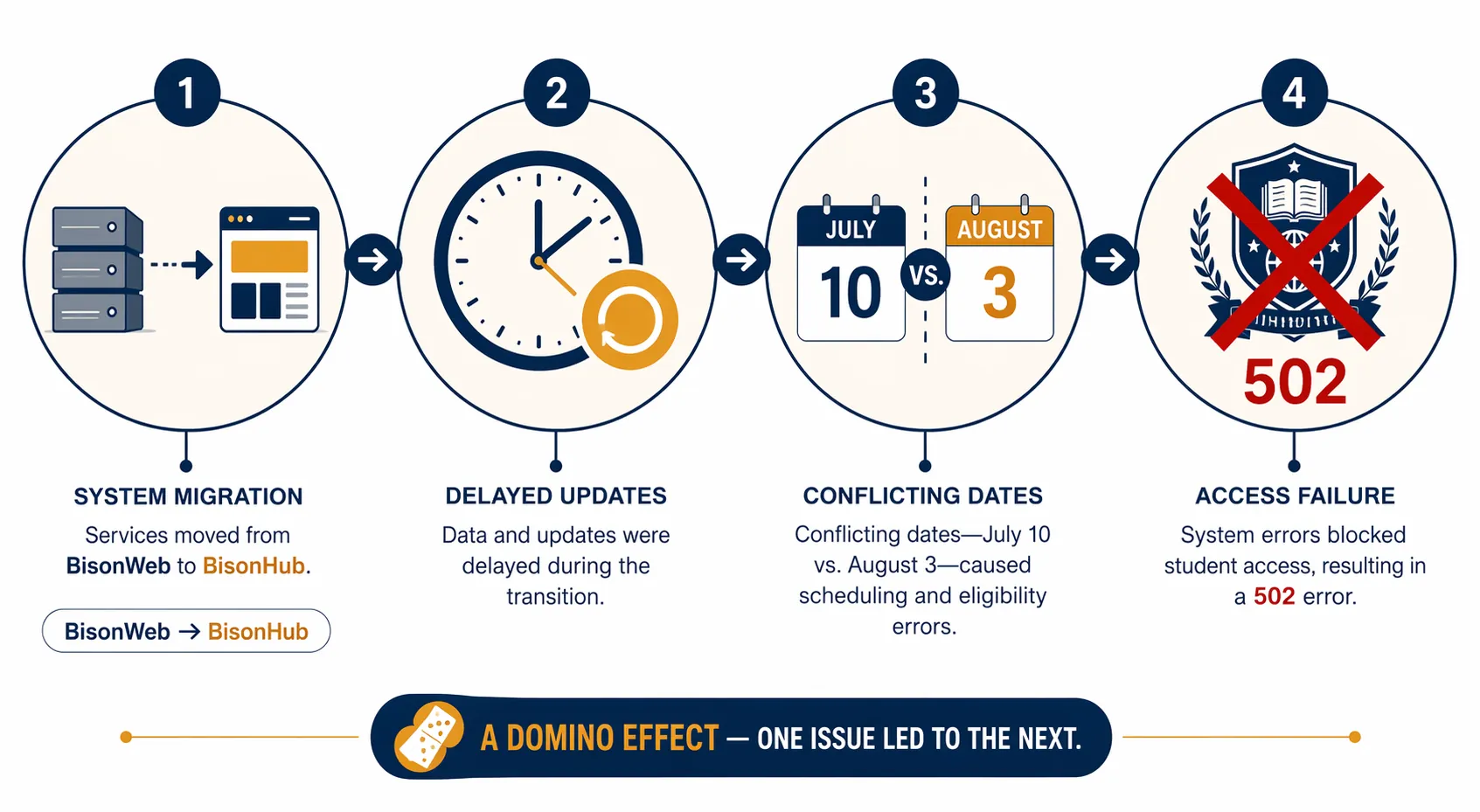
The Hilltop, Howard’s student newspaper, also reported student anger over unexpected charges tied to account updates and billing confusion after the platform change.[6] The point is not that a software migration automatically caused the July 2026 unenrollments. The narrower, better-supported point is that Howard had already experienced visible problems with whether students could trust account information to be current, complete, and actionable.
| Point in the timeline | What changed for students |
|---|---|
| January-June 2025 | BisonHub transition delays affected account updates for roughly 1,000 of 14,500 students. |
| Summer 2025 | Students reported surprise charges and collection notices after believing their accounts were settled. |
| July 10, 2026 | Howard enforced an internal requirement that 50% of the balance be covered. |
| August 3, 2026 | A published payment date still appeared as the relevant deadline. |
| July 22, 2026 | Howard unenrolled 502 first-time-in-college students 13 days before scheduled move-in. |
This is how a student can be current in the student’s own understanding and delinquent inside the institution’s system at the same time. A scholarship can be awarded but not posted. A grant can be expected but still pending. A portal balance can change after a family checked it. A representative can describe an account as covered based on anticipated aid while the clearance system still treats the account as underfunded. None of those conditions requires bad faith by a front-line employee. They do require a system that warns students before the consequence becomes removal.
The harshest part of the July 22 action was its timing. Thirteen days before move-in, students are not just deciding whether to attend. They may have declined other offers, turned down waitlist movement, arranged transportation, bought supplies, and built family work schedules around arrival. A payment warning in March or April gives a family a chance to compare options. An unenrollment notice in late July narrows the field to panic, borrowing, appeals, or walking away.
Howard’s Explanation Deserves Space, But Not the Last Word
Howard was not wrong to say that students need financial clearance before enrollment can continue. Universities cannot run on promised money that never arrives, and an unpaid balance is a real institutional problem. The issue is whether Howard’s process gave students a clear, consistent, and timely path to satisfy that requirement before the university imposed the most severe enrollment consequence.
That is where the university’s support language has to be tested against the sequence of events. Howard said it was working to support students with financial aid and account challenges before the fall semester.[7] Yet families were still trying to understand why the operative clearance deadline was July 10 when the published payment date they could point to was August 3.[3][4] If the internal deadline controlled enrollment status, it needed to be the date students could not miss, not a date explained after the fact.
The same is true for reinstatement. Reports shortly after the notices described shifting counts of affected students and students being restored as accounts were reviewed.[1][2] That fluidity is better than a locked door. It also suggests the initial action was not a clean list of students who had simply ignored a bill. Some cases required human review because the account status, aid status, or communication record was not straightforward.
The Financial Gap Was Getting Wider Before the System Broke in Public
The billing confusion landed in a cost environment where small delays and partial aid gaps could quickly become enrollment-threatening. Howard’s estimated cost of attendance rose from $51,345 in 2021-22 to $64,700 in 2025-26, according to the university’s published cost information.[8] That is a steep increase for families who may be assembling tuition from federal aid, institutional scholarships, Parent PLUS loans, outside scholarships, work income, and short-term payment plans.
Borrowing patterns point in the same direction. Bloomberg, citing Fitch Ratings, reported that student loans processed at Howard increased 17% year over year, from 5,882 to 6,905.[9] Loan processing is not the same as financial distress, and it does not prove that every affected freshman lacked resources. It does show more families were using debt as the bridge between the bill and the aid package.
That bridge is fragile. If a loan is approved but not fully reflected, if a scholarship is listed in an award letter but not posted to the account, or if a payment plan is active in one view but not recognized by the clearance process, the family’s plan can be real while the institution’s balance still shows a problem. The larger the total cost, the less room there is for even a temporary mismatch.
This is also why the crisis should not be flattened into a warning against HBCUs. Howard’s role as a major historically Black university makes the impact more painful for families who selected it for academic, cultural, and professional reasons. But the operational standard is not different because the institution is an HBCU. Families need the same basic guarantees anywhere: visible balances, consistent deadlines, posted aid, and written confirmation that means what it appears to mean.
Administrative Fragility Has a History Here
The 2025 and 2026 problems also sit against an older oversight backdrop. A Welcome Home Kin+ investigation noted that Howard had been placed on the Department of Education’s Heightened Cash Monitoring 2 status in 2018 after a whistleblower alleged roughly $1 million in misdirected grants, a designation described as the strictest federal oversight level for financial-aid administration.[4]
That 2018 episode should not be used as a shortcut to explain every later problem. It does not prove the 2026 freshman unenrollments were caused by the same failures or involved the same conduct. Its relevance is narrower: Howard’s financial-aid administration had already been important enough to draw serious scrutiny, and later platform and billing failures occurred in a system where accuracy and trust were already high-stakes.
What Prospective Students Should Verify Before Treating Enrollment as Safe
The practical lesson for a prospective Howard student is not “do not attend.” It is that admission, scholarship language, and a portal screen are not enough until the money, deadline, and enrollment status all line up in writing. Families making college decisions for 2027 and beyond should treat financial clearance as a separate process from admission.
- Ask which date controls enrollment status, not only which date appears as the general payment due date.
- Confirm whether scholarships, grants, outside awards, military benefits, and loans are posted or merely anticipated.
- Get written confirmation that a payment plan satisfies financial-clearance rules if the balance is not paid in full.
- Save portal screenshots with dates, especially after aid changes, payment-plan enrollment, or bursar conversations.
- Ask what specific account condition would trigger unenrollment, housing cancellation, class cancellation, or late fees.
- Escalate early if a representative says the account is covered but the portal still shows a balance.
Those steps can feel excessive to families who have already done everything colleges tell them to do. They are also the steps that make invisible conditions visible. A student should not have to become a forensic accountant to start freshman year. But after Howard’s July 2026 action, families have reason to ask for more than reassurance.
The most defensible reading of the record is that the 502 unenrollments were not just a bad email or a single collections decision. They were the public break point of a system that had already shown strain: delayed account updates after a platform transition, disputed or unexpected balances, conflicting deadline signals, rising attendance costs, and heavier reliance on debt. The students caught in that sequence were not merely late payers in a spreadsheet. Many were families trying to act on information the institution had not made reliable enough to carry the consequence it imposed.
References
- Hundreds of Howard University freshman unenrolled weeks before Fall semester — WJLA
- Howard University freshmen say they were mistakenly unenrolled over unpaid bills — FOX 5 DC
- What happened to Truth and Service?: Incoming Howard freshmen speak out after sudden unenrollment emails — Yahoo News / theGrio
- DEVELOPING: Howard University Enrollment Update Leaves Deadline Questions — Welcome Home Kin+
- Howard students unexpectedly discover they owe thousands after school changes financial platform — NBC Washington
- Unexpected Student Charges Spark Social Media Outcry — The Hilltop
- Howard University Works to Support Students Facing Financial Aid and Account Challenges Ahead of Fall Semester — The Dig
- 2025-2026 Estimated Cost of Attendance — Howard University
- Howard University's Sharp Growth Reverses in 5% Enrollment Drop — Bloomberg
Related case links
No matching exam hub found
Browse the exam hubs directory to find the study plan for this exam.
Did a similar plan work for you?
Share whether a comparable timeline and starting point produced a similar result — this is verification discussion, not general commentary.
Comments
Join the discussion with an anonymous comment.