SAT Planner
Study Advice That Actually Works for Gen Z Career Readiness
The most useful Gen Z career study advice that actually works does not begin with another certificate, another AI tool, or another productivity app. It begins with a harder question: does the way you study force you to think, decide, notice errors, recover under pressure, and improve after feedback?
That question matters because the current mismatch is not simply that young people are unmotivated. Many are doing extra learning. Udemy reported in 2024 that Gen Z ranked programming at 36% and AI skills at 30% as top career investments, while 84% still considered soft skills critical to success.[3] The anxiety is not imaginary either. In a Hult International Business School/Walr survey of 800 graduates and 800 HR leaders, only 24% of recent graduates said they had all the skills their current role required, 55% said college did not prepare them at all, and 89% of HR leaders said they avoid hiring recent graduates.[2]
Employers are naming a different set of weak points than the ones most course catalogs advertise. A Cangrade analysis of about 72,000 workforce assessments, reported in June 2026, found Gen Z workers scoring 18% below average in critical thinking, 17% below in attention to detail, and 10% below in creative problem-solving.[1] That is one proprietary assessment model, not a final verdict on an entire generation. Still, the pattern lines up too neatly with what many students experience during test prep: they can consume explanations for hours, then miss the same kind of question because they never practiced checking their reasoning.
AACSB, drawing on work with Quinnipiac and Deloitte, points to gaps such as asking effective questions, navigating ambiguity, and receiving and applying feedback.[4] Those are not personality traits you acquire by agreeing that they are important. They are behaviors built through repeated situations where the answer is not handed to you, the clock is running, and your first attempt has consequences.

Your Exam Prep Is Already Close to the Right Training Ground
If you are preparing for the SAT, ACT, GRE, MCAT, or ASVAB, it is easy to feel as if exam prep is a detour from career readiness. Programming looks more practical. AI tools look more current. A test booklet can look painfully school-shaped.
But high-quality exam prep has one advantage many loose career-learning plans do not: it can give you a tight feedback loop. You retrieve information, make a decision, commit to an answer, see whether the decision held up, diagnose the error, and try again later under similar but not identical conditions. That sequence is much closer to workplace learning than rereading notes or watching another tutorial at 1.5x speed.
This is why the experiential-learning data is useful, but only if handled carefully. NACE found that Gen Z professionals with experiential learning such as internships, co-ops, or clinics earned an average of $15,000 more and reported 71% degree-to-job relevance, compared with 56% for those without experiential learning.[5] That does not prove internships caused the salary difference. Students who pursue them may also have other advantages. What the finding does show is that repeated performance in a real or realistic context is associated with better early-career outcomes.
Exam prep cannot replace a job, internship, clinic, lab, or team project. It will not teach every workplace norm, conflict, meeting habit, or communication expectation. But it can train some of the mental moves employers keep asking for: careful reasoning, prioritization, revision after feedback, reliable recall, and flexible problem selection.
The Study Stack: Five Methods That Turn Test Prep Into Career Practice
The Study Stack is not a motivational routine. It is a way to rebuild the study you are already doing so that every week includes five kinds of practice: active recall, timed practice, error analysis, spaced repetition, and interleaved practice.
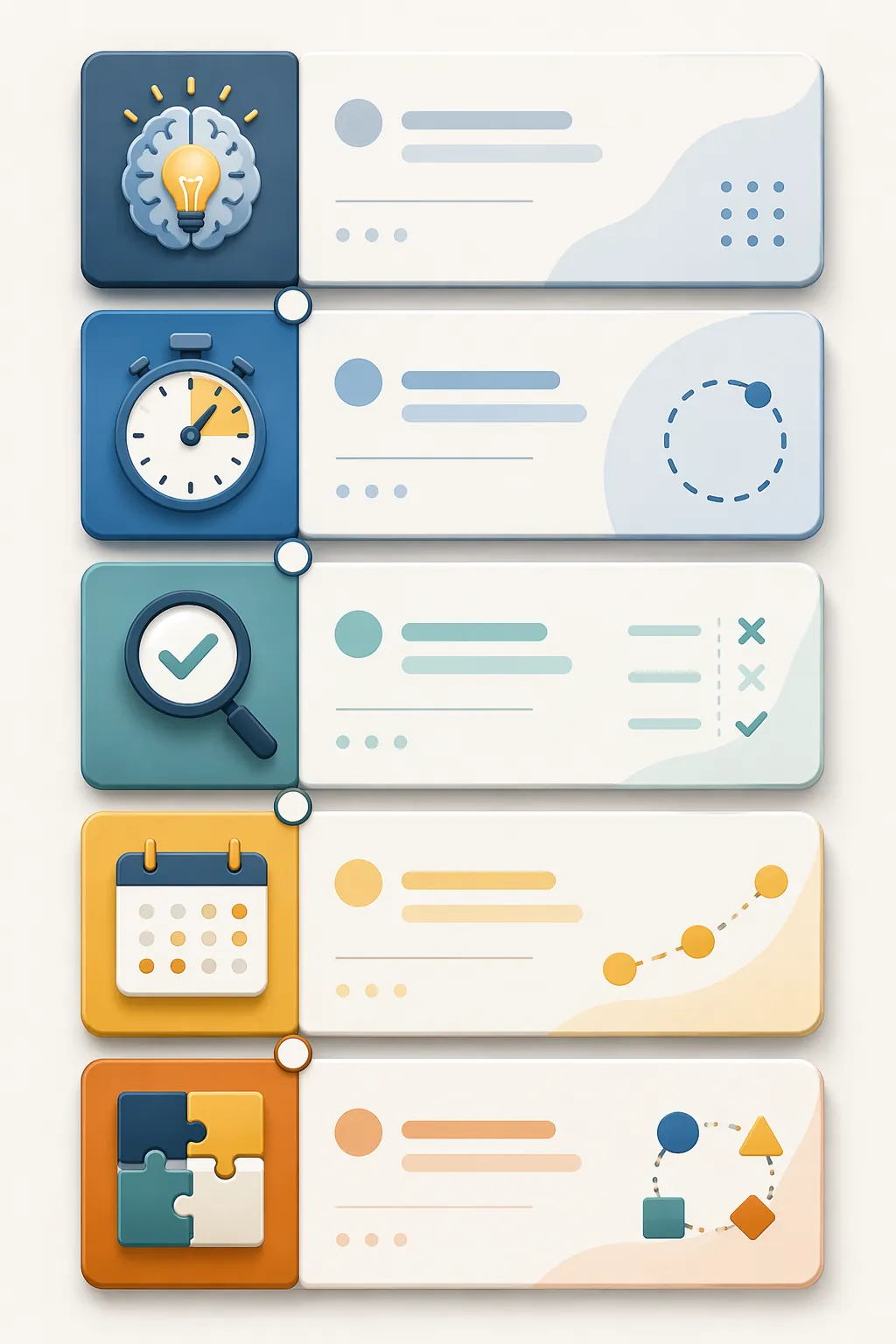
| Study method | What the student does | Career-ready skill it trains |
|---|---|---|
| Active recall | Answers before looking, explains from memory, reconstructs the method | Critical thinking and self-checking |
| Timed practice | Works under a clock and chooses where attention goes first | Pressure management and prioritization |
| Error analysis | Labels why an answer failed and changes the next attempt | Attention to detail and feedback use |
| Spaced repetition | Reviews weak material later, before forgetting becomes permanent | Reliability over time |
| Interleaved practice | Mixes problem types so the method is not obvious from the page | Flexible decision-making and ambiguity navigation |
Active Recall: Reason Before You Recognize
Active recall means you try to produce the answer, rule, formula, passage logic, or explanation before you look at the solution. That small delay matters. Recognition feels fluent because the explanation is in front of you. Recall exposes whether you can generate the reasoning yourself.
For SAT Reading and Writing, this might mean predicting the function of a sentence before checking the answer choices. For ACT Math, it might mean writing the setup before scanning for a familiar-looking option. For the MCAT, it might mean explaining a pathway or concept out loud before flipping the card. For the ASVAB, it might mean solving a mechanical comprehension question from the principle rather than from a memorized diagram.
That is why active recall is more than a memory trick. It forces a student to notice the difference between “I have seen this” and “I can use this.” If that gap keeps showing up in your notes, start with a direct guide to the active recall study technique before adding another study app.
Timed Practice: Learn What to Do When Time Is Not Enough
Timed practice is often treated as a late-stage rehearsal: first learn everything, then take practice tests. That order wastes one of the best parts of the test environment. A clock reveals habits you cannot see in untimed review.
Under time pressure, you learn which questions deserve a full attempt, which ones should be marked and returned to, and which ones are traps for your attention. That is prioritization, not just speed. The student who spends six minutes protecting one hard point while losing three easier ones is practicing a workplace problem too: over-investing in the wrong task because it is emotionally uncomfortable to move on.
A useful timed block does not have to be a full test. It can be 10 SAT questions, one GRE quant set, a short ACT science passage set, a targeted MCAT passage group, or one ASVAB subtest drill. The key is that the time limit changes your decisions, then gives you something specific to review.
Error Analysis: Stop Counting Misses and Start Reading Them
Most students review missed questions too politely. They read the explanation, nod at it, maybe write “careless mistake,” and move on. That is not feedback use. It is emotional relief.
An error log should force a cleaner diagnosis. Did you miss the concept? Misread a condition? Choose too soon? Use the wrong formula? Fail to eliminate? Run out of time because the earlier question took too long? Each label points to a different repair. “Study harder” does not.
| Error label | What it usually means | Next repair |
|---|---|---|
| Concept gap | You did not know the rule, fact, or principle | Add a recall card or targeted lesson |
| Process gap | You knew the content but used the wrong steps | Write the correct procedure and redo a similar problem |
| Reading error | You missed a word, condition, unit, or constraint | Underline constraints before solving |
| Timing error | You spent too long or rushed the wrong moment | Repeat the set with a pacing rule |
| Pattern-match error | You chose based on resemblance instead of reasoning | Mix that problem type with nearby distractor types |
This is where attention to detail becomes visible. It is not a vague virtue. It is the habit of finding the exact point where your answer stopped matching the task. SAT students can build this into a score-gap routine with the SAT Score-Gap Method, then use SAT practice questions as a review cycle rather than a score-checking ritual.
Spaced Repetition: Make Reliability Boring
Spaced repetition is the least glamorous part of the stack, which is probably why it is so easy to neglect. It asks you to return to material after a delay, not because it feels productive in the moment, but because future-you needs the knowledge to still be there.
For content-heavy exams, this is nonnegotiable. MCAT prep is the obvious example: a student can understand a biology explanation on Monday and still fail to retrieve it two weeks later inside a passage. A spaced system catches that decay early. If you are using Anki, the work is not merely making cards; it is writing prompts that force retrieval, tagging weak concepts honestly, and reviewing often enough that old mistakes do not keep reappearing as “surprises.”
For implementation, start with how to use Anki for the MCAT if your exam is content-dense. If you already have several resources open and no workflow holding them together, the MCAT study prep workflow is the better starting point. Tool-hopping is not the same as spaced review.
Interleaved Practice: Break the Hint System
Blocked practice tells you what kind of problem you are doing before you begin. A whole page of linear equations announces the method. A whole deck of amino acid cards narrows the mental search. A whole section of grammar questions makes every sentence feel like an editing task.
Interleaving removes that hint. You mix related but different problem types so you must decide what the problem is asking before choosing a method. That is where ambiguity navigation enters exam prep. The hard part is not only solving; it is selecting the correct frame.
A GRE student might mix rate, ratio, algebra, and data interpretation questions. An ACT student might rotate between grammar, rhetoric, and punctuation tasks. An ASVAB student might alternate arithmetic reasoning with word knowledge and mechanical comprehension depending on target score needs. The goal is not chaos. It is flexible recognition.
How to Embed the Stack Without Starting Over
Keep your current book, course, question bank, class notes, or app unless it is truly unusable. The first move is not buying a new system. It is changing what each study session requires from you.
| Weekly block | Main action | What to record |
|---|---|---|
| Diagnostic or mixed set | Take a timed set under realistic constraints | Score, pacing, skipped questions |
| Error review | Label every miss and every lucky guess | Error type and repair action |
| Recall rebuild | Turn weak rules, concepts, and methods into recall prompts | Cards, questions, or blank-page prompts |
| Spaced review | Review older weak points before they disappear | Items missed again |
| Interleaved set | Mix old and new problem types | Whether you chose the right method without hints |
A simple week might start with a timed mixed set, move into a slower error review the next day, then convert the most important misses into recall prompts. Later in the week, you revisit those prompts and test them inside a new mixed set. The loop is small enough to fit around school, work, sports, or family responsibilities, but it is strong enough to make every mistake useful.
The repair action is the part students most often skip. If a missed question shows a concept gap, read or watch the explanation once, then close it and reproduce the idea. If it shows a timing problem, repeat a shorter set with a pacing rule. If it shows a reading error, change your annotation habit before the next passage. If it shows pattern-matching, put that question beside two similar-looking questions that require different methods.
This is also where passive notes become a liability. Notes can support the stack, but they cannot replace it. If your notebook is full and your performance is flat, compare your habits against common note-taking mistakes that destroy study efficiency. The issue is often not effort. It is that the effort never asks you to retrieve, decide, or revise.
Use the Same Stack Differently by Exam
The five methods stay stable, but the emphasis changes by test. A student preparing for the SAT does not need the same weekly shape as a student preparing for the MCAT. An ASVAB student choosing subtest priorities has a different constraint from a GRE student trying to balance verbal and quant.
| Exam | Stack emphasis | Practical starting point |
|---|---|---|
| SAT | Timed practice, error analysis, active recall for rules and passage logic | Use score gaps and practice-question review cycles |
| ACT | Pacing, passage strategy, interleaving across English, math, reading, and science | Build shorter timed blocks before full-test stamina |
| GRE | Interleaved quant/verbal practice and error labels for method selection | Mix problem types so recognition does not do the work for you |
| MCAT | Spaced repetition, passage review, and concept-to-application recall | Connect Anki, content review, and practice passages into one workflow |
| ASVAB | Subtest priority, timed sets, and targeted repair | Study by score impact instead of treating every subtest equally |
For ASVAB prep, the career-readiness link is especially direct because the exam itself affects qualification paths. That does not mean studying everything equally. It means deciding which subtests deserve the next hour because they matter most for your goal, then using timed practice and error review to improve those areas first. The ASVAB subtest-priority guide is built around that kind of constraint.
For students who genuinely need a tool, choose one that serves the routine instead of replacing it. A flashcard app can support spaced repetition. A question bank can support timed sets and interleaving. A planner can protect review days. If the tool does not make retrieval, feedback, or later correction easier, it is probably decoration. For a broader implementation pass, use the best study tools for college students or compare Anki, Knowt, RemNote, and Brainscape only after you know what job the tool must do.
What This Does Not Promise
No study routine can guarantee a salary, a job offer, an admissions result, or a military qualification outcome. The NACE salary figure is an association, not a promise.[5] The Cangrade data is one platform’s assessment result, not a complete measure of every Gen Z student’s ability.[1] A strong exam-prep routine also cannot replace workplace exposure, references, project experience, interviewing practice, or the messy social learning that happens on teams.
The narrower claim is still worth taking seriously: the same study behaviors that improve serious exam prep also resemble the learning behaviors employers say they want. You practice reasoning before recognition. You make decisions under constraints. You inspect small errors. You apply feedback. You return later and prove the skill stayed available.
So choose the exam in front of you. Keep the materials that already give you decent questions and explanations. Rebuild the week around the Study Stack: active recall, timed practice, error analysis, spaced repetition, and interleaved practice. Then your SAT, ACT, GRE, MCAT, or ASVAB prep stops being a disconnected academic chore and becomes a deliberate career-readiness workout.
References
- Younger workers may be falling behind in critical thinking skills, HR Dive, June 2026.
- Colleges Are Not Preparing Gen Z for Jobs, BestColleges, 2025.
- New Research Finds 65% of Generation Z Eager for Professional Development, Udemy, 2024.
- Prove It: Measuring Gen Z’s Career Readiness, AACSB, April 2025.
- Impacts of Experiential Learning on the Gen Z Early Career Experience, National Association of Colleges and Employers, 2025.
Fill in this timeline
This is a skeleton schedule, not a performance claim — for section-by-section strategy to fill in each slot, read the exam hub. For evidence that a similar timeline worked, compare against real outcome logs.