
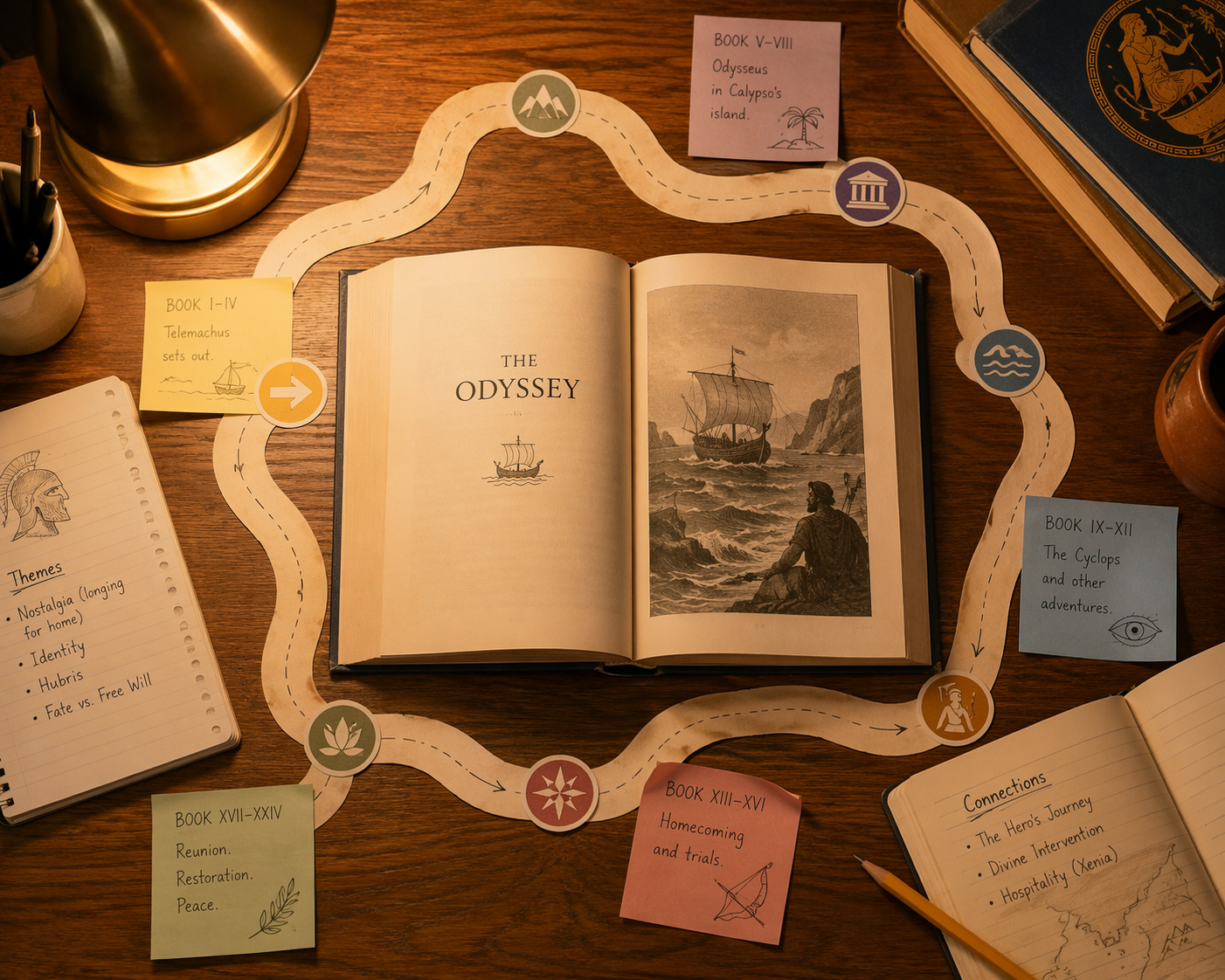
A Student's Reading Roadmap for The Odyssey
Does The Odyssey feel confusing or impossible to finish? This guide explains why the epic's oral-poetic conventions make it hard on a first read — and shows you how to choose a translation, map characters, and approach each book so you actually understand and enjoy the poem.
Updated:
If The Odyssey feels like it is trying to lose you on purpose, start by admitting the obvious: the first pages are disorienting. The poem throws out names, gods, places, and detours before a modern reader has time to settle in. A recent Guardian guide addresses that problem directly, timed to renewed student interest around the 2026 Nolan film. That is the right entry point: not awe, but a workable path through the confusion. [1]
What makes the book feel difficult is mostly its machinery. The poem was built for oral performance, so it leans on repeated epithets, set-piece type scenes, and an in medias res opening rather than the linear, explanation-heavy style students expect today. The repetitions are not filler; they help the poem move, remember, and perform. [2][3]
It also helps to know the size of what you are handling: The Odyssey is usually described as a 24-book poem of 12,109 lines in dactylic hexameter, composed in the world of Homeric Greece. You do not need that background to be impressive; you need it because it explains why the poem can sound ceremonious, loop back, and leave gaps the reader has to bridge. [2][3]
Choosing a translation
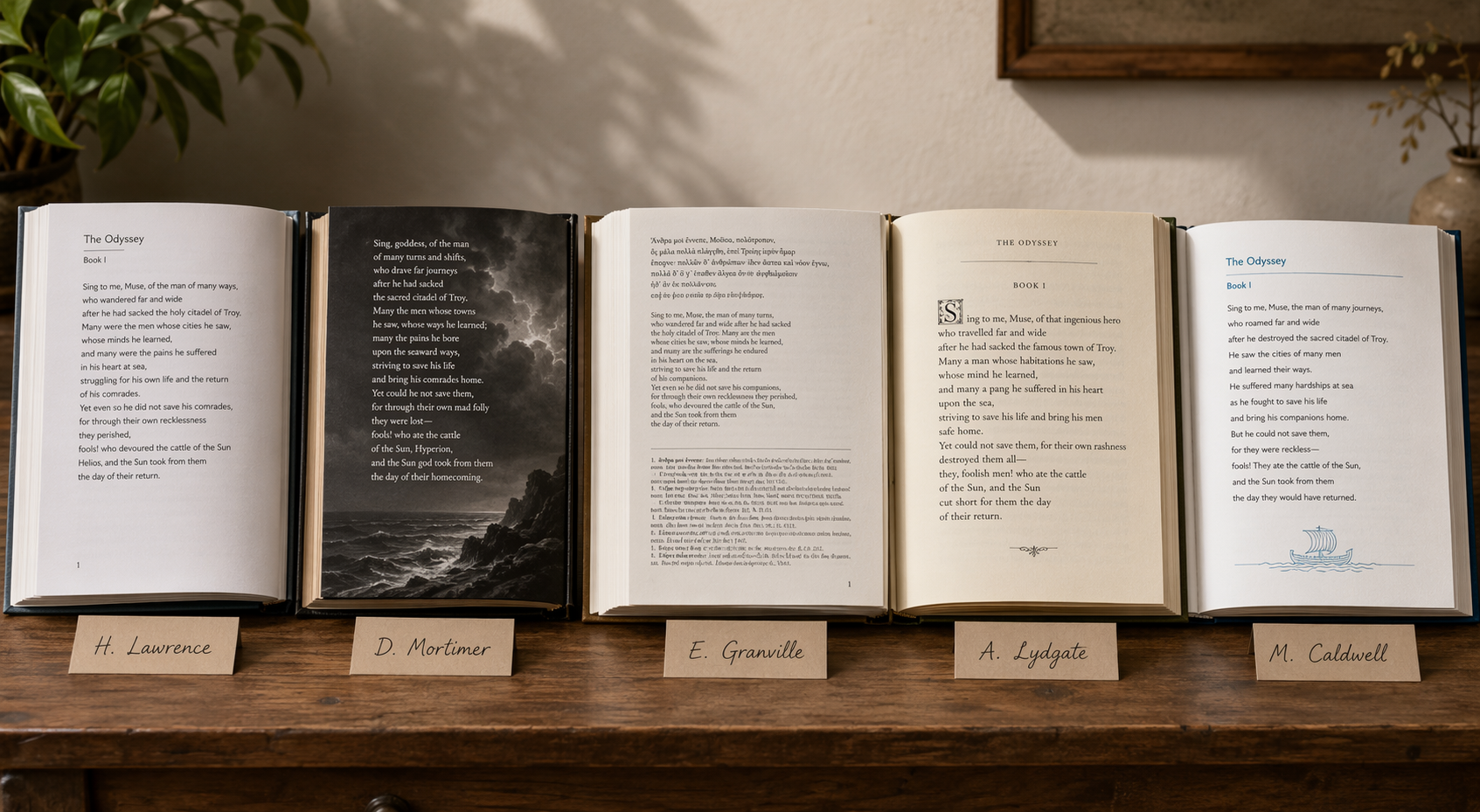
Translation is the first real choice that changes the reading experience. If you want the version most likely to get a student moving without constant backtracking, Emily Wilson is the most accessible modern default. If you want a more dramatic oral ear, Robert Fagles is the one to try. If you want a more poetic, older-school feel, Robert Fitzgerald still rewards patient reading. If you want line-by-line closeness, Richmond Lattimore stays near the Greek. Daniel Mendelsohn is the newer option worth noticing if you want to compare what a fresh voice does with the same poem.
| Translation | What it feels like | Best if you want |
|---|---|---|
| Emily Wilson | Clear, modern, and least hostile on a first read | A smooth way into the poem without feeling flattened |
| Robert Fagles | Broad, dramatic, and easy to hear aloud | A strong oral cadence and a more theatrical read |
| Robert Fitzgerald | Poetic, graceful, and older in classroom tone | A literary feel with a classic register |
| Richmond Lattimore | Close to the line and more literal | Maximum closeness to the wording |
| Daniel Mendelsohn | Fresh, contemporary, and interesting to compare | A newer voice you want to test against the others |
If the 2026 Nolan film is what got you back to the poem, use it as a companion rather than a shortcut. It can help you remember people, places, and stakes, which is genuinely useful when the cast starts multiplying, but it cannot replace the act of reading the epic itself. If you want to compare the film and the poem, the site has a student analysis of Christopher Nolan's The Odyssey, a guide to 10 ways Nolan's The Odyssey diverges from Homer's epic, and a shorter page for studying Homer's Odyssey through Christopher Nolan's film.
Make the first four books manageable
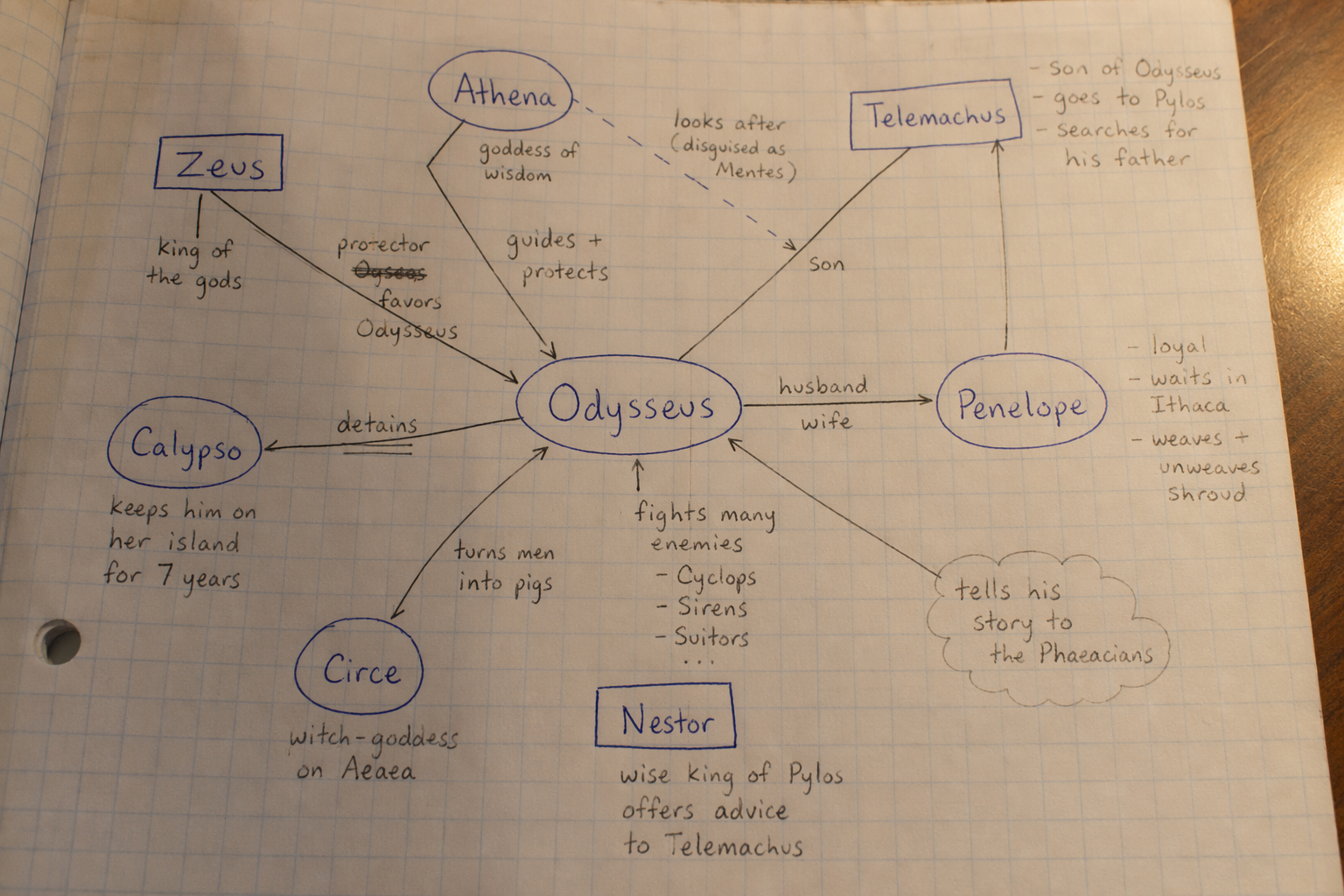
Before you try to memorize the whole cast, put the names on paper. Rebecca Laemmle's practical advice in the Guardian piece is to sketch the relationships as you go, especially in the first four books, where the density of names can make a student feel lost before the story has really started. A quick map of Odysseus, Telemachus, Penelope, Athena, and the recurring suitors does more for comprehension than rereading the same page in frustration. [1]
Once you start reading, watch for what repeated formulas are doing. Epithets such as "swift-footed" or "grey-eyed" are not there because Homer ran out of adjectives; they carry rhythm, memory, and recognition. Type scenes work the same way: welcomes, meals, departures, prayers, arming, and recognition scenes return in recognizable shapes so you can follow the action without treating every repetition as a new problem. If you keep expecting a modern novel instead of an oral poem, those features will keep feeling like padding.
If you read better by hearing, use audio. The Fagles translation read by Ian McKellen is especially useful because it restores some of the cadence and performance pressure that the page can hide. It will not do the reading for you, but it can make the poem feel less like a stalled classroom assignment and more like a spoken story.
A small amount of background is enough. Homeric Greece matters because the poem assumes a world organized by guest-friendship, household order, honor, and reputation; that is why many scenes turn on who welcomes whom, who is recognized, and who is allowed to speak. You do not need to master the scholarship before you start. You only need enough context to stop treating every unfamiliar custom as a roadblock.
Once you know why the poem is built this way and pick a translation that matches how you read, the intimidation drops fast. What looked like repetition or detour starts to serve the poem's structure instead. If you want the plot, character, and theme reference that this roadmap intentionally does not repeat, use the existing The Odyssey Summary and Analysis for Students next.
References
- A voyage of discovery: an idiot's guide to reading The Odyssey, The Guardian, July 16, 2026
- The Odyssey | Epic poem by Homer, Britannica
- Odyssey, Wikipedia
Comments
Join the discussion with an anonymous comment.