

Children's Book Giveaway Programs Compared: Which Model Works Best?
This article compares the leading children's book giveaway models—Reach Out and Read, Dolly Parton's Imagination Library, and Bookstart—on literacy outcomes, cost, and scalability to help program coordinators and funders decide which model to adopt.
Updated:
The most uncomfortable comparison in children's book giveaway programs is not between a program that gives books and doing nothing. It is between programs that all give books and still produce different results. In a 2020 meta-analysis of 44 studies, Reach Out and Read, the pediatric-visit model, showed the strongest literacy-related effect at d=0.42. Dolly Parton’s Imagination Library, the monthly mail model, showed d=0.25. Bookstart, which typically provides only 1–2 books on 1–2 occasions, showed d=0.23.[1]
That last comparison should slow down any grant table that is about to rank proposals by shipment totals. Bookstart’s tiny dose performed about as well as Imagination Library’s 60-book, birth-to-five mail sequence in that shared evidence base.[1] The obvious interpretation is not that 58 books are worthless. It is that the book itself is only part of the intervention. The other part is the adult cue: who hands it over, what they say, whether the caregiver feels expected and able to read with the child, and whether the family keeps encountering books often enough for reading to become normal.
The Comparison That Matters
For a coordinator choosing among named models, the practical question is not whether books matter. It is whether the program turns a free book into shared reading, language exposure, and repeated contact with print. The strongest evidence in the shared comparison points toward personal contact.
| Model | Typical delivery mechanism | Book dose in the comparison | Reported effect size | What the result suggests |
|---|---|---|---|---|
| Reach Out and Read | Book and reading guidance delivered through pediatric well-child visits | About 10 books over 5 years | d=0.42 | The trusted adult interaction appears to add substantial force |
| Dolly Parton's Imagination Library | Monthly books mailed to enrolled children from birth to age 5 | 60 books over 5 years | d=0.25 | Repeated access helps, but mail alone does not supply the same adult nudge |
| Bookstart | Small book pack usually given through a public or community touchpoint | 1–2 books on 1–2 occasions | d=0.23 | A small book gift can matter when it prompts caregiver behavior |
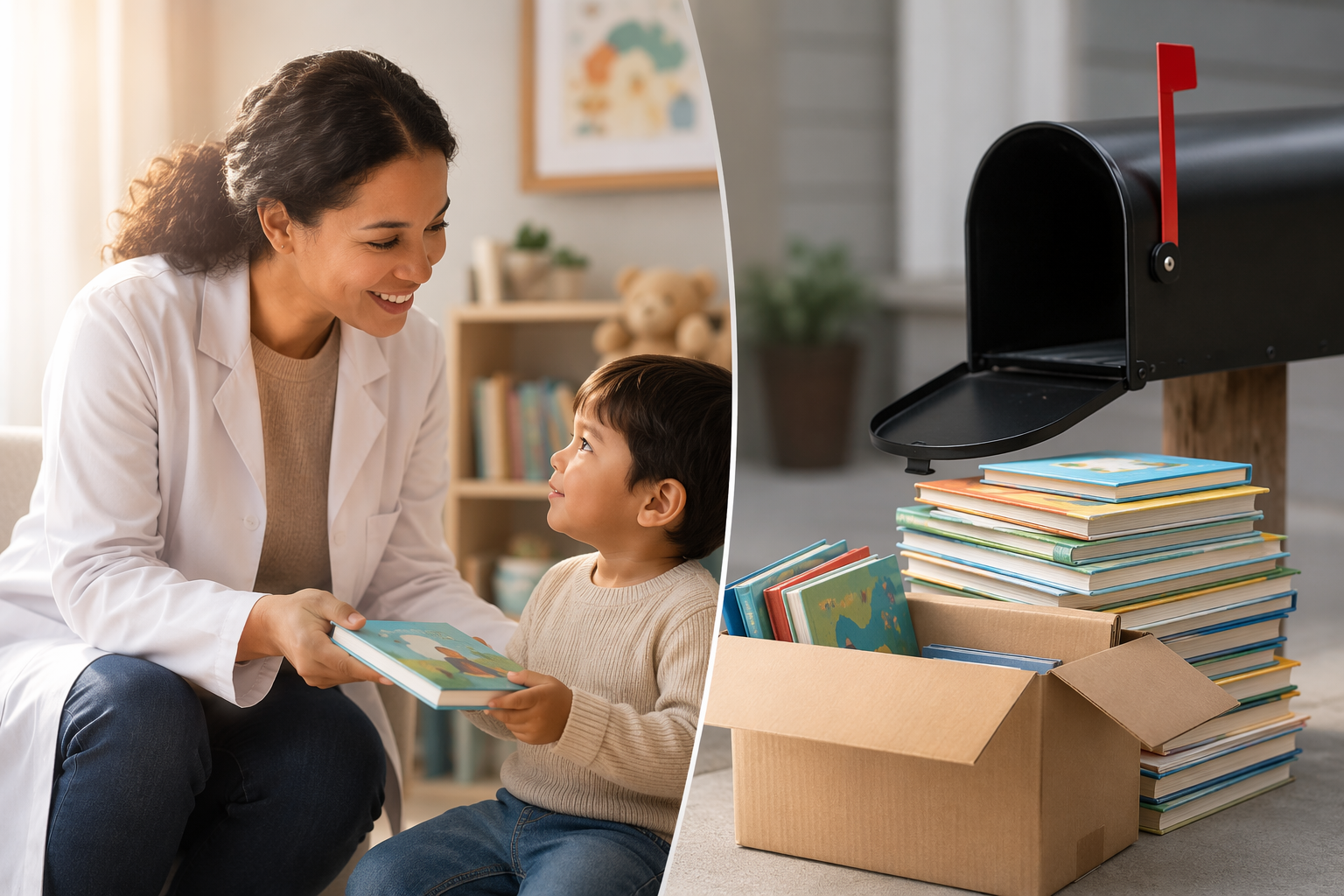
The Reach Out and Read result is the cleanest warning against treating distribution as the whole job. The model borrows the authority and repetition of pediatric care. A clinician does not merely move a book from shelf to family. During a visit, the book becomes part of a conversation about development: hold the child, name the picture, let the toddler turn pages, use the child’s attention as the guide. That advice is brief, but it arrives from a person many caregivers already trust.
That does not make Reach Out and Read automatically cheaper or easier. Provider time is real. Training is real. Clinic workflow is real. A pediatric office that is already seeing children for well-child visits may be able to absorb the model because the trusted-adult infrastructure already exists. A nonprofit trying to build that infrastructure from scratch may discover that the most effective mechanism is also the hardest to operate.
Why Two Books Can Compete With Sixty
Bookstart’s performance is easy to misread. It does not prove that one or two books are enough for every child. It does show that a small intervention can be powerful when the missing ingredient is not only supply, but permission, encouragement, or a starting ritual. A caregiver who has not been reading aloud may need a concrete cue more than a large home library on day one.
That distinction matters in low-resource planning. If a funder has enough money to buy books but not enough to support coaching, outreach, or follow-up, a bigger purchase order may look like the safer choice. The meta-analysis says that assumption needs testing. Book volume and literacy movement did not rise in a straight line across the three best-known models.[1]
Imagination Library still solves a problem that clinic and community handoff models often cannot solve: regular household delivery at large scale. For rural families, families without easy transportation, or communities where early-childhood services are fragmented, a book in the mailbox every month may be the most dependable contact the program can make. The risk is describing that contact as if it were the same as guidance. It is not. It is access, repetition, and predictability.
The 2026 School Trial Complicates the Book-Count Lesson
The strongest reason not to dismiss high-volume access comes from a newer randomized trial, not from nostalgia for book drives. In a five-year randomized trial across 60 high-poverty schools, researchers tested cumulative access to print books through a 34-book program. Students receiving the full treatment scored 0.207 standard deviations higher on literacy achievement, which the authors describe as 52–65% of a typical year’s learning. Students with partial exposure showed a smaller effect of d=0.100.[2]
That is not the same model as Imagination Library or Reach Out and Read. It is school-based, not birth-to-five mail or pediatric delivery. But it is highly relevant for decision-makers because it separates a casual giveaway from a durable access system. The treatment lasted five years. The setting was high-poverty schools. The program delivered enough books over time for exposure to accumulate. The cost was roughly $2 per book, or about $68 per student for the full 34-book program.[2]
The partial-exposure result is almost as useful as the full-treatment result. A one-year or intermittent version produced about half the effect of the full program.[2] That is the kind of finding that should make a district hesitate before funding a launch year with no maintenance plan. If the model depends on cumulative exposure, stopping early is not a neutral budget adjustment. It changes the treatment.
Cost also needs careful handling. The trial’s roughly $2-per-book figure is attractive, but it came from a specific implementation context.[2] It should not be copied into a budget as if every community can reproduce procurement, distribution, staffing, and school cooperation at the same price. Still, it gives funders a useful benchmark: a book-access program can be inexpensive per unit and still produce measurable literacy gains when it is sustained long enough.
What Imagination Library Is Strongest At
Imagination Library’s case is not that mail beats personal contact. The 2020 comparison does not support that. Its case is that monthly delivery creates a low-friction, birth-to-five access channel that many communities can understand, fund, and scale. The commonly cited cost benchmark is about $126 per child over five years for 60 books, though local costs and funding arrangements can vary.[3]
The best supportive evidence for the model is engagement, not a head-to-head victory on literacy outcomes. A 2025 global caregiver study reported responses from more than 86,000 caregivers across five countries. In that study, children in the program were 11 times more likely to be interested in books and 15 times more likely to join in during shared reading.[4]
Those are caregiver-reported engagement measures, so they should not be treated as the same thing as independently measured reading scores. They are still operationally important. A book that a child wants to open, carry, request, and revisit gives the caregiver more chances to read aloud. For a mail-based program, that may be the main mechanism: not professional guidance at the point of delivery, but repeated invitations inside the home.
Access Is Still a Serious Barrier
Skepticism about shipment totals should not turn into indifference about access. Book deserts are not a metaphor to the families living in them. One access-focused synthesis reports that 61% of U.S. children at or below poverty have no books at home and that 45% of children live in book-desert neighborhoods.[5] It also reports a strong correlation between home book ownership and later schooling: children with more than 100 books at home have about a 90% likelihood of completing ninth grade, compared with about 30% for children with no books.[5]
Those figures do not prove that placing 100 books in a home will by itself produce ninth-grade completion. Families with many books often differ from families with no books in income, stability, school access, caregiver education, and time. The numbers are better read as a warning about unequal childhood environments. When a child has no books within reach, a program that creates first access is doing something real, even before anyone can claim test-score movement.
Choice deserves a small place in the decision, too. Scholastic’s Kids & Family Reading Report found that 89% of children say their favorite books are the ones they picked out themselves.[6] That does not settle the model comparison, but it matters for selection and retention. A program can be evidence-minded and still notice whether children see themselves, their humor, their language, and their interests in the books arriving at home or school.
Recent UK data also points to the emotional and identity side of book ownership. The National Literacy Trust’s 2025 report surveyed 114,970 children and young people across the UK on book ownership.[7] Because that data is UK-based, it should not be used as a direct U.S. prevalence estimate. It is still a useful reminder that ownership is not only inventory. For many children, having a book that is theirs changes how reading feels.
Which Model Fits Which Community?
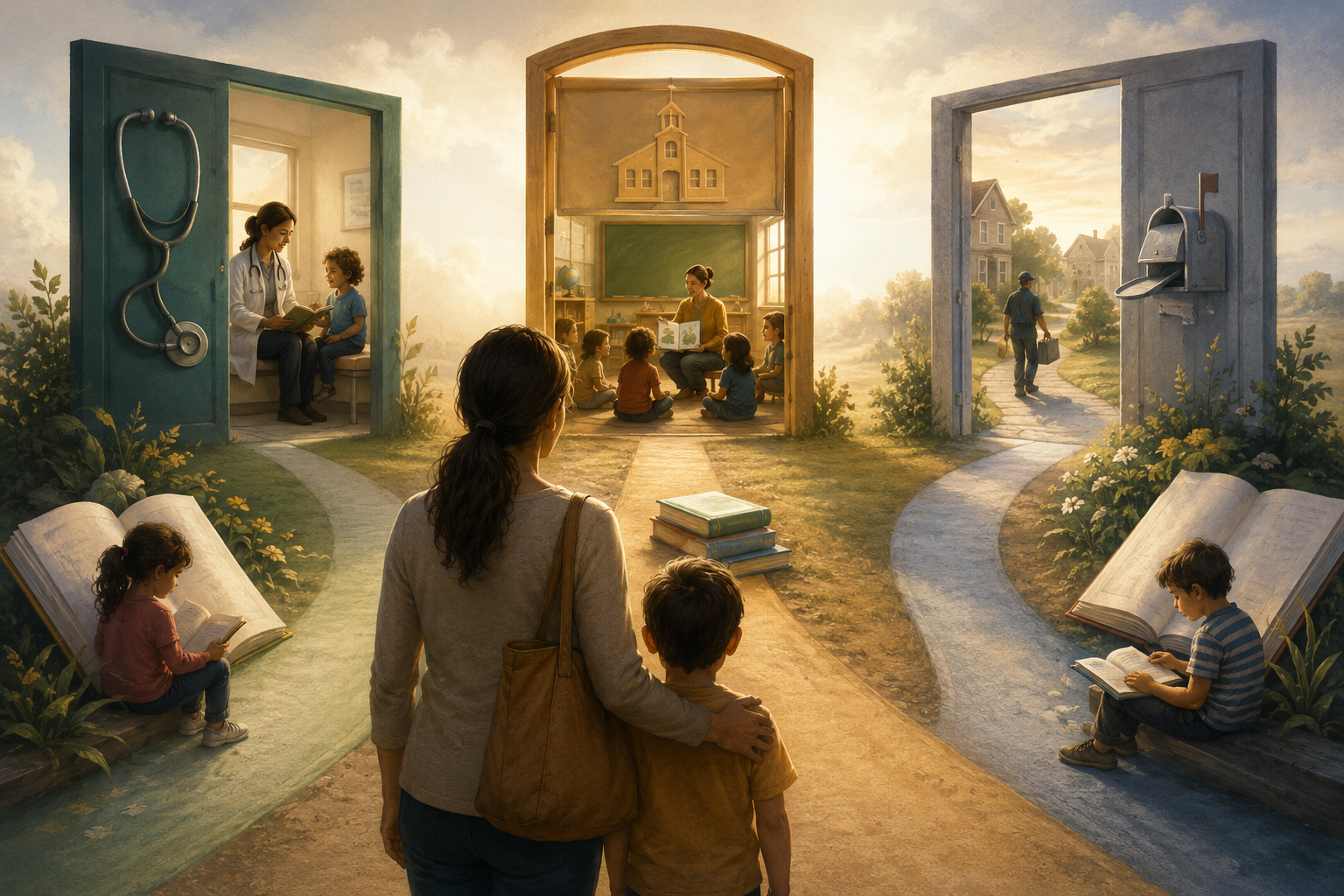
The decision starts with existing trust infrastructure. If a community already has pediatric well-child visits that reach the target families, Reach Out and Read has the strongest effect size in the shared comparison and a plausible mechanism for that advantage: the book comes with guidance from a trusted clinician.[1] The barrier is not the theory. It is whether clinics can protect the time, training, book supply, and workflow.
If the community needs birth-to-five coverage across scattered households, Imagination Library may be easier to operate. It does not require every family to attend a literacy event or every clinic to change practice. It can put books into homes month after month. The tradeoff is that the adult nudge is weaker unless local partners add enrollment support, caregiver messaging, library connections, or other touchpoints around the mail delivery.
If the target population is school-age children and the district can coordinate sustained distribution, the 2026 school-based evidence should be taken seriously. The full five-year treatment mattered more than partial exposure, and the per-student cost was low enough to make long duration imaginable in some budgets.[2] The relevant question is whether schools can maintain the program long enough for cumulative exposure to mean anything.
| If the strongest available channel is... | Look first at... | Main advantage | Main caution |
|---|---|---|---|
| Pediatric care | Reach Out and Read | Highest effect size in the shared meta-analysis and a trusted adult cue | Requires clinic participation, staff time, and workflow discipline |
| Household mail | Imagination Library | Low-friction monthly access from birth to age 5 | Engagement depends on whether caregivers convert delivery into shared reading |
| Schools or educators | A cumulative classroom or school-based book-access model | Sustained exposure can produce measurable achievement gains | Short or partial implementation may deliver a much smaller effect |
| A thin budget with limited infrastructure | A small-dose model such as Bookstart | Can act as a caregiver nudge without pretending volume is everything | Needs a meaningful handoff or prompt, not just a bag of books |
What Not to Count as Success
Books distributed is a logistics metric. It is not a literacy outcome. It can tell a board whether the warehouse, mailing list, or event schedule worked. It cannot tell the board whether caregivers read more often, whether children handled books more confidently, whether vocabulary exposure increased, or whether reading scores moved.
The better measures depend on the model. A pediatric model should track whether clinicians actually give anticipatory guidance, not only whether books leave the exam room. A mail model should track enrollment persistence, caregiver reading behavior, and whether books are reaching the families least likely to buy them. A school-based model should track duration and dosage, because the five-year trial suggests that full exposure and partial exposure are not interchangeable.[2]
Large national book distributors such as Reading Is Fundamental and First Book are important to the access ecosystem, especially because they move books through schools, educators, and community partners. Their scale is not the same kind of evidence as a randomized trial or a shared meta-analysis. Scale can solve scarcity. It does not automatically prove that a particular delivery model produces stronger literacy gains than another.
The Decision Rule
If the goal is the strongest documented literacy-related outcome among the named early-childhood giveaway models, Reach Out and Read has the advantage in the shared meta-analysis.[1] The reason appears to be less about the number of books and more about the trusted adult attached to the book. That advantage is most useful where clinics can absorb the work without making the model fragile.
If the goal is broad, low-friction access from birth to age 5, Imagination Library remains a serious option, especially where mail can reach families that programs cannot easily gather in one place. It should be judged by whether it increases shared reading and sustained engagement, not by the elegance of sending 60 books.
If the goal is school-age literacy improvement in high-poverty settings, the five-year cumulative-access evidence points toward long-duration school or educator channels. The full program result was meaningfully larger than the partial-exposure result, and the cost benchmark was low enough to make the durability question unavoidable rather than abstract.[2]
The hierarchy is simple enough to use and hard enough to execute: choose the model that combines books with the strongest adult nudge your community already has, then ask whether the cost and infrastructure can survive for five years. If the trusted adult is a pediatrician, use the clinic. If it is a teacher, use the school. If no such channel exists, mail or small-dose giveaways still have value, but the program should be honest about what it is buying first: access, a caregiver prompt, or sustained literacy exposure.
References
- Do Book Giveaway Programs Promote the Home Literacy Environment and Children's Literacy-Related Behavior and Skills? — Reach Out and Read
- Cumulative access to print books improves literacy achievement: Evidence from a five-year randomized trial in high-poverty schools — PNAS, 2026
- Proof Points: The literacy secret that Dolly Parton knows: Free books work — Hechinger Report
- Largest-Ever Shared Book Reading Study Finds Dolly Parton's Imagination Library Dramatically Improves Early Literacy for Children — Imagination Library Washington, 2025
- 10 Powerful Ways Book Access Boosts Children's Literacy — Little Free Library, 2026
- Kids & Family Reading Report: Access Matters — Scholastic
- Children and young people's book ownership in 2025 — National Literacy Trust, 2025
Comments
Join the discussion with an anonymous comment.