

The Odyssey Summary and Analysis for Students
Master Homer's The Odyssey with this comprehensive study guide that includes book summaries, character breakdowns, theme analysis, symbol explanations, and essay preparation strategies for students.
Updated:
If The Odyssey feels like a heap of islands, monsters, disguises, speeches, and delayed homecomings, start by refusing the weakest kind of summary: “Odysseus has adventures and eventually gets home.” That version remembers the Cyclops and the sirens, then has very little to say in an essay. A useful student reading asks what each episode tests.
Three lenses make the poem manageable: its non-linear structure, its codes of xenia and nostos, and its preference for cunning intelligence over brute force. The poem traditionally attributed to Homer does not simply begin at the beginning and march forward. It opens near the end of Odysseus’s absence, while earlier adventures are narrated later in flashback; Britannica identifies the poem as focused on the final phase of Odysseus’s long return after the Trojan War, with the larger authorship question bound up in oral epic tradition rather than a settled modern biography of “Homer.” [1]
| Use this guide for | What to memorize | What to analyze |
|---|---|---|
| Plot control | The 24-book movement: Ithaca, Telemachus’s journey, Odysseus’s flashbacks, return, revenge, restoration | Why the poem begins in medias res instead of with Troy or the first shipwreck |
| Theme essays | Xenia, nostos, metis, temptation, loyalty, recognition, divine justice | How each scene tests social order rather than merely adding adventure |
| Character questions | Odysseus, Penelope, Telemachus, Athena, Poseidon, the suitors, Eumaeus, Circe, Calypso, the Phaeacians | What each character reveals about home, intelligence, waiting, power, and self-control |
| Quote analysis | Opening invocation, Nobody trick, Argos, scar, bow, marriage bed | How evidence proves a claim instead of decorating a paragraph |
The Plot Is Not Chronological, and That Matters
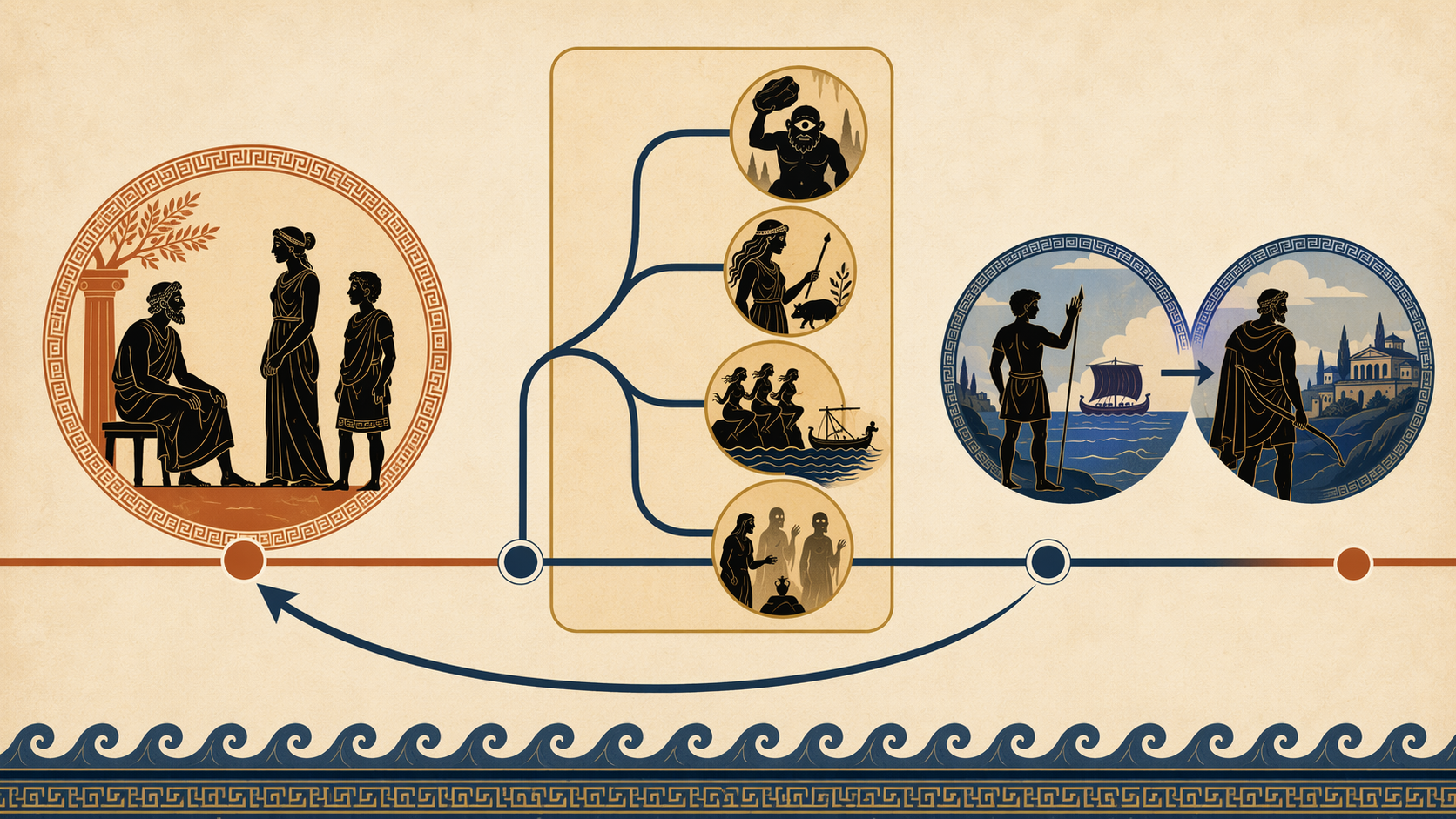
The Odyssey begins in medias res, “in the middle of things.” Odysseus has already been gone for years; Telemachus has grown up without his father; Penelope’s household is under siege by suitors; and the hero himself is not yet at the center of the stage. SparkNotes summarizes the poem’s structure as moving from Ithaca and Telemachus to Odysseus’s own narrated wanderings and then back to Ithaca for recognition and revenge. [2]
That structure is not a decorative trick. It teaches the reader to study delayed knowledge. Characters are constantly trying to find out who someone is, whether a story is true, whether a guest is honorable, whether a husband has really returned, whether a son can act like an adult, whether a household can be restored. The poem’s form makes the reader live inside uncertainty before it grants recognition.
Book-by-Book Summary of The Odyssey
The table gives you the whole poem without pretending every book carries the same interpretive weight. Books 1–4 establish the broken household and Telemachus’s education. Books 9–12 contain Odysseus’s famous Apologoi, his narrated adventures. Books 17–23 are especially rich for essays because recognition, disguise, loyalty, violence, and restoration all collide there.
| Book | What happens | Why it matters |
|---|---|---|
| 1 | The gods discuss Odysseus’s fate while Poseidon is absent. Athena visits Ithaca in disguise and urges Telemachus to challenge the suitors. | The poem opens with a damaged household, not a monster. Telemachus’s growth begins under Athena’s pressure. |
| 2 | Telemachus calls an assembly, criticizes the suitors, and prepares to travel for news of his father. | Public speech becomes part of maturation. The suitors’ abuse of the household is no private annoyance; it is a civic and moral disorder. |
| 3 | Telemachus visits Nestor at Pylos and hears memories of the Trojan heroes’ returns. | The poem places Odysseus’s nostos among other homecomings, showing that return after war can fail in different ways. |
| 4 | Telemachus visits Menelaus and Helen in Sparta. He hears that Odysseus is alive but trapped with Calypso. | Telemachus gains information and social confidence. The suitors plot against him, proving that his education has consequences. |
| 5 | The gods order Calypso to release Odysseus. He builds a raft, survives a storm, and reaches Scheria. | Homecoming requires endurance, divine permission, and refusal of seductive delay. |
| 6 | Nausicaa discovers Odysseus after Athena arranges the encounter. She helps him approach the Phaeacian court. | A vulnerable stranger must be received properly. This is xenia in action before anyone knows the guest’s status. |
| 7 | Odysseus enters the palace of Alcinous and Arete, asks for help, and receives hospitality. | The Phaeacians model ordered guest-friendship: food, shelter, listening, and eventual transport. |
| 8 | The Phaeacians hold games and hear songs about Troy. Odysseus weeps, prompting Alcinous to ask who he is. | Identity emerges through emotional response and storytelling. The hero is not just strong; he is a listener wounded by memory. |
| 9 | Odysseus begins his flashback narrative: the Cicones, Lotus-Eaters, and Polyphemus the Cyclops. He escapes by calling himself Nobody, then endangers himself by revealing his real name. | This is the clearest metis-versus-force episode. The Nobody trick saves him; pride after the escape worsens his suffering. |
| 10 | Odysseus tells of Aeolus’s wind bag, the Laestrygonians, and Circe. Circe turns his men into swine, then becomes a helper after Odysseus resists her magic. | Leadership is tested by crew discipline, temptation, and negotiation. Circe is not merely a monster; she becomes part danger, part guide. |
| 11 | Odysseus journeys to the Underworld and speaks with the dead, including Tiresias, his mother, and figures from heroic tradition. | The homeward journey passes through memory, prophecy, grief, and mortality. Odysseus learns what return may demand. |
| 12 | Odysseus tells of the Sirens, Scylla and Charybdis, the cattle of Helios, and the destruction of his crew. | Temptation and self-restraint become deadly serious. Odysseus survives, but survival is not the same as innocence. |
| 13 | The Phaeacians bring Odysseus to Ithaca while he sleeps. Athena disguises him and helps plan his return. | Home is reached before it is regained. Odysseus must enter Ithaca as a stranger and test his own household. |
| 14 | Odysseus, disguised as a beggar, is received by the swineherd Eumaeus. | Eumaeus honors xenia without knowing the beggar’s identity. His loyalty contrasts sharply with the suitors’ consumption. |
| 15 | Athena sends Telemachus home. Odysseus remains with Eumaeus, and the poem prepares father and son for reunion. | The two plots converge: the son’s education and the father’s disguised return. |
| 16 | Telemachus reaches Eumaeus’s hut. Odysseus reveals himself to his son, and they plan against the suitors. | Recognition becomes strategic, not sentimental only. Father and son become collaborators. |
| 17 | Odysseus enters his palace disguised as a beggar. The old dog Argos recognizes him and dies. | Argos condenses loyalty, neglect, and recognition into one painful scene. The household’s moral decay is visible even in the treatment of a dog. |
| 18 | Odysseus fights the beggar Irus and continues to endure insults in the hall. | Disguise requires self-control. Odysseus can use force, but he must not reveal himself too soon. |
| 19 | Penelope speaks with the disguised Odysseus. The nurse Eurycleia recognizes his scar while washing his feet. | The scar is a recognition token, but Odysseus controls who may know. Penelope’s testing intelligence becomes more visible. |
| 20 | Omens and insults intensify as the suitors continue their reckless behavior. | The poem slows down before violence so that judgment feels accumulated, not sudden. |
| 21 | Penelope sets the bow contest. The suitors fail to string Odysseus’s bow; the disguised Odysseus succeeds. | The bow joins identity, strength, memory, and rightful authority. It is not just a weapon; it proves who belongs. |
| 22 | Odysseus reveals himself and kills the suitors with Telemachus and loyal servants. | The punishment answers repeated violations of xenia, though modern readers may still find the violence harsh and unsettling. |
| 23 | Penelope tests Odysseus with the secret of their marriage bed. He proves his identity by describing its construction. | This is the poem’s strongest recognition scene. Penelope does not simply believe; she verifies. |
| 24 | The souls of the suitors reach the Underworld. Conflict threatens in Ithaca until Athena intervenes to establish peace. | Homecoming ends with social settlement, not private reunion alone. |
Xenia Is the Poem’s Moral Test, Not Just Good Manners
Xenia is often translated as hospitality or guest-friendship, but for The Odyssey it is closer to a social law. A stranger arrives before the host knows whether he is noble, dangerous, poor, divine, or deceptive. The ethical test comes before certainty. CliffsNotes identifies hospitality as one of the major themes of the poem, closely tied to social order and moral judgment. [3]
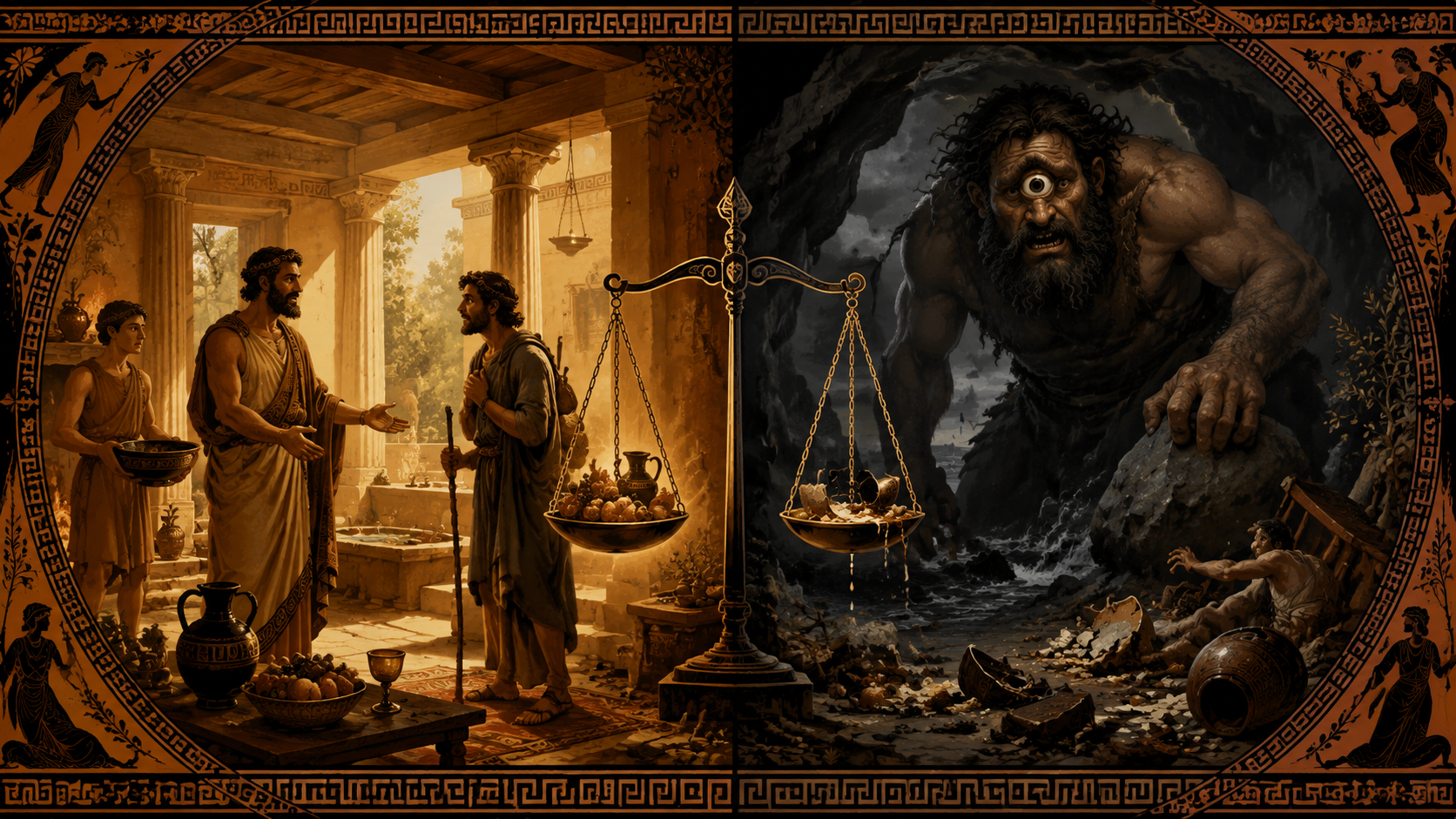
This is why the Phaeacians matter. They feed Odysseus, listen to him, honor him, and send him home. Eumaeus matters for the same reason, though he has far less power: he welcomes a ragged beggar because the obligation does not depend on visible status. Polyphemus is the opposite case. He traps guests, eats them, and mocks the gods. The suitors commit their own domestic version of the same violation by consuming another man’s household while pressuring Penelope and plotting against Telemachus.
For essays, this lens is more useful than a list of “good hosts” and “bad hosts.” Ask what each hospitality scene reveals about knowledge. A host does not yet know the guest. A guest does not yet know whether the house is safe. The disguised Odysseus turns this uncertainty into a weapon when he reaches Ithaca. He tests his servants, his wife, and the suitors before anyone receives the full truth.
Nostos: Homecoming Is Harder Than Arrival
Nostos means homecoming, but The Odyssey is careful about what “home” requires. Odysseus reaches Ithaca in Book 13, well before the poem ends. If the story were only about transportation, the problem would be solved there. Instead, arrival opens a harder phase: he must find out who remained loyal, who betrayed the household, whether his son can stand with him, and whether Penelope will recognize him.
That distinction is a gift in timed writing. You can argue that The Odyssey separates physical return from social restoration. Odysseus must come back to a place, then reclaim a name, a marriage, a household, and a public order. The bed in Book 23 matters because it proves that home is not geography. It is shared knowledge that cannot be faked.
Metis Beats Force, but It Does Not Stay Clean
Odysseus is often introduced through the Greek idea of polytropos, a word associated with many turns, many devices, and adaptability. The opening invocation asks the Muse to sing of a man defined by wandering and complexity; translations render that quality differently, so do not build an argument on one English phrase unless your class edition supports it. SparkNotes emphasizes Odysseus’s intelligence, resourcefulness, and capacity for disguise as central to his heroic identity. [2]
The Cyclops episode is the cleanest classroom example. Odysseus cannot overpower Polyphemus directly. He survives by planning: wine, the sharpened stake, the name “Nobody,” and the timing of the sheep escape. Then the scene complicates him. Once safe enough to shout, he reveals his real name, allowing Polyphemus to call on Poseidon. The same hero who wins through cunning damages his own nostos through pride.
That is why “Odysseus is clever” is not yet analysis. Better claims notice the cost of cleverness. He lies well, disguises himself effectively, withholds truth even from allies, and survives by managing appearances. In Ithaca, those habits are necessary; in other moments, they make him morally difficult. The poem admires metis without pretending it is gentle.
Character Analysis
Odysseus
Odysseus is admirable because he adapts. He survives shipwreck, monsters, enchantment, temptation, poverty, insult, and delayed recognition. He can speak persuasively in a royal court and sit silently in his own hall while being abused. The second skill is often harder for students to notice because it is less spectacular than blinding a Cyclops.
He is also troubling. His fame matters intensely to him. His stories are not neutral recordings; they are performances delivered to audiences. He uses false identities repeatedly. He orders violence in the palace. A strong essay does not need to choose between “hero” and “bad man” as if those were the only options. The poem is more interesting because Odysseus’s saving intelligence and his dangerous appetite for control are connected.
Penelope
Penelope is not merely “faithful,” though she is loyal. Her loyalty works through intelligence. The shroud trick, in which she delays remarriage by weaving by day and undoing the work by night, makes waiting active rather than passive. SparkNotes treats the shroud and the marriage bed as major symbols tied to Penelope’s cunning and fidelity. [2]
Her finest moment is the bed test. She does not accept Odysseus because a man claims the name, wins the bow contest, or kills the suitors. She tests him with knowledge only the real husband would possess: the rooted bed built into their household. This makes her Odysseus’s intellectual counterpart. Both understand that identity must be proven under conditions of deception.
Telemachus
Telemachus begins as a young man trapped in a house where adult authority has collapsed. His journey to Pylos and Sparta does not turn him instantly into Odysseus. It teaches him how to speak publicly, receive stories, judge men, and imagine himself as the son of a famous father. By the time Odysseus returns, Telemachus can take part in planning and action, even if he still needs correction.
Athena and Poseidon
Athena favors strategy, disguise, timing, and controlled revelation. Her patronage fits Odysseus because he wins by intelligence rather than direct force. She also guides Telemachus, which means her work is not only rescue but education.
Poseidon’s opposition gives Odysseus’s journey divine resistance, especially after the blinding of Polyphemus. The conflict should not be reduced to “Athena good, Poseidon bad.” The gods in The Odyssey often magnify human actions. Odysseus’s choices still matter, but divine pressure shapes the scale and duration of their consequences.
The Suitors
The suitors are not simply romantic rivals. They are prolonged violators of xenia inside Odysseus’s own house. They eat his stores, insult beggars, pressure Penelope, threaten Telemachus, and behave as if the household has no rightful order. Their punishment is severe, and modern readers may find the palace violence disturbing, but the poem has spent many books building the case that their behavior is not a minor breach of etiquette.
Circe, Calypso, Eumaeus, and the Phaeacians
Circe and Calypso are often grouped as temptation figures, but they are not identical. Calypso offers delay from suffering and a life away from Ithaca; Circe first threatens Odysseus’s men, then becomes a source of instruction. Both episodes ask whether comfort, pleasure, or enchantment can replace nostos.
Eumaeus and the Phaeacians show hospitality at different social levels. The Phaeacians have wealth, ships, ceremony, and public honor. Eumaeus has a hut and limited resources. The poem values both because xenia is not measured only by luxury; it is measured by the treatment of the vulnerable stranger.
Symbols and Motifs That Actually Help in Essays
| Symbol or motif | Where to use it | Analytical value |
|---|---|---|
| The bow | Book 21 | Proves identity, authority, memory, and controlled strength. The suitors cannot even begin what Odysseus can complete. |
| The marriage bed | Book 23 | Turns recognition into shared private knowledge. Penelope’s test protects marriage from easy appearances. |
| The shroud | Penelope’s delay of remarriage | Shows that fidelity can be strategic, verbal, and intellectual, not merely emotional endurance. |
| The scar | Book 19 | Makes identity bodily and historical. Eurycleia recognizes what disguise cannot erase. |
| Argos | Book 17 | Condenses loyalty and neglect. The dog recognizes Odysseus before the corrupted household openly can. |
| Disguise | Athena’s plans and Odysseus’s return | Allows testing before revelation. The poem treats identity as something performed, hidden, proven, and recognized. |
| Homeric epithets | Throughout the poem | Repeated descriptive phrases reflect oral epic style and help preserve character identity across performance traditions. |
Symbols in The Odyssey are most useful when attached to action. Do not write that the bed “symbolizes love” and stop. Write that Penelope uses the bed as a test because it is immovable, handmade, and known intimately by husband and wife. That lets the symbol do literary work.
Key Quotes and How to Use Them
Quote wording changes across translations, so match your teacher’s edition when you write. The analytical function of the passage is usually more important than memorizing one famous English rendering.
| Passage | Use it for | What to say about it |
|---|---|---|
| Opening invocation: “Sing to me of the man, Muse…” | Structure, oral epic, heroism, complexity | The poem begins by asking for song and by defining Odysseus through wandering, suffering, and many-sided intelligence. |
| Odysseus’s “Nobody” trick in Book 9 | Metis versus force | The false name works because language becomes a weapon. Odysseus defeats a stronger enemy by controlling what can be reported. |
| Argos recognizing Odysseus in Book 17 | Loyalty, neglect, recognition | The dog’s recognition is emotionally direct, but the setting exposes how badly the household has decayed during Odysseus’s absence. |
| Eurycleia recognizing the scar in Book 19 | Identity, memory, concealment | The body preserves history even when Odysseus performs a false social identity. |
| The bow contest in Book 21 | Authority, masculinity, rightful rule | The bow is a test the suitors misunderstand. They want Penelope and power, but they cannot handle the sign of Odysseus’s place. |
| The marriage-bed test in Book 23 | Penelope, recognition, nostos | Penelope’s intelligence completes the homecoming. Odysseus must be known, not merely seen. |
Common Essay Angles That Teachers Actually Reward
A good Odyssey thesis usually joins a plot pattern to a value system. It does not merely announce a theme. “Hospitality is important in The Odyssey” is true and thin. “The Odyssey uses repeated hospitality tests to distinguish households that preserve social order from those that consume and corrupt it” gives you an argument.
| Prompt type | Weak thesis | Stronger thesis |
|---|---|---|
| Odysseus as hero | Odysseus is a hero because he is brave. | Odysseus’s heroism depends less on brute strength than on metis, but the same desire for reputation that makes him memorable also prolongs his suffering after the Cyclops episode. |
| Penelope | Penelope is loyal to Odysseus. | Penelope’s fidelity is active and intellectual: through the shroud and the bed test, she controls time, interpretation, and recognition inside a household under pressure. |
| Xenia | The poem shows good and bad hospitality. | The Odyssey turns xenia into a moral sorting device, rewarding those who protect vulnerable strangers and condemning those who consume households without restraint. |
| Structure | The poem uses flashbacks. | By delaying Odysseus’s own account until Books 9–12, The Odyssey makes identity something reconstructed through storytelling rather than delivered in chronological order. |
| Homecoming | Odysseus wants to get home. | The poem separates arrival from restoration: Odysseus reaches Ithaca before he can reclaim his name, marriage, household, and social order. |
A Practical Study Method for The Odyssey
When you review, do not make one giant list of events. Make three columns: structure, xenia or nostos, and metis or force. Put each major episode into at least one column. The Cyclops belongs under xenia and metis. The Phaeacians belong under xenia and nostos. Penelope’s bed test belongs under nostos, recognition, and metis. The suitors belong under violated xenia and corrupted household order.
- For each book, write one sentence of plot and one sentence of analytical purpose.
- For each major character, attach one scene that proves your claim about them.
- For each quote, memorize the situation first, then the wording from your translation.
- For each essay theme, prepare one Ithaca example and one travel-adventure example.
- For timed writing, build topic sentences around tests: of hospitality, identity, patience, speech, loyalty, or restraint.
If you want to extend this into a broader study routine, use a syllabus-based study guide method to turn your class calendar into review tasks. For adaptation work, especially if your teacher likes modern structure comparisons, pair this guide with Study Homer's Odyssey Through Christopher Nolan's Film. If your exam depends on names, symbols, and scenes, convert the tables into flashcards after comparing Quizlet and NotebookLM for flashcards. For audio review during a commute or walk, try an Audio Overview for exam review.
References
- Odyssey, Britannica.
- The Odyssey Study Guide, SparkNotes.
- Major Themes in The Odyssey, CliffsNotes.
Comments
Join the discussion with an anonymous comment.