
What Geomagnetic Storms Do to Earth's Technology, Weather, and Life
This research-backed study guide explains how geomagnetic storms disrupt power grids, satellites, and GPS, influence weather patterns within hours to days, and correlate with cardiovascular changes in humans — with clear distinctions between proven technology impacts and debated biological effects.
Updated:
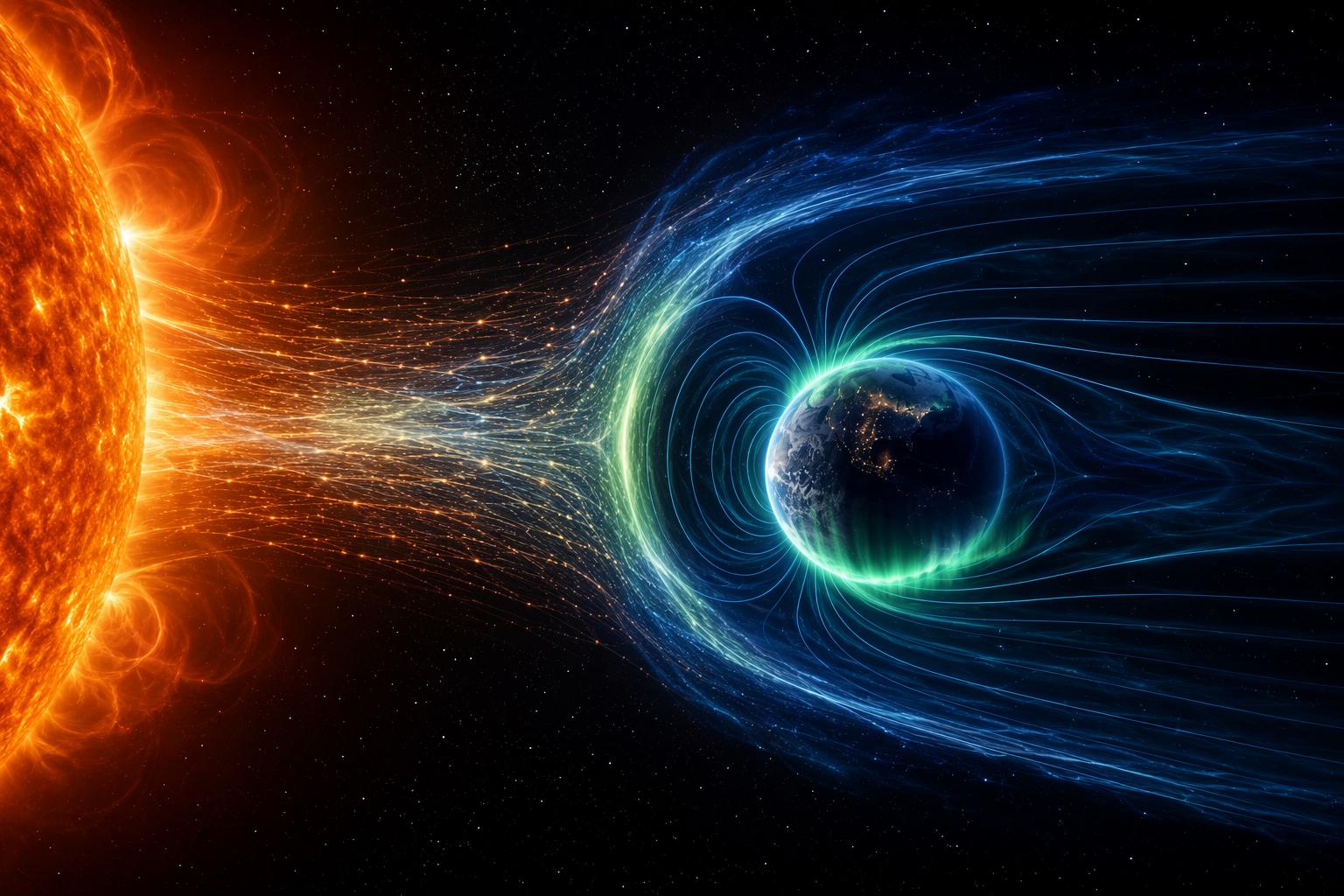
A useful study of geomagnetic storm effects on Earth starts with the machinery, not the mystery. Power grids, satellites, radio links, and navigation systems give us the cleanest evidence because the causal chain can be followed: the Sun disturbs Earth’s magnetic environment, electric currents and particle effects appear in the wrong places, and operators see equipment trip, drift, lose signal, or fail. Weather and biology belong in the same article, but not in the same evidentiary box.
That distinction matters. A blackout is not a metaphor. A satellite losing altitude is not a mood. A statistical rise in heart attack mortality during disturbed geomagnetic conditions is important, but it is still not the same kind of claim as a relay tripping in a grid control room. Keep those levels separate and the subject becomes much easier to study.
The clearest damage appears in technology
Geomagnetic storms begin with solar activity that disturbs Earth’s magnetosphere. For students, the practical point is not that “space weather affects everything.” The practical point is narrower: changing magnetic fields can induce electric currents in long conductors, and those currents can interfere with systems designed for ordinary electrical conditions.
The March 1989 Quebec blackout is the standard case because it is not vague. A severe geomagnetic storm with a Dst index of −589 nT collapsed Quebec’s power grid for about 9 hours and affected roughly 6 million people. Geomagnetically induced currents entered the grid, protective relays tripped, and the failure cascaded through the Hydro-Québec system rather than staying as a local nuisance.[1]
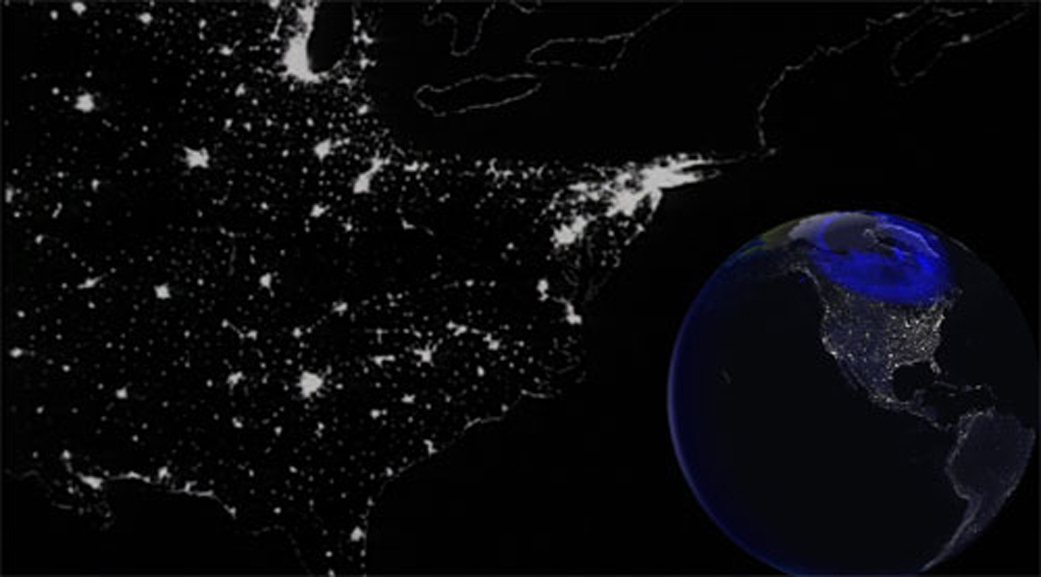
That event is a good model because each step has an identifiable job. The storm does not have to “attack” the grid. It only has to create abnormal currents in infrastructure that was not built to treat the ground as an active electrical participant. Long transmission lines, transformers, and protective systems then decide how much of the disturbance becomes an outage.
This is why the NOAA G scale is mostly an operations tool. A G1–G5 rating describes geomagnetic storm intensity in a way that helps flag power-system, spacecraft, navigation, and radio risks. It does not automatically tell you what will happen to a person’s blood pressure, or whether rain will fall in a particular town. Different systems couple to the storm through different mechanisms.
| Earth system | Main documented effect | How strong is the evidence? |
|---|---|---|
| Power grids | Geomagnetically induced currents can trip relays, stress transformers, and contribute to cascading outages. | Strong causal evidence from operational failures such as Quebec in 1989. |
| Satellites | Upper-atmosphere heating can increase drag; charged particles can affect spacecraft operations. | Strong operational evidence, especially for low-Earth-orbit spacecraft. |
| GPS and radio | Ionospheric disturbance can degrade positioning accuracy and disrupt high-frequency radio paths. | Strong operational evidence, though severity depends on location, timing, and system design. |
| Weather | Recent work links storms with pressure, temperature, and precipitation changes over hours to days. | Emerging evidence; promising but geographically limited and awaiting replication. |
| Human biology | Several studies report cardiovascular and physiological correlations during disturbed geomagnetic conditions. | Statistically significant correlations, but direct causation remains unsettled. |
Satellites and GPS show that the problem is not historical
The Quebec blackout can make geomagnetic risk look like a late-20th-century grid story. It is not. The more crowded near-Earth space becomes, the more exposed some systems are to changes in the upper atmosphere.
In February 2022, 38 Starlink satellites were lost after a geomagnetic storm increased atmospheric drag while the satellites were still in a low orbit and trying to raise altitude. The mechanism is not exotic: storm energy heats and expands the upper atmosphere, increasing drag on low-Earth-orbit spacecraft. If the spacecraft cannot compensate fast enough, its orbit decays instead of stabilizing.[2]
Navigation and radio systems have their own pathway. GPS signals pass through the ionosphere, and during geomagnetic storms that region can become irregular enough to delay, scatter, or scintillate radio signals. NOAA’s effects reporting for the May 2024 storm includes roughly $500 million in agricultural losses tied to GPS disruption, a reminder that positioning errors are no longer a niche aviation or surveying issue. Modern farming equipment, logistics, construction, emergency response, and timing systems all depend on radio signals behaving predictably.[3]
High-frequency radio is similarly exposed because it relies on ionospheric reflection. A storm can make a usable path disappear, shift, or become noisy. The result is not usually cinematic. It is a dispatcher waiting, a ship or aircraft losing a preferred communication path, a correction signal arriving late, or a satellite operations team having to revise a maneuver plan.
The newer weather question is narrower than the headline
Weather is where the subject becomes more interesting and easier to overstate. There has long been speculation about solar activity, cosmic rays, clouds, and climate. Much of that older discussion is too broad for a careful study answer because it tends to leap from a possible physical pathway to a planetary conclusion. The more useful recent work asks a smaller question: after geomagnetic storms, do measurable weather variables change over short time scales?
A 2026 Geophysical Research Letters study by Jimmy Raeder examined 67 years of hourly geomagnetic storm data across North America and paired those events with modern reanalysis models. The reported finding was that geomagnetic storms influence pressure, temperature, and precipitation within hours to days. In winter, the study found a regional pattern in which storms tended to warm the U.S. West Coast while cooling much of the rest of the country.[4]
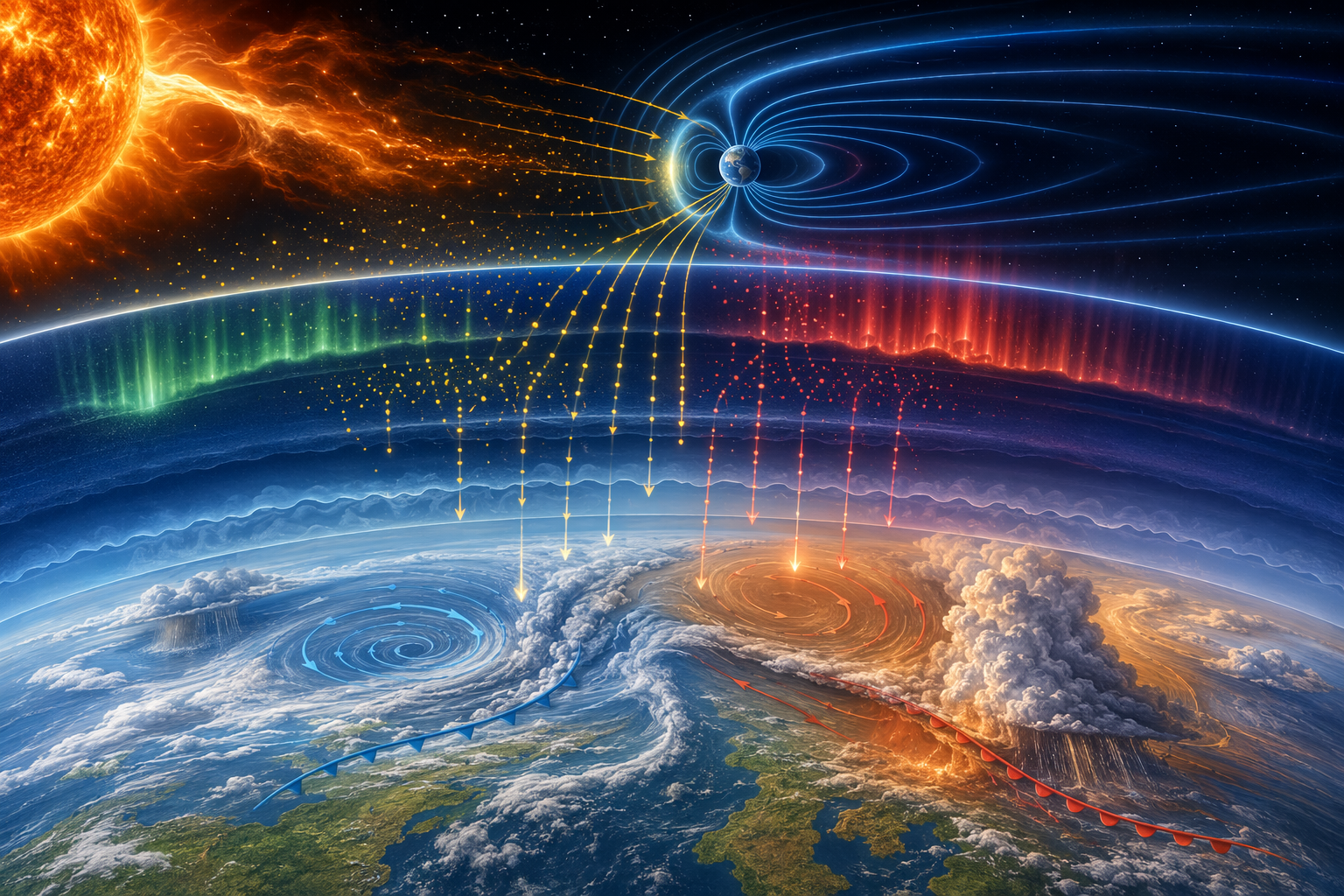
That is a serious result because it moves the discussion away from vague cloudiness claims and toward specific variables, regions, and time windows. Pressure, temperature, and precipitation are quantities weather models already handle. Hours-to-days is a forecast-relevant scale. North America is a defined study domain, not the whole planet wearing a borrowed conclusion.
The proposed direction is also different from the older cosmic-ray cloudiness idea. The Raeder work, as summarized by Eos, rules out that cloudiness hypothesis for its result and instead supports a top-down mechanism: disturbance beginning higher in the atmosphere and propagating downward into weather-relevant layers.[4]
This does not mean geomagnetic storms control weather in the ordinary forecast sense. It means they may add a measurable short-term influence to an already complicated atmosphere. A winter pressure response over North America is not a universal climate law. An hours-to-days signal is not evidence that geomagnetic storms explain long-term warming or rainfall trends. The study was published in June 2026, so its value is high, but so is the need for replication and comparison in other regions.[4]
How to state the weather finding defensibly
- Say that geomagnetic storms have been linked with short-term changes in pressure, temperature, and precipitation over North America.
- Say that the time scale in the 2026 study is hours to days, not seasons to decades.
- Say that the reported winter pattern differs by region, with West Coast warming and broader U.S. cooling.
- Do not say that geomagnetic storms are proven drivers of global climate change.
- Do not use the result as a shortcut for the older claim that cosmic rays simply make clouds and therefore control climate.
Biological studies show signals, not settled causation
The health literature deserves attention, but it also demands discipline. Several studies report cardiovascular patterns during geomagnetic disturbances. That is not the same as proving that a geomagnetic storm directly injures the cardiovascular system through a known physical mechanism.
A 2019 Environmental Health study by Zilli Vieira and colleagues examined more than 44 million records across 263 U.S. cities. It reported about a 50% increase in total and cardiovascular mortality risk, and about a 100% increase in myocardial infarction mortality risk, during geomagnetic disturbances.[5]
A 2025 Communications Medicine study by He and colleagues analyzed 554,319 blood pressure measurements collected over 6 years in mid-latitude China. The authors reported a statistically significant positive correlation between geomagnetic activity, measured with the Ap index, and both systolic and diastolic blood pressure. They also reported shared 3-, 6-, and 12-month periodicities, greater sensitivity in female blood pressure, and a 1–2 month lag.[6]
A 2023 review collected a wider set of reported associations: 50–100% increased myocardial infarction risk, about 50% increased stroke risk, and about 50% increased cardiovascular mortality during storms. The same review also described other physiological findings, including roughly 20% melatonin reduction at high latitudes, migraine severity increases of 10–68%, and 20–25% heart-rate-variability shifts in laboratory simulations.[7]
Those numbers are not trivial. Large datasets make it harder to dismiss the entire topic as folklore. But correlation is still doing most of the work. Cardiovascular outcomes are affected by temperature, air pollution, infection, stress, age, medication, baseline disease, and many other variables that can cluster in time and place. A geomagnetic index lining up with a health outcome is a signal to investigate, not permission to skip mechanism.
The physics problem is real. The 2023 review notes the controversy: extremely low frequency magnetic field energies are orders of magnitude below thermal energy kT, and skeptical experts, including NJIT’s Dale Gary, question whether direct biological causation is plausible at those energy levels.[7]
A careful study answer should therefore separate three claims. First, human cardiovascular data show statistically significant associations with geomagnetic activity in several studies. Second, some physiological pathways have been proposed, including autonomic, melatonin, and heart-rate-variability mechanisms. Third, the direct causal pathway remains debated. If an answer collapses those three into “solar storms cause heart attacks,” it has stopped doing science and started doing headline compression.
What belongs in a solid study answer
The best organizing frame is not “everything on Earth is connected.” Of course Earth systems interact. That statement is too broad to help. The useful frame is evidence strength.
- Proven operational effects: power-grid disruption, satellite drag and operational loss, GPS degradation, high-frequency radio disruption.
- Emerging atmospheric effects: short-term changes in pressure, temperature, and precipitation reported over North America in the 2026 Raeder study.
- Unresolved biological effects: statistically significant cardiovascular and physiological correlations, with causal mechanisms still debated.
That frame also prevents a common mistake with geomagnetic storm scales. The G scale helps describe expected space-weather disturbance for technology and operations. It should not be treated as a universal severity scale for weather outcomes or human health outcomes. The same storm can be operationally important for one system and scientifically ambiguous in another.
Geography matters as well. The weather result discussed here is North American. The 2025 blood-pressure study is from mid-latitude China. Many health studies focus on mid- to high-latitude regions, where geomagnetic effects tend to be stronger. A defensible answer does not quietly generalize those results to every population and climate zone on Earth.
So the answer to “what do geomagnetic storms do to Earth?” is uneven, and that unevenness is the point. They can disrupt technology through mechanisms that are well documented and operationally costly. They now appear to have credible short-term links to weather variables, especially in the newer North American work, but that claim is still young. They correlate with cardiovascular outcomes in large datasets, but the biological cause remains scientifically unsettled.
References
- Great Geomagnetic Storm of March 1989, NOAA Space Weather Prediction Center.
- Worst-case solar storm report, Space.com, 2026.
- Space Weather Effects, NOAA NESDIS.
- Solar Storms Can Affect Earth’s Weather, a New Study Examines How, Eos, June 2026.
- Long-term exposure to geomagnetic disturbances and mortality in 263 U.S. cities, Environmental Health, 2019.
- Geomagnetic activity is associated with blood pressure in a Chinese population, Communications Medicine, 2025.
- The influence of space weather on human cardiovascular and nervous systems, PMC, 2023.
Comments
Join the discussion with an anonymous comment.