
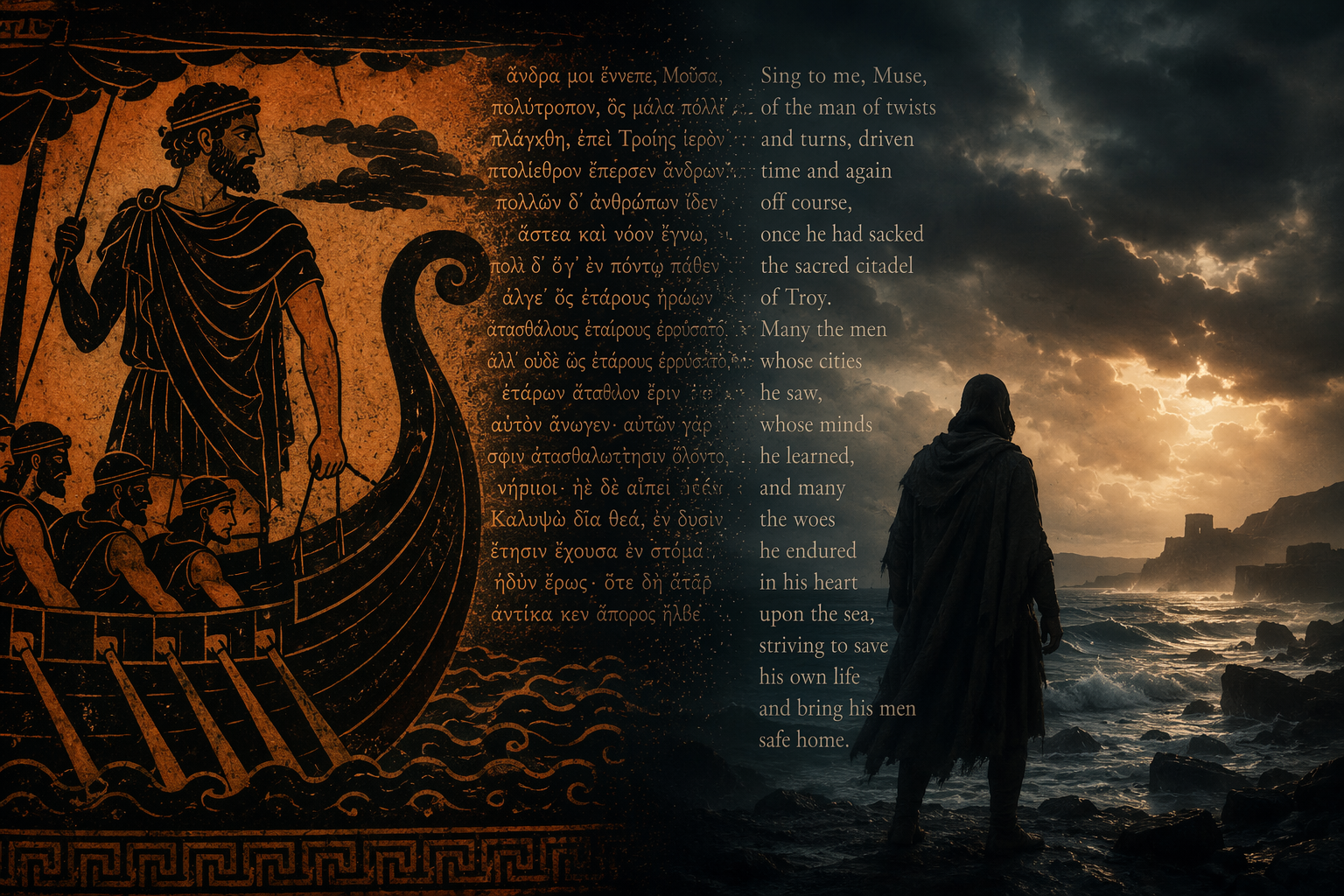
10 Ways Nolan's The Odyssey Diverges from Homer's Epic
This article breaks down the ten most significant changes Christopher Nolan made in his 2026 film adaptation of Homer's The Odyssey, with context from the original poem and explanations of why each change matters for essays and class discussions.
Updated:
A useful comparison between Homer’s Odyssey and Christopher Nolan’s 2026 film starts with a warning: the movie is not a replacement for the poem. It is a deliberate reinterpretation. If you are using the film for class, the important move is not to decide whether Nolan is “faithful” in some vague way. The important move is to say which version you are discussing, what changed, and what that change does.
For the poem itself — the order of events, the major characters, and the epic’s structure — use our Homer’s Odyssey study guide. This article has a narrower job: to separate Homer from Nolan clearly enough that the film can help your essay instead of quietly replacing your evidence.
The Ten Changes at a Glance
Vanity Fair’s change-by-change account is the backbone for the comparison here, because it identifies the specific departures students are most likely to blur together: the Trojan Horse opening, the altered Odysseus, the missing Phaeacian frame, the rewritten Calypso and Circe episodes, the Cyclops changes, the reduced gods, Sinon, the slave girls’ altered fate, and the new ending.[1]
| Change | In Homer or the relevant ancient source | In Nolan’s film | Why it matters for class |
|---|---|---|---|
| 1. Trojan Horse opening | The Trojan Horse is not narrated as a main episode of the Odyssey; it belongs to the wider Trojan War tradition, and the film’s opening leans especially on Virgil’s Aeneid.[1] | The film begins with the Trojan Horse. | Do not cite the film’s opening as if Homer’s Odyssey begins there. |
| 2. Odysseus’s character | Homer’s Odysseus is famously complicated, cunning, and resourceful; SparkNotes summarizes the poem around his long struggle to return home after the Trojan War.[2] | Nolan presents him as PTSD-afflicted and guilt-ridden, shaped by wartime damage and moral injury.[1] | The film shifts attention from heroic cunning toward trauma, memory, and responsibility. |
| 3. Phaeacian frame removed | In Homer, Odysseus tells much of his journey while among the Phaeacians.[1] | The film removes that frame-narrative structure.[1] | This changes how storytelling itself works in the adaptation. |
| 4. Calypso rewritten | Homer’s Calypso is a divine captor who wants Odysseus to remain with her.[1] | Nolan makes her function more like a trauma therapist.[1] | The island becomes a place for psychological processing rather than mainly divine detention. |
| 5. Circe rewritten | Homer’s Circe is dangerous, seductive, and magical.[1] | Nolan makes her a moralizing critic of Odysseus.[1] | The encounter becomes less about enchantment and more about judgment. |
| 6. Cyclops altered | In Homer, the Nobody trick is central, and Polyphemus’s divine parentage matters to the aftermath.[1] | The film drops the Nobody trick and the divine-parentage conversation.[1] | A classic example of Odysseus’s verbal cunning becomes less central. |
| 7. Gods reduced | The Homeric world is thick with divine action, including Athena’s role in Odysseus’s return.[2] | Nolan reduces the Olympian presence; Athena is intermittent rather than structuring the whole moral order.[1] | The film modernizes the causal world by moving pressure away from gods and toward human psychology. |
| 8. Sinon added | Sinon is not a Homeric Odyssey character; he is associated with Virgil’s Aeneid.[1] | Nolan includes Sinon, played by Elliot Page.[1] | This is a source-boundary trap: it is ancient material, but not Homer’s Odyssey. |
| 9. Slave girls’ fate altered | In Homer, the disloyal slave women are hanged after the suitors are killed.[1] | The film has Penelope kill Melantho rather than staging a mass hanging.[1] | The film changes the distribution and visibility of punishment. |
| 10. Ending changed | Homer’s ending restores Odysseus to Ithaca and resolves the crisis around the household and suitors.[2] | Nolan has Odysseus sail west to atone.[1] | The film refuses to let homecoming settle the moral account. |
1. The Trojan Horse Opening Is Not Homer’s Odyssey Opening
The film’s Trojan Horse opening is the first place a student can go wrong. It is vivid, dramatic, and very easy to remember. It is also not how Homer’s Odyssey begins. Vanity Fair identifies the opening as material drawn from the Aeneid rather than from the Odyssey itself.[1]
That does not make the choice lazy or illegitimate. Nolan is allowed to begin with the war that haunts his version of Odysseus. Roger Ebert’s review notes that Nolan’s film mixes material from the Iliad, the Aeneid, and modern translations, which helps explain why the film feels like a broad mythic remix rather than a straight line-by-line adaptation.[3]
For an essay, though, the source boundary matters. If you want to discuss the Trojan Horse, treat it as part of Nolan’s chosen mythic background, not as an episode from Homer’s main homecoming narrative. For more on that distinction, see our guide to the Trojan Horse myth and reality.
2. Nolan’s Odysseus Is Damaged Before He Is Clever
Homer’s Odysseus is not simple. The famous modern translation phrase “a complicated man,” associated with Emily Wilson’s opening, gives Nolan a real foothold.[1] But the film presses that complication in a particular direction: Odysseus becomes a man visibly damaged by war, burdened by guilt, and forced to narrate himself through trauma rather than merely through clever survival.
That matters because students often use “complicated” as a shortcut. In Homer, Odysseus’s complexity includes intelligence, endurance, deception, pride, status, appetite, and his ability to survive under divine and human pressure. In Nolan, the center of gravity moves toward psychological injury and moral accountability. Those are not identical claims.
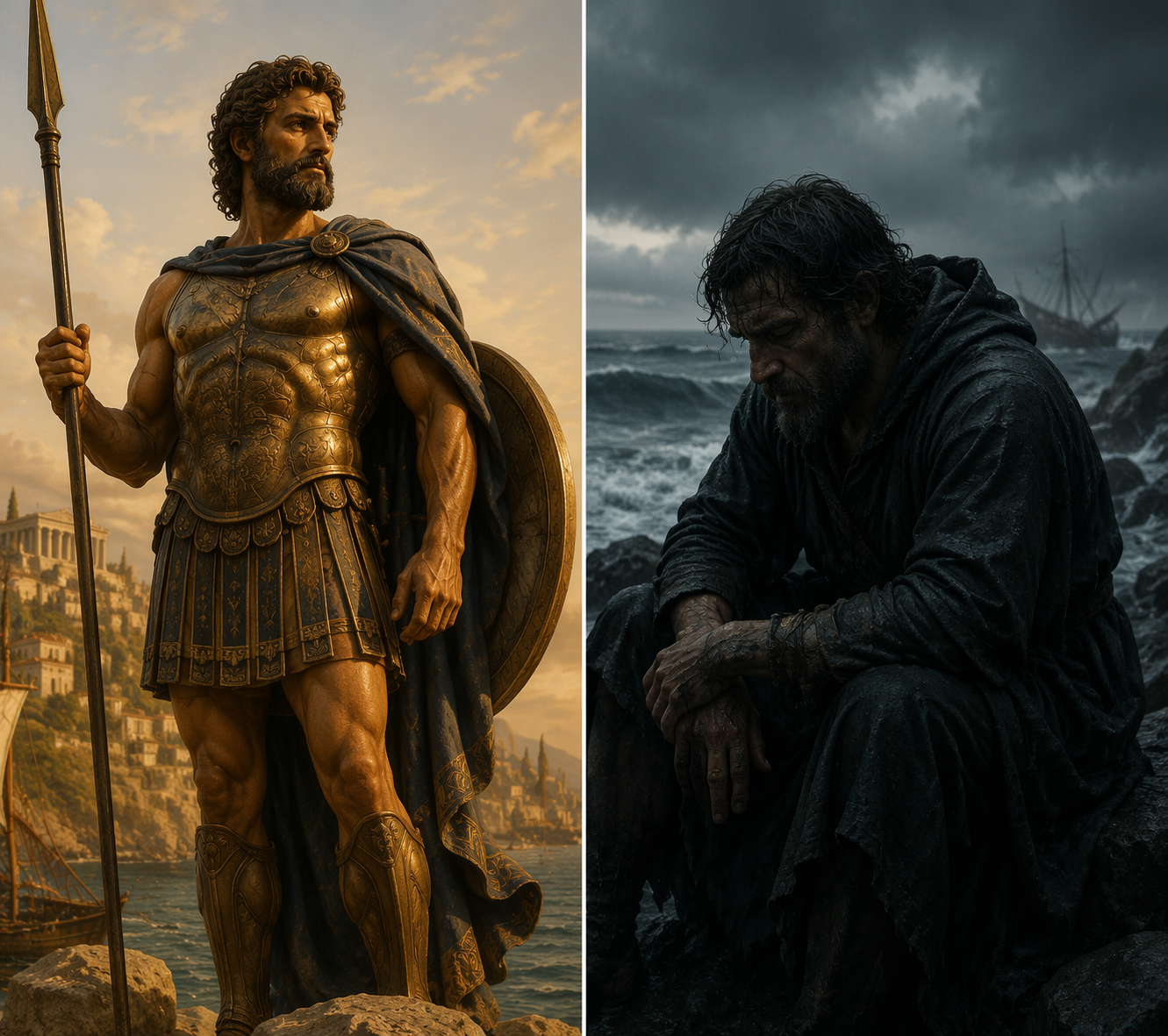
A clean comparison sentence might look like this: Homer emphasizes Odysseus’s adaptive intelligence within an epic world of honor, danger, and divine intervention; Nolan emphasizes the psychic cost of violence and the problem of whether a returning warrior can give a truthful account of himself. That is a stronger claim than saying the film “makes Odysseus more modern,” because it names what kind of modern pressure the film adds.
3. Removing the Phaeacians Changes Who Controls the Story
The Phaeacians are easy to treat as a framing convenience if you are rushing through the poem. Do not. In Homer, Odysseus tells many of his adventures while he is among them, which means the poem makes storytelling part of the action.[1] Odysseus is not only a man who had experiences; he is a man arranging those experiences for an audience.
Nolan’s removal of the Phaeacian frame reduces that formal distance. The film can still care about narration, memory, and self-explanation, but it does not give students the same Homeric structure: a hero recounting his wanderings inside the poem’s larger movement toward home. If your essay discusses narrative control, this is one of the most important differences to track.
4. Calypso Becomes a Trauma Therapist Instead of a Divine Captor
In Homer, Calypso detains Odysseus and wants him to stay with her. The episode is bound up with desire, immortality, captivity, and the hero’s longing for home. Nolan reworks Calypso into a figure closer to a trauma therapist, someone who draws Odysseus into confronting what the war has done to him.[1]
This is not just a character tweak. It changes the function of the island. Homer’s Calypso episode tests the pull between sensual ease, divine possession, and mortal return. Nolan’s version turns the delay into an encounter with damage. The question becomes less “Will Odysseus leave this divine woman and continue home?” and more “Can Odysseus face the truth of what he carries?”
That can produce a powerful film scene. It should not become evidence that Homer’s Calypso is “really” a therapist in disguise. In a comparison essay, keep the functions distinct: Homer dramatizes captivity and longing within an epic-divine world; Nolan uses the episode to open a psychological account of war.
5. Circe Becomes a Moral Critic
Circe’s Homeric power is dangerous, magical, and seductive. She transforms Odysseus’s men and has to be confronted through a mixture of divine help, courage, and negotiation. Nolan’s Circe, as described by Vanity Fair, becomes more explicitly moralizing: she criticizes Odysseus and forces ethical pressure onto the encounter.[1]
The change belongs with the Calypso change. Both episodes move away from external enchantment and toward inward reckoning. The women Odysseus meets are less important as supernatural obstacles than as interpreters of his violence. That is a coherent adaptation choice, but it narrows the ancient strangeness of the episode. Circe is no longer only a perilous figure in a magical landscape; she becomes part of the film’s moral tribunal.
6. The Cyclops Episode Loses the Nobody Trick
The Cyclops episode is one of the easiest parts of the poem to remember, partly because the Nobody trick is such a clean example of Odysseus’s verbal intelligence. Nolan’s version removes that trick, along with the divine-parentage conversation that connects Polyphemus to the larger divine consequences of the episode.[1]
For class discussion, the consequence is straightforward: the scene becomes less useful as evidence for Homeric cunning. If you are writing about Odysseus as a strategist in the poem, use Homer’s Cyclops episode, not the film’s revised version. If you are writing about Nolan, the omission helps show how the film deemphasizes the trickster-hero pattern in favor of a harsher, less verbally playful journey.
7. The Gods Recede, and the Moral World Changes With Them
This may be the deepest difference, even when it looks less dramatic than a changed ending or a new character. Homer’s Odyssey is not merely a human adventure story with occasional divine cameos. Athena, Poseidon, Zeus, Hermes, and other divine forces shape what happens, what can be judged, and what kind of order the poem imagines.[2]
Nolan reduces that divine environment. The New Yorker’s review puts the cost sharply: by suppressing the divine realm, the film omits “much of what makes the Homeric age so different, including the ambience of the divine and the distinctive moral realm that goes with it.”[4]
That sentence is worth taking seriously. A reduced god-world does not merely make the movie more realistic. It relocates responsibility. In Homer, human action is judged and complicated inside a cosmos where gods intervene, favor, punish, disguise, and test. In Nolan, the pressure more often comes from conscience, memory, violence, and human accusation. The film’s moral vocabulary is modern even when its names are ancient.
8. Sinon Is a Virgilian Import, Not a Homeric Odyssey Character
Sinon, played by Elliot Page in Nolan’s film, is another source-confusion trap.[1] A student who remembers the movie vividly may write as if Sinon belongs naturally to Homer’s Odyssey. That is the wrong attribution. Sinon is associated with Virgil’s Aeneid, not Homer’s homecoming epic.[1]
The distinction is not pedantic. Homer, Virgil, and Nolan are doing different things with related mythic material. Ancient does not automatically mean Homeric. If you need the longer version of that source boundary, use our guide on why Sinon is not in Homer’s Odyssey.
9. The Slave Girls’ Punishment Is Reassigned and Softened in Form
After the suitors are killed in Homer, the disloyal slave women are hanged. Nolan alters that punishment: Vanity Fair describes a version in which Penelope kills Melantho rather than the film staging the mass hanging.[1]
This is a concise but important change. Homer’s scene is part of the violent restoration of household order. Nolan’s version concentrates punishment onto a named figure and gives Penelope more direct participation. That changes the scene’s emotional and ethical shape. It also changes what evidence you can use if your essay discusses gender, servitude, household power, or the brutality of restoration.
10. The Ending Refuses Simple Homecoming
Homer’s poem moves toward Odysseus’s return to Ithaca, the defeat of the suitors, and the reestablishment of order around his household and identity.[2] Nolan changes the endpoint: Odysseus sails west to atone.[1]
This ending gathers the film’s earlier changes into one final pressure. If Odysseus is mainly a damaged veteran with unresolved guilt, then arriving home cannot by itself close the story. Homecoming becomes insufficient. The film’s westward sailing turns return into continuation: a man who has reached Ithaca still has a debt to face.
That is a major interpretive divergence from Homer, not a minor plot adjustment. In the epic, return has social, household, heroic, and divine dimensions. In Nolan, return is filtered through atonement. The question is no longer only whether Odysseus can get home, reclaim his place, and survive the consequences of his absence. It is whether coming home can mean anything if the violence that made him famous remains morally unsettled.
How to Use the Film Without Misusing the Poem
Nolan’s Odyssey can be very useful for study, especially if your class is interested in adaptation, trauma, myth, or modern receptions of ancient literature. The danger is letting the movie supply your memory of Homer. A strong essay keeps three layers apart: Homer’s poem, other ancient material such as Virgil’s Aeneid, and Nolan’s modern adaptation.
- Use Homer when discussing the poem’s structure, divine world, Phaeacian frame, Odysseus’s cunning, and the epic logic of homecoming.
- Use Nolan when discussing trauma, guilt, atonement, reduced divinity, and the film’s modern reshaping of Odysseus’s moral burden.
- Use Virgil or the broader Trojan War tradition when discussing the Trojan Horse opening and Sinon; for broader context, see our Trojan War history study guide.
- Do not call every difference “creative license” and stop there. Explain what the difference changes: causation, character, moral judgment, structure, or source tradition.
The film’s basic release context is worth knowing but should not dominate a literature essay: Nolan’s adaptation was released on July 17, 2026, with early critical reception reported at 96% on Rotten Tomatoes and 88 on Metacritic, figures that should be treated as preliminary because the release is still new.[5] Those numbers may explain why classmates are talking about the film. They do not explain Homer.
The best final frame is simple: Homer’s Odyssey and Nolan’s Odyssey ask different questions about what it means to come home after violence. Homer’s epic imagines return inside a world of cunning, household order, heroic status, and divine pressure. Nolan’s film imagines return through damage, confession, and the unfinished demand for accountability.
References
- 10 Major Changes From Book to Screen, Vanity Fair
- The Odyssey Study Guide, SparkNotes
- The Odyssey Christopher Nolan Matt Damon Film Review 2026, RogerEbert.com
- The Odyssey Christopher Nolan Movie Review, The New Yorker, July 27, 2026
- The Odyssey (2026 film), Wikipedia
Comments
Join the discussion with an anonymous comment.