
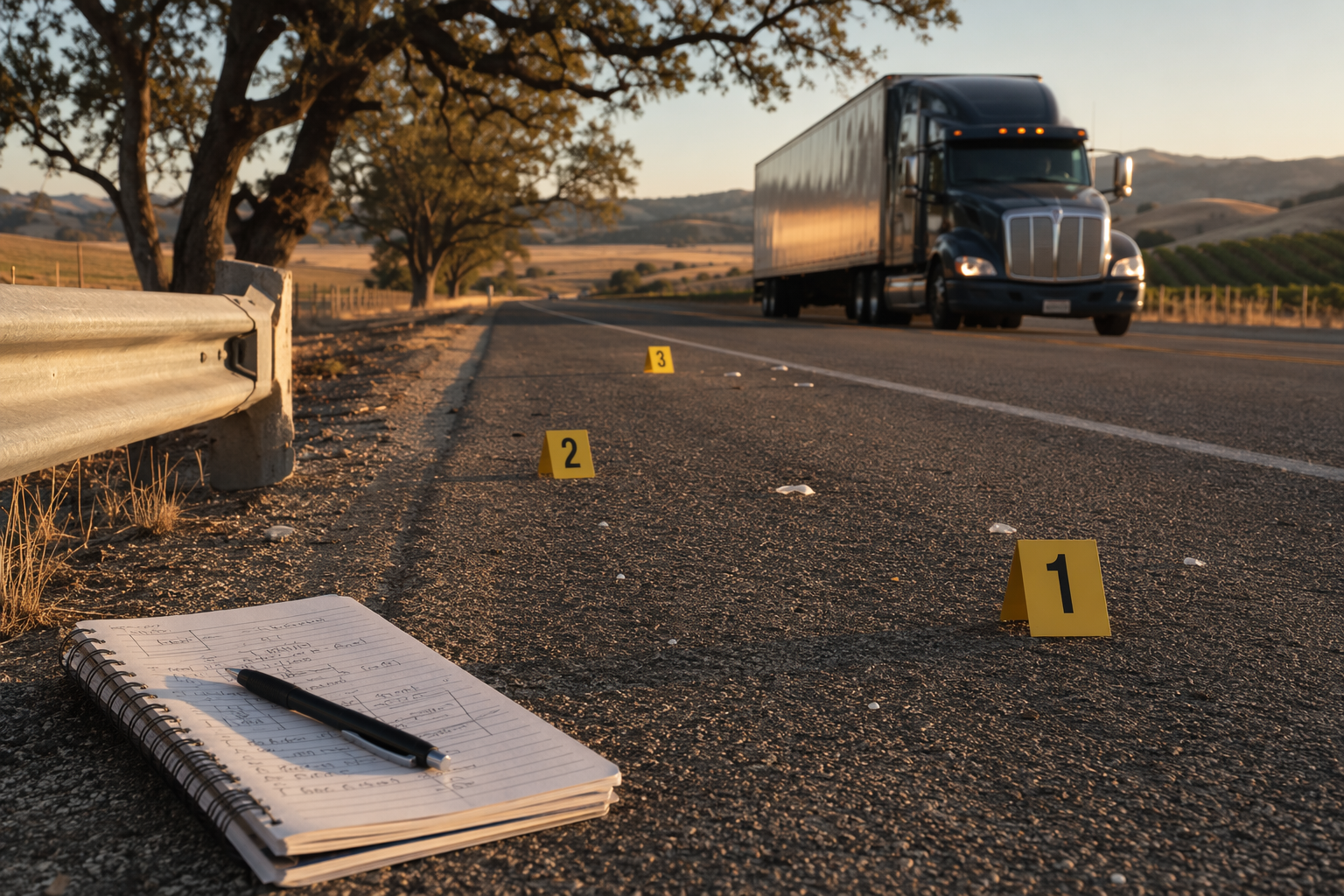
A Study Guide to Truck Accident Lawyers in Chico
This study guide explains the key evidence, legal timelines, and local accident patterns that Chico residents need to understand before hiring a truck accident lawyer. It combines national crash causation data with Chico-specific risk factors to help you make an informed decision.
Updated:
A useful study of truck accident lawyers in Chico starts with a clock, not a sales pitch. After a collision with a semi-truck, delivery truck, dump truck, agricultural hauler, or other commercial vehicle, the question is not only whether a lawyer might help. It is whether the facts needed to answer that question are still available.
Some of the most important records in a truck crash are temporary by design. Electronic logging device data may be overwritten in a short window, electronic control module data can be lost if the truck is repaired or returned to service, and nearby video may disappear on a routine retention cycle. A person recovering from injuries, arranging transportation, replacing a phone, or helping a family member through the first week after a crash is also being asked to preserve technical evidence they may not know exists.
The national data gives the first study frame. The Federal Motor Carrier Safety Administration’s Large Truck Crash Causation Study analyzed 963 crashes and used them to estimate about 141,000 large-truck crashes nationally. In that study, 87% of the critical reasons assigned to large trucks were driver-related, while specific associated factors included fatigue, brake problems, cargo shift, and inadequate surveillance.[1] The study is old: its crash data came from 2001 through 2003. That matters. Truck technology, phone use, logistics software, and roadway design have changed. Still, it remains the most comprehensive federal causation study of its kind, so it is useful if it is treated as a study lens rather than a shortcut to blame.
The Six Evidence Categories to Learn First
The first job after a Chico truck crash is to identify which records could explain what happened before they are overwritten, repaired away, discarded, or simply forgotten. The categories below are not a claim that every crash involves wrongdoing. They are a way to keep the investigation from depending only on memory and the police report.
| Evidence category | Why it matters | Time pressure |
|---|---|---|
| Electronic data | ELD logs can show hours of service, rest breaks, and possible fatigue patterns; ECM or black-box data can show speed, braking, throttle, and other vehicle events. | ELD data may be overwritten in 7-14 days; ECM data should be preserved immediately through a written preservation request.[2] |
| Driver qualification files | These files can show licensing, training, prior safety issues, medical qualification, and whether the driver should have been assigned that route or load. | Not usually as fragile as video, but they should be requested early before the dispute narrows around only the crash scene. |
| Maintenance and repair records | Inspection reports, brake service, tire work, and repair history can connect a mechanical condition to the collision. | Urgent if the truck is repaired, inspected by only one side, or returned to service. |
| Cargo and billing documents | Bills of lading, weight records, loading instructions, and delivery schedules can matter when cargo shift, overload, or time pressure is part of the question. | Important early because loading participants may include companies beyond the driver and carrier. |
| Scene evidence | Photos, skid marks, debris fields, vehicle resting positions, lane markings, sight lines, and weather conditions can help reconstruct the crash. | Fastest-changing category; road cleanup, traffic, weather, and repairs can alter the scene quickly. |
| Medical records | Emergency care, follow-up visits, imaging, work restrictions, and symptom progression connect the crash to actual injuries and losses. | The issue is less disappearance than continuity; gaps in treatment can make later reconstruction harder. |
A lawyer’s value can be studied in concrete terms here. Ask whether the lawyer knows how to send preservation letters quickly, who should receive them, which electronic systems the carrier uses, and whether a truck inspection or accident reconstruction expert may be needed. The point is not to make the injured person into an investigator. It is to know enough to recognize whether the investigation is being handled with the right urgency.
How National Crash Causes Turn Into Local Evidence
The FMCSA study does not tell you what happened at East Avenue, Highway 99, or a Chico arterial road on a particular afternoon. It does tell you which questions deserve disciplined follow-up. If fatigue had a relative risk of 8.0 in the LTCCS, the evidence question is not “Was the driver tired?” It is: what do the ELD logs, dispatch records, fuel receipts, delivery schedule, phone records if obtainable, and witness observations show about the driver’s prior hours and rest? If brake problems appeared in 29% of the crashes studied, with a relative risk of 2.7, the evidence question becomes: who inspected the brakes, when, what defects were documented, and what happened to the truck after the collision?[1]
Cargo shift is a good example of why a small number can still matter. In the LTCCS, cargo shift had the highest relative risk listed in the study brief, 56.3, but that does not mean cargo shift caused most truck crashes.[1] Relative risk is about how strongly a factor is associated with crash involvement when present, not how frequently it appears in every crash. That distinction changes the investigation. If there is evidence of a sudden lane departure, rollover, spilled load, or unusual trailer movement, cargo documents and loading practices deserve attention. If there is no hint of cargo involvement, forcing the theory may waste time.
Inadequate surveillance is another study term that becomes practical quickly. The LTCCS associated inadequate surveillance with 14% of crashes and reported a relative risk of 9.3.[1] In plain terms, the question is whether the truck driver failed to see something that should have been seen. At an intersection, that can lead to camera footage, sight-line photos, signal timing records if relevant, witness statements, dashcam video, lane positioning, and the location of pedestrians, cyclists, students, or turning vehicles. It is not a conclusion by itself. It is a checklist for what to preserve.
Why ELD and ECM Data Get Special Attention
Electronic logging device data and electronic control module data answer different questions. ELD information is usually about the driver’s work time, driving time, rest periods, and compliance with hours-of-service rules. ECM data is closer to the truck itself: speed, braking, engine activity, and other event information depending on the vehicle and system. Together, they can connect schedule pressure to what the truck physically did in the seconds or minutes around the crash.
This is where delay causes real damage. A trucking evidence guide identifies ELD data as vulnerable to overwriting in a short period and emphasizes immediate preservation of electronic and vehicle data after a crash.[2] If a truck is moved, repaired, downloaded by only one party, or put back into service, later arguments may be left with fragments. A preservation letter does not prove liability. It tells the carrier, insurer, and related companies not to destroy or alter evidence that may become relevant.
The Evidence That Is Not Inside the Truck
A truck crash investigation can fail by looking only at the truck. In Chico, useful evidence may sit with a business near an intersection, a transit camera, a private dashcam, a university-area storefront, a road crew, a loading facility, or the injured person’s own phone. Surveillance footage is especially easy to overestimate after the fact. People assume video exists because cameras are everywhere, but many systems record over old footage on a short cycle, and the person at the counter may not know how long the system retains it.
Scene photos also age badly. Skid marks fade. Debris is swept. Construction barrels move. Vegetation is trimmed. A temporary sign disappears. A phone photo taken from the passenger seat may be imperfect, but it can still preserve lane positions, traffic signal visibility, vehicle damage, weather, lighting, and road surface conditions. If the injured person cannot safely gather this material, a family member, investigator, or lawyer may need to do it.
Chico’s Risk Map Is Practical, Not Theatrical
Chico does not need to be described as uniquely dangerous for local knowledge to matter. The more useful point is narrower: certain road patterns make certain evidence more important. The City of Chico’s Local Road Safety Plan reported that broadside and rear-end crashes accounted for about 64% of all collisions in the city.[3] Those crash types raise immediate questions about intersection timing, following distance, speed, lane changes, sight lines, stopping distance, and whether a truck driver saw the traffic developing ahead.
A Chico-focused list of high-crash intersections identifies Esplanade and East Avenue, Mangrove Avenue and East Avenue, Notre Dame Boulevard and East 20th Street, Cohasset Road and East Avenue, and Park Avenue near Highway 99 as notable local danger points.[4] That kind of list should not be stretched into a claim that any crash at those places is automatically a trucking case or that one driver is automatically at fault. Its value is more modest and more useful: it tells a reader where a lawyer’s familiarity with signal patterns, commercial routes, congestion, and nearby camera sources may shorten the investigation.
Highway 99 adds another layer because it carries freight movement through and around Chico. Agricultural shipments, regional deliveries, student traffic, commuters, visitors, bicycles, and pedestrians do not move with the same rhythm. A semi-truck approaching an arterial intersection has different stopping distance, blind spots, acceleration, and turning limits than the smaller vehicles around it. A driver in a sedan may experience the crash as a sudden impact. The records may show a longer chain: route assignment, load timing, speed choice, lookout, brake condition, and the geometry of the road.
Chico State traffic deserves careful treatment for the same reason. Student travel can mean concentrated pedestrian, bicycle, rideshare, and late-day congestion patterns near campus and commercial areas. That does not make students the cause of truck crashes, and it does not make commercial drivers automatically negligent. It means the investigator should pay attention to the mix of road users and the evidence that captures it: camera angles, crosswalk placement, turn lanes, delivery timing, lighting, and witness locations.
California Rules That Change the Decision
The legal rules matter most when they change what someone must do next. California Vehicle Code section 22406 sets a 55 mph maximum speed for certain vehicles, including trucks or truck tractors with three or more axles and vehicles towing another vehicle.[5] In a truck crash, that rule can make speed evidence important even where a passenger-car case might focus more generally on whether traffic was moving too fast for conditions. Speed from ECM data, witness statements, dashcam footage, skid analysis, and road geometry can all become part of the same question.
Insurance is another reason truck cases do not feel like ordinary car accident claims. Federal rules set a $750,000 minimum financial responsibility requirement for many interstate motor carriers, far above ordinary passenger-vehicle minimums.[6] That does not mean every case is worth that amount, and it does not guarantee easy recovery. It does mean the claim may involve a carrier, broker, shipper, maintenance contractor, cargo loader, or multiple insurers, rather than only two drivers and one adjuster.
California’s pure comparative negligence rule also affects how a case is evaluated. An injured person may still recover damages even if they are assigned some share of fault, with recovery reduced by that percentage.[6] For a Chico reader, the practical lesson is not to decide alone that a case is hopeless because the police report contains an unfavorable detail, or because the injured driver may have been speeding, turning, distracted, or entering a lane. Those facts matter. They do not end the study.
Deadlines are less forgiving. California generally has a two-year statute of limitations for personal injury claims, while claims involving a government entity can require action within six months.[6] The government-claim issue can arise if the theory involves road design, signal maintenance, signage, public vehicle involvement, or another public-entity role. These deadlines do not wait for pain to stabilize, insurance negotiations to finish, or a family to feel ready to organize paperwork.
What to Ask a Chico Truck Accident Lawyer
The first consultation should not be a performance of confidence. It should give you a clearer evidence plan than you had before the call. If the lawyer talks only about settlement value before asking about the truck, carrier, location, video, medical care, and timing, the conversation may be moving too fast.
- Which preservation letters would you send, and to whom?
- How quickly can ELD, ECM, dashcam, maintenance, and driver qualification records be requested?
- Would you inspect the truck or hire an expert before repairs or return to service?
- What local camera sources, business locations, traffic patterns, or intersection features would you check?
- Does the crash location suggest a possible public-entity issue, and if so, how would the six-month claim deadline be handled?
- How would comparative negligence be evaluated if the injured person may have made a mistake too?
The answers do not need to sound dramatic. In fact, practical answers are better. A good evidence plan names records, custodians, deadlines, and next steps. It also admits what is not known yet. Truck cases often begin with uncertainty: the driver may not know the carrier’s full legal name, the police report may not be ready, the truck may be owned by one company and operated by another, and the injured person may remember only fragments. That uncertainty is the reason for preservation, not a reason to wait.
A Short Study Checklist for the First Days
If you are using this article the way you might use a class packet, start with the evidence that expires fastest. For a more general method of turning scattered material into a usable packet, the same habit applies as in a syllabus-based study guide: collect the source material, group it by deadline and topic, then turn each group into questions you can actually answer.
- Write down the crash date, time, location, weather, direction of travel, and the truck’s company name or identifying numbers if known.
- Save photos, videos, dashcam files, medical discharge papers, tow records, insurance messages, and names of witnesses in more than one place.
- Identify nearby businesses, homes, buses, campus buildings, traffic cameras, or vehicles that may have recorded the crash.
- Ask any lawyer you contact how ELD, ECM, maintenance, cargo, and driver files will be preserved before they disappear or change.
- Track medical symptoms and appointments from the beginning, even if the full injury picture is not clear yet.
- Flag any possible public-road, signal, signage, or government-vehicle issue because a six-month government-claim deadline may apply.[6]
Key Terms Worth Knowing Before the Call
| Term | Working meaning |
|---|---|
| ELD | Electronic logging device; usually used to record a commercial driver’s hours of service and driving status. |
| ECM or black box | Electronic control module; vehicle data that may show speed, braking, throttle, and related truck activity depending on the system. |
| Spoliation letter | A written notice telling a person or company to preserve evidence because litigation may be reasonably anticipated. |
| Driver qualification file | Carrier-maintained records concerning licensing, qualifications, training, medical certification, and related driver information. |
| Hours of service | Rules limiting commercial driving and work time; relevant when fatigue or scheduling pressure may be involved. |
| Comparative negligence | A rule that allows fault to be divided by percentage; in California, partial fault does not automatically bar recovery.[6] |
| Negligence per se | A doctrine that can treat violation of a safety statute as evidence of negligence when the rule was meant to prevent the type of harm that occurred. |
Self-Assessment Questions
Before choosing a lawyer, it helps to know which parts of the case are still blank. These questions are not a substitute for legal advice. They are a way to make the first conversation more specific.
- Do I know the truck carrier’s name, USDOT number, license plate, or trailer markings?
- Was the crash at or near an intersection where signal timing, sight lines, or turning movement matters?
- Could fatigue, braking, cargo movement, maintenance, or inadequate surveillance plausibly be part of the fact pattern?
- What evidence might disappear in the next week, and who is responsible for preserving it?
- Is there any reason a government entity could be involved, such as road design, a signal problem, signage, or a public vehicle?
- What medical records already exist, and what symptoms have changed since the crash?
National data explains why fatigue, braking, cargo, surveillance, and driver decisions deserve attention. Chico data explains why intersections, Highway 99 freight movement, and mixed local traffic deserve a closer look. But the first practical task is narrower than both: preserve the records while they still exist, so the decision about hiring a lawyer is made from facts rather than guesses.
References
- Large Truck Crash Causation Study Analysis Brief, Federal Motor Carrier Safety Administration.
- Guide to a Truck Crash Lawsuit, Trucking Watchdog.
- City of Chico Local Road Safety Plan 2021, Butte County Association of Governments.
- Top 5 Dangerous Intersections in Chico CA, Rooney Law Firm.
- California Vehicle Code §22406, California Legislative Information.
- Truck Accident Lawsuit Guide 2026, TorHoerman Law.
Comments
Join the discussion with an anonymous comment.