
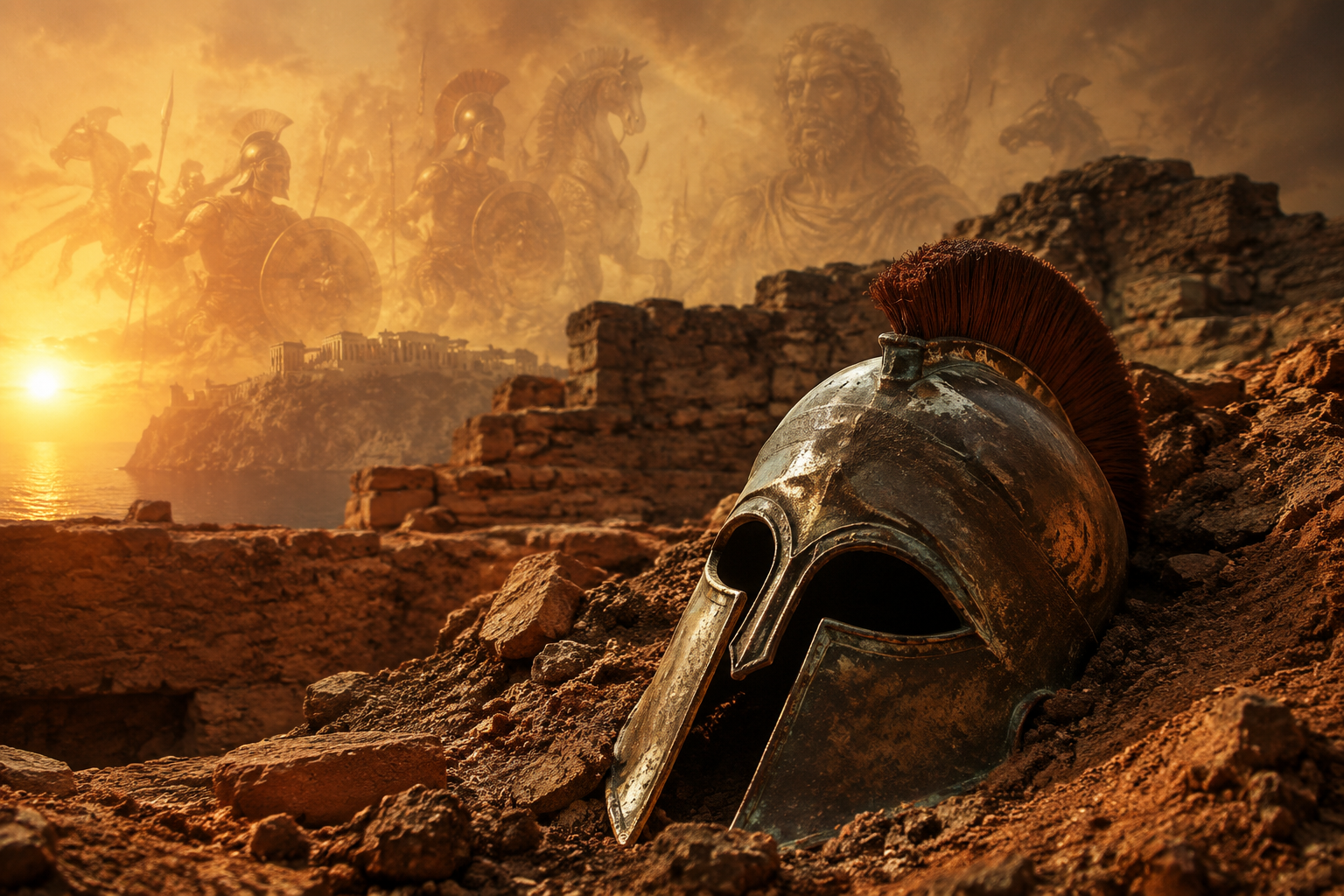
The Complete Trojan War History Study Guide
This complete Trojan War study guide covers the full narrative from the Judgment of Paris to the fall of Troy, including key characters, a detailed timeline, and historical context — all organized for exam preparation.
Updated:
The first exam mistake to avoid is simple: the Trojan War is not one ancient book. The story students usually call “the Trojan War” is stitched together from Homer’s Iliad and Odyssey, the fragmentary Epic Cycle, Greek tragedy, later Roman poetry, and archaeological interpretation. Homer’s poems are usually placed in the eighth century BC, while the war they imagine is traditionally set centuries earlier; Eratosthenes dated it to 1194–1184 BC.[1]
That gap matters. If an exam question asks about Achilles’ anger in the Iliad, do not answer with the Trojan Horse. If an exam question asks whether the Trojan War “really happened,” do not retell the Judgment of Paris as though it were a historical cause. A strong Trojan War history study guide has to keep four layers visible at once: mythic narrative, literary source, archaeological evidence, and uncertainty.
If you are building this into a broader course packet, it helps to pair the story with your syllabus dates, assigned translations, and lecture terms; a general method for that is outlined in How to Create a Study Guide from Your Syllabus in 5 Steps. For the Trojan War itself, start with the sequence.
The Trojan War in One Orientation Table
| Question | Exam-safe answer |
|---|---|
| Is the Trojan War one story from Homer? | No. Homer’s Iliad covers only a short crisis late in the war, and the larger story comes from multiple later and fragmentary sources. |
| Does the Iliad include the Trojan Horse? | No. The horse is mentioned in the Odyssey, but the fullest surviving ancient account is in Virgil’s Aeneid, much later than Homer. |
| Was there a real Troy? | Yes, the site is usually identified with Hisarlık in modern Turkey, but that does not prove the epic story literally happened. |
| Was there a real war? | Possibly. Archaeology and Hittite texts suggest conflict around Troy/Wilusa in the Late Bronze Age, but the received legend is a poetic fusion, not a clean military report. |
| What should an essay distinguish? | Mythic cause, literary source, archaeological evidence, and historical inference. |
The Story Before the War: Gods, Paris, and Helen
The mythic chain begins not with armies but with a divine slight. At the wedding of Peleus and Thetis, Eris, goddess of discord, throws a golden apple marked for “the fairest.” Hera, Athena, and Aphrodite each claim it. Zeus refuses to judge and sends the dispute to Paris, a Trojan prince also known as Alexander.[2]
Each goddess offers Paris a reward. Hera offers power, Athena offers victory or wisdom in war, and Aphrodite offers the most beautiful woman in the world. Paris chooses Aphrodite. That choice matters less as a “real cause” than as a mythic explanation for why divine rivalry follows the human war so closely. In many versions, Hera and Athena become hostile to Troy, while Aphrodite protects Paris and the Trojans.
The woman promised to Paris is Helen, wife of Menelaus, king of Sparta. Ancient accounts vary in tone: some emphasize abduction, some seduction, some divine compulsion. For exam writing, the careful wording is that Paris takes Helen to Troy, and the Greek expedition forms to recover her and punish Troy. That keeps the story clear without pretending all ancient authors agreed about Helen’s agency.
Menelaus turns to his brother Agamemnon, king of Mycenae and commander of the Greek coalition. A famous tradition says Helen’s former suitors had sworn to defend the marriage, which helps explain why so many Greek leaders gather for a war that begins as a Spartan royal crisis.[2]
The Greek Mustering and the Cost of Getting to Troy
The Greek side is not a modern nation-state army. It is a coalition of rulers and heroes: Agamemnon from Mycenae, Menelaus from Sparta, Odysseus from Ithaca, Achilles and the Myrmidons from Phthia, Ajax from Salamis, Diomedes from Argos, Nestor from Pylos, and others. The Iliad famously includes a Catalogue of Ships giving 1,186 vessels, a number already treated cautiously in antiquity because of the logistical strain such a force would imply.[1]
Before the fleet can sail, the Greeks gather at Aulis and become trapped by unfavorable winds. Here the story of Iphigenia enters. In one major version, Agamemnon must sacrifice his daughter Iphigenia to appease Artemis. In another, Iphigenia is rescued or substituted at the last moment. Greek tragedy makes this episode emotionally central, but the variant endings are a useful reminder that “the Trojan War story” is not a single fixed script.[2]
The sacrifice also gives the war a domestic wound before the fighting properly begins. It helps explain later hatred inside Agamemnon’s household, especially in stories of his return from Troy. That is why Iphigenia belongs in a study guide even when an assigned text only touches the battlefield.
The Long Siege Before the Iliad
The traditional war lasts ten years. Most of that time is not narrated in the Iliad. The Greeks raid nearby communities, struggle to maintain the expedition, and fail to take Troy by direct assault. The Trojans remain behind strong walls under King Priam, with Hector as their main defender and Paris as the prince whose action helped bring the war home.[3]
Several pre-Iliad episodes often appear in summaries. Achilles kills Troilus in some traditions. Philoctetes, owner of Heracles’ bow, is abandoned because of a foul wound, though accounts differ on the circumstances. The Greeks capture women from surrounding areas, including Chryseis and Briseis. These prizes become the immediate trigger for Homer’s poem.
This is the point where many students accidentally begin treating background myth as if it were Homer’s plot. It is better to say: by the time the Iliad opens, the war has already been going on for years, the Greek coalition is strained, and Achilles’ honor is about to collide with Agamemnon’s authority.
What the Iliad Actually Covers
The Iliad is not a beginning-to-end war chronicle. It covers a narrow period late in the war and centers on Achilles’ rage. The immediate conflict begins when Apollo sends a plague against the Greeks after Agamemnon dishonors Chryses, a priest of Apollo. Agamemnon returns Chryseis but seizes Briseis from Achilles as compensation. Achilles withdraws from battle, and the Greek army suffers.[1]
That quarrel is not a side plot. It is the engine of the poem. Achilles’ absence changes the battlefield, exposes Agamemnon’s weakness as commander, and gives Hector room to press the Trojans toward the Greek ships. The poem’s question is not simply “Who wins the war?” but what happens when heroic honor, public responsibility, grief, and mortality pull against one another.
Several major battlefield moments belong here: Paris and Menelaus duel over Helen; Diomedes has a spectacular aristeia, or heroic killing spree; Hector returns to Troy and speaks with Andromache and their child; Ajax stands out as a crucial Greek defender; and Patroclus, Achilles’ closest companion, eventually enters battle wearing Achilles’ armor.[3][4]
Patroclus drives the Trojans back but is killed by Hector. That death brings Achilles back into the war. He receives new armor made by Hephaestus, kills Hector, and abuses the corpse in grief and fury. The Iliad ends not with Troy’s fall but with Priam entering Achilles’ camp to ransom Hector’s body. Achilles and Priam briefly recognize each other’s suffering, and Hector is buried.[1]
For exams, that ending is worth memorizing because it prevents a common false claim: Homer’s Iliad does not narrate Achilles’ death, the Trojan Horse, or the fall of Troy.
After the Iliad: Achilles, Ajax, Paris, and the Horse
The rest of the war comes from later summaries, fragments, and retellings. After Hector’s death, Troy still does not fall immediately. The Amazons arrive in some accounts, led by Penthesilea. Memnon, an Ethiopian ally of Troy, also fights. Achilles kills both, but his own death follows. The usual version has Paris shoot him with an arrow, often guided by Apollo, striking the vulnerable heel that later tradition made famous.[2]
After Achilles dies, the Greeks quarrel over his armor. Odysseus receives it, and Ajax, humiliated, kills himself. The episode matters because Ajax is not a minor soldier in Homer; he is one of the Greeks’ strongest defenders. His death marks another fracture in the Greek camp after the loss of Achilles.[4]
The Greeks eventually learn that Troy cannot be taken without certain conditions being met. Neoptolemus, Achilles’ son, is brought to Troy. Philoctetes returns with the bow of Heracles and kills Paris in many versions. Helen remains in Troy, now linked in some accounts to Paris’s brother Deiphobus. Again, the details shift by source, but the broad movement is stable: Troy loses its greatest defenders, and the Greeks turn from open assault to deception.[2]

The wooden horse enters here, but not from the Iliad. The horse is mentioned in the Odyssey, appears in early art such as the Mykonos vase from around 670 BC, and receives its most famous surviving narrative treatment in Book 2 of Virgil’s Aeneid, a Roman poem composed long after the supposed Bronze Age war.[2]
In the familiar version, Odysseus devises the plan. The Greeks build a huge wooden horse, hide warriors inside it, and pretend to sail away. The Trojans debate what to do. Laocoön warns against trusting the gift, but divine signs are interpreted against him. The Trojans bring the horse into the city. At night the hidden Greeks emerge, open the gates, and the returning army sacks Troy.
The Fall of Troy and the Greek Returns
The fall of Troy is brutal in the tradition. Priam is killed. Astyanax, Hector’s young son, is killed in many accounts to prevent a future revenge. Trojan women are enslaved and distributed among the victors. Cassandra, Priam’s daughter and a prophetess cursed not to be believed, is taken by Agamemnon. Andromache, Hector’s widow, becomes the captive of Neoptolemus. These scenes are especially important in Greek tragedy, where the cost of victory often receives more attention than the glory of conquest.[2]
Aeneas escapes from Troy in the Roman tradition, carrying his father Anchises and leading survivors away from the ruined city. That story becomes central to Virgil’s Aeneid, where Trojan defeat is folded into a Roman origin story. This is another source-labeling moment: Aeneas matters in Greek myth too, but his later destiny as ancestor of Rome belongs especially to Roman literary tradition.
The Greek victors do not simply sail home into happiness. The “Returns,” or Nostoi, tell of delayed, cursed, or disastrous homecomings. Agamemnon returns to Mycenae and is murdered by Clytemnestra and Aegisthus. Menelaus eventually returns with Helen after wandering. Odysseus spends years trying to reach Ithaca, the subject of the Odyssey.[1][2]
So the complete mythic arc does not end at the burning city. It ends with scattered consequences: dead heroes, enslaved survivors, broken households, and stories that branch into Greek tragedy and Roman national epic.
Characters Students Actually Need to Sort
Character memorization is useful only if it keeps relationships straight. A name list without loyalties is where mistakes start.
| Figure | Side | What to remember |
|---|---|---|
| Achilles | Greek | Greatest Greek warrior; withdraws after Agamemnon takes Briseis; returns after Patroclus dies; kills Hector. |
| Agamemnon | Greek | Commander of the expedition; brother of Menelaus; his conflict with Achilles drives the Iliad. |
| Menelaus | Greek | King of Sparta and Helen’s husband; his grievance helps launch the expedition. |
| Odysseus | Greek | Strategist associated with persuasion, disguise, and the wooden horse; later hero of the Odyssey. |
| Ajax | Greek | Powerful defender of the Greek ships; later dies by suicide after losing Achilles’ armor to Odysseus. |
| Diomedes | Greek | Major battlefield hero in the Iliad, especially during his aristeia. |
| Hector | Trojan | Troy’s chief defender; son of Priam; husband of Andromache; killed by Achilles. |
| Priam | Trojan | King of Troy; ransoms Hector’s body from Achilles; dies during the sack in later tradition. |
| Paris/Alexander | Trojan | Chooses Aphrodite in the Judgment of Paris; takes Helen to Troy; kills Achilles in many accounts. |
| Helen | Greek/Trojan household | Wife of Menelaus and central figure in the war’s mythic cause; ancient accounts differ in how they judge her. |
| Aeneas | Trojan | Trojan survivor; especially important in Roman tradition as the ancestor figure of Rome. |
The divine alignments are not perfectly mechanical, but the usual pattern is clear enough for study purposes: Hera, Athena, and Poseidon favor the Greeks, while Aphrodite, Ares, and Apollo often support Troy.[4]
A Source Map for the Complete Story
When an instructor asks “Where does that episode come from?” they are usually checking whether you know the difference between Homer and the later tradition. The simplest map looks like this:
| Part of the story | Main ancient source tradition |
|---|---|
| Achilles’ quarrel with Agamemnon, Patroclus’ death, Hector’s death, Priam’s ransom | Homer’s Iliad |
| Odysseus’ return home, memories of the horse, Menelaus’ return | Homer’s Odyssey |
| Judgment of Paris, Iphigenia, Achilles’ death, Ajax’s suicide, detailed fall traditions | Epic Cycle fragments and later summaries |
| Agamemnon’s murder, Trojan captives, Iphigenia variants | Greek tragedy |
| Full famous account of the wooden horse and Aeneas’ escape | Virgil’s Aeneid |
| Historical Troy, destruction layers, Hittite connections | Archaeology and Near Eastern diplomatic texts |
The Epic Cycle is especially easy to overstate. It once covered much of the larger Trojan War story, but it survives only in fragments and summaries. That means modern readers often know the “complete” war through later retellings of earlier lost material rather than through complete archaic poems.[2]
What Archaeology Can and Cannot Prove
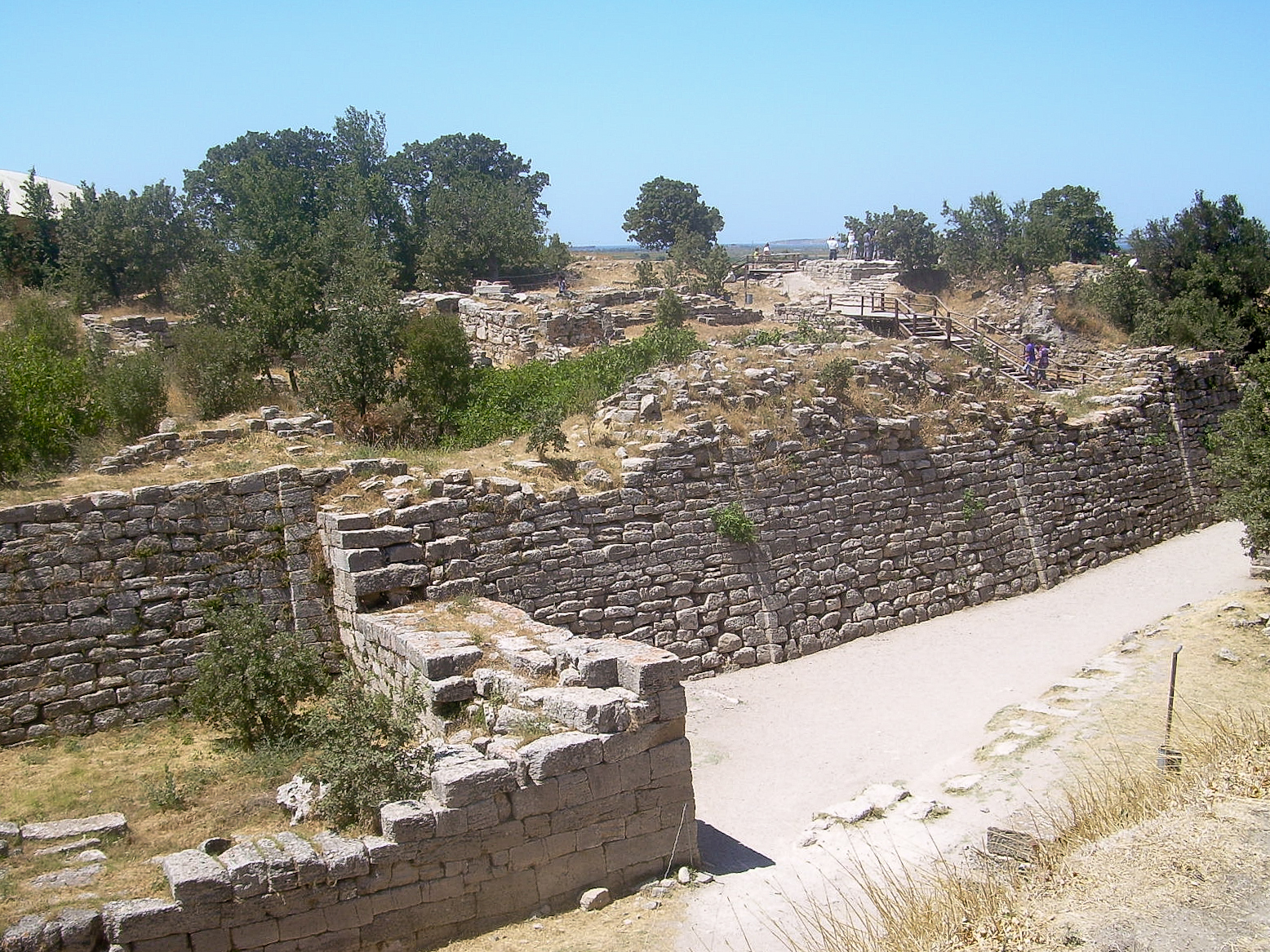
The real site usually identified as Troy is Hisarlık, in modern Turkey. Heinrich Schliemann’s excavations there, beginning in the nineteenth century, helped demonstrate that the mound contained layered remains of ancient cities, not merely a literary fantasy.[5]
The complication is that Hisarlık was occupied and destroyed more than once. Troy VI, a strong Late Bronze Age city, appears to have been destroyed around 1275 BC, commonly linked to earthquake damage. Troy VIIa, a later level, was destroyed by fire around 1180 BC and has evidence such as charred debris, arrowheads, and unburied skeletons.[6][5]
That Troy VIIa date is close enough to Eratosthenes’ traditional 1194–1184 BC range to interest historians, but “close” is not the same as “proved Homer right.” Archaeology can show that a fortified city existed, that it suffered destruction, and that the region belonged to the world of Late Bronze Age conflict. It cannot show that Achilles killed Hector, that Athena intervened, or that a wooden horse entered the gate.
Hittite texts add another layer. Diplomatic material refers to Wilusa, widely but not universally identified with Troy, and to Ahhiyawa, often connected with Achaean Greeks. The Tawagalawa letter, dated around 1250 BC, mentions conflict over Wilusa, and the Alaksandu treaty, dated around 1280 BC, names a ruler whose name resembles Alexander, another name for Paris.[5]
This is suggestive evidence for a historical core: western Anatolia, Mycenaean Greeks, diplomatic tension, and conflict around a city that may be Troy. It is not evidence for the whole epic plot. The safer conclusion is that the Trojan War legend likely preserves memories of Late Bronze Age struggles around Troy, later reshaped by oral poetry and written literature.
Why the Epic War Is Hard to Treat as Literal History
Several details in the tradition strain historical reconstruction. The ten-year siege is difficult to treat as a straightforward military report, especially when compared with the size of the citadel. Modern discussions often note that the citadel itself was only about 200 meters across, making the logistics of an enormous decade-long siege hard to accept literally.[6]
The ship count raises the same problem. The Catalogue of Ships gives 1,186 vessels, but even ancient critics such as Thucydides doubted the scale and emphasized the financial and logistical limits of early Greek expeditionary warfare.[1]
The gods create a different kind of problem. They are not decorative in Homer; Apollo sends plague, Athena restrains Achilles, Aphrodite rescues Paris, and Zeus weighs destinies. A literary reading must take divine action seriously inside the poem. A historical reading cannot convert those scenes into direct evidence for Bronze Age events.
The best exam answer usually avoids both extremes. It does not say “the Trojan War is fake” as though Hisarlık, Troy VIIa, and Hittite texts do not exist. It also does not say “the Iliad is history” as though oral poetry, divine machinery, later Roman sources, and centuries of retelling create no problems.
How to Use This in an Exam Answer
A good Trojan War paragraph usually names the layer it is using. If you are writing about Achilles’ rage, stay close to the Iliad. If you are writing about the horse, label it as later tradition, with the Aeneid as the fullest surviving account. If you are writing about historicity, move to Hisarlık, Troy VI, Troy VIIa, and Hittite Wilusa evidence.
- For a literature question: focus on honor, rage, mortality, supplication, divine action, and heroic identity.
- For a mythology question: know the full sequence from the Judgment of Paris to the Returns.
- For a history question: distinguish archaeological Troy from Homer’s poetic Troy.
- For a source question: remember that the Iliad does not narrate the beginning or end of the war.
- For an argument question: use cautious verbs such as “suggests,” “preserves,” “reflects,” and “cannot prove.”
A concise thesis might say: “The Trojan War tradition combines mythic storytelling with memories of Late Bronze Age conflict around Troy; Homer’s Iliad preserves one powerful poetic episode within that tradition, while archaeology at Hisarlık supports a historical setting but not the literal events of the epic.”
That answer leaves room for the story’s force without confusing categories. Achilles can still rage, Hector can still die, Priam can still kneel, and Troy can still burn. The student just has to know which Troy is being discussed: the city in the ground, the city in Homer, or the city rebuilt by centuries of later imagination.
References
- Trojan War. Encyclopaedia Britannica.
- Trojan War. Wikipedia.
- Major Events in the Trojan War. ThoughtCo.
- 15 Heroes of the Trojan War. History Hit.
- Trojan War. HISTORY.
- Did the Trojan War actually happen?. BBC Culture. November 22, 2019.
Comments
Join the discussion with an anonymous comment.