
Jackson Hinkle and MAGA Communism Explained for Political Studies
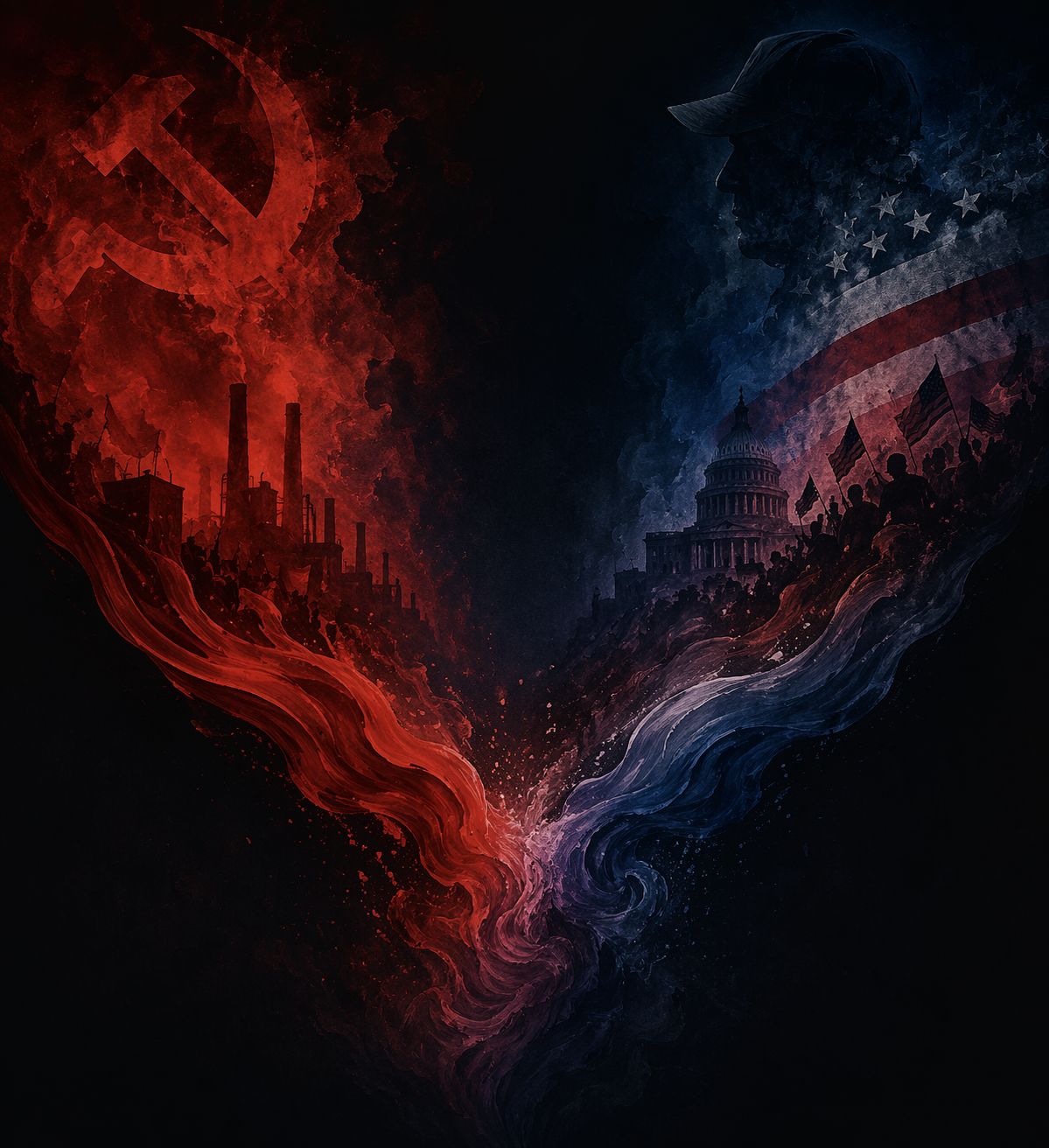
MAGA Communism blended anti-imperialism and social conservatism into a short-lived digital movement. This explainer covers its ideological components, key figures, institutional attempt, and 2026 decline for students analyzing far-left/far-right convergence.
Updated:
MAGA Communism was a short-lived digital-era political formation that tried to join communist vocabulary to MAGA-coded nationalism, anti-imperialist foreign-policy language, social conservatism, and conspiratorial media style. For political studies students, the useful question is not whether the name was internally consistent. It was not. The useful question is what the name allowed its promoters to do: borrow the moral vocabulary of anti-capitalism and anti-imperialism while moving audiences toward nationalist, authoritarian, and socially reactionary conclusions.
By Q3 2026, the movement is best treated as a completed case study rather than a rising tendency. Haz Al-Din, one of its principal theorists, was reported by Geese Magazine to have declared in March 2026 that “MAGA Communism is dead,” with the magazine’s July 2026 autopsy presenting the declaration as the endpoint of a fractured experiment rather than a temporary branding dispute.[1] That account is important, but it should be handled carefully: the demise is not yet a universally documented consensus across major outlets. It is still enough to let students analyze the movement as a trajectory: online fusion, rapid amplification, attempted party-building, and decline.
Why This Case Matters for Political Studies
MAGA Communism matters less as a mass movement than as an unusually visible example of anti-liberal convergence. It gathered people who rejected liberal institutions, mainstream media, U.S. foreign policy, progressive cultural politics, and conventional party alignments. Some of those positions have recognizable left-wing histories; others belong more comfortably to the far right. The movement’s distinctiveness came from packaging them together as a single posture.
That makes the case useful in coursework on ideology, populism, authoritarianism, propaganda, and political communication. It also makes it easy to misread. Treat it only as a joke, and the mechanism disappears. Treat it as a coherent doctrine, and the contradictions are flattened into theory. The better approach is to ask what was being fused, who benefited from the fusion, and why the same rhetoric could sound anti-capitalist, nationalist, conspiratorial, and socially conservative at once.
The Architects: Hinkle as Amplifier, Haz as Theorist
Jackson Hinkle is the figure many students encounter first when researching MAGA Communism. His public trajectory is also part of the phenomenon. Hinkle’s biography is often summarized as a shift from environmental and left-populist activism into a pro-Russia, pro-China, anti-U.S. influencer politics that increasingly overlapped with MAGA-coded audiences.[2][3] The biographical arc matters because it shows how a language of anti-establishment politics can travel across ideological spaces without remaining attached to its original commitments.
Hinkle’s role was not chiefly that of a systematic theorist. He functioned as an amplifier: a broadcaster, provocateur, and international-facing media personality who made the label legible beyond small online circles. After the October 7, 2023 Hamas attack and the subsequent war in Gaza, his following on X reportedly grew from about 500,000 to 2.6 million in roughly six months, a growth curve tied in reporting to his Gaza-related posting and broader anti-Israel, anti-U.S. messaging.[3][4] That number measures platform attention, not ideological conversion. Still, attention mattered because it gave the movement a scale that its organizations did not possess.
Haz Al-Din, associated with the Infrared media network, played a different role. He supplied the more explicit ideological architecture: the attempt to frame MAGA-style patriotism and communist rhetoric as compatible parts of a national-populist, anti-liberal politics.[2] If Hinkle helped distribute the brand, Haz helped rationalize it. That division should not be made too neat; digital movements rarely separate theory from performance cleanly. But it helps students avoid treating every viral personality as if they were doing the same kind of political work.
The movement also gained visibility through hostile attention and state-media ecosystems. Reporting has noted Hinkle’s bans from platforms including YouTube and Twitch, and his amplification by Russian and Iranian state-linked media.[2][3] The China Media Project has also examined the movement’s China-facing dimensions while warning that some specific claims about Chinese account management and invitation networks remain uncertain.[4] For analysis, the key point is not that foreign media created MAGA Communism. It is that international legitimation channels helped a marginal U.S. internet formation appear larger and more geopolitically consequential than its domestic organization could prove.
What the Ideological Blend Contained
The label “MAGA Communism” joined elements that usually sit in tension. Its promoters presented the fusion as a breakthrough beyond stale left-right politics. A more disciplined reading breaks the blend into components and asks what each component did inside the whole.
| Component | How it appeared in MAGA Communism | Analytical caution |
|---|---|---|
| Anti-imperialism | Opposition to U.S. power, NATO, and Western liberal foreign policy; sympathy toward or support for Russia, China, and Iran. | Anti-U.S. alignment is not the same thing as a consistent anti-imperialist theory. |
| Social conservatism | Anti-woke, anti-LGBTQ, anti-feminist, and traditionalist rhetoric presented as working-class or patriotic politics. | Borrowed economic-left language did not prevent socially reactionary conclusions. |
| Economic nationalism | Protectionist and producerist themes, hostility to global finance, and appeals to national industry. | National economic rhetoric can point toward redistribution, exclusion, or authoritarian state capitalism depending on its institutional form. |
| Conspiracy integration | Suspicion of mainstream media, liberal elites, intelligence agencies, globalist networks, and official accounts of geopolitical events. | Conspiratorial style can bind contradictory audiences without resolving their contradictions. |
Anti-Imperialism Without Universalism
The most recognizable left-coded element was anti-imperialism. MAGA Communist rhetoric attacked U.S. foreign policy, NATO, and Western interventionism, while often presenting Russia, China, and Iran as counterweights to U.S. empire.[2][4][5] That stance gave the movement access to an older left vocabulary: empire, sovereignty, multipolarity, sanctions, proxy war, and regime change.
The harder question is whether this was anti-imperialism as a general principle or anti-Americanism as geopolitical alignment. The sources support the narrower conclusion. The movement’s public rhetoric emphasized opposition to U.S. and Western power far more clearly than it articulated a universal standard against domination by any state. That distinction matters in political studies because “anti-imperialist” is not self-validating. It can describe a principled critique of empire, but it can also become a selective defense of rival authoritarian states.
Social Conservatism in Left Vocabulary
MAGA Communism also made social conservatism central rather than incidental. Reporting on the movement describes anti-woke, anti-LGBTQ, anti-feminist, and traditionalist messaging as part of its appeal.[2][5] These positions were often framed as defenses of the working class against liberal cultural elites. That framing is analytically important because it translated reactionary cultural politics into a language of class resentment.
Here the borrowed vocabulary did a great deal of work. Instead of saying that the movement was simply conservative on culture and left on economics, it is more precise to say that it used economic and anti-elite language to authorize conservative cultural conclusions. The object of attack was not only capitalism or imperial power, but liberal pluralism itself: feminism, LGBTQ rights, multiculturalism, and rights-based progressive politics became signs of elite decay rather than claims made by actual social groups.
Economic Nationalism and the Working-Class Claim
The “communist” part of MAGA Communism did not usually appear as a detailed program for worker control, democratic planning, or class organization. It appeared more often as a rhetoric of the productive nation against global finance, liberal elites, and imperial institutions. That is why economic nationalism is a better description of much of its public-facing language than orthodox Marxism.
This does not mean economics was irrelevant. It was central to the movement’s claim that MAGA constituencies and communist constituencies could be reconciled around a betrayed working class. But the reconciliation was achieved by redefining the working class through national and cultural belonging. Once that move is made, “worker” can become less a position in production than a moral identity opposed to cosmopolitan liberalism.
Conspiracy as Adhesive
Conspiracy thinking helped hold the fusion together. A movement combining Marxist-Leninist references, MAGA aesthetics, anti-Israel rhetoric, pro-Russia positioning, anti-woke grievance, and platform-native influencer culture needs a way to explain why ordinary ideological boundaries should be ignored. Conspiracy supplies that bridge. It tells audiences that the apparent contradictions are illusions produced by a hidden establishment.
This is where platform dynamics become part of ideology rather than mere distribution. Online conspiracy communities reward claims that reveal secret alignments, expose false oppositions, and reclassify enemies. MAGA Communism’s fusion was easier to accept in spaces where the central political habit was already distrust: of official expertise, mainstream journalism, liberal institutions, and conventional ideological categories.
Three Frameworks That Help Explain It
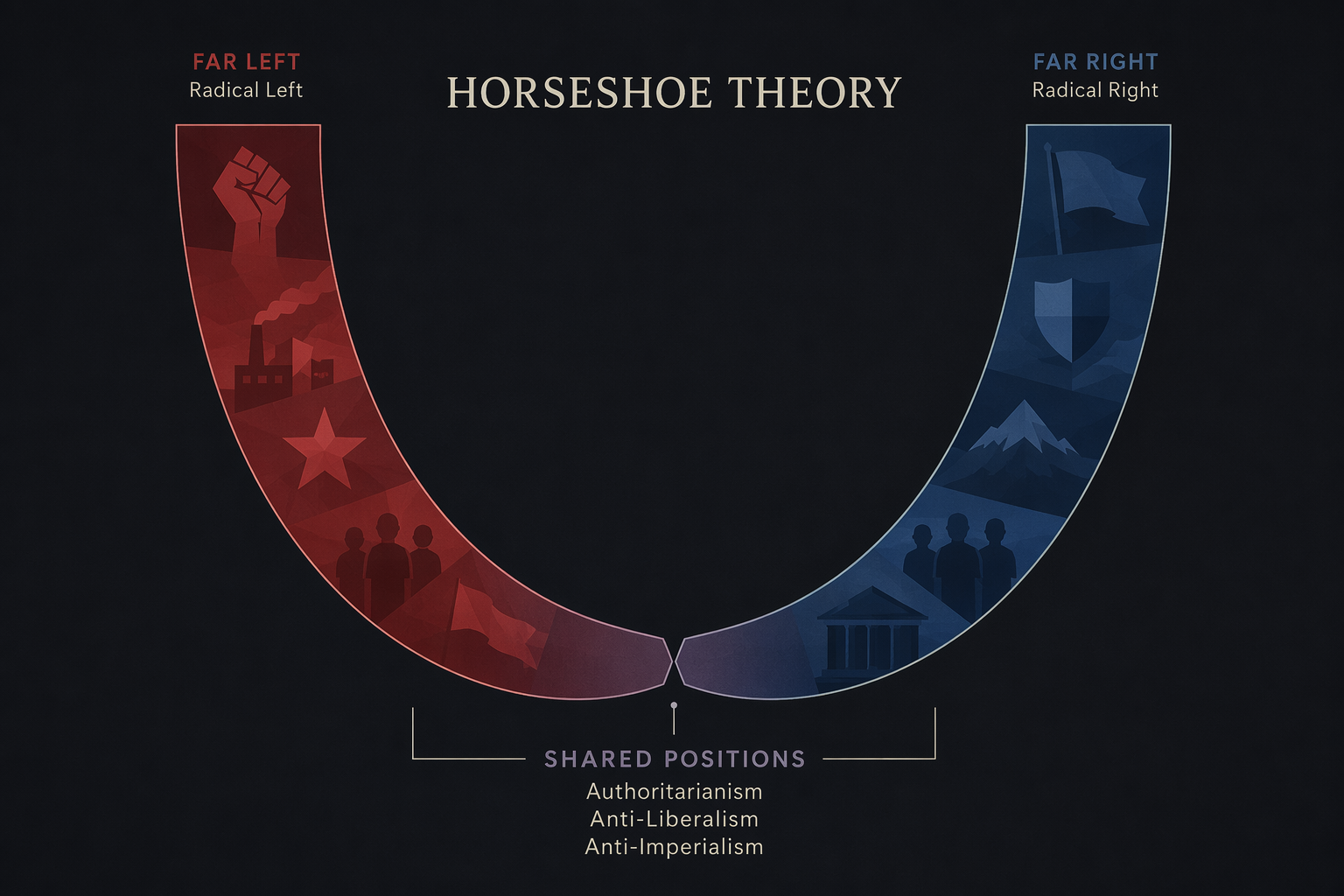
No single framework explains MAGA Communism completely. Three are especially useful for students: horseshoe theory, the red-brown alliance framework, and syncretic populism. Each clarifies something; each can also mislead if treated as a shortcut.
Horseshoe Theory: Useful, but Too Smooth
Horseshoe theory proposes that political extremes can resemble each other more than the linear left-right spectrum suggests. In academic and student-facing discussions, it is often used to analyze shared anti-liberal tendencies: hostility to pluralism, distrust of institutions, authoritarian temptation, and conspiratorial thinking among actors located at opposite ends of conventional politics.[6]
MAGA Communism seems almost designed to invite a horseshoe reading. It combined far-left signifiers with far-right cultural politics and anti-liberal authoritarian sympathies. The danger is that the metaphor can become too elegant. It may imply that the far left and far right naturally meet, when the actual case involved specific platforms, personalities, wars, state-media incentives, U.S. polarization, and a post-2016 populist vocabulary. Horseshoe theory names the convergence; it does not by itself explain the machinery.
Red-Brown Alliance: The Historical Warning
The red-brown framework is more historically specific. “Red” refers to communist or far-left traditions; “brown” refers to fascist or far-right traditions. The term is used to describe alliances or overlaps in which left-wing anti-capitalist language converges with nationalist, authoritarian, antisemitic, or reactionary politics. Scholarly work on MAGA Communism places the movement in this red-brown lineage, while also treating it as a contemporary internet formation rather than a simple replay of twentieth-century cases.[7]
Several critics cited in reporting and scholarship read the movement in this way. Yanis Varoufakis called its adherents “neofascists,” Alexander Reid Ross described a “far-right agenda in anti-imperialist clothing,” and Richard Wolff drew a parallel to the way National Socialism used socialist language without being socialist in substance.[2][7] Those judgments are sharp, but they address a real analytical problem: a political formation can adopt left terminology while directing its energy toward authoritarian nationalism.
Syncretic Populism: The Less Dramatic Explanation
Syncretic populism may be the least dramatic and most practical framework. It treats MAGA Communism as a hybrid that drew selectively from different ideological traditions in order to build an anti-establishment people-versus-elite story. The “people” were patriotic workers, anti-globalists, dissident leftists, anti-woke conservatives, and online anti-imperialists. The “elite” was liberal, cosmopolitan, pro-NATO, pro-Israel, pro-LGBTQ, feminist, technocratic, and allegedly captured by intelligence or finance networks.
This framework helps explain why the movement could attract contradictory constituencies without resolving their disagreements. Populism often simplifies politics by concentrating resentment on a corrupt elite. Syncretic populism goes further by allowing incompatible ideological fragments to coexist as long as they point toward the same enemy. In MAGA Communism, the enemy was liberal internationalism in nearly all of its forms.
The American Communist Party and the Test of Organization
The American Communist Party, founded in July 2024, was the movement’s clearest attempt to become more than an online tendency.[8] It emerged in the context of a split from the Communist Party USA over Resolution 5, associated with a “broad front” strategy, and it presented itself as a Marxist-Leninist party rather than simply an influencer network.[8] For students, the ACP is useful because it shows the gap between digital visibility and institutional durability.
Its platform reportedly incorporated references to Marxism-Leninism, Xi Jinping Thought, and Juche, placing it within a self-consciously anti-Western and state-socialist symbolic field.[8] These references should not be mistaken for proof of organizational depth. Platforms can announce lineage more easily than parties can build cadres, chapters, discipline, and electoral presence.
Membership figures are especially fragile. Available accounts place ACP claims or estimates somewhere around 300 to 1,000 members, but those numbers should be treated as rough and not independently verified counts.[8] In political analysis, that uncertainty is itself meaningful. A movement with international online reach can still have a very small and hard-to-measure organizational base.
The party’s limited electoral output points in the same direction. Its most notable reported electoral result was a Vermont high bailiff elected as a write-in in a race with about 2.5% turnout.[8] That result is not meaningless; local offices and write-in campaigns can matter in small-party history. But it is evidence of minimal electoral penetration, not proof of a mass communist-MAGA constituency.
Why the Movement Declined
The reported 2026 collapse should not be read as surprising simply because the online brand had been loud. The contradictions were present from the beginning. MAGA Communism asked audiences to accept communist identity without a conventional communist class program, MAGA alignment without ordinary Republican institutional loyalty, anti-imperialism with selective sympathy for rival states, and working-class politics filtered through socially conservative culture war.
Those contradictions are manageable in meme form. They are harder to manage in party form. Online, a movement can move quickly from Gaza to NATO, from China to masculinity, from anti-woke grievance to anti-finance rhetoric, without having to settle disputes over membership, strategy, doctrine, or candidates. A party cannot avoid those questions for long.
Geese Magazine’s July 2026 account presents Haz Al-Din’s March declaration that “MAGA Communism is dead” as part of a broader unraveling involving internal fractures and unresolved ideological tensions.[1] Because that account remains the main cited source for the declaration, the strongest defensible claim is not that every participant accepted the movement’s death. It is that by mid-2026 the original MAGA Communist formation had lost enough coherence that even one of its central architects could describe it as over.
How to Classify MAGA Communism in a Student Paper
A careful paper should avoid two lazy classifications. The first is to call MAGA Communism “just fascism” and stop there. That may capture part of the authoritarian and nationalist direction, but it can miss the specific role played by anti-imperialist and communist language. The second is to call it “communism with conservative values.” That accepts the movement’s self-description too easily and ignores how far its social and geopolitical commitments departed from many socialist and communist traditions.
A stronger classification would describe MAGA Communism as a syncretic, anti-liberal, digital-era movement that fused far-left signifiers with far-right nationalist and socially conservative politics. If the assignment requires theory, horseshoe theory can frame the convergence, the red-brown alliance framework can supply historical warning, and syncretic populism can explain the coalition-making logic.
- Use “adoption” carefully: the movement adopted communist symbols and language, but that does not establish communist substance.
- Separate attention from support: Hinkle’s follower growth shows visibility, not mass organizational commitment.
- Separate foreign amplification from foreign control: state-media attention helped legitimacy, but available sources do not prove a single command structure.
- Separate party formation from party strength: the ACP’s founding matters as an institutional attempt, not as evidence of major electoral power.
- Treat the 2026 death claim as credible but source-limited: it is useful evidence of collapse, not a universally verified final verdict.
What Remains After the Collapse
The collapse does not make MAGA Communism irrelevant. Failed movements can be analytically cleaner than successful ones because their tensions become visible quickly. This one exposed how anti-liberal politics in the 2020s could scramble inherited categories: left economic resentment could travel with right cultural politics; anti-war language could become selective geopolitical campism; communist symbolism could coexist with nationalist identity; platform attention could mimic movement growth.
That is the main reason to study Jackson Hinkle and MAGA Communism in political studies. The case is not evidence that left and right no longer exist, or that all extremes are the same. It is evidence that ideological labels can be repurposed under conditions of polarization, war, platform incentives, and institutional distrust. By Q3 2026, MAGA Communism looks less like a stable ideology than a brief experiment in anti-liberal convergence: loud enough to travel internationally, organized enough to attempt a party, and contradictory enough to fracture before becoming durable.
References
- “MAGA Communism Is Dead,” Geese Magazine, July 2026.
- “A deranged fringe movement: what is Maga communism, the online ideology platformed by Trump allies?,” The Guardian, May 2024.
- “Jackson Hinkle,” Wikipedia.
- “MAGA Communism and the China Grift,” China Media Project, July 2024.
- “Trumpist communists: the bizarre ideology combining MAGA and Marxism,” El País, September 2024.
- “Horseshoe Theory: The Far Right and Far Left Are Closer Than You Think,” Vanderbilt Political Review.
- “MAGA Communism: Form and Substance,” Cultural Logic.
- “American Communist Party,” Wikipedia.
Comments
Join the discussion with an anonymous comment.