
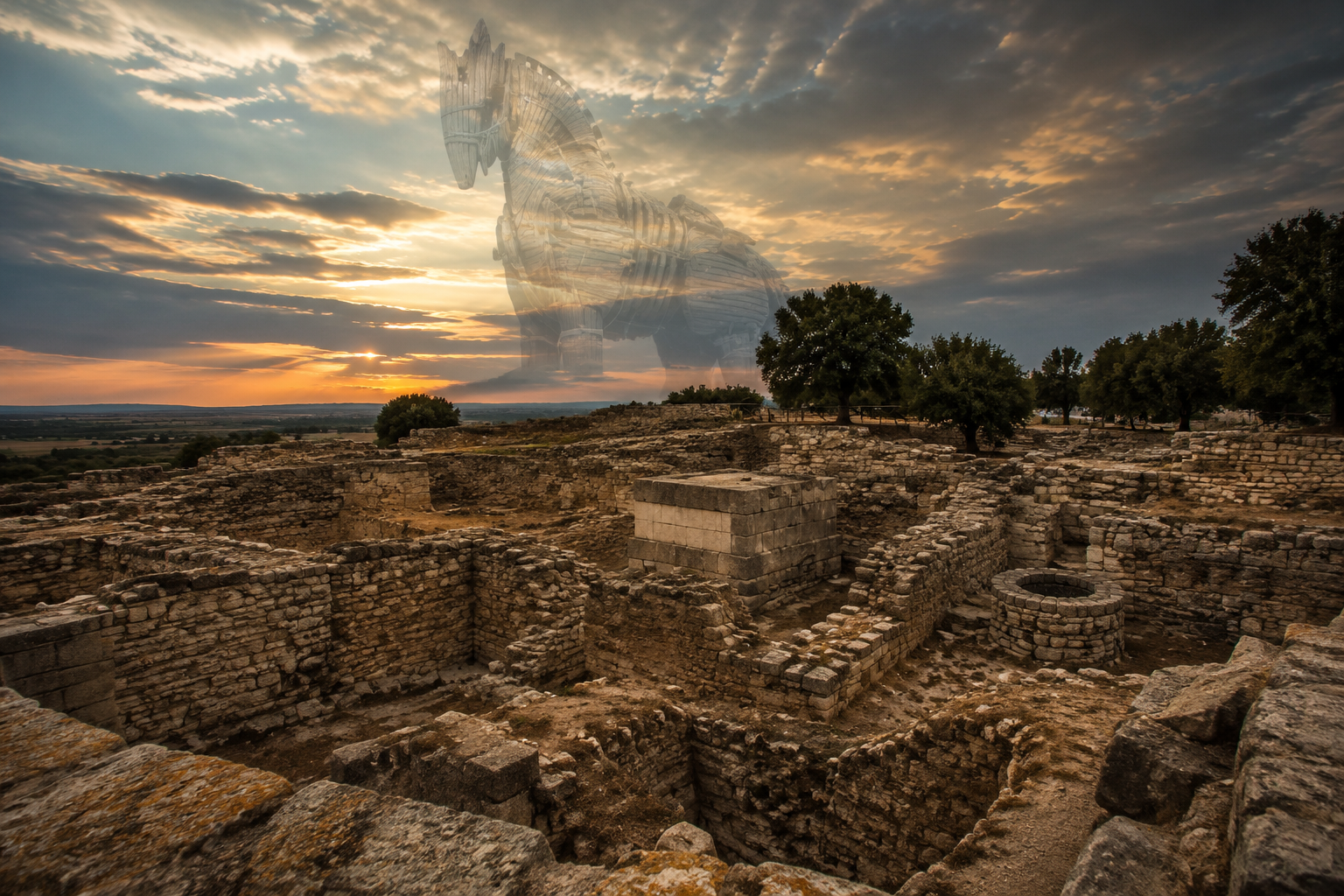
Was the Trojan Horse Real? What the Evidence Says
Historians and archaeologists agree that the city of Troy was real and was destroyed by war around 1180 BC, but the famous wooden horse is a literary invention. This article examines the archaeological and textual evidence to separate historical fact from Greek myth.
Updated:
The clean answer is split in two: Troy was a real city, and a violent destruction around 1180 BC is a plausible historical core for later Trojan War stories; the wooden horse, however, has no archaeological evidence behind it. For a myth-versus-reality study of the Trojan Horse, that distinction matters more than any dramatic retelling of Sinon, Laocoon, or the warriors crouched inside the animal.
The strongest evidence is not a horse-shaped artifact. It is a city mound at Hisarlik in northwest Turkey, with many settlement layers from roughly 3000 BC into the Roman period, including the layer usually called Troy VIIa, which shows signs of destruction in the Late Bronze Age.[1] That is where a careful paper should begin: with what can be dug, dated, compared, and limited.
What Archaeology Can Actually Support
Troy VIIa does not prove Homer line by line. It does something more modest and more useful: it gives us a destroyed Bronze Age city in the right region, at roughly the right time, with material signs consistent with attack. Archaeologists have reported burned structures, Mycenaean-style arrowheads, sling stones, and hastily buried human skeletons in connection with the destruction layer.[1]
Those details deserve attention because they are not decorative. A burned building tells one kind of story. A weapon point tells another. A hurried burial tells a third. None of them says, “A wooden horse entered the city.” Together, though, they make it hard to dismiss the Trojan War tradition as pure fantasy with no contact at all with Bronze Age violence.
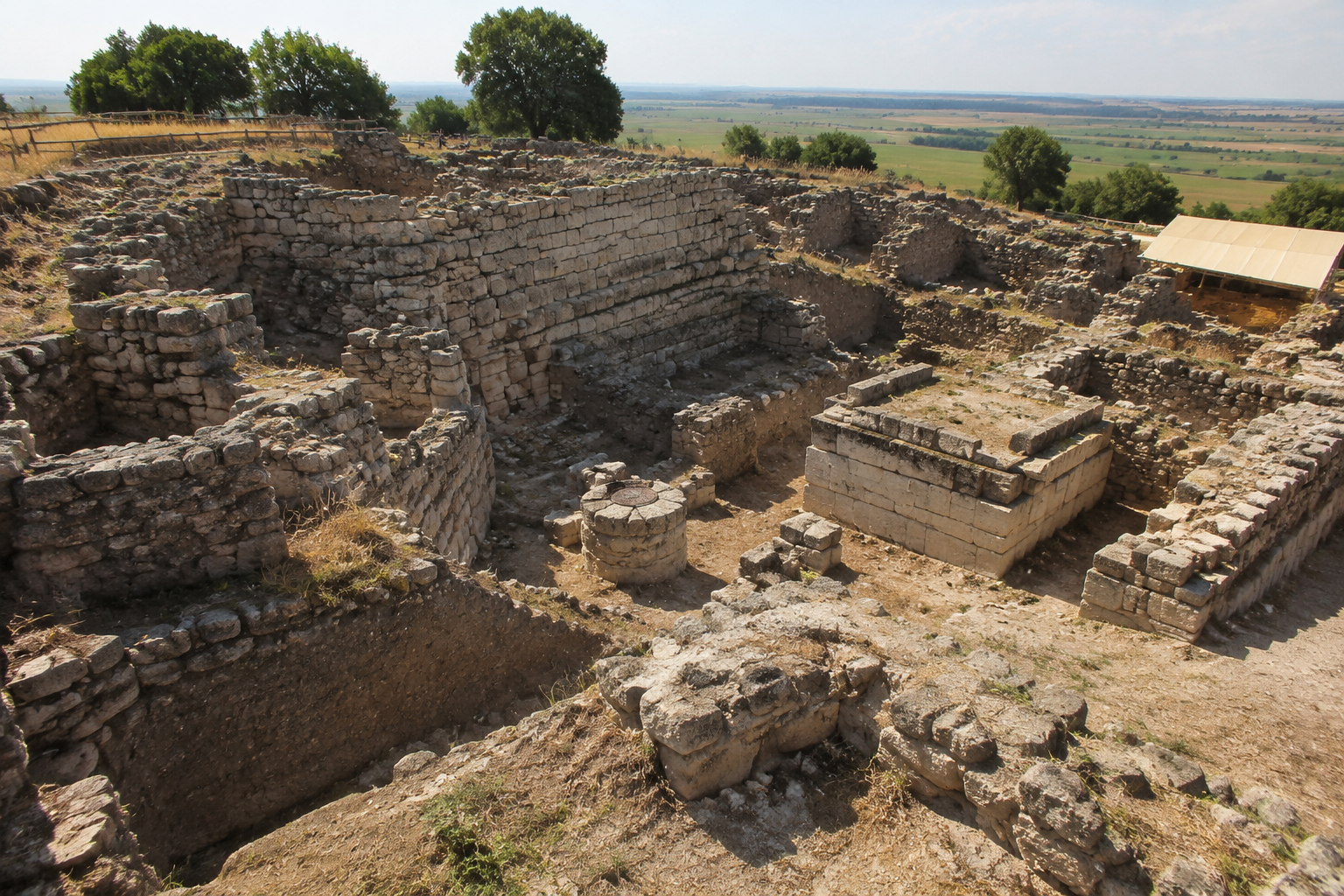
The 2025 excavation reports from Troy strengthen that physical side of the argument. Work led by Prof. Rüstem Aslan was reported to have uncovered 87 additional sling stones, burned beams, and remnants of a defensive ditch, all of which fit a picture of military pressure on the city.[2] The number of sling stones is not a magic proof of the Iliad, but it is exactly the sort of evidence a student can use responsibly: it supports assault, siege conditions, or organized violence, not the literal plot device of a hollow horse.
That difference is the heart of the evidence problem. “Troy was real” is a supported claim. “Troy was violently destroyed in the Late Bronze Age” is also supportable. “That destruction was the exact war remembered in Greek epic” is more cautious, because archaeology rarely hands us character names and motives. “The Trojan Horse existed” is a leap over the evidence.
| Claim | Best Evidence | How Strong Is It? |
|---|---|---|
| A city later identified as Troy existed at Hisarlik. | Settlement layers at the archaeological site. | Strong. |
| A violent destruction occurred around the period associated with Troy VIIa. | Burned structures, weapons, sling stones, hurried burials, and later reported burned beams and ditch remains. | Strong, though interpretation still requires caution. |
| Greek-related powers were involved in conflict in the region. | Hittite references to Wilusa and Ahhiyawa. | Suggestive and important, but not a full narrative of the Trojan War. |
| A giant wooden horse was used to capture Troy. | Later literary tradition. | Not archaeologically supported. |
Why the Hittite Evidence Matters
The Hittite material is valuable because it does not come from Greek epic poetry trying to sing itself into permanence. The Tawagalawa letter, usually dated to around 1250 BC, refers to Wilusa, widely connected with Ilios/Troy, and to Ahhiyawa, often connected with the Achaeans or Mycenaean Greeks.[3] Other discussion of the Hittite evidence has also treated these names as part of the case that western Anatolia saw conflicts involving Greek-related powers in the Late Bronze Age.[4]

This is the kind of evidence that can quietly improve a student paper. It gives an outside textual witness to political trouble in the right broad zone. It also keeps the argument from depending only on Greek memory. If a paper says, “Hittite records independently support the possibility of conflict involving Troy/Wilusa and Greek-related Ahhiyawa,” that is a defensible sentence.
But the same records do not mention a wooden horse. They do not give us Achilles, Hector, Helen, or Odysseus hiding men inside a ritual-looking gift. They are not a second version of Homer. Their value is narrower and therefore stronger: they show that the world behind the legend had real states, real diplomatic anxieties, and real conflicts.
The Horse Enters Through Literature, Not Excavation
Once the physical and Hittite evidence is on the table, the wooden horse looks different. It is not the foundation of the historical case. It is part of the literary afterlife of the war.
Homer’s Iliad does not narrate the fall of Troy by horse. The Odyssey does mention the horse briefly, especially in the passage where Demodocus sings of the wooden horse and the men hidden inside it.[5] That matters chronologically. The famous scene exists in Greek tradition, but in Homer it is not yet the full dramatic version many modern readers picture.
The fuller, emotionally charged deception story comes much later in Virgil’s Aeneid, written nearly 1,000 years after the events it describes.[5] That is where many of the familiar classroom images gather force: the Trojans debating the strange offering, Laocoon warning against Greeks bearing gifts, Sinon telling his false story, and the city pulling its own ruin inside the walls.
Virgil is magnificent. He is not a Bronze Age field report. The Aeneid is Roman epic, shaped by Roman memory, politics, ancestry, and poetic ambition. Treating it as near-contemporary evidence for a Late Bronze Age siege is one of the fastest ways to weaken an otherwise promising paper.
Ancient readers were not all credulous about the horse either. Pausanias, writing in the 2nd century AD, called the literal story “utter silliness,” unless one reduced the horse to something more like a siege engine.[6] That does not settle the matter by itself, but it is a useful reminder that skepticism about the literal horse is not just a modern habit.
What the Horse Might Have Been
Because the horse is unsupported as a literal object, scholars and writers have proposed ways the image might have developed. These theories are best handled as possibilities, not replacement certainties. A paper should not trade one overconfident story for another.
- A siege engine or battering ram: Pausanias’s skeptical reading leaves room for the idea that “horse” may have referred to a military machine rather than a hollow statue. Some later explanations imagine a battering ram covered with horse hides, though this remains speculative.[6]
- A ship-name confusion: one theory connects the story to the Phoenician word hippos, meaning “horse,” and to a type of ship. In that reading, a story about men arriving by ship could have shifted, through language and retelling, into a story about a horse.
- An earthquake symbol: because Poseidon was associated with both horses and earthquakes, another proposal treats the horse as a symbolic memory of earthquake damage. This can explain imagery, but it does not override the archaeological signs of violent destruction.
All three theories share the same limitation: they explain how a horse story could have formed, not what definitely happened at Troy. They are useful in a discussion section, especially if the assignment asks how myth develops from historical memory. They are weaker if presented as discoveries.
How to State the Answer in a Research Paper
The safest argument is not “the Trojan War was real exactly as told” or “the Trojan War was fake.” Both flatten the evidence. A better thesis separates categories: archaeology supports a real city and a violent Late Bronze Age destruction; Hittite texts support a regional context of conflict involving Wilusa and Ahhiyawa; Greek and Roman literature preserves and expands the story of the horse.
If you are building notes from a messy packet of sources, sort each piece before you quote it: archaeological evidence, near-contemporary external text, later Greek epic, later Roman epic, or modern interpretation. That small act prevents the common mistake of using Virgil to prove Bronze Age events, or using sling stones to prove a wooden horse.
A workable paper claim would read something like this: the Trojan War tradition likely preserves a historical kernel, especially in the destruction of Troy VIIa and in Hittite references to conflict around Wilusa, but the Trojan Horse itself is best treated as a literary invention shaped by oral tradition and later authors. That conclusion leaves room for the myth’s power without pretending that cultural memory is the same thing as archaeological proof.
References
- Trojan War, Wikipedia.
- Archaeologists uncover evidence of Trojan War at ancient Troy, The Jerusalem Post, 2025.
- The Trojan War: history or myth?, British Museum.
- Did the Trojan War actually happen?, BBC Culture.
- Trojan horse, Encyclopaedia Britannica.
- The Trojan Horse: Fact or Fiction?, History Today.
Comments
Join the discussion with an anonymous comment.