
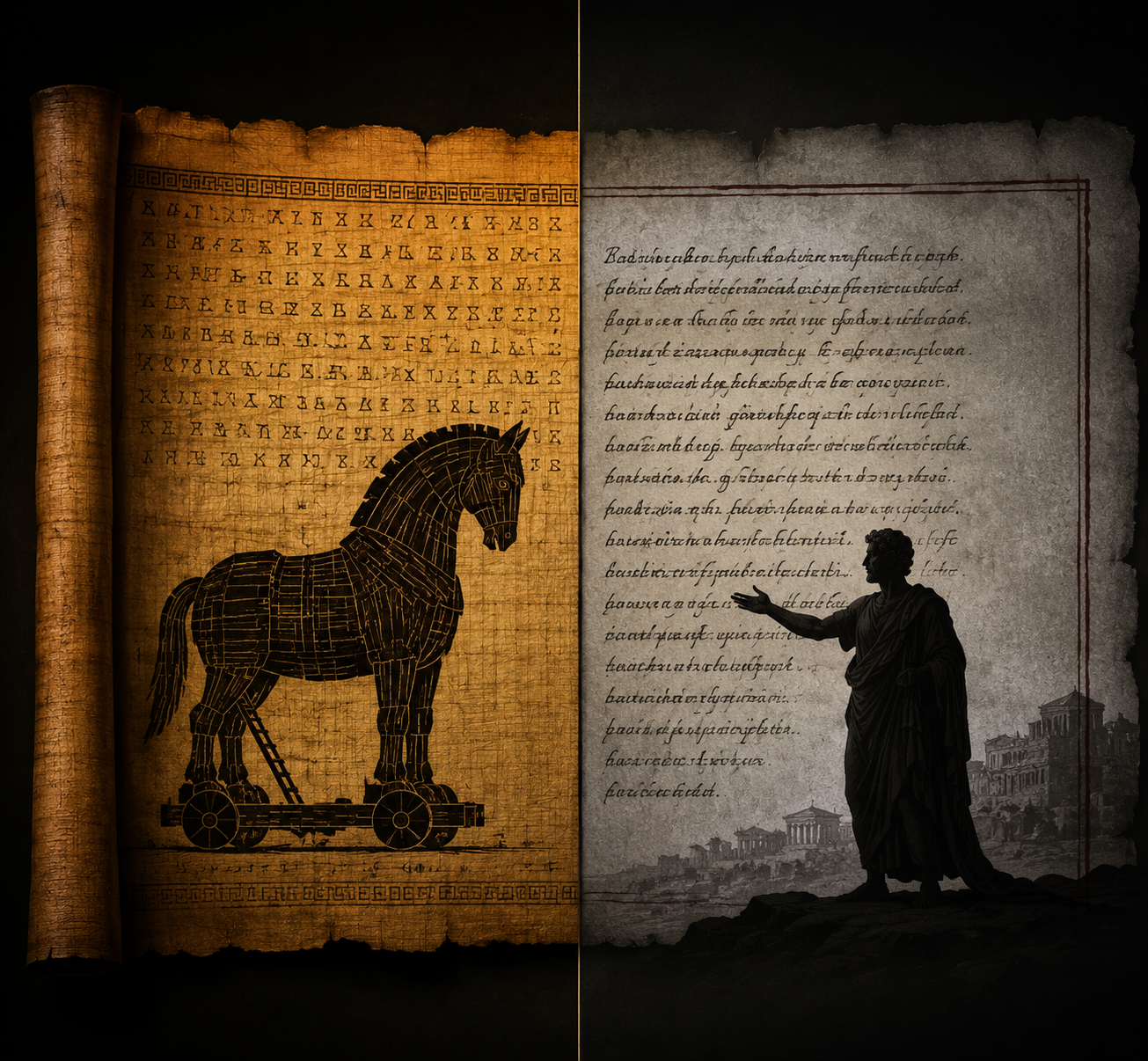
Why Sinon of Greek Mythology Is Not in Homer's Odyssey
Many students assume Sinon appears in Homer's Odyssey, but he actually originates from Virgil's Aeneid and later Greek epics. This article clarifies the misconception using ancient sources and explains why the confusion persists.
Updated:
If you are searching for “sinon greek mythology odyssey” because a film, quiz, or handout put Sinon next to Homer’s Odyssey, the clean answer is this: Sinon is not a character in Homer’s Iliad or Odyssey. Homer does mention the Trojan Horse in the Odyssey, but he does not name the Greek who tricks the Trojans into bringing it inside the city. That named deceiver belongs mainly to Virgil’s Aeneid and to later retellings of the Trojan War story, not to Homer’s own text.[1][2]
The confusion is understandable, because the horse is Homeric and Sinon is attached to the horse in later tradition. But those are not the same claim. “The Odyssey mentions the Trojan Horse” is correct. “Sinon appears in the Odyssey” is not.
What Homer Actually Gives Us
In the Odyssey, the Trojan Horse appears as a remembered episode from the fall of Troy, not as a fully narrated scene with all the later details filled in. The two important Homeric places are Book 4 and Book 8. In Book 4, Helen recalls the Greeks hidden inside the wooden horse while she and Menelaus are speaking with Telemachus. In Book 8, the bard Demodocus sings at the Phaeacian court about the wooden horse and the sack of Troy.[1][2]
Those passages matter because they prove that the horse story was already part of the mythic material around the Odyssey. They also show the limit of what can honestly be credited to Homer. The Odyssey gives the horse, the concealment, and the destruction of Troy. It does not give Sinon’s name, his speech, his invented backstory, or the scene in which the Trojans decide to trust him.
The Iliad does not solve the problem either. It ends before the fall of Troy, so it does not narrate the Trojan Horse episode as a completed event. If an assignment asks for characters in Homer’s Iliad or Odyssey, Sinon should not be listed as one of them.[1][2]
| Claim | Best answer for class |
|---|---|
| Does Homer mention the Trojan Horse? | Yes. The Odyssey refers to it in Book 4 and Book 8. |
| Does Homer name Sinon? | No. Sinon is absent from both the Iliad and the Odyssey. |
| Where does the famous Sinon scene come from? | Primarily Virgil’s Aeneid, Book 2. |
| Why does the confusion happen? | Later tradition attaches Sinon to the same Trojan Horse story that Homer mentions. |
Virgil Is Where Sinon Becomes Unforgettable
The Sinon most students are thinking of comes from Book 2 of Virgil’s Aeneid, a Roman epic composed roughly seven centuries after the Homeric poems. In that book, Aeneas tells Dido how Troy fell. The Greeks have left behind the wooden horse, and Sinon appears as the living explanation the Trojans think they need.[2][3]
Virgil’s Sinon is not a passing name. He receives an extended deception scene, including a long speech to Priam. The scene is usually cited as Aeneid 2.57–198, with Sinon delivering a 142-line performance that turns him from a captured Greek into the apparent victim of Greek cruelty.[2][3]
His trick works because it is not pure nonsense. He says things that sound anchored in known Greek suffering and resentment. He invokes Palamedes, a Greek hero associated with unjust treatment, and Iphigenia, the girl sacrificed before the Greek fleet could sail to Troy. These embedded truths give his larger lie a shape the Trojans can believe. He does not merely say, “Trust the horse.” He gives them a story in which trusting the horse feels like a pious, anti-Greek decision.[2][3]
That is why Sinon is so powerful as a literary figure. He is not just the man who opens a gate or waves toward a wooden object. He supplies the missing interpretation. The Trojans are looking at an alarming Greek construction outside their walls; Sinon tells them what it means, and his meaning is fatal.
Virgil also sets Sinon’s lie beside the Laocoön episode. Laocoön warns the Trojans against the horse, but the surrounding signs and Sinon's performance help move the city toward the wrong conclusion. After Troy accepts the horse, Sinon later gives the signal to the Greek fleet, traditionally with a shield, and the hidden warriors emerge from the horse when the city is vulnerable.[2][3]
So when Sinon feels central to the Trojan Horse story, that feeling is not a modern mistake. It is a Virgilian inheritance. The mistake begins only when that Virgilian version is quietly pushed backward and treated as if Homer wrote it.
Later Greek Sources Keep Reworking Him
After Virgil, Sinon does not simply remain one fixed character. Later Greek sources also include him, and they reshape the emphasis. Quintus of Smyrna’s Fall of Troy, dated to the 3rd–4th century CE, gives a more heroic version. In that account, Sinon volunteers for the dangerous mission and declares that he will either succeed or die trying at 12.243–251.[2][3]
Quintus makes the physical cost of the role especially stark. Sinon is tortured by the Trojans; his ears and nose are cut off, but he does not betray the Greek plan. That version still depends on deception, but it frames Sinon less as a smooth manipulator and more as a soldier enduring pain for the mission.[2][3]
Tryphiodorus’ Taking of Ilios is another later source in which Sinon belongs to the Trojan Horse tradition. The important study point is not that these later Greek texts somehow make Sinon Homeric. They show the opposite: ancient authors after Homer continued to fill out, revise, and dramatize parts of the Trojan War cycle that Homer had left unnarrated or only briefly mentioned.[2]
This is a common pattern in Greek and Roman myth. A later author can preserve an old tradition, invent a new literary treatment, or combine inherited material in a way that becomes more famous than the earlier version. For a student, the practical question is not “Is it ancient?” but “Which ancient source says this?”
Where Sinon Fits in the Mythic Family Tree
Sinon is often connected to Odysseus by family. A common version makes his father Aesimus the brother of Anticlea, Odysseus’ mother; both are children of Autolycus, the famous trickster and thief. Under that genealogy, Sinon is Odysseus’ cousin, which helps explain why Odysseus would trust him with a delicate deception inside the Trojan plan.[2][4]
There is some variation. GreekMythology.com reports Sisyphus as a possible father for Sinon, while other accounts use Aesimus. That disagreement is worth noting, but it should not distract from the larger source issue. A family link to Odysseus does not put Sinon into Homer’s Odyssey. Genealogy and textual appearance are separate kinds of evidence.[4]
Why Modern Adaptations Make the Confusion Worse
Christopher Nolan’s The Odyssey, released wide on July 17, 2026, has given the confusion a fresh push because Elliot Page plays Sinon in an Odyssey adaptation. That casting choice naturally sends viewers to search whether Sinon is “in the Odyssey,” and the honest answer needs two layers: he is in Nolan’s Odyssey, but he is not in Homer’s Odyssey.[5][6]
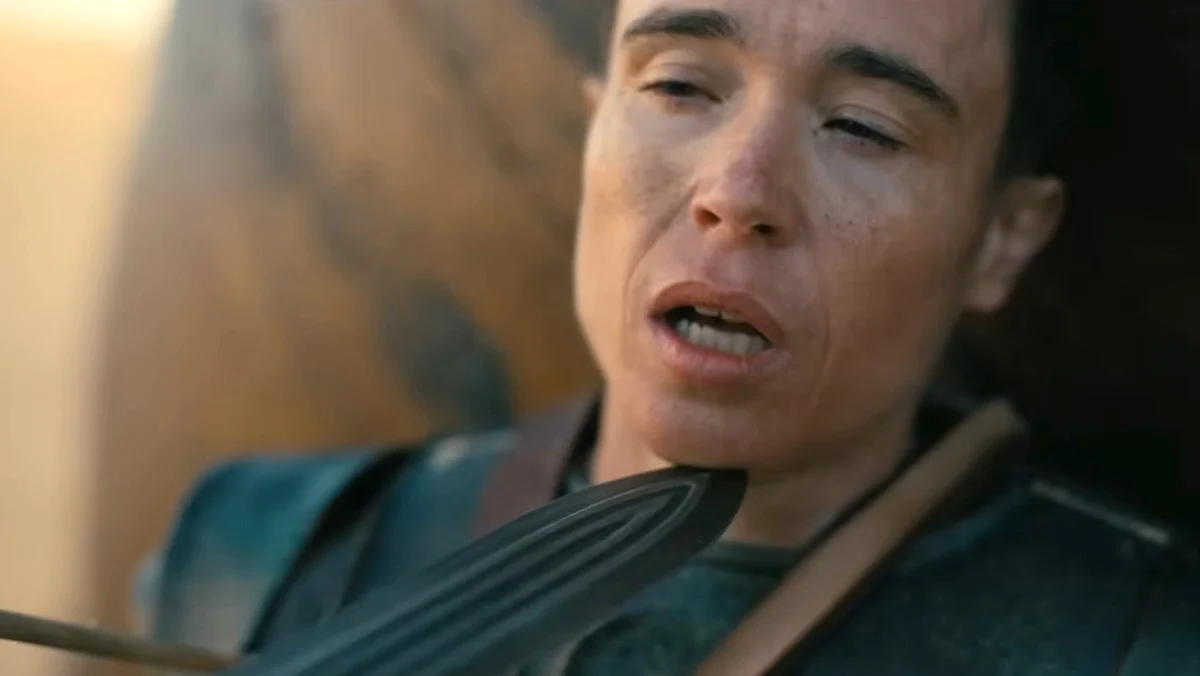
The film also changes the character in a significant way. Nerdist describes Nolan’s Sinon as an honorable soldier who does not know the horse’s real purpose, which departs sharply from the ancient tradition of Sinon as a knowing and willing deceiver.[5]
There is nothing automatically wrong with that as adaptation. Films compress, relocate, and reassign material all the time. The problem begins when the film version becomes an accidental citation. If a paper or quiz asks about Homer, a 2026 creative decision cannot supply a missing Homeric character.
Sinon’s Later Reputation
By the Middle Ages and Renaissance, Sinon had become a convenient name for treachery. Dante places him in Inferno Canto XXX among the falsifiers, punished for falsifying words. Shakespeare can allude to him as a byword for deceit in Henry VI Part 3 and Cymbeline. Those later references depend on the reputation that grew from the Trojan Horse story, especially the Virgilian version.[2][3]
Even his name was read in that direction. Classical Wisdom notes a connection with the Greek verb sinomai, “to harm” or “to hurt,” which suits a character whose speech damages a city more effectively than a weapon could.[3]
These details are useful for understanding why Sinon survives so strongly in the literary imagination. They are not evidence that he appears in Homer. They are evidence that later readers and writers found him a compact symbol for destructive falsehood.
The Citation Path to Use
For class work, separate the sources this way. Homer’s Odyssey gives you the Trojan Horse as remembered story in Book 4 and sung story in Book 8. Virgil’s Aeneid gives you the famous Sinon deception scene in Book 2. Quintus of Smyrna and Tryphiodorus show later ancient versions of the same Trojan Horse tradition. Modern films may borrow from any of these layers, but they do not change what is actually in Homer.
- If the question is about Homer’s Odyssey: say that Sinon does not appear, though the Trojan Horse is mentioned.
- If the question is about Virgil’s Aeneid: discuss Sinon’s speech, false desertion, and role in persuading the Trojans.
- If the question is about the Trojan Horse tradition broadly: include Sinon, but identify which later source you mean.
- If the question is about Nolan’s 2026 film: treat its Sinon as an adaptation, not as evidence for Homer.
That distinction is the whole answer in its most usable form: the Odyssey mentions the horse; the Aeneid gives us Sinon.
References
- Who is Sinon in The Odyssey?, Britannica.
- Sinon, Wikipedia.
- Who Tricked the Trojans?, Classical Wisdom.
- Sinon, GreekMythology.com.
- Who Does Elliot Page Play in THE ODYSSEY? Sinon, Explained, Nerdist.
- The Odyssey (2026 film), Wikipedia.
Comments
Join the discussion with an anonymous comment.