

10 Differences Between Homer's Odyssey and Nolan's Film
A side-by-side comparison of Homer's Odyssey and Nolan's 2026 film adaptation, highlighting 10 major changes in gods, characters, plot, and themes for students writing comparison essays.
Updated:
For an odyssey movie vs book study comparison, the strongest essay claim is not that Christopher Nolan’s 2026 film is “faithful” or “unfaithful.” That language is usually too vague to survive a good paragraph. The more useful claim is this: Nolan changes the source of meaning. Homer’s Odyssey is shaped by divine politics, kleos, xenia, and Odysseus’s dazzling capacity for cunning. Nolan’s The Odyssey, released July 17, 2026, turns that material into a modern psychological drama about guilt, trauma, moral injury, and redemption.[1]
That does not make the film a mistake. Adaptations are allowed to think. But when you compare the poem and the movie, you need to ask what each change does. Who causes action? What counts as heroism? What gets forgiven? What gets hidden? Those questions will take you much further than a list of scenes the movie “left out.”
The Whole Comparison at a Glance
| Difference | Homer’s Odyssey | Nolan’s 2026 film | Essay use |
|---|---|---|---|
| 1. The gods | Olympian politics drive the plot. | The divine council is removed; Athena remains mainly as narrator and observer.[2] | Shows the shift from divine causation to human responsibility. |
| 2. Odysseus’s identity | Odysseus is polytropos: many-turning, strategic, duplicitous, and admired for it. | He becomes a guilt-ridden veteran haunted by Troy and the Horse.[2][3] | Shows how cunning becomes trauma. |
| 3. The Trojan Horse | The Horse is not narrated as a central event in Homer’s Odyssey. | The film opens with it, borrowing the frame from Virgil’s Aeneid rather than Homer.[2][4] | Shows how the film builds its psychology around one imported wound. |
| 4. Calypso | Calypso keeps Odysseus as a captive lover for seven years. | She becomes a therapeutic figure using lotus-derived narcotics to numb his trauma.[2][3] | Shows the move from erotic captivity to psychological sedation. |
| 5. Circe | Circe’s episode involves enchantment, sex, and a long delay. | She moralizes Odysseus’s violence, especially through the Cyclops episode.[2] | Shows how the film adds guilt to episodes Homer treats differently. |
| 6. The Cyclops | Odysseus defeats Polyphemus through the famous “Nobody” trick. | The trick is removed; the encounter becomes more direct survival horror.[2] | Shows the loss of Odysseus as celebrated trickster. |
| 7. Penelope | Penelope is loyal, intelligent, and patient within the household plot. | She receives more screen time, more fury, and a reunion staged as a meeting of equals.[2][4] | Gives a clean character-comparison paragraph. |
| 8. The slave girls | Twelve disloyal slave girls are hanged after the suitors are killed. | The episode is almost entirely elided, with only Melantho’s implied death remaining.[2][4] | Shows what modern adaptation finds ethically difficult to stage. |
| 9. The ending | Peace is fragile and imposed by Athena; Odysseus still faces unfinished obligations. | The film ends with a westward voyage to honor fallen soldiers.[2][3][4] | Shows the move from uneasy settlement to redemption. |
| 10. The moral system | Kleos and xenia belong to an aristocratic heroic world. | Xenia becomes “Zeus’s Law,” a broader moral principle, while kleos gives way to guilt over violence.[2][5][6] | Shows the film translating ancient values into modern ethics. |
1. Nolan Removes the Gods, and That Changes the Machinery of the Story
In Homer, the gods are not decorative. They are part of the engine. Athena advocates for Odysseus. Poseidon obstructs him. Zeus weighs justice, order, and divine hierarchy. The poem’s human drama is constantly entangled with Olympian politics.
Nolan’s film removes that council-of-the-gods framework entirely. Vanity Fair’s account of the adaptation notes that only Athena remains, and even she functions as narrator or observer rather than as the same kind of divine plot manager Homer gives us.[2] That is not a small cut. It changes what an event means.
In the poem, Odysseus’s suffering is partly a matter of cosmic conflict. He is a man, but he is also a case argued among immortals. In the film, suffering has fewer metaphysical excuses. If a choice damages someone, the film is more likely to leave that damage with the human being who made the choice. For an essay, this is one of the safest major arguments: Nolan relocates responsibility from divine order to human conscience.
2. Odysseus Stops Being Mainly Polytropos
The first word many students need for Homer’s Odysseus is polytropos: much-turning, complicated, adaptable, slippery. His lies are not only sins to be exposed. They are often signs of intelligence. Vanity Fair, drawing on Emily Wilson’s translation notes, emphasizes that Homer’s poem can treat deception as cleverness, not merely moral failure.[2]
Nolan strips much of that celebrated trickster identity away. His Odysseus is less the man who can talk himself through any room and more the veteran who cannot escape the cost of what he has done. TIME’s interview material frames Nolan’s adaptation choices around a psychologically burdened Odysseus rather than a purely heroic strategist.[3]
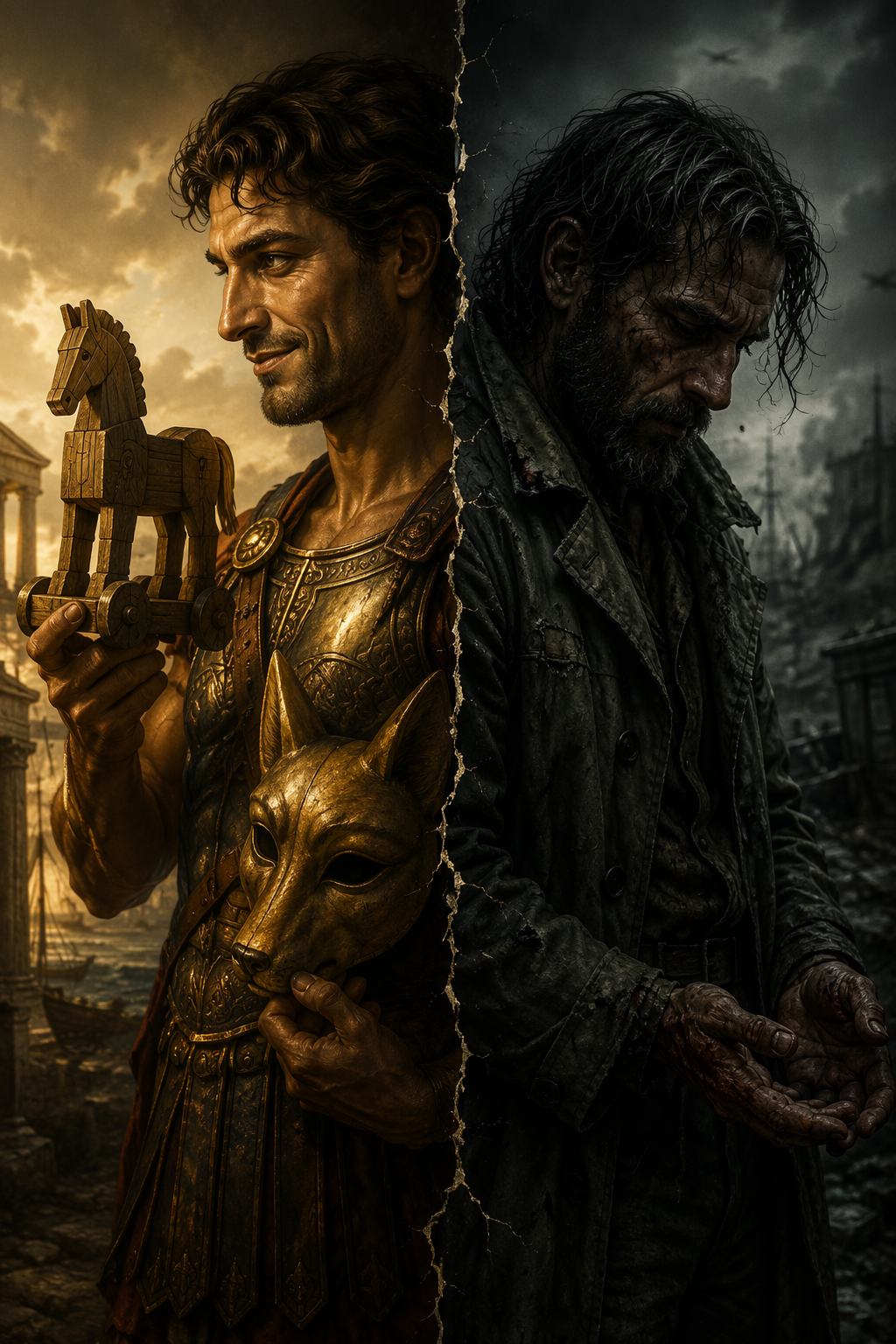
This difference is stronger than “the movie makes Odysseus sadder.” Homer’s Odysseus can be morally troubling, but his intelligence is one of the poem’s chief pleasures. Nolan makes that same intelligence feel like the source of psychic damage. The trick that won Troy becomes the wound that follows him home.
3. The Trojan Horse Becomes the Film’s Emotional Center
Students often assume the Trojan Horse is a major episode in Homer’s Odyssey because it belongs so firmly to the larger Trojan War myth. But the film’s opening use of the Horse is not taken from Homer’s poem in that direct way. The major ancient source for that frame is Virgil’s Aeneid, and both Vanity Fair and The New Yorker identify Nolan’s use of the Horse as an imported structural choice.[2][4]
That matters because the Horse gives the film a single psychological origin point. Instead of beginning from the poem’s divine dispute and delayed homecoming, the film begins from an act of strategic deception that led to slaughter. In Homer, the Trojan War is part of Odysseus’s heroic past. In Nolan, it becomes the event that contaminates the journey home.
A good essay paragraph could argue that Nolan imports the Horse because he needs a modern trauma structure. The film is not just asking, “How does Odysseus get home?” It is asking whether a man can return from a victory that has morally disfigured him.
4. Calypso Becomes a Healer, Not Simply a Captor
In Homer, Calypso keeps Odysseus on her island for seven years. She desires him, offers him immortality, and delays his return to Ithaca. The situation is troubling, but it is not framed as therapy.
Nolan reimagines Calypso through a modern psychological lens. Vanity Fair describes the film’s Calypso as a therapeutic figure who uses lotus-derived narcotics to numb Odysseus’s trauma, a change also connected to Nolan’s interest in the character’s damaged mental state in TIME’s coverage.[2][3]
The change turns delay into sedation. Homer’s island tests Odysseus’s desire for home, mortality, and marriage. Nolan’s island tests whether relief from pain can become another form of captivity. That is a useful distinction because it lets you compare the same plot function — Odysseus is prevented from going home — while showing that the meaning of the delay has changed.
5. Circe Adds Moral Judgment to the Adventure Pattern
Homer’s Circe episode is strange, sensual, and matter-of-fact. Men become pigs. Hermes helps Odysseus resist her magic. Odysseus becomes her lover. The crew stays for a year. It is not a courtroom scene.
Nolan’s Circe, according to Vanity Fair, presses Odysseus toward moral recognition, including by reminding him that the Cyclops is a “son of Poseidon.”[2] The point is not merely that the film changes her dialogue. The point is that Circe becomes part of the film’s conscience system. She helps convert an adventure episode into a reckoning.
This is one place where students should avoid writing, “The movie makes Circe more serious,” and stop there. More serious how? More serious because she makes consequences speak. The film repeatedly turns mythic encounters into scenes where Odysseus must feel the moral residue of survival.
6. The Cyclops Scene Loses the “Nobody” Trick
If one scene proves Homer’s affection for Odysseus’s verbal brilliance, it is the Cyclops episode. Odysseus tells Polyphemus that his name is “Nobody,” blinds him, and lets the joke become a weapon when the other Cyclopes hear Polyphemus shout that “Nobody” is hurting him.
Nolan removes that famous trick, presenting the encounter instead as more straightforward survival horror.[2] The loss is not just a missing clever line. It narrows the gap between Odysseus and the audience. Homer lets us admire the elegant cruelty of the trick. Nolan pushes us toward fear, bodily danger, and aftermath.
Put the Trojan Horse, Calypso, Circe, and the Cyclops together and a pattern appears. Nolan repeatedly replaces cunning, enchantment, and divine pressure with psychological consequence. The Horse is not just strategy; it is guilt. Calypso is not just temptation; she is narcotic relief. Circe is not just danger and pleasure; she is accusation. The Cyclops is not a showcase for wit; he is a survival ordeal.
7. Penelope Is Angrier and More Active
Penelope in Homer is not passive in the simple sense. She delays the suitors with the weaving trick, tests Odysseus before accepting him, and protects the household through intelligence rather than force. Still, her role is shaped by waiting, endurance, and fidelity.
The film expands her agency. Vanity Fair notes that Nolan gives Penelope significantly more screen time, while The New Yorker describes the reunion as a more equal confrontation, with Penelope’s anger at Odysseus’s long absence brought forward.[2][4]
For an essay, this does not have to become a sweeping claim that the film fully “modernizes women” or solves the gender politics of the poem. The evidence supports a cleaner point: Nolan makes Penelope’s emotional claim on Odysseus harder to contain. She is not only the prize of return. She becomes one of the people entitled to judge what his return has cost.
8. The Slave Girls Are Nearly Removed
One of the most ethically disturbing moments in Homer’s poem comes after the slaughter of the suitors, when twelve enslaved women associated with them are hanged. Modern readers often pause there because the episode forces uncomfortable questions about gender, slavery, loyalty, and whose suffering the heroic ending permits.
Nolan’s film almost entirely cuts that material. The New Yorker and Vanity Fair both note that the hanging of the slave girls is elided, with only Melantho’s implied death remaining.[2][4] This omission is not a minor housekeeping cut. It removes one of the poem’s hardest moral shocks.
Here the essay question is not simply “Why did the movie leave it out?” It is better to ask what becomes easier when the scene disappears. The film can preserve sympathy for Odysseus more cleanly. It can move toward redemption without forcing viewers to sit with the punishment of enslaved women. That tells us something about modern reception: some ancient violence can be reframed as trauma, while other violence is too ethically destabilizing for the redemptive arc the film wants.
9. The Ending Changes from Fragile Peace to Redemptive Voyage
Homer’s ending is not as clean as many summaries make it sound. Odysseus returns, kills the suitors, reunites with Penelope, and reclaims his household, but the violence threatens to continue. Athena must impose a settlement. Odysseus also has unfinished obligations beyond the household.
Nolan rewrites that closure. The film ends with Odysseus sailing west on a mission to honor fallen soldiers, a redemptive and outward-looking conclusion discussed across Vanity Fair, TIME, and The New Yorker.[2][3][4]
That is a large thematic substitution. Homer’s poem ends with social order patched back together under divine authority. Nolan’s film ends by sending Odysseus toward moral repair. The poem worries about whether violence can be contained. The film asks whether guilt can be transformed into purpose.
10. Kleos and Xenia Become Trauma and “Zeus’s Law”
The deepest difference is thematic. Homer’s world runs on values that do not map neatly onto modern morality. Kleos means glory or fame won through deeds. Xenia, often translated as guest-friendship or hospitality, is sacred and socially practical; it binds strangers, hosts, travelers, and aristocratic households into networks of obligation.
Nolan reframes that system. Vanity Fair describes the film’s xenia as “Zeus’s Law,” a universalized moral principle connected to contemporary anxieties about strangers, outsiders, and immigration.[2] Interviews with scholars at UC Santa Cruz and Georgetown also stress that the poem’s moral world is historically distant and that adaptation involves translation rather than simple “accuracy.”[5][6]
This is where a comparison essay can become more than plot matching. Homer’s Odysseus wants home, honor, recognition, and restored status. Nolan’s Odysseus wants some form of moral survival after violence. Ancient heroic culture does not disappear entirely, but the film filters it through modern ideas about trauma, guilt, and accountability.
How to Turn These Differences into an Essay Argument
Do not try to use all ten differences with equal force. That usually produces a thin essay. Choose one governing claim, then use two or three differences as evidence. The best comparison paragraphs explain a pattern, not just a change.
| If your essay argues... | Use these differences | Your paragraph should prove... |
|---|---|---|
| Nolan makes the story more psychological. | Gods removed; Trojan Horse frame; Calypso’s narcotics; ending rewritten. | The film replaces divine causation with trauma, memory, and guilt. |
| Nolan changes Odysseus’s heroism. | Polytropos reduced; Cyclops trick removed; Circe moralizes him. | The film values moral reckoning more than verbal brilliance. |
| Nolan modernizes the poem’s ethics. | Xenia becomes Zeus’s Law; slave girls are elided; Penelope gains agency. | The film adapts ancient social codes for a modern audience but also avoids some of the poem’s hardest violence. |
| Nolan changes the ending’s meaning. | Athena’s fragile settlement becomes a westward voyage. | The film wants redemption where Homer leaves political and moral instability. |
A weak comparison says, “In the book, the gods are important, but in the movie they are not.” A stronger version says, “By removing the divine council, Nolan changes suffering from a condition negotiated among gods into a burden carried by human beings.” That second sentence gives you a claim, a cause, and a consequence.
The same approach works for Odysseus. Do not write only that Homer’s Odysseus is clever and Nolan’s is traumatized. Write that Nolan turns the very trait Homer celebrates — strategic deception — into the source of moral injury. Then use the Trojan Horse, the missing “Nobody” trick, and the rewritten ending to prove it.
If your essay needs one strong argument, make it this: Nolan does not merely modernize the events of The Odyssey. He changes the source of meaning. Homer’s poem belongs to a world where gods, honor, hospitality, and cunning organize the hero’s return. Nolan’s film moves that return into a world of human guilt, psychological damage, ethical discomfort, and the hope that violence might still be answered by some form of repair.
References
- The Odyssey (2026 film), Wikipedia.
- The Odyssey: 10 Major Changes From Book to Screen, Vanity Fair.
- TIME cover story, TIME, May 12, 2026.
- The New Yorker review, The New Yorker, July 27, 2026.
- Professor interview on the poem's enduring fascination and moral structure, UCSC News.
- Professor interview on adaptation challenges and why 'historical accuracy' is a misnomer, Georgetown University.
Comments
Join the discussion with an anonymous comment.