
SAT
Learn how to build a personalized SAT study plan for 2026 using the score-gap method — start with a diagnostic test, calculate your score gap, and follow a tailored timeline that focuses on targeted weakness drilling and methodical error review with free official tools.
Updated:
Start with the number, not the notebook. To study for the SAT test in 2026, your first job is to find your current score, compare it with the score you actually need, and turn that gap into a weekly plan. A student at 1180 trying for 1250 needs a different month than a student at 1180 trying for 1450. Same starting score, different problem.

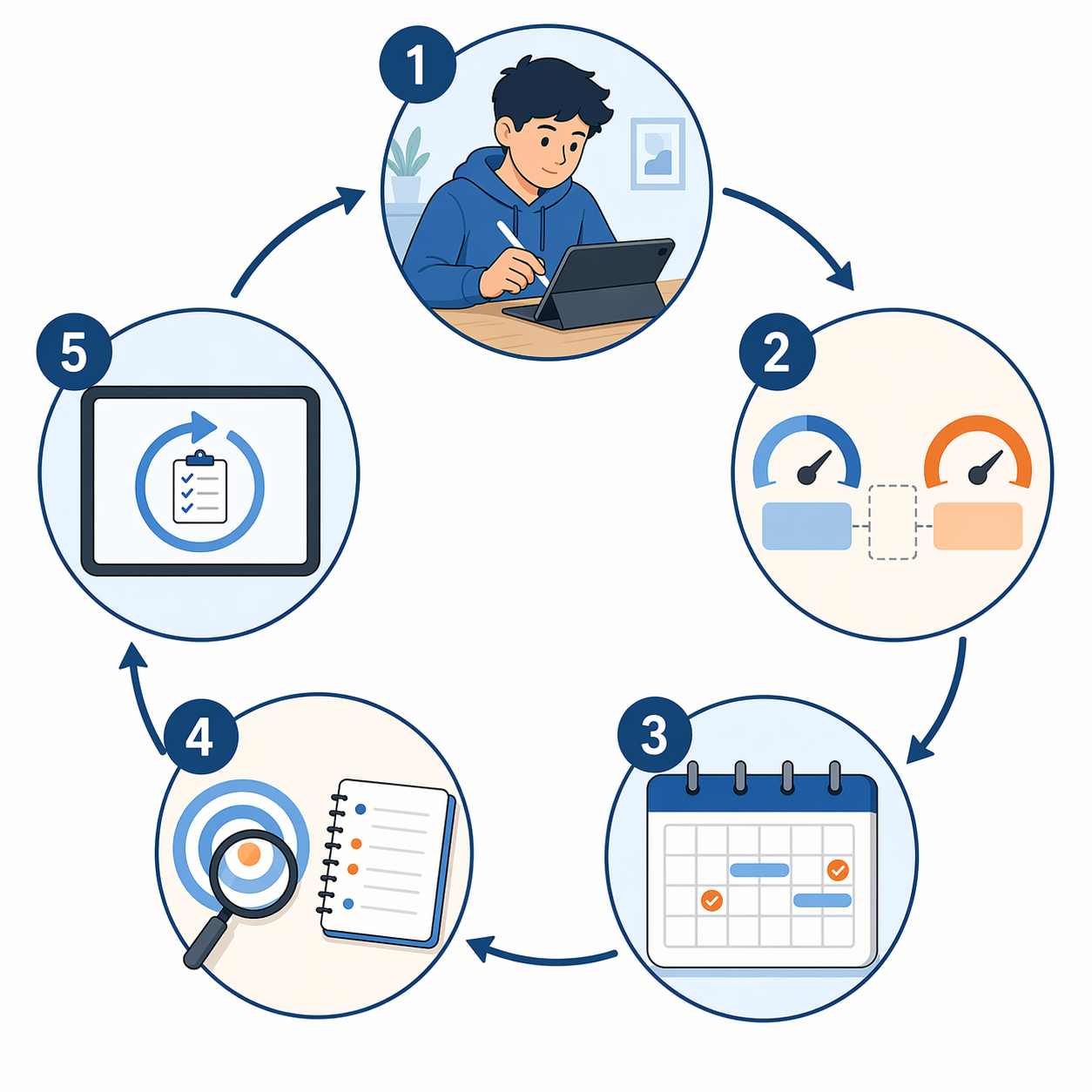
The working cycle is simple enough to begin today: take a Bluebook diagnostic, calculate the score gap, estimate the prep load, choose a timeline, drill the weak areas, review every miss by cause, then retest. If a study session cannot name the gap it is closing, it is probably just keeping you busy.
| Step | What you do | What comes out of it |
|---|---|---|
| 1. Diagnostic | Take a full Bluebook practice test under timed conditions. | A current total score, section scores, and missed-question patterns. |
| 2. Score gap | Subtract your current score from your target score. | A realistic estimate of how much work the plan must carry. |
| 3. Timeline | Match the gap to available weeks and weekly hours. | A 1-month, 3-month, or 6-month plan. |
| 4. Targeted drill | Use Khan Academy and the College Board Question Bank by domain, skill, and difficulty. | Practice that attacks the specific questions costing points. |
| 5. Error review | Label each miss as content gap, careless error, or timing issue. | A correction route instead of a vague promise to “study harder.” |
| 6. Retest | Take another Bluebook test after a complete study cycle. | A new score gap and a revised plan. |
Know Just Enough About the 2026 Digital SAT to Study Correctly
The 2026 SAT is digital, adaptive, and shorter than the old paper test. One 2026 overview describes the exam as 2 hours and 14 minutes, with 98 questions and no essay.[1] That matters because your practice has to prepare you for the interface, the timing, and the adaptive module structure—not just the subject matter.
Bluebook matters because it is the closest match to the test-day environment. Reading a PDF, watching explanation videos, or doing untimed worksheets can help with content, but they do not teach the rhythm of the digital SAT screen, the built-in tools, or the pressure of moving through modules on a clock. If you are just getting oriented, use the site’s SAT Exam Prep Guide as the parent hub, then come back to this score-gap workflow.
The adaptive design also changes what “good enough” means during Module 1. EdisonOS estimates that students generally need about 60% correct on Math, roughly 13 of 22 questions, and about 70% correct on Reading and Writing, roughly 19 of 27 questions, to route into the harder second module.[2] Those are industry estimates, not official College Board cutoffs, and they may vary by form. Still, they explain why the first module cannot be treated as warm-up practice.
EdisonOS also reports that students routed to the easier Module 2 face score ceilings around 650 in Math and about 580–600 in Reading and Writing even with a perfect easier second module.[2] The practical takeaway is not panic. It is this: early accuracy protects your score range. For many students, the first phase of prep should focus on making the most common medium-difficulty questions automatic enough that Module 1 does not decide the test before the harder problems appear.
For Math, the built-in Desmos graphing calculator is part of the test environment, not an optional shortcut. Test Ninjas notes that Desmos is available in Bluebook for every math question and highlights features such as regression, intersections, and tables as time-saving tools students should learn before test day.[1] If your math plan ignores Desmos, it is leaving pacing help on the table.
Domain weights help decide what deserves the most study time. Test Ninjas summarizes Math as roughly 35% Algebra, 35% Advanced Math, 15% Problem-Solving and Data Analysis, and 15% Geometry and Trigonometry.[1] A student missing algebra questions every week does not need an equal-hours tour through every math topic. That student needs algebra cleaned up first.
Step 1: Take a Bluebook Diagnostic Before You Build the Plan
Pick a full Bluebook practice test you have not used before. If several are available, save the earliest or most familiar ones for light practice and use one of the later active tests, such as Practice Test 7, 8, 9, or 10, for your baseline. Before starting, check Bluebook itself for the current active test list; College Board has changed available practice tests before, and stale internet advice can quietly wreck a retest plan.
Take the diagnostic like a real test. Use the timer. Stay in one sitting except for the official break. Do not pause to look up formulas, text a friend, or rewatch a lesson. A diagnostic is not a character judgment; it is a measuring tool. If you soften the conditions, the number becomes less useful.
When you finish, write down four things: total score, Reading and Writing score, Math score, and the date. Then add a quick note about conditions: full test or broken into pieces, quiet room or noisy kitchen, calculator comfort, and whether you ran out of time. That note will matter later when you decide whether a score change reflects learning or just a different testing setup.
For a more detailed walkthrough of pairing Bluebook tests with Khan Academy review, use How to Take SAT Practice Tests with Bluebook and Khan Academy. If you are unsure which free tests are worth saving for full-length checkpoints, the free SAT practice tests guide can help you avoid burning through your best retest material too early.
Step 2: Calculate the Score Gap
Your score gap is the distance between your current diagnostic score and your target score. The formula is plain: target score minus current score equals score gap.
Target score - current Bluebook diagnostic score = score gapSuppose a student’s current score is 1210 and the target score is 1340. The score gap is 130 points. That does not automatically say whether the student can reach 1340 by the next test date, but it does tell the student what the plan has to be strong enough to support.
Set the target from real admissions or scholarship needs when possible. If you do not have a college list yet, use a temporary planning target, then revise it later. A temporary target is better than drifting through practice with no finish line.
For calibration, the College Board’s 2025 Total Group report lists an average SAT score of 1029, with 521 in Evidence-Based Reading and Writing and 508 in Math; it also reports a median total score of about 1010.[3] That benchmark is not a verdict on your ability. It is a way to understand where your current score sits nationally while you choose a realistic next target.
Step 3: Turn the Gap Into Study Hours
PrepScholar’s study-plan model gives a useful planning heuristic: 0–30 points may take about 10 hours, 30–70 points about 20 hours, 70–130 points about 40 hours, 130–200 points about 80 hours, and 200–330 points about 150 or more hours.[4] Treat those as rough test-prep estimates, not promises. Students do not improve at identical rates, and a point gap caused by weak algebra is different from a point gap caused by rushing through Reading and Writing.
| Score gap | PrepScholar hour estimate | What it usually means for planning |
|---|---|---|
| 0–30 points | About 10 hours | A short tune-up may be enough if practice-test conditions were realistic. |
| 30–70 points | About 20 hours | A 1-month sprint can work if the calendar is not crowded. |
| 70–130 points | About 40 hours | A 2- to 3-month plan is safer for most students. |
| 130–200 points | About 80 hours | Plan for multiple diagnostic-drill-retest cycles. |
| 200–330 points | 150+ hours | Use a longer runway or consider adding outside structure. |
This is where many students accidentally design a plan that cannot survive their week. Eighty hours sounds manageable until you notice the test is six weeks away, AP exams are coming, and you have away games every Tuesday and Friday. Divide the estimated hours by the number of real weeks you have, then look at the weekly number without optimism.
Estimated prep hours ÷ usable weeks before test day = weekly SAT hoursIf the answer is 11 hours per week and you can honestly give the SAT four, you have three choices: lower the near-term target, choose a later test date, or add more structure so the hours you do have are cleaner. Pretending the calendar will suddenly open up is not a strategy.
Choose a Timeline That Matches the Gap
A 1-month SAT plan is not a miniature version of a 6-month plan. It has different rules. A short sprint works best for students already close to their goal, usually within about 50–70 points, and able to study 8–10 hours per week. A 3-month plan is the steadier default because it leaves room for at least one full cycle of diagnostic, targeted drilling, retest, and adjustment. A 6-month plan fits students with large score gaps, heavy schedules, or the need to rebuild core skills slowly. PrepScholar, College Essay Guy, and UPI Study all frame multi-week planning as preferable to cramming, with 8–12 weeks often treated as an ideal middle range.[4][5][6]
| Timeline | Best fit | Weekly rhythm |
|---|---|---|
| 1 month | Students close to target and able to protect 8–10 hours per week | Two targeted drill blocks, one timed section or module set, one error-review block, and one shorter mixed review |
| 3 months | Most students with moderate gaps and normal school schedules | Three to four study blocks per week, with a full retest every few weeks |
| 6 months | Students with 200+ point gaps, packed calendars, or major content rebuilding | Two to three hours per week at first, increasing near test day if the schedule allows |
If your gap points toward a 3-month plan, the site’s Digital SAT Practice Schedule 2026 gives a more detailed 90-day structure. Use this article to understand the logic; use the schedule when you want the weeks laid out.
Use Free Tools in the Right Order
Bluebook, Khan Academy, and the College Board Question Bank can carry a disciplined self-study plan a long way, especially for students working toward roughly the 1300–1400 range. That does not mean tutoring or courses are useless. It means you should not buy a program just because your free practice felt scattered. First fix the system.
The order matters. Bluebook gives you the diagnostic and retest checkpoints. Khan Academy gives you lessons and practice for skills you actually need to relearn. The College Board Question Bank lets you filter practice by skill, difficulty, and domain for targeted drilling between full tests.[5] If you want a broader tool comparison, use the SAT study tools guide instead of turning your study week into a shopping project.
- Use Bluebook for full-length diagnostics, test-day interface practice, and retests.
- Use Khan Academy when an error shows that you do not know the underlying concept.
- Use the College Board Question Bank when you need more questions in a specific domain, skill, or difficulty band.
- Use a spreadsheet or notebook to track misses, causes, and next actions; Strategic Test Prep points students toward free tracking tools, including a Google Sheets tracker.[7]
For students trying to decide whether Khan Academy alone is enough, read Khan Academy SAT Prep. For a tighter Bluebook-plus-Khan workflow, use How to Structure Your SAT Prep with Khan Academy and Bluebook.
Build the Weekly Routine
A useful SAT week has three kinds of work: learning, drilling, and testing. If you only learn, you may understand more without getting faster. If you only drill, you may repeat mistakes without noticing why. If you only test, you spend most of your time measuring the problem instead of fixing it.
| Study block | Purpose | Example |
|---|---|---|
| Targeted lesson | Fix a content gap | Khan Academy lesson on linear equations or punctuation boundaries |
| Filtered drill | Practice the exact weak skill | Question Bank set filtered by Algebra, medium difficulty |
| Timed set | Train pacing and decision-making | One Reading and Writing module or a timed Math question set |
| Error review | Convert misses into next actions | Update the log and assign each miss to content, careless, or timing |
| Retest checkpoint | Measure whether the plan is working | Full Bluebook practice test after several weeks of targeted work |
For a 3-month plan, a normal school-week version might be: one 45-minute Khan lesson block, one 45-minute Question Bank drill block, one 60-minute timed practice block, and one 30- to 45-minute error-review block. On a lighter weekend, add a longer Bluebook section or full test when scheduled. On a brutal school week, keep the error review and one targeted drill block rather than doing four shallow sessions.
The Error Log Is Where the Score Changes
The most important SAT habit is not taking more practice tests. It is refusing to let a missed question disappear as soon as you see the explanation. Every miss needs a cause, and the cause decides the next study action.
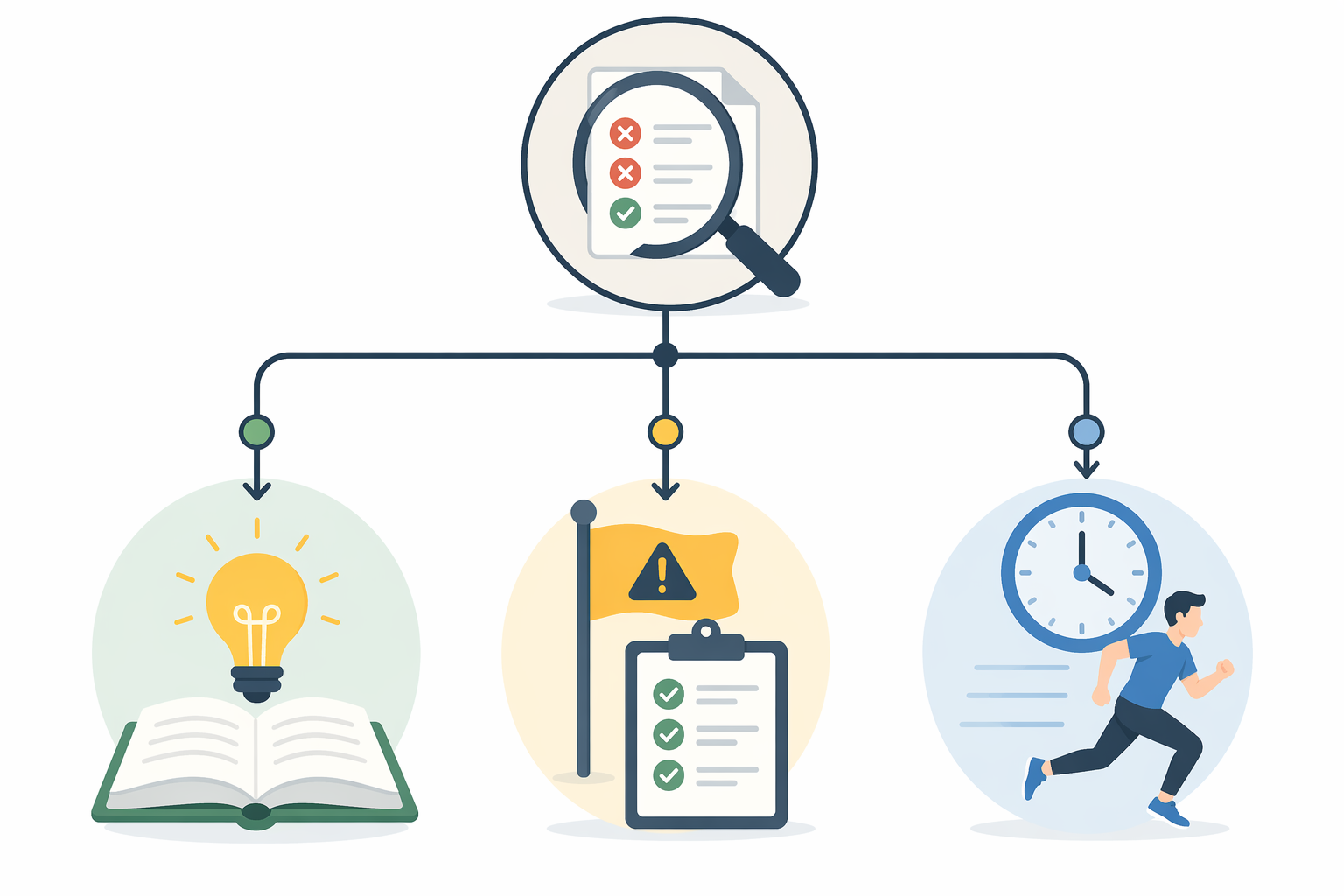
Use three labels: content gap, careless error, and timing issue. This same basic categorization appears across test-prep guidance, including PrepScholar and Strategic Test Prep, because it keeps students from treating every wrong answer the same way.[4][7]
| Error type | How it looks | What to do next |
|---|---|---|
| Content gap | You did not know the rule, formula, concept, or reading move. | Go to Khan Academy for the lesson, then drill the same skill in the Question Bank. |
| Careless error | You knew the method but misread, skipped a word, solved for the wrong value, or made an arithmetic slip. | Add the trap to a checklist and repeat a small set of similar questions slowly. |
| Timing issue | You rushed, guessed late, or spent too long on one question and paid for it later. | Practice timed sets and write down the decision rule for when to skip, mark, or move. |
A content gap should send you backward before it sends you forward. If you miss a systems-of-equations question because you cannot set up the equations, doing 20 more mixed math questions is inefficient. Watch or read the targeted lesson, do a few guided examples, then return to a filtered set. The goal is not to finish a pile of questions. The goal is to make the next similar question look familiar.
A careless error needs a trap checklist, not a lecture about focus. The checklist should be personal: “circle except,” “check whether the question asks for x or 2x,” “plug answer back into the original equation,” “read the full sentence before choosing a punctuation answer.” Five personal traps are more useful than 30 generic tips.
A timing issue needs pacing practice. Write down where the time went. Did you spend four minutes on a hard math question early in the module? Did you reread a Reading and Writing passage three times because you had no plan for the question type? Did you save too many questions for the end? The fix is a timed set with a rule, such as marking a question after one serious attempt and returning only if time remains.
Your error log can be simple. Use columns for date, source, section, domain, question type, difficulty if available, your answer, correct answer, error type, reason, and next action. If that sounds like too much, keep only four columns: question, error type, reason, next action. A small log used every week beats a beautiful spreadsheet abandoned after one Saturday.
For more on using practice questions without turning them into random reps, use How to Use SAT Practice Questions to Actually Raise Your Score. For full-test review habits, use The Right Way to Take SAT Practice Tests.
Retest Only After the Plan Has Had Time to Work
A full Bluebook retest is valuable, but it is expensive in time and attention. Do not spend every weekend taking another full test if you have not reviewed the last one. Retest after you have completed a real study cycle: lessons for content gaps, filtered drills for weak skills, timed sets for pacing, and error-log review for repeated traps.
After the retest, compare more than the total score. Did Math rise but Reading and Writing stay flat? Did Module 1 accuracy improve? Did timing feel better even if the score moved only slightly? Did the same three question types reappear in the error log? The next plan comes from those answers.
Fit the Plan Around 2026 Test Dates
Published 2026 fall SAT dates include August 22, September 12, October 3, November 7, and December 5.[1][8] Treat those dates as planning anchors, then verify the current registration deadlines and availability directly with the College Board before you build your final calendar. Some fall 2026 deadline listings were still marked to be announced in mid-2026 sources, so do not rely on a copied deadline from a prep blog.
Work backward from the test date. The final week should not introduce a new math unit or a brand-new testing strategy. Use it for light review, sleep protection, Desmos comfort, formula and grammar refreshers, and a short pass through your personal trap checklist. If you are still discovering major content gaps three days before the test, record them for the next test date rather than trying to rebuild everything at once.
Bluebook mistakes are also easier to prevent than to repair. Before test week, make sure you know how the tools work, how breaks appear, how the calculator opens, and how your device setup feels. The guide to Bluebook Digital SAT Practice Mistakes is worth reading before your last full practice test, not after the official exam.
When Free Self-Study May Not Be Enough
Free official tools are strong, but they do not solve every problem. If you are aiming for 1500+, if your score has stayed flat after several honest cycles, if you cannot keep the weekly routine without outside accountability, or if the error log keeps showing the same content gaps after lessons and drills, a course, tutor, teacher, or study group may be the right structure.
The point is not to prove that self-study is morally superior. The point is to avoid paying for structure before you have identified the actual gap. A tutor can do much better work with a student who can say, “Here is my diagnostic, here is my target, here are my repeated misses, and here is where I get stuck.”
The System You Should Have Before Test Day
By the time your plan is running, you should be able to name six things without searching through tabs: your current Bluebook score, your target score, your score gap, your test date, your weekly study hours, and your three most expensive error patterns.
That is the difference between “I need to study for the SAT” and “I am 110 points short, I have 10 usable weeks, and Algebra, punctuation, and end-of-module pacing are costing me points.” The second student has a plan the calendar can hold. In 2026, SAT prep is less about finding more resources and more about forcing every practice hour to answer one question: what specific gap is this closing?
References
- The SAT in 2026: Everything You Need to Know — Test Ninjas.
- Digital SAT Format: Sections, Time & Structure Breakdown (2026) — EdisonOS.
- 2025 Total Group SAT Suite of Assessments Annual Report — College Board.
- How to Build an SAT Study Plan: 4 Sample Schedules — PrepScholar.
- How Do I Self-Study for the SAT? — College Essay Guy.
- How to Prepare for the SAT Exam in 2026: Study Plan & Tips — UPI Study.
- 10 Free SAT Prep Tools to Help You Score Over 1500 in 2026 — Strategic Test Prep.
- Preparing for the SAT in 2026? Everything You Should Know — eTutorWorld.
Supporting Resources
- ASVAB Study Apps: Which Ones Actually Boost Your AFQT Score? (Real Data From Users) →
Most ASVAB study apps are just question banks. This guide identifies the ones that combine representative practice, weak-area remediation, and spaced repetition to deliver real score improvements, with before-and-after data from actual users.
- Is Anki Actually Evidence-Based for the MCAT? What the Research Says About Spaced Repetition and Score Improvement →
Skeptical about the time investment Anki requires for MCAT prep? This article examines the peer-reviewed evidence — including a 2023 cohort study showing 6.2–12.9% higher exam scores for Anki users — alongside the valid critiques about the 'Anki trap,' so you can make an informed decision about whether and how to use it.
- How to Use ASVAB Study Apps Effectively: A Study Plan Framework for Scoring 50+ on the AFQT →
Most recruits download an ASVAB app but don't use it systematically. This guide provides a step-by-step study plan framework — from diagnostic testing to timed simulations — to help you turn app access into a competitive AFQT score of 50 or higher.
Comments
Join the discussion with an anonymous comment.