
SAT
Khan Academy's free SAT prep is a strong foundation with proven score gains, but it has specific gaps in test-taking strategies and advanced content. This guide breaks down what it does well, where it falls short, and what supplements you need based on your starting score and target.
Updated:
If you use Khan Academy SAT preparation seriously, it can take you a meaningful distance. The best published evidence in its favor is not small: in a 2017 College Board and Khan Academy analysis of roughly 250,000 students, 6 hours of Official SAT Practice was associated with an average 90-point gain, and 20 hours was associated with an average 115-point gain. More than 16,000 students gained 200 points or more, and the reported gains were consistent across gender, race, family income, and ethnicity.[1][2]
That is the reason Khan Academy deserves to be the starting point in many SAT plans, especially for students who need structure but cannot casually add a paid course to the family budget. The access story is real, too: Khan Academy reported that nearly 40% of all SAT test-takers used its prep, and only 28% of usage happened during school hours, which means a large share of students were doing the work on their own time.[3]

But the same evidence has boundaries. The 115-point figure came from data released in 2017, before the current digital adaptive SAT. It was an association between Khan Academy use and score gains, not a randomized trial proving that Khan Academy caused every point of improvement. It also was not a controlled head-to-head comparison against paid prep. So the right conclusion is strong but narrower: Khan Academy has credible evidence as a high-access foundation, not proof that it is sufficient for every student or every target score.
What Khan Academy Is Especially Good At
Khan Academy is strongest when the problem is content: a student misses linear equations, punctuation boundaries, transitions, systems of equations, ratios, or data interpretation and needs a place to relearn the skill, practice it, and get used to seeing it in SAT-style form. That is not glamorous prep, but it is where many score gains actually begin.
The current digital SAT course is organized into three difficulty levels—Foundations, Medium, and Advanced—and Khan Academy described the early digital course structure as 12 Math units and 4 Reading and Writing units.[4] That imbalance matters, but it also points to one of the platform’s clearest strengths: Math remediation is more visibly scaffolded. A student who is losing points because they never fully learned a skill can make Khan Academy the center of daily work without needing much else at first.
It also reduces the number of decisions a student has to make. Instead of comparing a dozen prep brands, a student can take an official diagnostic, open the related Khan Academy skills, and start. For a student doing this alone after school, that simplicity has value.
The Score Range Matters More Than the Brand Name
The question is not whether Khan Academy is good or bad. It is whether its strengths match the next 100 to 200 points a particular student is trying to earn. A student starting at 980, a student starting at 1150, and a student starting at 1280 do not need the same plan.
If You Are Below Roughly 1100
Khan Academy can reasonably be the core of your prep. At this range, many missed questions usually come from skills that can be rebuilt: algebra fluency, function notation, grammar rules, sentence boundaries, word problem setup, and basic reading precision. Khan Academy is built for that kind of repetition.
The practical plan is simple: take an official Bluebook practice test, identify the skill areas that cost the most points, then use Khan Academy until those categories stop feeling unfamiliar. Do not begin by hunting for obscure tricks. First remove the obvious leaks.
For students in this range, the 2017 gain data is most relevant in spirit even though it predates the digital SAT. A 90- or 115-point average associated gain is large enough to change a testing plan, especially if it moves a student into a new scholarship band, a stronger application range, or simply closer to a school’s middle 50% score range.[1][2]
If You Are Around 1100 to 1250
Khan Academy is still useful, but it should become more targeted. At this range, students often know some content but lose points unevenly: one week it is advanced punctuation, the next it is nonlinear equations, then it is a reading question where two answer choices feel defensible. More practice alone can help, but only if review becomes sharper.
The work should shift from “complete more lessons” to “explain why each missed answer happened.” Was it a missing rule, a careless setup, a vocabulary problem, a timing decision, or a trap answer? Khan Academy gives you practice, but it does not fully solve the review system for you. A spreadsheet, notebook, or error log becomes part of the prep.
This is also the range where Reading and Writing needs more attention. The digital course structure has more Math units than Reading and Writing units, and several independent reviews converge on the concern that Khan Academy’s Reading and Writing support is thinner than its Math support.[4][5][6] That does not make the Reading and Writing material useless. It means students should watch for plateaus sooner.
If You Are Aiming for 1300+
Khan Academy is a foundation here, not the whole house. A student already near the upper ranges is often trying to gain points from fewer, harder misses: advanced algebra, function behavior, subtle transitions, rhetorical purpose, words in context, and timing choices under adaptive-test pressure. At that point, the missing piece is not always another lesson. It may be test strategy, deeper answer review, or more realistic full-test practice.
This is where the repeated outside critiques become useful, even allowing for the fact that several reviewers operate in the test-prep market. PrepScholar criticizes Khan Academy for limited test strategy and weak explanations; PrepMaven points to weaker Reading and Writing support and a clunky experience for targeted practice; Sharp highlights the lack of Desmos instruction; McElroy Tutoring argues that Khan questions can be similar to but not identical with real SAT questions; and TestPrepInsight concludes that Khan Academy is strongest for students below 1100 rather than students already pushing high scores.[5][6][7][8][9]
None of those critiques should be treated as a controlled study proving that paid prep is better. They are better read as a pattern: when students need high-score precision, Khan Academy leaves some jobs unfinished.
| Starting Point | How to Use Khan Academy | What to Add |
|---|---|---|
| Below roughly 1100 | Use it as the main daily program for Math and Reading and Writing foundations. | Official Bluebook practice tests; optional free bootcamp if eligible. |
| Around 1100–1250 | Use it for targeted skill repair after each practice test. | Error log, deeper review of Reading and Writing misses, timing practice. |
| Around 1250–1300+ | Use it to patch specific weak skills, not as the full plan. | Bluebook test strategy, Desmos fluency, advanced Reading and Writing work, stronger mistake tracking. |
The Modern Workflow Is Khan Academy Plus Bluebook
For the digital SAT, students should not expect Khan Academy to contain the whole official practice-test experience. Since January 2024, full-length adaptive SAT practice tests have lived in the College Board’s Bluebook app, while Bluebook results can link back to Khan Academy for targeted skill practice.[10]
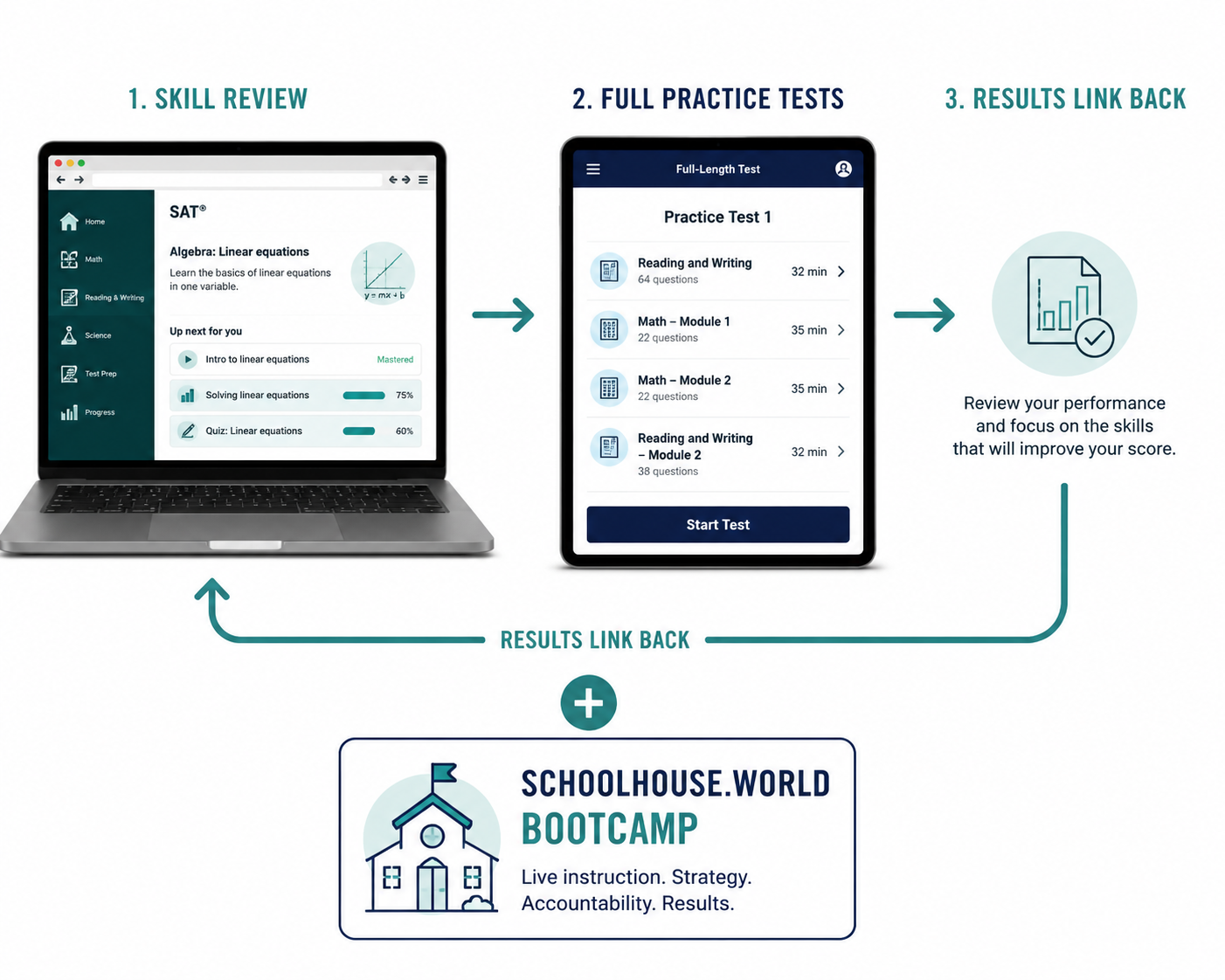
That two-platform split is not a nuisance to ignore; it is the prep workflow. Bluebook shows how the student performs in the official digital testing environment. Khan Academy helps repair the skills exposed by that performance. Then the next Bluebook test checks whether the repair transferred under test conditions.
- Take a full Bluebook practice test under realistic conditions.
- Review the score report by section and skill area.
- Use Khan Academy for the skills that are actually costing points.
- Keep a separate mistake log for misses that Khan Academy does not clearly explain.
- Take another Bluebook test only after enough targeted review has happened.
If you want the mechanics of that loop spelled out, use this guide to taking SAT practice tests with Bluebook and Khan Academy. Students comparing official and unofficial tests should also be careful about test realism; this breakdown of which digital SAT practice tests are most accurate is the better place for that decision.
The Gaps That Actually Need Supplements
A supplement should have a job. Adding tools because a dashboard looks nicer or a parent is nervous can turn prep into busywork. The useful question is: what is Khan Academy not doing well enough for this student’s next score jump?
Digital Test Strategy
Khan Academy teaches skills more directly than it teaches a complete testing strategy. Students still need to practice when to skip, when to guess, how to manage the shorter digital modules, how to avoid over-investing in one hard question, and how to use the built-in testing tools without wasting time.
Bluebook is the right place to practice that behavior because it is the official testing app. But students can also misuse it by taking too many practice tests too quickly or reviewing only the score. Before burning through official tests, read the common Bluebook digital SAT practice mistakes.
Reading and Writing Depth
Khan Academy can help with Reading and Writing foundations, but the course structure and outside reviews both point to a lighter experience than Math.[4][5][6] Students aiming for a strong section score should not stop at recognizing the rule. They need to explain why the wrong answers are wrong, especially on transitions, rhetorical synthesis, command of evidence, and words-in-context questions.
The supplement here does not have to be expensive. It can be a disciplined answer-review routine: write the tested skill, the trap you picked, the phrase in the passage that proves the correct answer, and the rule or reasoning you will use next time. The point is to make Reading and Writing review visible instead of letting it dissolve into “I narrowed it down to two.”
Desmos Fluency
The digital SAT gives students access to Desmos, and that changes how some Math questions should be approached. Sharp specifically identifies lack of Desmos instruction as a Khan Academy gap.[7] That matters because Desmos is not just a calculator; it can be a strategy tool for graphing, checking systems, testing function behavior, and confirming solutions.
A student who can solve everything by hand may still be slower than a student who knows when Desmos is the cleaner route. The supplement is not random calculator play. It is practicing official-style Math questions twice: once by hand, once with Desmos, then deciding which method should be used under time pressure.
Mistake Tracking
Khan Academy provides practice and feedback, but students who are trying to break a plateau usually need a more explicit mistake system. The test does not care that a student completed a unit. It cares whether the student stops making the same error when the skill appears in a slightly different package.
| Log This | Why It Matters |
|---|---|
| Question type | Shows whether misses cluster by skill rather than by section. |
| Error cause | Separates content gaps from timing, misreading, and careless setup. |
| Correction rule | Turns a missed question into a repeatable decision. |
| Retest date | Checks whether the fix survived after a few days. |
Where Schoolhouse.world Fits
Schoolhouse.world can be a useful free layer for students who want live structure. Its SAT bootcamps are described as 4-week programs that meet twice per week for 75 minutes, with a maximum of 10 students, and they are available for students scoring 400–690 per section.[11]
That eligibility range is important. Schoolhouse is not the missing free answer for every advanced student trying to move from a 700 section score to something higher. It is better viewed as a structure and accountability option for students within the eligible band who would benefit from live peer tutoring alongside Khan Academy skill work.
When Paid Prep Enters the Conversation
There is no solid basis here for saying paid prep is automatically better than Khan Academy. The available evidence does not provide a controlled comparison showing that a paid course beats Khan Academy for similar students using similar study time. Some paid-prep critiques of Khan Academy are useful because they identify repeated weaknesses, but they also come from organizations with their own incentives.
Paid help starts to make more sense when the student has a specific unsolved problem: repeated high-score Reading and Writing misses, weak pacing under the adaptive format, no progress after several carefully reviewed Bluebook tests, or a need for outside accountability. If the issue is simply “I have not learned the content yet,” Khan Academy should usually get a serious attempt first.
Families comparing free and paid layers can use a broader SAT prep toolkit guide before buying anything. If you are already looking at commercial options, this Kaplan SAT prep plans guide is a more specific comparison point.
A Practical Verdict
Khan Academy SAT preparation is enough to begin, and for many students below roughly 1100 it can be the main program for a substantial stretch of prep. It is free, official, skill-based, and backed by large-scale evidence showing meaningful associated score gains under the older SAT format.[1][2]
For students aiming around 1300 or higher, it should not be treated as the entire plan. Keep Khan Academy for skill repair. Add Bluebook for official adaptive practice. Build a real mistake log. Add Desmos practice if Math timing or method choice is costing points. Give Reading and Writing review more structure than Khan Academy alone provides. Use Schoolhouse.world if you fit the score band and need live support.
That stack is still budget-conscious. It just refuses to confuse a strong free foundation with a complete prep system for every target.
References
- Studying for the SAT for 20 hours on Khan Academy associated with 115-point average score increase — Khan Academy Blog
- New Data Links 20 Hours of Personalized Official SAT Practice on Khan Academy to 115-Point Average Score Gains — College Board
- SAT Prep and Equity: What the Data Shows — Khan Academy Blog
- Preparing for the digital SAT: A Guide to Transitioning — Khan Academy Blog
- Khan Academy SAT Will Never Be Enough - Here's Why — PrepScholar
- Khan Academy Review: Is It The Best SAT Prep Service? — PrepMaven
- Is Khan Academy enough for SAT prep? — Sharp Blog
- What happened to Khan Academy—and is the SAT Getting Harder in 2024? — McElroy Tutoring
- Khan Academy SAT Prep Review (Better Than Kaplan?) — TestPrepInsight
- Is Official SAT Practice on Khan Academy as good as expensive test prep? — College Board
- Free SAT Tutoring | Schoolhouse SAT Bootcamps — Schoolhouse.world
Supporting Resources
- A Complete Guide to Kaplan SAT Prep Plans for 2026 →
A detailed breakdown of every Kaplan SAT prep plan for 2026, including On Demand, Live Online, Bootcamp, Unlimited Prep, and Private Tutoring, with honest pricing, features, and limitations to help you decide which plan is worth your money.
- Faithlife Study Bible for Students: How Seminary Students and College Christians Can Use This Free Tool →
This article shows college and seminary students how the free Faithlife Study Bible can serve as a powerful, budget-friendly study tool. It covers the app's original-language notes, visual resources, and cross-platform availability, and explains how to use it alongside other tools for deeper academic study.
- Google Gemini Free SAT Practice Test: What to Expect and How to Use It →
Google Gemini now offers free full-length SAT practice tests powered by Princeton Review content. This guide explains how to access it, what it does well, and where documented accuracy issues mean you should treat it as a supplementary tool — not a replacement for official College Board materials.
Comments
Join the discussion with an anonymous comment.