
SAT
There are more than a dozen free SAT practice tests for the digital SAT, but they vary widely in quality and accuracy. This guide ranks the best sources and shows the optimal sequence to use them for real score improvement.
Updated:
A free SAT practice test is only useful if it answers the question you actually care about: what would happen on the real digital SAT? In 2026, the answer depends less on how many tests you can find and more on whether the test can reproduce the College Board’s adaptive structure. Plenty of free PDFs, quizzes, and generated question sets can help you practice. Far fewer can tell you whether your score is ready to move.
The safest ranking is simple: use official College Board Bluebook tests to measure readiness, Khan Academy and the Student Question Bank to repair the skills those tests expose, and third-party resources for extra volume after you know what your official baseline looks like. That order matters. If you burn through the best official tests like casual worksheets, you lose the cleanest evidence you have.

The free SAT practice tests worth trusting first
Here is the working hierarchy. It is not a list of every free SAT page on the internet; it is a ranking by usefulness for score prediction and score improvement.
| Rank | Free source | Best use | What to watch |
|---|---|---|---|
| 1 | College Board Bluebook official digital SAT tests | Most accurate full-length benchmark for the digital adaptive SAT | Do not waste them as untimed worksheets |
| 2 | College Board Student Question Bank | Official targeted drilling by skill and difficulty | Questions are practice, not a full adaptive score predictor |
| 3 | Khan Academy Official SAT Practice | Skill repair after a test reveals weaknesses | Best when connected to missed-question review, not random video watching |
| 4 | Piqosity free digital adaptive tests | Closest third-party adaptive-style practice among the listed free options | Score claims are proprietary, not College Board validation |
| 5 | Mometrix free practice test materials | Spotting common difficulty patterns and getting extra practice | Useful, but not a replacement for official adaptive testing |
| 6 | Google Gemini with Princeton Review content, Magoosh, Test Ninjas, BestColleges roundups | More reps, resource discovery, and generated practice | Question style and difficulty may drift from the real SAT |
| 7 | Trackers and AI explanation tools | Error logging, pattern spotting, and follow-up explanations | They organize practice; they do not certify readiness |
If you only remember one rule, make it this: the more a resource looks like the official digital SAT under timed, adaptive conditions, the more you can trust it as a score benchmark. The further it moves toward loose practice, generated questions, or printable review, the more it belongs in the “training” bucket instead of the “measurement” bucket.
Why Bluebook has to anchor the plan
College Board’s Bluebook app is the official testing platform for digital SAT practice. College Board lists official full-length digital practice tests in Bluebook and also provides paper linear versions for students who need or want nonadaptive practice formats.[1] PrepScholar reported that Bluebook had eight active digital SAT practice tests, Tests 4–11, as of June 2026; PrepMaven had reported seven, Tests 4–10, as of December 2025, so the current count is worth checking directly in Bluebook when you sit down to plan.[2][7]
That uncertainty about whether the active count is seven or eight does not change the main point. These are the tests you protect. They are the closest free version of the real testing experience because they use official questions, official timing, and the digital SAT’s module structure.
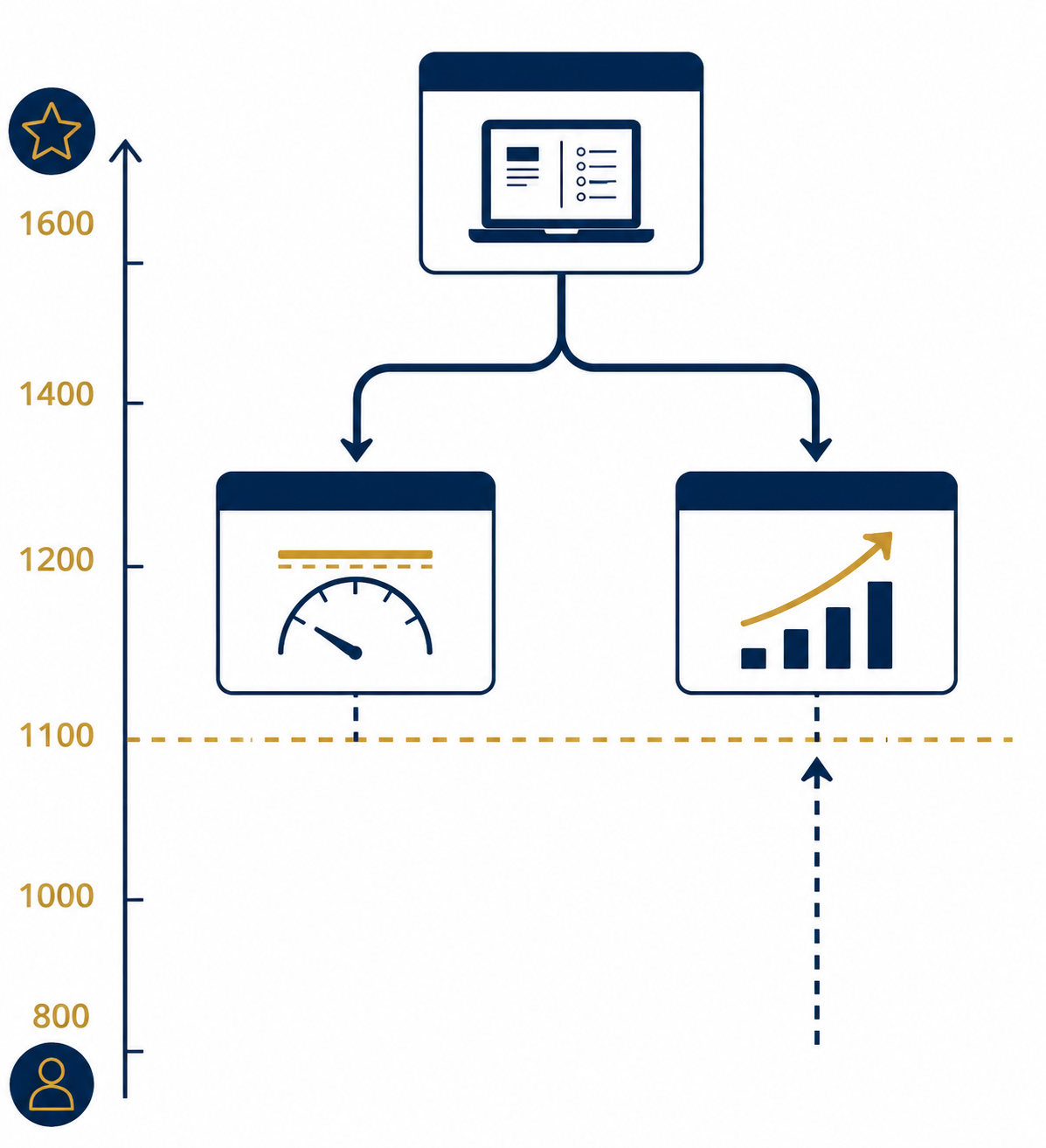
The adaptive structure is the reason generic “full-length” practice can mislead you. On the digital SAT, your performance in the first module affects whether you see the easier or harder second module. The key consequence is blunt: if you do not reach the harder Module 2b, your maximum score is capped at approximately 1100 out of 1600. That does not mean every student below 1100 failed in the same way, and it does not mean one module alone explains a whole score. It does mean a nonadaptive free test can make progress look cleaner than it really is.
This is where many students lose weeks. They take five free tests that all give them plenty of questions, then get surprised when Bluebook feels different. The problem was not that they practiced too much. The problem was that they used low-stakes volume before establishing whether they could survive the adaptive jump.
Where the paper linear tests fit
The paper linear versions are still official College Board material, so they are better than random worksheets for question style. But they do not carry the same diagnostic weight as Bluebook because they are not reproducing the adaptive path. Use them for extra official practice, accommodations-related familiarity, or section review. Do not let a strong paper score convince you that you have already handled the digital adaptive version.
Use the Student Question Bank between full tests
The College Board Student Question Bank gives you a large supply of official questions that can be filtered by skill and difficulty. PrepScholar describes it as containing more than 1,000 official questions, which is more than enough for targeted drilling between full-length tests.[2]
That is its proper job. If Bluebook shows that you miss command of evidence questions, linear equations, or advanced punctuation under time pressure, the Question Bank lets you practice the exact type of work that failed. It is not as glamorous as taking another full test, but it is usually where the score movement starts.
Khan Academy is the repair system, not the scoreboard
Khan Academy remains the most important free companion to Bluebook because it turns missed-question patterns into lessons and practice. When a student completes official practice, Khan Academy can recommend skill work tied to what went wrong; that makes it more useful than a generic playlist of SAT tips. For a deeper walkthrough of that two-platform setup, use How to Take SAT Practice Tests with Bluebook and Khan Academy.
The score-gain evidence often cited for Khan Academy should be read carefully. A 2017 College Board/Khan Academy analysis of roughly 250,000 students found an average gain of about 90 points from 6 hours of Official SAT Practice and about 115 points from 20 hours.[3] That is encouraging, but it is not a guarantee that watching a few videos will move your score. It describes an average association within that official-practice context, not a promise for every student or every study routine.
The best use is narrower and stronger: take an official benchmark, review what you missed, assign Khan Academy practice to those skills, then come back to official questions to check whether the mistake pattern changed. If you want more detail on where Khan Academy helps and where it runs out, see How Far Can Khan Academy SAT Prep Take You?.
The best third-party free SAT practice tests
Third-party practice can be genuinely useful. It can give you extra reps, help you stay in timed-test shape, and expose you to more explanations. It becomes a problem only when it starts pretending to be the official scoreboard.
Piqosity: strongest free third-party adaptive option
Piqosity offers 12 full-length digital adaptive SAT tests, with 2 available free, making it the closest free third-party match to the Bluebook-style experience among the options covered here.[4] That does not make it official, but it does make it more useful than a static PDF when you need additional timed practice after your Bluebook baseline is established.
Piqosity also reports proprietary research suggesting roughly 40 points of improvement per 7 hours of quality studying.[4] Treat that as Piqosity’s finding, not as a universal SAT law. The safer takeaway is that structured practice time matters more than just collecting tests.
Mometrix: useful for common difficulty patterns
Mometrix reports an analysis of 22,000 test-takers in which about 70% missed the same 5 questions.[5] That kind of pattern is worth noticing because students often assume every miss is personal and random. Sometimes a question is doing a predictable job: testing a common trap, a dense wording move, or a skill many students have half-learned.
Use Mometrix as extra practice and as a way to notice recurring traps. Do not use it as your final answer on whether you are ready for test day.
Google Gemini with Princeton Review content: good for more reps, weaker for score evidence
Strategic Test Prep notes that Google Gemini, with Princeton Review content, can generate free SAT practice tests on demand.[6] That can be handy when you need more examples, especially if you are trying to stay active between official benchmarks. The limitation is also clear: third-party generated questions may not perfectly match official SAT style or difficulty.[6]
Use generated practice for repetition, not diagnosis. If Gemini produces a reading question that feels close enough to practice main idea or evidence use, fine. If it gives you a score estimate that conflicts with Bluebook, trust Bluebook. For paid Princeton Review context, see Your Guide to Princeton Review SAT Prep Courses in 2026.
Magoosh, Test Ninjas, and BestColleges: useful discovery sources
Magoosh maintains a list of 6+ free SAT resources, Test Ninjas provides free digital SAT practice resources, and BestColleges publishes both a top-10 free SAT prep resources list and an 18-practice-tests roundup.[8][9][10] These are useful when you have already used the official ecosystem correctly and need more practice options.
Just keep the categories clean. A roundup can help you find resources. A free third-party test can help you build stamina. Neither should overrule an official Bluebook result.
How many full-length practice tests should you take?
There is no magic number, but the outside estimates are useful guardrails. PrepScholar recommends taking at least 4–6 full-length practice tests before test day, Strategic Test Prep recommends 8–12 weeks of consistent prep, and PrepMaven says most high-scoring students take 10 or more practice tests.[2][6][7]
The mistake is turning those numbers into a race. Ten sloppy tests with no review are not better than four serious tests with targeted repair between them. A full-length test should create work for the next week, not just a score for the next five minutes.
A free SAT practice sequence that actually makes sense
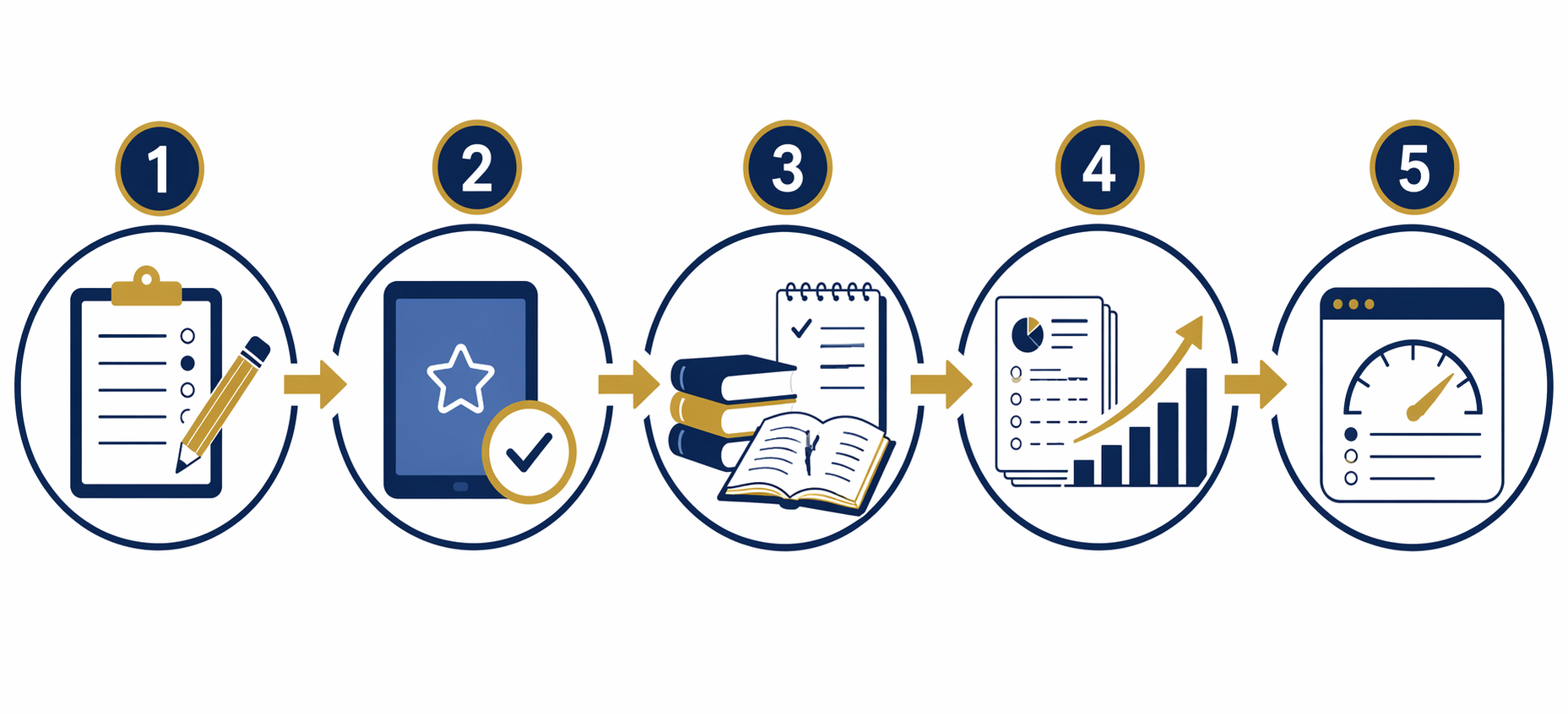
The right order keeps official tests meaningful while still giving you enough practice volume. Think in phases, not in a pile.
- Take one official Bluebook test as a diagnostic under real timing.
- Review every missed and guessed question before choosing new practice.
- Use Khan Academy and the Student Question Bank for the exact weak skills.
- Add third-party adaptive or timed practice when you need more volume.
- Return to Bluebook for a benchmark only after you have completed real repair work.
Step 1: Take the diagnostic seriously
Your first diagnostic should be official, timed, and taken in one sitting if possible. Do not pause constantly, look up formulas midstream, or split the test across random days and then call the score real. If you need help choosing a baseline test and interpreting the result, start with How to Use SAT Practice Test 1 as a Diagnostic Baseline.
The diagnostic is not there to flatter you or scare you. It tells you which section is leaking points, whether timing is part of the problem, and whether your first-module performance is strong enough to put the harder second module in play.
Step 2: Turn the score report into a repair list
After the diagnostic, do not immediately take another full test. Sort the misses first. You are looking for patterns: algebra setup, function notation, transitions, punctuation, command of evidence, vocabulary in context, or running out of time near the end of a module.
This is where Khan Academy and the Student Question Bank do the heavy lifting. Khan gives you instruction and guided practice; the Question Bank gives you official reps filtered to the skills that need work. If a miss was careless, write down the habit that caused it. If a miss was conceptual, assign the lesson. If a miss came from timing, practice the question type under a clock.
Step 3: Use third-party tests only after the official baseline is clear
Once you know your official weak spots, third-party tests become much more useful. Piqosity can give you extra adaptive-style full-length practice. Mometrix can expose common traps. Gemini-generated practice can keep you moving when you need more examples. Magoosh, Test Ninjas, and BestColleges can help you find additional free materials.
The condition is that you keep comparing them back to the official standard. If a third-party math section feels much harder, that may build toughness, but it does not automatically mean your SAT math score is lower. If a generated reading set feels easy, that does not mean you have mastered the official reading and writing section.
Step 4: Track errors instead of collecting scores
Strategic Test Prep offers a free Google Sheets tracker designed to help students identify accuracy rates by question type and link directly to practice sets.[6] A tracker like that is boring in the best possible way. It forces you to see whether “I’m bad at math” actually means linear equations, nonlinear functions, geometry, or rushing on medium questions.
ChatGPT or another AI tool can also help explain why an answer is wrong, rewrite a concept in simpler language, or generate a few additional examples. But if an AI explanation conflicts with the official answer or teaches a shortcut that only works on its own generated question, drop the shortcut. The official question wins.
Step 5: Save Bluebook tests for real benchmarks
A benchmark should happen after enough practice to plausibly change the result. For many students, that means one official test at the start, one after a focused repair cycle, one a few weeks before test day, and one final check close enough to the test that it still reflects current skill. If you have access to more official tests, you can use more, but each one should answer a real question.
Good benchmark questions sound like this: Did my reading and writing timing improve? Am I reaching the harder second module more consistently? Did the algebra practice transfer under pressure? Is my target score realistic for the next test date, or do I need a longer runway?
A practical 8–12 week free prep plan
If you are starting with 8–12 weeks, you have enough time to use free materials well. The plan does not need to be complicated.
| Timeframe | Main action | Best free resources |
|---|---|---|
| Week 1 | Take an official diagnostic and review every miss | Bluebook, score report, error tracker |
| Weeks 2–3 | Repair the highest-value weak skills | Khan Academy, Student Question Bank |
| Week 4 | Take a timed practice test or section set | Piqosity, Mometrix, official paper practice if appropriate |
| Weeks 5–6 | Drill recurring misses and timing problems | Khan Academy, Student Question Bank, tracker |
| Week 7 | Take another official Bluebook benchmark | Bluebook |
| Weeks 8–10 | Add volume without ignoring review | Piqosity, Gemini with Princeton Review content, Magoosh, Test Ninjas |
| Final 1–2 weeks | Use one final official benchmark and light targeted review | Bluebook, Student Question Bank, Khan Academy |
If you are still deciding whether the SAT is the right test to prioritize, do that before you build a long practice schedule. The comparison in How to Decide Between SAT and ACT Prep in 2026 can help you avoid spending weeks on the wrong exam. And if free self-study starts to stall, How to Choose Between Local SAT Prep and Online Courses can help you decide whether paid support is worth considering.
Quick answers about free SAT practice tests
Are free SAT practice tests enough?
For many students, yes. Free can be enough if official Bluebook tests anchor the plan, Khan Academy and the Student Question Bank handle skill repair, and third-party resources supply extra practice without replacing official benchmarks. Free is not enough if you keep taking tests without reviewing them.
Which free SAT practice test is most accurate?
The official Bluebook digital SAT tests are the most accurate free benchmarks because they come from College Board and reproduce the digital testing environment. For a deeper accuracy comparison, see Which Digital SAT Practice Tests Are Most Accurate?.
Should I take every free SAT test I can find?
No. Take enough full-length tests to build stamina and measure progress, but spend at least as much energy reviewing mistakes and drilling weak skills. A student who reviews one official test deeply usually learns more than a student who rushes through three unofficial tests and only checks the score.
Can third-party adaptive tests replace Bluebook?
No. The better third-party tools can be excellent practice, especially when they mimic digital timing and adaptive structure, but they are still secondary. Use them to increase volume after you understand your official baseline.
What should I do if my Bluebook score is lower than my unofficial scores?
Believe the Bluebook score first. Then inspect why the difference happened: timing, adaptive module placement, harder official wording, or weak spots the unofficial test did not hit. That gap is not a disaster; it is the reason official benchmarks exist.
Free SAT practice can absolutely move a score, but only when the official adaptive tests stay at the center. Use Bluebook to measure, Khan Academy and the Student Question Bank to repair, third-party tests to add volume, and trackers or AI tools to keep mistakes visible. The source is free; the order is what makes it work.
References
- SAT Practice and Preparation, College Board.
- Digital SAT Practice Tests, PrepScholar.
- How Far Can Khan Academy SAT Prep Take You?.
- Digital SAT Prep, Piqosity.
- SAT Practice Test, Mometrix.
- SAT Prep Resources, Strategic Test Prep.
- Digital SAT Practice Tests, PrepMaven.
- Free SAT Resources: The Ultimate List, Magoosh.
- Digital SAT Practice Resources, Test Ninjas.
- Free SAT Prep Resources, BestColleges.
Supporting Resources
- How to Use Anki for the MCAT: A Complete Step-by-Step Guide →
A practical, no-fluff guide for pre-med students new to Anki. Covers deck selection, FSRS configuration, daily review habits, and how to integrate Anki into a balanced MCAT study plan that prioritizes practice passages and full-length exams.
- ESV Study Bible App: A Complete Profile of Features, Pricing, and Best Use Cases →
A comprehensive profile of the ESV Bible app for students, pastors, and serious readers. We cover the free tier, premium subscription, study tools, audio experience, and who this clean single-translation reader is best for — and where it falls short as a study platform.
- Your Guide to SAT Test Tutoring Near Me →
Learn how to find, evaluate, and choose the right SAT test tutoring near you. This guide provides a structured framework for comparing qualifications, pricing, and teaching styles so parents can avoid overpaying and select a tutor who actually improves scores.
Comments
Join the discussion with an anonymous comment.