

7 Bluebook Digital SAT Practice Mistakes That Are Costing You Points
Identify the seven most common mistakes students make when using Bluebook for digital SAT practice and learn how to fix each one to avoid false confidence and maximize your score.
Updated:
The most dangerous Bluebook digital SAT practice mistake usually starts with a perfectly normal screenshot: a student finishes a full-length test, sees a decent score, sends it to a parent or tutor, and feels the room relax.
That score may be useful. It may also be much less useful than it looks. Bluebook is the closest thing students have to the real digital SAT environment, which is exactly why careless practice inside it can do real damage. There are only about seven active full-length Bluebook practice tests available now, with Tests 1–3 retired in February 2025 and Tests 4–10 remaining in circulation, according to prep-source tracking at the time of writing.[1][2] Once a student burns through those tests casually, the family has fewer clean benchmarks left for the final weeks before the actual SAT.
The issue is not that Bluebook is bad practice. It is that students often use official tests in ways that hide weak pacing, shaky Module 1 accuracy, overreliance on memory, and review habits that never turn mistakes into future points. If you are building a longer prep plan, Bluebook should sit inside a larger system, not become the whole system. A 90-day digital SAT practice schedule can help space official tests instead of spending them all in the first burst of motivation.
Mistake 1: Treating Official Bluebook Tests Like Regular Worksheets
The behavior is easy to recognize: a student takes a Bluebook test on a random weeknight, pauses between sections, checks texts during the break, finishes late, maybe reviews a few missed questions, then starts another official test a few days later because “more practice” feels productive.
The point-costing mechanism is scarcity. Official Bluebook tests are valuable because they are close to the actual digital SAT workflow. They are not valuable in the same way a worksheet or question bank is valuable. A worksheet can be repeated, chopped up, and used for targeted drilling. A clean official test is most useful when it can still tell you something honest about readiness.
Once a student has seen the questions, the test becomes less predictive. Even if the student does not remember exact answers, the passages feel familiar, the hard math setup rings a bell, and the trap answer that was confusing last time is easier to avoid. That can produce a score that feels like growth but is partly recognition.
The replacement habit is to assign each Bluebook test a job before opening it. Early in prep, use one official test as a diagnostic. In the middle, use official tests sparingly to check whether the study plan is working. In the final stretch, save the newest and most relevant Bluebook forms for full test-day rehearsal. For extra reps between those checkpoints, use Khan Academy, question banks, tutor-created sets, AI-supported drills, or other supplemental tools. Bluebook should measure progress; it should not be the place where every skill gets learned from scratch.
A broader SAT exam prep guide is useful here because it separates official benchmarking from skill practice, strategy practice, and review. Those jobs overlap, but they are not identical.
Mistake 2: Retaking Bluebook Tests and Trusting the Jump
Retaking a Bluebook test is not useless. It can be a fine way to check whether a student understands previously missed questions. The mistake is treating the second score like a fresh prediction.
Practitioner estimates from tutor communities often put Bluebook retake inflation around 20–50 points, mainly because students remember question structures, answer choices, or pacing landmarks. That range is not a peer-reviewed College Board statistic, so it should be treated as a practical rule of thumb rather than settled research.[3]
The score inflation matters because it changes behavior. A student who retakes a test and jumps from 1280 to 1330 may stop reviewing the exact habits that still cost points on new material. A parent may see the higher number and assume the prep plan is working. Then a new Bluebook test, or the real SAT, gives the family a colder answer.
| If the Bluebook test is... | Use the score for... | Do not use it for... |
|---|---|---|
| A first attempt under realistic conditions | A benchmark and review map | Proof that the next official score is guaranteed |
| A retake after review | Checking whether old errors were understood | A clean score prediction |
| A partial or interrupted attempt | Targeted practice notes | Comparing against full-length test scores |
The replacement habit is to label retakes clearly. Write “retake” next to the score. Track the missed questions separately from first-attempt results. If the retake score rises, ask what changed: Did the student apply a new rule, manage time better, and avoid the same trap? Or did the passage simply feel familiar?
Mistake 3: Rushing Module 1 to Save Time for Module 2
On the digital SAT, Module 1 does more than start the section. Performance in Module 1 helps determine whether the student is routed into the harder, higher-scoring Module 2 or the easier Module 2.[4][5] That does not mean a single question decides everything, and students do not need a full adaptive-testing lecture to use the information well. The practical lesson is simpler: careless misses in Module 1 are expensive.
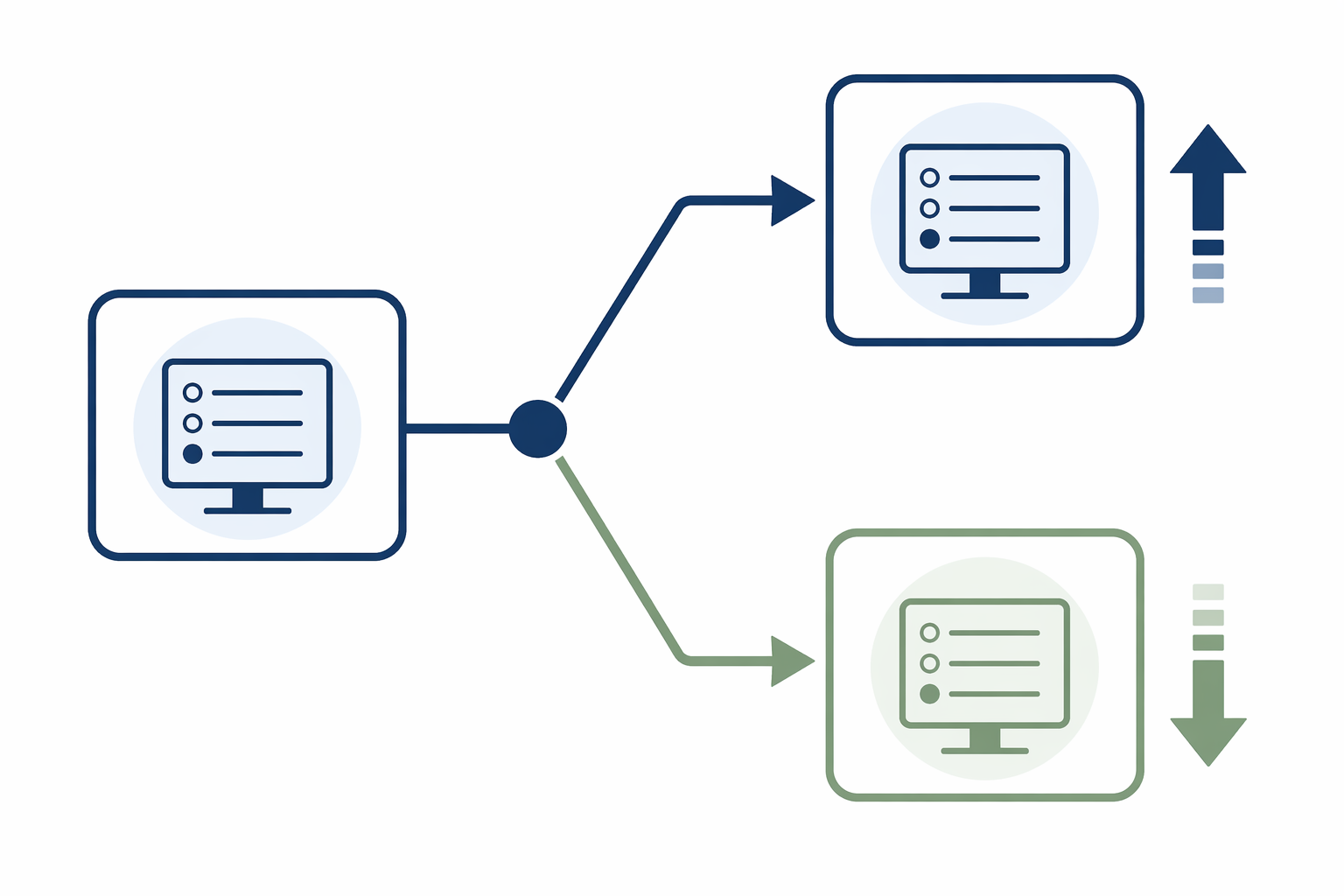
The common Bluebook behavior is a student racing through the first module because the second module has a reputation for being harder. The student thinks, reasonably enough, that saved minutes will be useful later. The problem is that those saved minutes may come from missed details on questions the student actually knew how to solve.
The replacement habit is to treat Module 1 as the gate, not the warm-up. In Reading and Writing, that means reading the actual question stem before falling in love with an answer choice, checking transition words, and refusing to skim the final sentence of a short passage. In Math, it means using quick checks on signs, units, and what the question asks for before moving on.
Pacing still matters. The fix is not to crawl through Module 1. The fix is to stop donating points through preventable haste. A student who finishes Module 1 with six minutes left and three careless misses has not managed time well; the student has transferred score potential into unused minutes.
Mistake 4: Ignoring Bluebook’s Built-In Tools Until Test Day
Bluebook is not just a container for questions. It includes tools students are expected to use fluently: the Desmos calculator, answer eliminator, flag-for-review, annotation tools, and “Get Tailored Practice.” College Board’s own Bluebook guidance highlights several of these tools, and tutor resources repeatedly point out that students underuse them in practice.[6][7]
The costly behavior is waiting until the real test to decide when a tool is worth using. A student who has never practiced eliminating answers inside the app may reread the same four choices again and again. A student who flags too many questions has created a second section instead of a review queue. A student who treats Desmos as an emergency calculator may miss the questions where graphing, solving, or checking a model would have been faster than handwork.
Desmos deserves special attention because it is powerful enough to save time and powerful enough to waste it. Students need a decision rule, not just calculator access. Use Desmos when it can graph a relationship, solve a system, test answer choices, or verify an algebraic result faster than manual work. Do not open it automatically for every arithmetic step. A Desmos decision framework helps students decide before the clock is running.
- Use the answer eliminator when a choice is definitely wrong, not when it merely feels unattractive.
- Flag only questions that have a realistic path to being fixed on review.
- Annotate Reading and Writing questions when the note will direct a decision, such as “contrast,” “evidence,” or “main claim.”
- Use Get Tailored Practice after a test to turn Bluebook results into targeted work instead of vague studying.
The replacement habit is tool rehearsal. During every official practice test, the student should use the same tool rules planned for test day. If a tool slows the student down in practice, that is not a reason to ignore it forever; it is a reason to practice it outside a full-length test until it becomes automatic.
Mistake 5: Making the Practice Environment Easier Than the Real One
A Bluebook test taken on a couch, with snacks nearby, a phone face-up, and flexible breaks, may still teach content. It does not fully test readiness. The real digital SAT includes a specific app workflow, section timing, device management, admission logistics, and the mental pressure of knowing the score counts.
This matters even when the app works as intended. In March 2025, College Board reported an auto-submit issue affecting 8,855 international students, equal to 12.8% of international test-takers, and 0.6% of domestic test-takers for that administration.[8] That incident should not be turned into a permanent scare story about Bluebook reliability. It does, however, show why tech readiness is now part of test readiness.
The replacement habit is a test-day rehearsal, not just a question session. Charge the device. Use the same approved calculator plan. Sit at a desk. Put the phone away. Follow official timing. Take only the allowed break. Do not pause the test to answer a question from a parent, look up a formula, or refill water. If something goes wrong, write it down afterward as part of the review.
Students do not need every practice session to be a full simulation. Many sessions should be shorter and skill-specific. But when a session is labeled “full Bluebook practice test,” the conditions should be honest enough that the score can mean something.
Mistake 6: Reading the Score Report and Skipping the Autopsy
This is the mistake that wastes the most good data. The student finishes Bluebook, checks the total score, maybe checks section scores, feels happy or disappointed, and moves on. The parent sees “practice test completed” and assumes progress happened. But completion is not the same as learning.
Tutor review methods commonly recommend categorizing every missed question by cause, often with a simple three-column review structure. Sources such as 1600.now and IVY Lounge Test Prep emphasize that the review process should distinguish content gaps from careless errors, misread or misinterpreted questions, and pacing problems.[2][9]
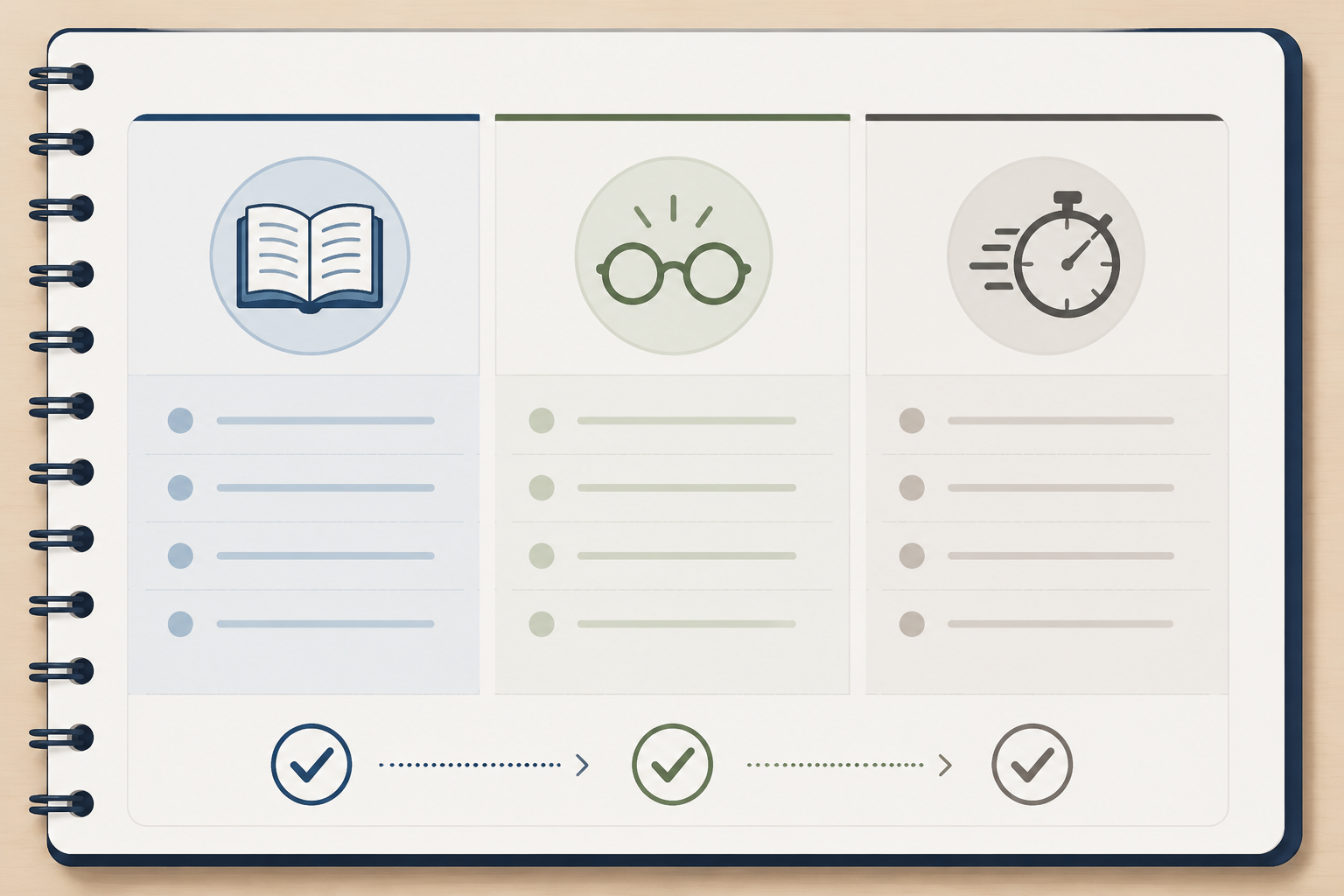
The categories matter because they lead to different fixes. A content gap means the student did not know the grammar rule, math concept, vocabulary relationship, or problem type well enough. A careless error means the student had the skill but lost the point through execution. A misread or misinterpretation means the student answered a nearby question instead of the one Bluebook asked. A pacing issue means the student’s time decisions made the miss more likely.
| Missed question cause | What it usually means | Next action |
|---|---|---|
| Content gap | The underlying skill is weak or missing | Study the rule or concept, then drill similar questions outside Bluebook |
| Careless error | The student knew the method but executed poorly | Identify the exact slip and add a check step |
| Misread or misinterpretation | The student misunderstood the task, wording, or evidence | Rewrite what the question was asking before reviewing the explanation |
| Pacing issue | Time pressure changed the student’s decisions | Set a skip, flag, or return rule for that question type |
A good review note is specific enough to change the next attempt. “Need to read better” is not a review note. “I chose a transition that showed addition, but the second sentence contradicted the first” is useful. “Bad at systems” is too vague. “I should have graphed both equations in Desmos after 45 seconds of algebra” can change behavior.
This is also where the warning needs a correction: many score drops do involve real content gaps. Bluebook habits can hide those gaps, but they do not erase them. If the review log shows the same grammar rule, function type, punctuation pattern, or data question appearing again and again, the student should stop taking full tests and go learn that skill directly.
Mistake 7: Comparing Every Bluebook Score to Test Day as If the Match Is Exact
Bluebook scores are useful benchmarks, especially when the test is new to the student and taken under realistic conditions. They are not promises. Prep sources and forum discussions have often described a rough 30–60 point gap between some Bluebook practice scores and real SAT results, with newer tests generally viewed as more predictive than older ones. That range is a rule of thumb from practitioner and student-report sources, not an official College Board guarantee.[10][11]
The practical mistake is treating one practice score as identity. A 1420 on Bluebook does not mean the student is now “a 1420 student” in all conditions. A 1290 does not mean the ceiling is fixed. A single score is a snapshot of one form, one day, one testing setup, and one review history.
The replacement habit is to read Bluebook scores with context. Was this a first attempt or retake? Was the test one of the newer active forms? Was it taken in one sitting? Did Module 1 contain careless misses? Did the student use Desmos and flagging the way they plan to use them on test day? Did the review create a study plan, or just a mood?
For extra practice, use non-Bluebook resources deliberately so official tests stay meaningful. A student might use Khan Academy for skill drills, an AI tutor comparison to choose feedback support, or a free SAT practice test option for additional exposure. The key is labeling those resources correctly: they can build skills and stamina, but they do not replace the value of a clean official Bluebook benchmark.
A Better Bluebook Reset Plan
If Bluebook practice has started to feel messy, reset the system before taking another official test.
- Treat official Bluebook tests as scarce benchmarks, not disposable worksheets.
- Save newer, unused tests for the final stretch whenever possible.
- Run full Bluebook tests under realistic timing, device, break, and workspace conditions.
- Distrust retake score jumps unless the review proves that the underlying behavior changed.
- Protect Module 1 accuracy instead of rushing through it to bank unused minutes.
- Review every miss by cause: content gap, careless error, misread or misinterpretation, or pacing issue.
- Use non-Bluebook resources for extra drilling so official tests remain predictive.
Bluebook is not failing most students. More often, students are using it in ways that hide the problems they most need to fix.
References
- Bluebook Practice Test Update. Sexton Test Prep. February 2025.
- Digital SAT Practice Tests Update. IVY Lounge Test Prep. March 2025.
- Bluebook Retake Score Inflation. Tutor community consensus.
- How the Digital SAT Is Scored. Acely.
- Digital SAT Adaptive Testing Explained. The SAT Crash Course.
- Bluebook Tips. College Board.
- Digital SAT Bluebook App Tips. MyTutor.
- College Board Provides Update on March SAT Weekend. College Board Newsroom.
- How to Review an SAT Practice Test. 1600.now.
- Bluebook SAT App: 7 Essential Tips. PracticeTestGeeks.
- Digital SAT Bluebook Practice Test Discussions. College Confidential.
Comments
Join the discussion with an anonymous comment.