
Digital SAT
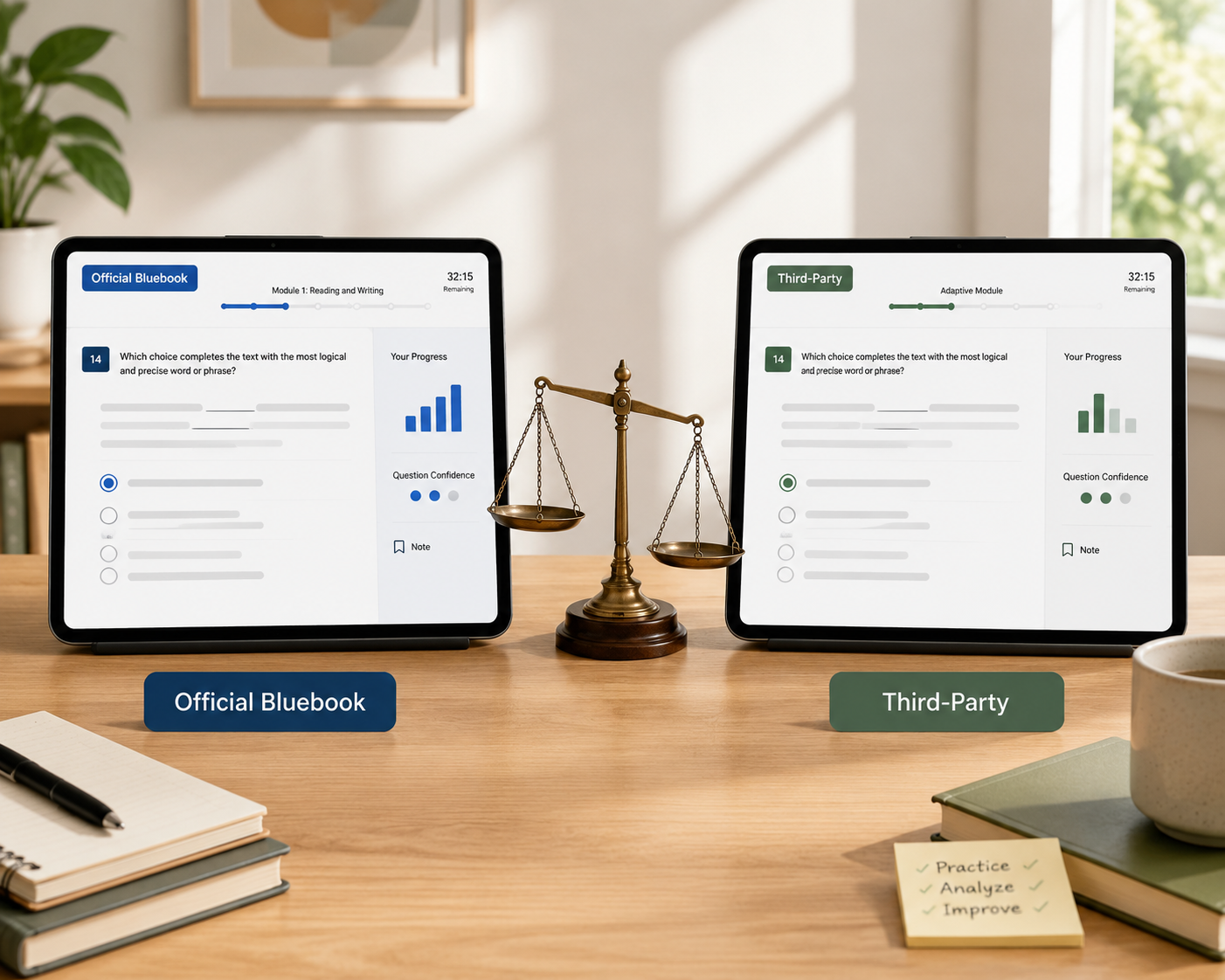
Not all digital SAT practice tests are equally accurate. This comparison of official Bluebook tests and top third-party options shows which ones to use for the most effective preparation and how to combine them.
Updated:
The most accurate digital SAT practice test is still the official Bluebook test. That answer is simple; the planning problem is not. As of the currently available information, Bluebook has 7 active full-length adaptive practice tests, Tests 4–10, after Tests 1–3 were retired in February 2025.[1] For a student who needs one diagnostic, several benchmarks, and a final dress rehearsal, 7 tests can disappear faster than expected.
That is why the best answer is not “only use official tests” or “take as many tests as possible.” Use Bluebook as the accuracy standard, protect it with a schedule, and add third-party adaptive tests only when they are doing a job Bluebook cannot do indefinitely: giving you more timed, full-length adaptive reps without burning another official form.
What “Accurate” Means for a Digital SAT Practice Test
A digital SAT practice test is not accurate just because the questions look polished. It needs to reproduce the parts of the test that change student behavior: the digital interface, the section timing, the short-question rhythm, the calculator environment, and, most importantly, adaptive routing.
The current digital SAT is 2 hours and 14 minutes long and contains 98 questions.[2] That shorter format is one reason old paper-test habits can mislead students. A paper booklet may still help with algebra, grammar, or reading precision, but it cannot show what happens when the first module quietly determines the difficulty range of the second.
Module 1 matters because performance there affects whether a student receives the harder or easier Module 2. PrepMaven estimates, based on repeated testing rather than an official College Board rule, that students can typically miss about 8 questions in Module 1 before being routed to the easier second module.[3] Test Ninjas reports, from student-collected data, that the easier Module 2 appears to cap a section score at roughly 560–600.[4] Those figures are useful planning estimates, not official thresholds.
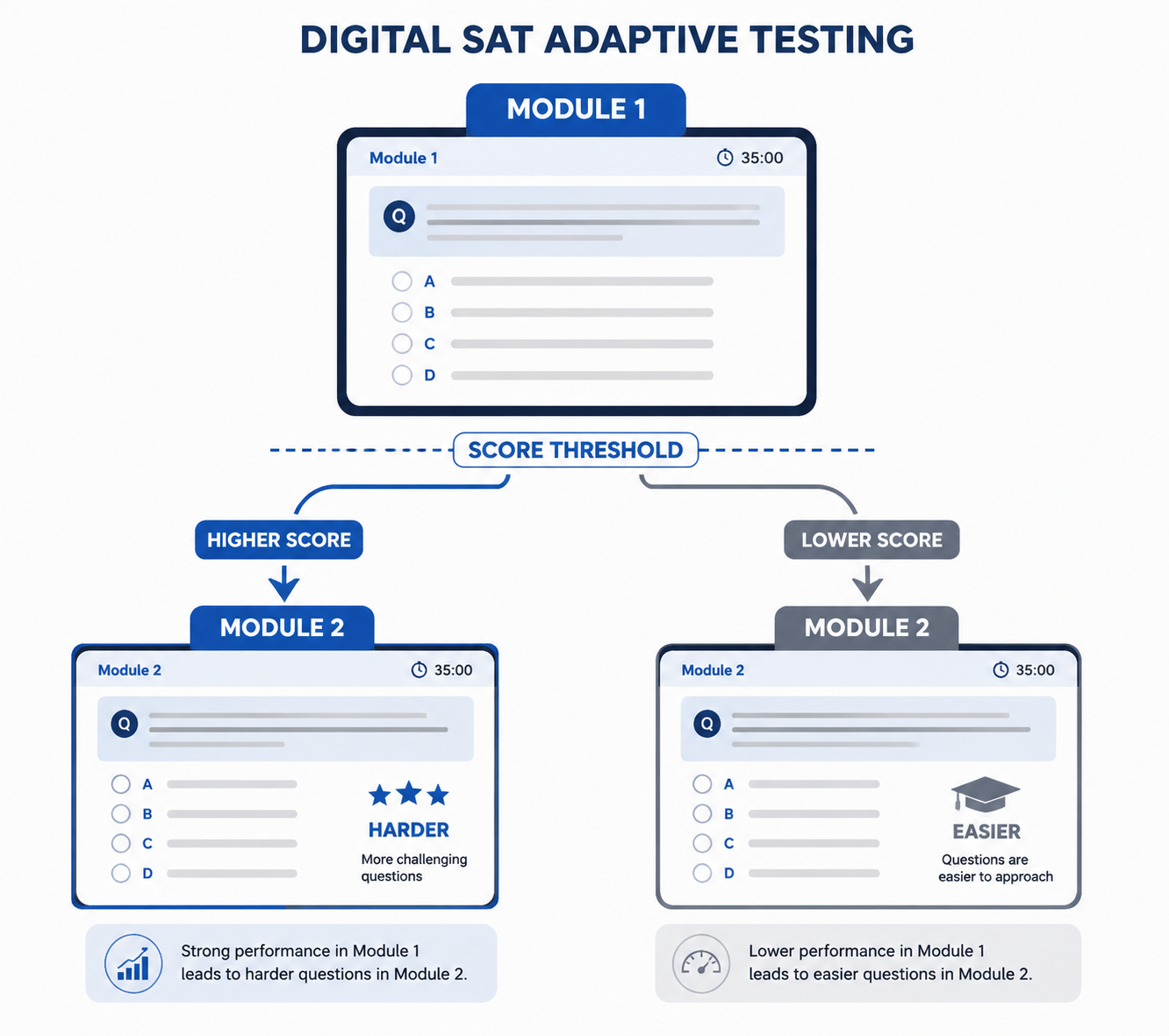
This is the accuracy gap that matters most. If a practice test lets a student bomb the first half, recover later, and still receive a score report that behaves like a linear paper test, it teaches the wrong lesson. On the real digital SAT, early accuracy is not just a confidence issue; it can change the scoring ceiling of the section.
| Accuracy criterion | Why it matters |
|---|---|
| Digital format | Students need to practice with screen reading, embedded tools, and digital pacing. |
| Same section timing | A test that feels relaxed will not expose timing decisions under real pressure. |
| Adaptive modules | Module 1 performance affects the difficulty range and score potential of Module 2. |
| Realistic score feedback | A useful practice score should help decide what to study next, not just rank a student. |
| Current availability | Retired official tests and outdated third-party materials can distort planning. |
Bluebook Is the Benchmark, So Do Not Spend It Randomly
Bluebook deserves the first slot because it is the official testing app and the closest available simulation of the real digital SAT. If a student asks which score estimate to trust before a test date, the Bluebook score usually carries more weight than a third-party score because the format, timing, and adaptive design are aligned with the exam students will actually take.
The mistake is treating official tests as disposable worksheets. A capable junior who takes three Bluebook tests in one week, reviews them lightly, and then complains that scores are “stuck” has not learned much about readiness. They have mostly reduced the supply of clean benchmarks.
A better use of Bluebook is spaced benchmarking. Start with one official diagnostic when you are ready to sit for a full test seriously. Then save the remaining official forms for checkpoints every 2–3 weeks, with targeted practice in between. If you want a fuller timeline, use a structured digital SAT practice schedule rather than deciding on test day by mood.
This matters even more for high-scoring students. PrepMaven reports that most students scoring 1400+ take 10 or more practice tests total.[1] That does not prove that taking 10 tests causes a 1400+ score; stronger students also tend to study more consistently. But it does show a practical pattern: 7 official Bluebook tests may not be enough for students aiming at the top end, especially if the first test is used early as a diagnostic.
Bluebook also should not be the only thing in the plan. A full-length test is expensive in time and energy. It tells you where the leak is; it does not automatically fix the leak. If Reading and Writing transitions, advanced punctuation, linear equations, or function notation are the problem, the next move is targeted practice, not another Saturday morning test.
Students who do use Bluebook should also review it like a scarce resource. That means checking not only missed questions, but also lucky guesses, slow correct answers, and Module 1 errors that could have affected routing. For a separate review checklist, see these Bluebook digital SAT practice mistakes before using another official test.
Where Third-Party Adaptive Tests Fit
Third-party tests are not all the same. The most useful distinction is not famous brand versus unfamiliar brand; it is adaptive simulation versus non-adaptive practice. A third-party platform that respects the modular structure of the digital SAT can be useful after a student has established a Bluebook baseline. A non-adaptive test may still have good questions, but it is not doing the same job.
Based on the available comparison materials, TestQube is the strongest third-party adaptive option. EdisonOS describes TestQube as offering highly accurate digital adaptive SAT tests with difficulty closely aligned to the real SAT, with up to 11 tests at roughly $20 per test.[5] Pricing is the shakiest kind of fact in test prep, so treat that as a last-reviewed July 2026 snapshot, not a permanent promise.
The right way to use TestQube is as a supplemental simulation layer, not as a replacement for Bluebook. For example, a student with 4 official tests left and 8 weeks until the exam might alternate: Bluebook for major benchmarks, TestQube for additional timed adaptive practice, and targeted drilling on non-test days. The third-party score is useful as a trend signal, but the official Bluebook score should still anchor major decisions about readiness.
Magoosh can also fit as an adaptive alternative when a student wants more digital practice beyond the official set. The same caution applies: use it for extra reps, stamina, pacing, and decision-making under adaptive conditions. Do not treat any third-party score as interchangeable with an official Bluebook result.
Gemini’s free SAT practice test can be worth a look for students comparing no-cost or low-friction options, especially because its content is Princeton Review-backed, but it should stay in the “try with caveats” category rather than become the spine of the plan. If you are considering it, read what to expect from the Google Gemini free SAT practice test before counting it as a benchmark.
Khan Academy and the Question Bank Are for Building Skill, Not Simulating Test Day
Khan Academy should remain visible in any serious plan because it is free, official College Board-partnered prep with explanations and skill review.[1] It is not valuable because it replaces full-length tests. It is valuable because it gives students somewhere productive to go after a full-length test identifies a weakness.
The College Board question bank belongs in the same middle space: not a dress rehearsal, but an efficient way to isolate skills. If Bluebook shows that a student keeps losing points on Standard English Conventions, there is no reason to spend 2 hours and 14 minutes confirming that problem again. Pull a focused set, drill the pattern, write down the rule, and then see whether the next timed module reflects the work.
This is also where the old score-gain data deserves careful handling. College Board has reported that 6–8 hours of Official SAT Practice was associated with about a 90-point gain and 20 hours with about a 115-point gain, but that evidence comes from the paper SAT era, not a published digital SAT-specific study.[1] It is useful support for the idea that structured practice matters. It is not proof that a digital student will receive the same point gain after the same number of hours.
For students choosing between free skill work and paid adaptive tools, the question is not which one is “better.” It is what problem you are solving this week. Khan Academy can be the right answer when the issue is skill development, especially on a budget. An adaptive full-length platform is the right answer when the issue is test-day simulation beyond the official Bluebook supply. For a budget-based comparison, see Khan Academy vs. AI SAT tutors.
Use Paper Books for Drills, Not Full Digital SAT Simulation
Barron’s, Princeton Review, and similar paper-based materials can still help students practice content. A good grammar question is still a good grammar question. A well-written math drill can still expose a shaky concept. The problem starts when a paper test is marketed or used as if it were a realistic full-length digital SAT simulation.
PrepMaven’s comparison notes the limitation plainly: paper-based third-party tests are useful for drilling but are not adaptive, which makes them less accurate for full-length digital SAT simulation.[1] That distinction saves time. Use the book when you need more questions on a topic. Do not use it to decide whether your official score is likely to rise next weekend.
A paper set can also be helpful for low-stakes repetition. If a student is learning how to solve systems of equations, there is no need to wrap every practice session in a full digital interface. But once the goal is pacing, adaptive pressure, endurance, or score prediction, switch back to Bluebook or a credible adaptive platform.
A Practical Combination Plan
A good digital SAT practice plan assigns each tool a job. It does not ask every resource to behave like Bluebook, and it does not waste Bluebook on days when the student has not fixed the problems from the last test.
| Prep need | Best-fit resource | How to use it |
|---|---|---|
| Most accurate diagnostic | Bluebook | Take one full official test under strict timing before building the study plan. |
| Benchmark score checks | Bluebook | Use every 2–3 weeks, then review deeply before taking another official test. |
| More adaptive full-length reps | TestQube or Magoosh | Add after the official supply becomes too tight or when a high-score goal requires more simulations. |
| Targeted skill repair | Khan Academy and College Board question bank | Drill the specific content areas exposed by practice tests. |
| Extra topic repetition | Paper books | Use for non-adaptive drills, not for official-score prediction. |
Here is what that can look like in practice. A student begins with Bluebook Test 4 as a diagnostic. The review shows that Reading and Writing Module 1 had too many early misses and Math Module 2 ran short on time. The next 10 days should not be another official test. They should be targeted Reading and Writing work, timed math sets, and maybe a third-party adaptive module or full test if the student needs more pressure practice.
Two or three weeks later, the student takes another Bluebook test. If the score and error pattern improve, keep the rhythm. If the same weakness appears again, the plan changes before another official test is used. The point of a benchmark is to make the next block of studying more specific.
Students aiming for very high scores may eventually need more than the active Bluebook set. That is where TestQube or another adaptive supplement earns its place. It gives the student more full-length practice without turning the last official Bluebook tests into casual warmups. Save at least one official test for the final stretch, when the most accurate read matters most.
If you are still deciding what belongs in your overall prep stack, start with a broader SAT prep toolkit or use a full SAT exam prep guide for section strategy. The practice-test decision is only one part of the system.
The Short Verdict
For accuracy, Bluebook comes first. Use it for the diagnostic, the major benchmarks, and the final readiness check. Because the active official supply is limited to 7 tests and many 1400+ scorers take 10 or more practice tests total, serious students often need a controlled supplement rather than more random testing.[1]
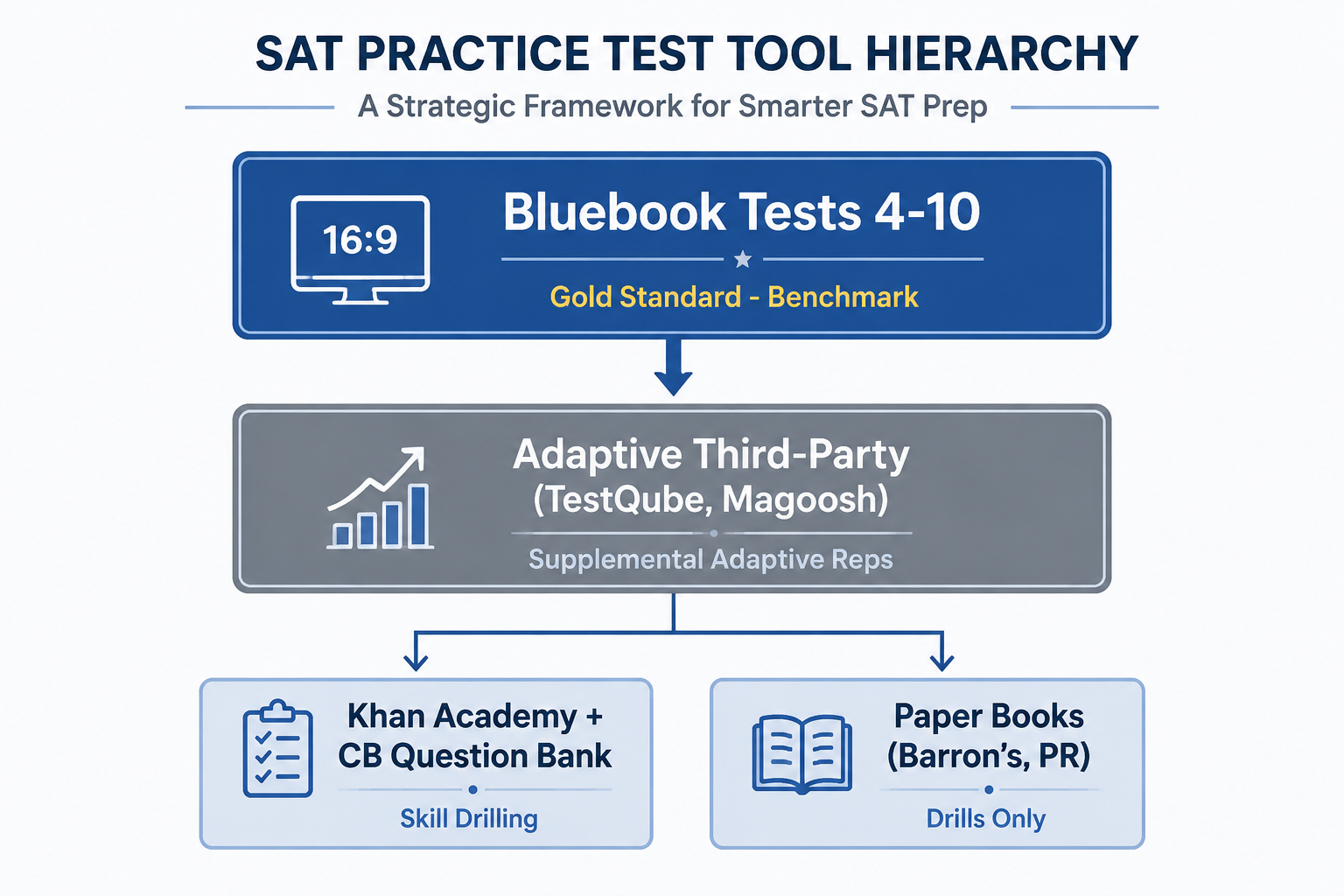
The clean hierarchy is: Bluebook for official simulation; TestQube or Magoosh for additional adaptive full-length practice; Khan Academy and the College Board question bank for targeted skill work; paper books for drills. A practice test is only accurate if it teaches the right lesson about the real exam. On the digital SAT, that means timed, adaptive practice used sparingly enough that the score still tells you something.
References
- Best Digital SAT Practice Tests (Official + Third-Party), PrepMaven, November 2025
- SAT Digital Versus Paper Test, Manhattan Review
- SAT Adaptive Testing: What it Means for You, PrepMaven
- Digital SAT Adaptive Testing Guide, Test Ninjas
- The 18 Most Accurate SAT Practice Tests for 2026, EdisonOS
Supporting Resources
- Best ACCUPLACER Study Apps of 2026: Free vs. Paid Options Compared →
Compare the official College Board ACCUPLACER practice app with top third-party study apps like Accuplacer Exam Training 2026 and Accuplacer Study App. This guide helps incoming community college students and adult learners decide which app fits their budget, target score, and study needs.
- The Trap of Anki for the MCAT: When Flashcards Hurt More Than Help (and How to Avoid It) →
For premed students already using Anki who feel stuck or burnt out, this critical guide exposes when Anki can become a productivity trap — replacing deeper learning with pattern recognition — and provides evidence-backed guardrails to use it effectively without wasting time.
- GRE Prep Hub: Best Study Tools, Anki Decks, and Study Schedule for 2026 →
A single organized starting point for GRE preparation in 2026 — covering the current test format, the best study tools by prep phase, top community Anki decks for vocabulary, and modular schedule templates for 1, 2, and 3 months of study time.
Comments
Join the discussion with an anonymous comment.