
SAT
A practical roadmap for high school students and parents deciding between local SAT classes and online prep. Learn how to build a personalized study plan starting with a baseline diagnostic, then match format to your timeline, learning style, and budget.
Updated:
When families search sat test prep near me, they usually are not just looking for a classroom within driving distance. They are trying to answer a more uncomfortable question: where do we start, and how much structure does this student actually need?
Start before you shop. A local class, an online course, a tutor, or a self-study plan can all work, but only after the family knows the student’s baseline score, target test date, score goal, weekly availability, and likely follow-through. Without those pieces, course shopping becomes a way to buy relief before anyone has looked at the student’s actual work.

First, get a baseline score
The cleanest first move is a full-length practice test in the College Board Bluebook app. It gives the student a digital SAT experience close to the real testing interface and produces the information a family needs before choosing a prep format: total score, section performance, and areas that need review. Current prep guidance also notes that Bluebook uses full-length adaptive practice tests, which matters because the real SAT is digital and adaptive, not a paper worksheet with bubbles.[1]
Treat that first score as a planning tool, not a family referendum. A student who is 40 points away from the goal needs a different plan from a student who is 180 points away. A student missing grammar rules needs a different plan from a student losing time on harder algebra. A student who finishes both modules early needs a different plan from a student who guesses through the last five questions.
If the student has not yet taken a full digital practice test, use that as the weekend assignment before paying for anything. Families who want a more detailed walkthrough can pair Bluebook with Khan Academy using a practice-test review routine such as How to Take SAT Practice Tests with Bluebook and Khan Academy.
Put the score on the calendar
The 2026 fall SAT dates are August 22, September 12, October 3, November 7, and December 5, with registration deadlines typically about two to three weeks before the test date.[2] That calendar is not background information; it decides what kind of prep is realistic.
| Time before test | Best use of the time | What to avoid |
|---|---|---|
| 3+ months | Build a steady plan with weekly content review, timed practice, and several full practice tests | Buying an intensive program before checking whether the student can sustain weekly work |
| About 6 weeks | Focus on the highest-return weaknesses if the student is already close to the goal score | Trying to relearn the whole test while school, sports, and applications are also happening |
| Less than 4 weeks | Use a targeted tune-up, interface practice, and a realistic decision about whether this should be the first of two test dates | Expecting a course package to compensate for too little time |
The three-month version is the sanest when the calendar allows it. It gives the student time to learn, forget, review, and prove the skill under timed conditions. The six-week version can work, but usually when the goal is close and the weak areas are specific. If the first available test is too soon, it may still be useful as a real sitting, but the family should plan the next date at the same time instead of treating one Saturday as the whole story.
This is also the point to ask whether the student is still deciding between the SAT and ACT. If that decision is unresolved, compare the tests before building a full prep plan; switching tests late wastes weeks that most students do not have.
Choose the format that protects the plan
Local prep earns its keep when the student needs a room, a teacher, a fixed time, and the quiet social pressure of other students doing the same thing. Online prep earns its keep when the student needs schedule flexibility, access to stronger instruction than the local market offers, or a lower price than a private tutor. Self-study works when the student will actually complete the work and review mistakes without someone chasing them. Tutoring works when the problem is specific enough, urgent enough, or uneven enough to justify one-on-one attention.
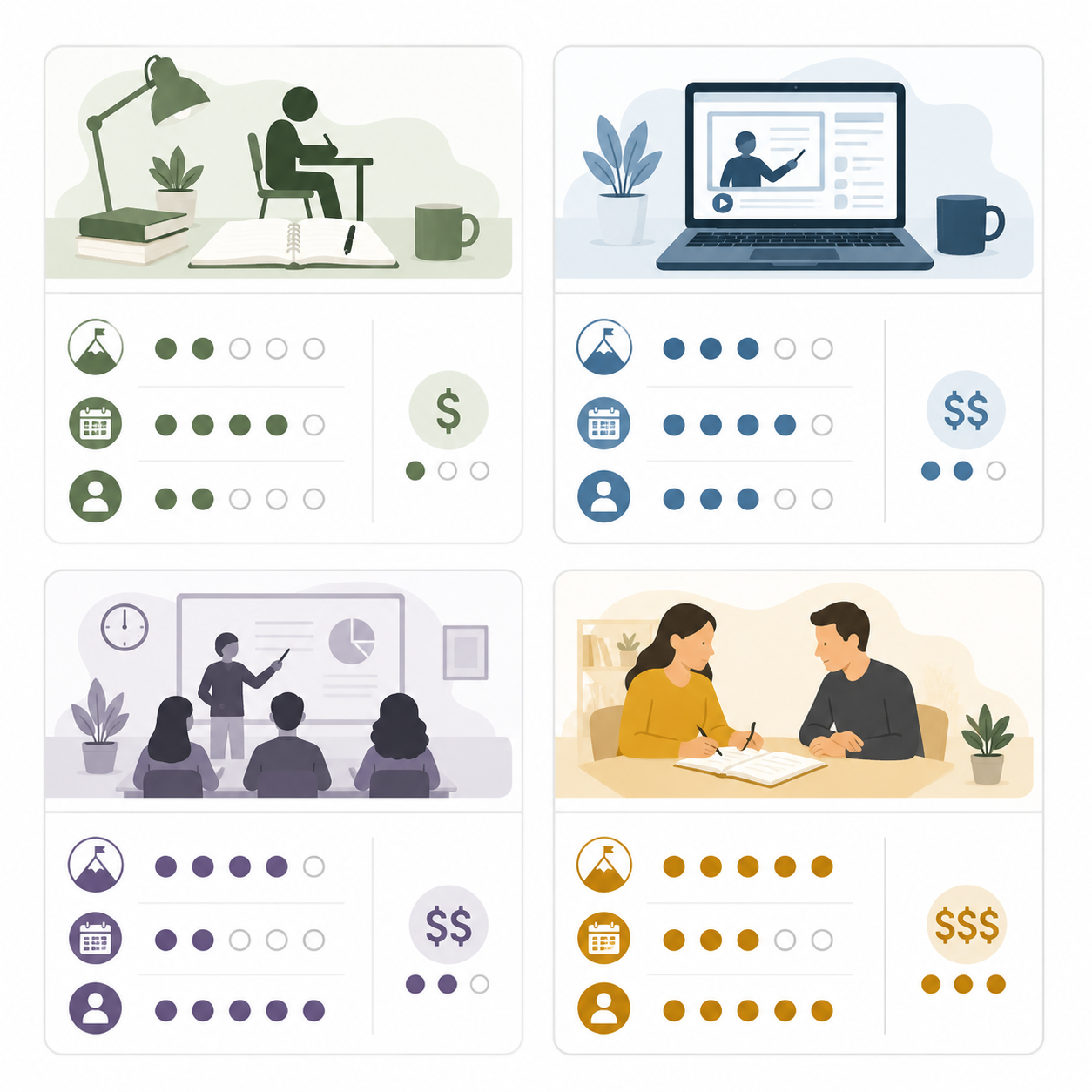
| Student situation | Likely better fit | Reason |
|---|---|---|
| Needs external structure and tends to skip independent work | In-person class or scheduled live online course | The calendar and attendance requirement do some of the accountability work |
| Has a packed schedule but follows through once assignments are clear | Online course or hybrid plan | The student can fit prep around school, activities, and family commitments |
| Has a clear weakness, such as algebra or grammar, and limited time | Private tutor or targeted small-group prep | Instruction can go directly to the score-limiting skill |
| Is self-motivated, organized, and budget-conscious | Bluebook, Khan Academy, and a strict review routine | Free tools can be enough when the student uses them consistently |
| Wants local accountability but also needs digital SAT fluency | Hybrid plan | Classroom structure can be paired with official digital practice |
The mistake is letting the word near carry more weight than the student’s needs. In 2026, local availability is uneven; national providers and independent centers may offer in-person classes only in selected cities, and families still need to check provider locator tools rather than assume a nearby option exists.[3] Even when a local class is available, the digital SAT rewards comfort with the Bluebook interface, adaptive modules, timing, and the built-in calculator. A convenient classroom is helpful only if it supports those skills.
For a deeper look at proximity itself, Does SAT Prep Near Me Really Matter for the Digital SAT? is the right companion question. The short version: location can help with accountability, but it should not outrank diagnostic fit, instructor quality, practice-test review, and the student’s ability to complete work between sessions.
Use price as a constraint, not a promise
SAT prep pricing changes often, so treat the following as a mid-2026 snapshot, not a permanent menu. Free options should still be on the table for almost every student: Khan Academy and official Bluebook practice tests form the foundation, and College Board data has reported gains of 39 or more points associated with at least six hours of Official SAT Practice on Khan Academy.[4] That number should be read carefully: it supports the value of sustained practice, not the idea that six hours automatically produces the same gain for every student.
| Budget tier | Examples from mid-2026 sources | Best fit |
|---|---|---|
| Free foundation | Bluebook official practice tests and Khan Academy | Students who can follow a plan and review errors honestly |
| Budget paid tools | Magoosh at about $129–$399, UWorld at about $249, self-paced PrepScholar at about $397 | Students who need more questions, explanations, or structure than free tools provide |
| Mid-range live courses | Kaplan Live Online at about $799, Princeton Review Essentials at about $949 | Students who need scheduled instruction without private-tutoring prices |
| Premium programs | Princeton Review 1400+ at about $1,899–$2,199, Prep Expert Flagship at about $1,199 | Students whose families want a more intensive packaged program and can afford it |
| Private tutoring | Commonly about $45–$500+ per hour, often totaling about $1,500–$6,000+ for 20–30 hours | Students with specific gaps, unusual schedules, or a need for direct accountability |
Those price ranges come from mid-2026 prep-market sources and can shift with promotions, location, tutor experience, and package length.[5][6][7][8] Provider score-improvement claims also need adult supervision. Reviews and companies often discuss average gains in broad ranges, but individual results depend on baseline score, study time, homework completion, and whether the practice matches the digital SAT. A high price can buy structure and expertise; it cannot take the test for the student.
If a family is comparing a mid-range course with a tutoring package, the deciding question is not just “Which is better?” It is “Which option will make this student do the right work every week?” A student who passively attends a premium course may gain less than a student who uses free tools, reviews every mistake, and retests on schedule.
The study loop matters more than the logo
The most important part of SAT prep is not the first lesson. It is the loop that happens after the student gets questions wrong: take a full practice test, review every miss, classify the error, drill the weak category, and test again. Guidance from SAT prep educators consistently treats this practice-test cycle as one of the highest-impact activities, with several full cycles recommended when time allows.[9]
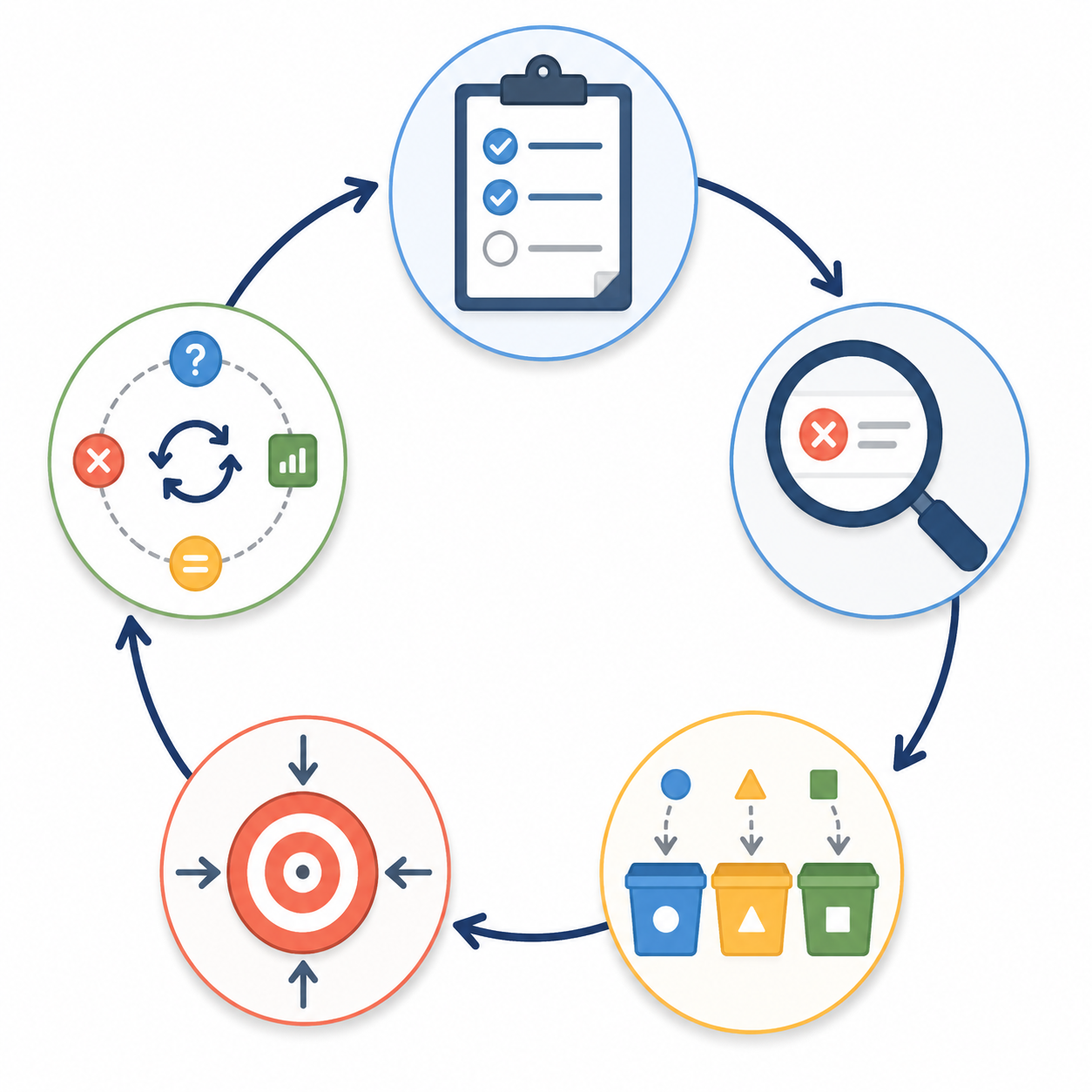
- Content gap: the student did not know the rule, concept, formula, or reading move.
- Careless error: the student knew the skill but misread, skipped a condition, copied incorrectly, or answered too fast.
- Timing error: the student could solve the problem untimed but used too much of the module.
- Strategy error: the student chose an inefficient path, ignored answer choices, or failed to use the available digital tools.
That classification is where useful prep begins. “Do more math” is too vague. “Review linear equations, then complete 25 targeted problems and explain every miss” is a plan. “Read more carefully” is too vague. “Slow down on transition questions and underline the relationship between sentences” is something the student can practice.
For the digital SAT, the loop should happen inside or alongside the official testing environment. The test lasts 2 hours and 14 minutes, is fully digital, uses adaptive modules, and includes a built-in Desmos graphing calculator.[10] Module 1 matters because performance there affects the difficulty of Module 2, which is one reason students aiming for high scores cannot afford a slow warm-up or a string of early careless mistakes.[10]
Bluebook familiarity is not decoration. Students should know how to move through questions, use the digital tools, manage module timing, and handle the on-screen calculator before test day. A local class that never makes students practice digitally is leaving a gap. An online course that assigns videos without full timed practice is doing the same thing.
When time is short, prioritize learnable, recurring patterns. Reading and Writing grammar rules often reward direct instruction and repetition. On Math, Algebra and Advanced Math make up a large share of the section in current digital SAT guidance, so weak algebra should not be buried under random mixed practice.[11] Students looking for more detail on which practice materials most closely match the exam can use Which Digital SAT Practice Tests Are Most Accurate? before buying extra question banks.
What local prep is good for
Local prep is most useful when the obstacle is not intelligence but consistency. Some students need to leave the house, sit in a room, see the teacher, and know that someone will notice if they did not complete the assignment. For them, the commute may be worth it.
A local class can also help families who want a familiar adult to interpret the process. Parents may feel better when they can talk to a teacher after class, and that comfort is not meaningless. The caution is that comfort should lead to better follow-through, not replace evidence. Before enrolling, ask whether the program includes full digital practice tests, written score reports, error review, homework accountability, and a plan for the next test date.
If the local options are thin, do not force it. A strong live online class with digital practice and responsive instruction can be a better choice than a nearby class that is mostly lecture. Families comparing local providers can use How to Find the Best SAT Prep Classes Near You in 2026 as a checklist, but the same standard applies everywhere: the class should protect the study loop.
What online prep is good for
Online prep is strongest when the student needs flexibility or when local instruction is limited. It can also give families access to national instructors, larger question banks, adaptive practice tools, and recorded lessons. For students juggling AP classes, sports, jobs, caregiving, or transportation limits, that flexibility can be the difference between a plan that happens and a plan that stays on the kitchen counter.
The weakness is obvious: online prep asks more of the student’s self-management unless the course has live meetings, deadlines, or tutor check-ins. A self-paced dashboard can look productive while the student quietly avoids the hardest work. Parents should look past the number of videos and ask how the program forces review, how often students test, and whether anyone responds when progress stalls.
A hybrid plan often solves the real problem. A student might use Khan Academy and Bluebook for the foundation, add a budget question bank for weak math areas, and meet with a tutor every other week to review errors. Another student might take a local class for structure while using official digital practice tests at home. The label matters less than whether the pieces work together.
Plan for two test dates when the calendar allows
A one-and-done plan puts too much pressure on one morning. College counseling guidance commonly recommends planning for two SAT dates when possible because many students improve after a first official sitting, especially when they use the first score report to focus the next round of prep.[11] The fall 2026 calendar makes that possible for many juniors: August to October, September to November, or October to December can all create a first test and a retake window if registration deadlines are handled in time.[2]
The retake plan should not be “do the same course again.” It should be narrower. If the first official score shows that Reading and Writing is mostly held back by punctuation and transitions, drill those rules. If Math is held back by algebra, give algebra the next three weeks. If timing collapsed in Module 2, practice under module conditions. The first test gives information; the second plan should use it.
This is also where families should be honest about energy. A student taking heavy classes, playing a fall sport, and finishing applications may need a lighter but steadier plan. A student with summer space before junior year can handle a more ambitious schedule. The best SAT plan is not the one that looks impressive in a brochure. It is the one the student can still follow in week five.
A practical final check before enrolling
Before choosing local, online, tutoring, or self-study, put the decision into one sentence: “We chose this because the student has this many weeks, is starting from this score, needs help with these skills, requires this much accountability, and we can afford this tier.” If that sentence is hard to complete, the family is not ready to buy yet.
- Diagnostic: Has the student completed a full Bluebook practice test?
- Timeline: Is there enough time for learning, drilling, full practice tests, and at least one possible retake?
- Format: Does the student need external accountability, flexible scheduling, targeted instruction, or all three?
- Budget: Is the family paying for a feature the student will actually use?
- Loop: Who will make sure mistakes are reviewed, categorized, and retested?
Choose the option that best protects that loop for this student’s calendar, score gap, motivation level, and budget. If the timeline permits, register with a retake strategy in mind rather than hoping the first test date has to carry everything.
References
- How to Take SAT Practice Tests with Bluebook and Khan Academy
- SAT Dates and Deadlines, College Board; College Essay Guy SAT timeline guidance
- How to Find the Best SAT Prep Classes Near You in 2026; Does SAT Prep Near Me Really Matter for the Digital SAT?
- Official SAT Practice, Khan Academy and College Board
- SAT Prep Course Pricing, Private Prep; The College Investor
- SAT Prep Course Reviews and Pricing, Test Prep Insight
- SAT Prep Course Cost and Options, PrepScholar Blog
- SAT Tutor Cost, Tutors.com
- College Essay Guy SAT practice-test guidance; Test Ninjas SAT practice-test guidance
- The SAT in 2026, Test Ninjas; Digital SAT information, College Board
- College Essay Guy retake guidance; Test Ninjas digital SAT section-strategy guidance
Supporting Resources
- Is a Paid ASVAB Study App Worth It? Free vs. Paid Prep ROI for Budget-Conscious Recruits →
A cost-benefit analysis for prospective military recruits deciding whether to invest $10–$20/month in a paid ASVAB prep app. Compares free resources (Army Challenge, Grammar Hero, Union Test Prep) with paid apps (ASVAB Mastery, ABC App) using user-reported score gains, retake costs, and branch score requirements.
- Life Application Study Bible App: Complete Profile and Review for 2026 →
A complete profile and review of the Life Application Study Bible app for Christians and Bible students. We break down its features, pricing options, recent 2026 updates, and how it compares to free alternatives like YouVersion.
- ASVAB Study Apps: Which Ones Actually Boost Your AFQT Score? (Real Data From Users) →
Most ASVAB study apps are just question banks. This guide identifies the ones that combine representative practice, weak-area remediation, and spaced repetition to deliver real score improvements, with before-and-after data from actual users.
Comments
Join the discussion with an anonymous comment.