
SAT
Learn how to use the original digital SAT Practice Test 1 as a free diagnostic baseline — where to find it after its Bluebook removal, how to score it, and how to interpret results to build a targeted study plan while understanding why it is noticeably easier than the current SAT.
Updated:
If you searched for sat practice test 1 and could not find it in Bluebook, you are not missing a hidden menu. College Board removed digital SAT Practice Tests 1, 2, and 3 from Bluebook on February 3, 2025, and replaced them with Tests 7 through 10. Test 7 was described as entirely new, while Tests 8 through 10 included a mix of new questions and questions recycled from Tests 1 through 3. Students who had already completed the removed tests kept their scores in Bluebook. [1][2]
That matters because Practice Test 1 did not disappear from the internet. It just stopped being one of the tests you can launch in Bluebook. The useful version for current SAT prep is the original digital SAT Practice Test 1 PDF, released for the digital format, not the older paper SAT Practice Test 1 from the 2016–2023 version of the exam. Those two files can look deceptively similar in search results, but they are not interchangeable for a 2026 digital SAT plan. [3]
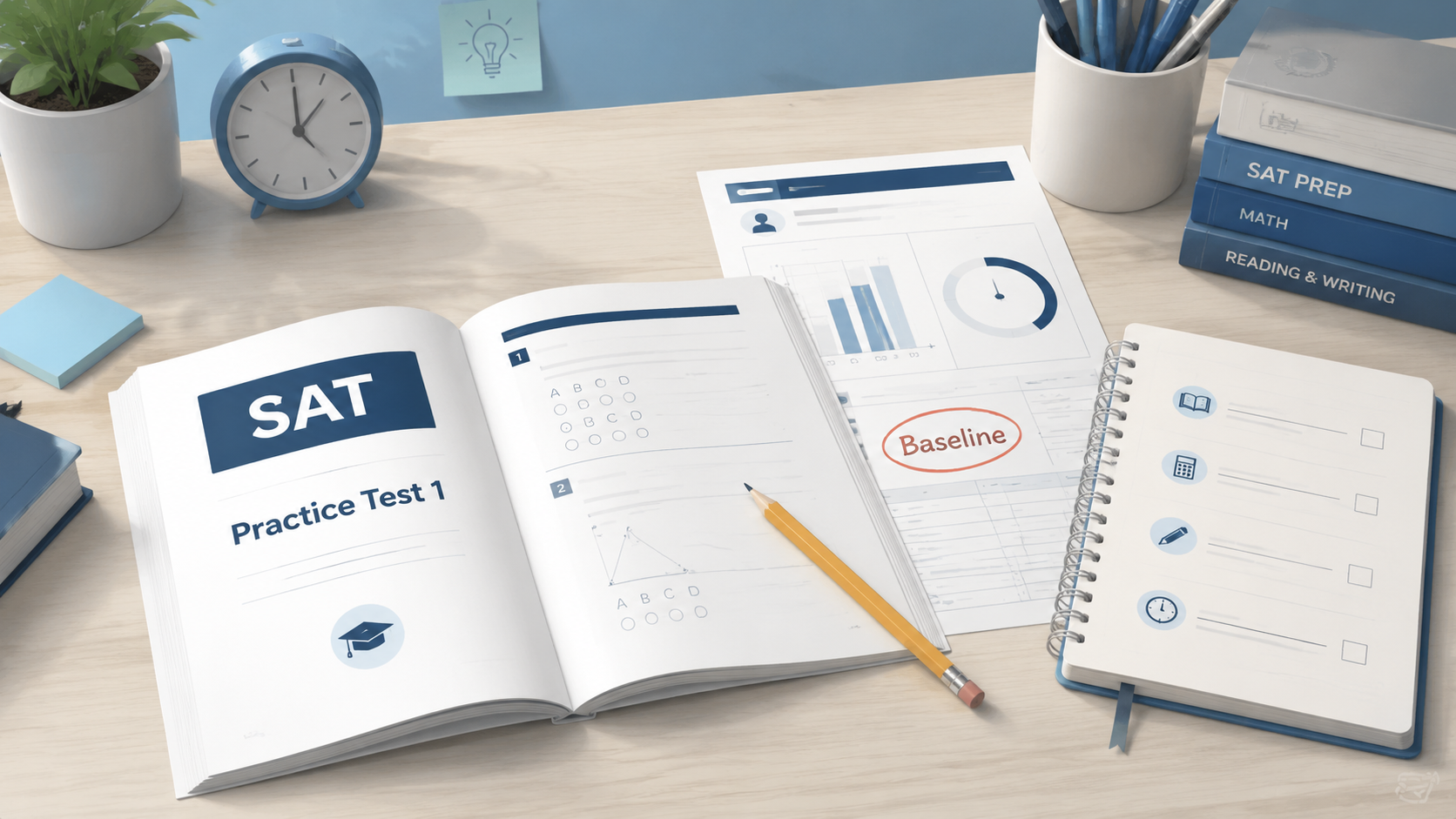
Use Practice Test 1 for the job it can still do
Practice Test 1 is still worth taking first if you need a free, low-stakes baseline before you spend money or burn through the newest official tests. It covers the core digital SAT shape: Reading and Writing questions, Math questions, module timing, and the basic experience of moving through a full exam-length sitting.
The mistake is treating the score as a forecast. A first diagnostic should answer narrower questions: Which section is costing you more points? Which question types slow you down? Are your misses mostly content gaps, careless errors, timing problems, or wrong-answer traps? That is enough information to build the first study plan.
Save the newer Bluebook tests for later, when you actually need a sharper readiness check. If you want the broader two-platform setup for current official practice, the Bluebook and Khan Academy practice-test workflow is the better place to handle that setup.
Make sure you have the right file
You are looking for the digital SAT Practice Test 1 PDF, not the old paper SAT Practice Test 1. The digital version should match the current exam structure: two Reading and Writing modules and two Math modules. If the test has long reading passages followed by groups of questions, you are probably looking at the older paper-format SAT, not the file you want.
Because College Board removed Tests 1–3 from Bluebook, students commonly find the PDF through third-party pages that collect free official practice-test links. PrepScholar, for example, still lists free official SAT practice-test PDFs and distinguishes printable versions, including materials from different SAT formats. [3]
- Use the digital-format PDF if your goal is 2026 SAT prep.
- Avoid the older paper SAT Practice Test 1 unless you are intentionally studying retired-format material.
- Do not compare your Practice Test 1 PDF score directly against a newer Bluebook score without accounting for difficulty.
- If a site labels several files as “Practice Test 1,” check the structure before starting.
Take it like a real digital SAT, even if the PDF is not adaptive
The official digital SAT lasts 2 hours and 14 minutes: 64 minutes for Reading and Writing and 70 minutes for Math. The test is divided into two modules per section, and in the live digital SAT, performance on Module 1 affects the difficulty of Module 2. [4]
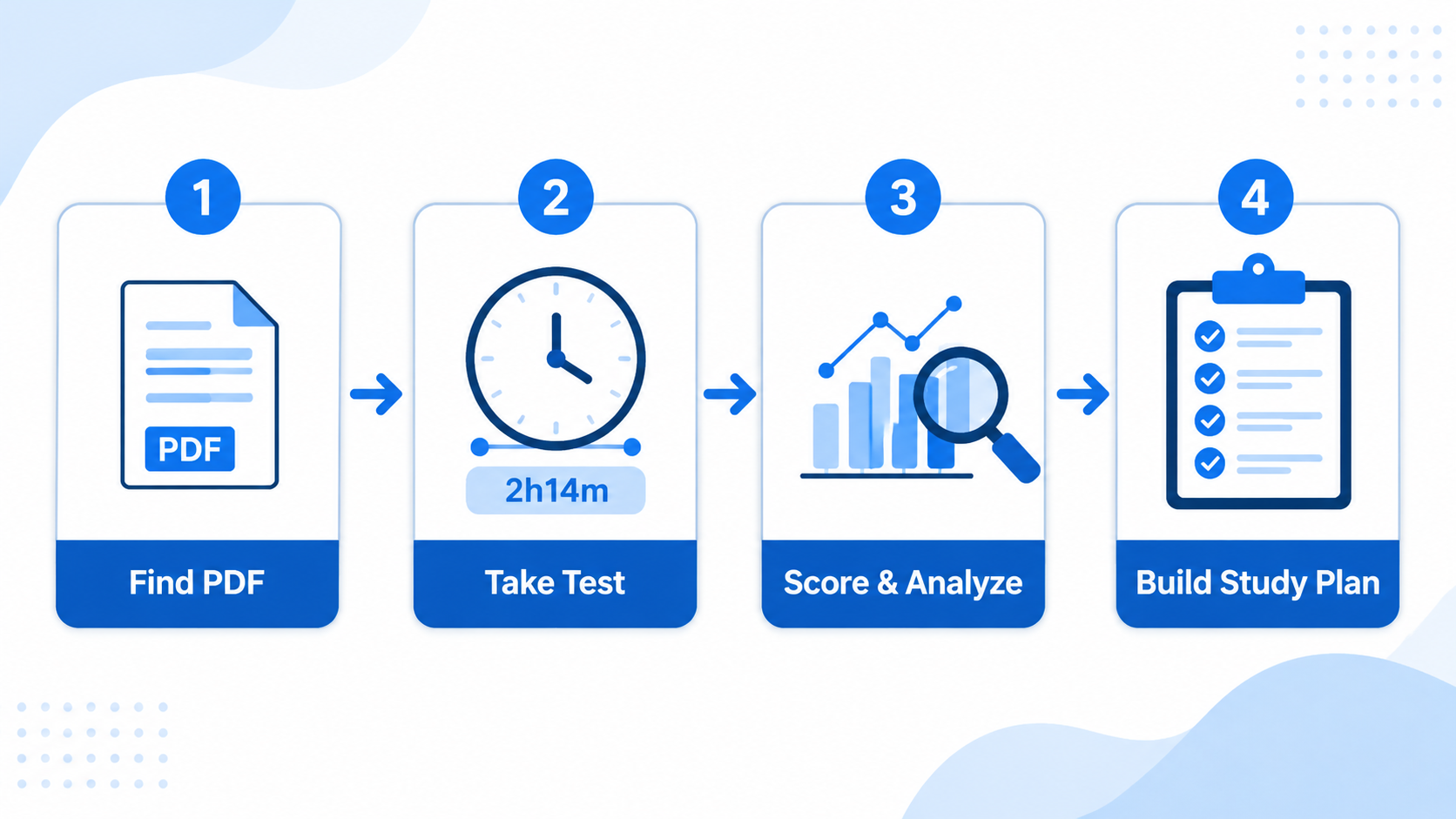
The PDF version of Practice Test 1 is not the same as launching a test inside Bluebook. You will not get the same app environment, and you will not experience a live adaptive engine. Still, you can make the diagnostic useful by protecting the parts that matter most: timing, order, scratch work, calculator use, and review discipline.
| Part | Time | What to do |
|---|---|---|
| Reading and Writing Module 1 | 32 minutes | Answer without pausing the clock. |
| Reading and Writing Module 2 | 32 minutes | Continue without adding extra time between modules. |
| Math Module 1 | 35 minutes | Use only the calculator and scratch-work rules you plan to use on test day. |
| Math Module 2 | 35 minutes | Finish even if you already know the score will be messy. |
Do not turn the diagnostic into a tutoring session with yourself. No checking formulas between modules, no looking up vocabulary, no pausing because someone texted, and no giving yourself “just two more minutes” on Math. A baseline with bruises is more useful than a polished number you cannot reproduce.
Score it, then separate the score from the evidence
Once you finish, score the test using the answer key and scoring materials that come with the digital SAT Practice Test 1 PDF. Record the total score, the Reading and Writing score, and the Math score. Then put the score aside for a moment, because the real diagnostic value is in the error pattern.
A useful review does not only mark questions right or wrong. It sorts each miss by domain and by cause. Top Tier Admissions recommends using score reports and breakdowns that identify specific areas such as algebra, problem-solving, data analysis, and transitions, then reviewing why each correct answer is correct and each wrong answer is wrong. [5]
| Review label | What it means | What to do next |
|---|---|---|
| Did not know the content | You lacked the rule, formula, grammar concept, or reading move. | Study the concept before doing more timed sets. |
| Knew it but missed it | You had the skill but made a careless, setup, or sign error. | Create a short checking routine for that error type. |
| Ran out of time | You might know the material, but the pacing failed. | Practice smaller timed sets before another full test. |
| Guessed correctly | The score hides uncertainty. | Review it like a miss. |
| Changed from right to wrong | Your second-guessing pattern may be costing points. | Write down what evidence made you switch. |
Guessed-right questions deserve special attention. A diagnostic score can flatter you when lucky guesses land, especially on a test that may be easier than newer official practice. Circle every question where you were not confident, even if the answer key gives you credit.
Turn the review into a first study plan
The first study plan should come from clusters, not from one embarrassing question. If you miss one punctuation item, note it. If you miss four boundaries questions, that becomes a study block. If your Math misses are scattered but every hard question took too long, pacing belongs in the plan before advanced content.
- Pick two Reading and Writing priorities and two Math priorities from your missed and guessed questions.
- Assign each priority a resource: lesson, drill set, error log, or timed mixed practice.
- Study the weakest content first if the same rule appears in multiple missed questions.
- Delay another full-length test until you have corrected at least some of the repeated misses.
A student with a lower-than-hoped Math score may not need “more Math” in general. They may need linear equations, function notation, and slower translation from word problems into equations. A student with a solid Reading and Writing score may still have a serious problem if every vocabulary-in-context question was a coin flip. The plan gets better when the labels get narrower.
How much should you trust the Practice Test 1 score?
Trust it as a baseline. Do not trust it as a final readiness verdict.
The strongest reason is difficulty. Piqosity’s independent comparison found that the hard Reading and Writing Module 2 on Practice Test 1 had 12 questions from easier subtopics, compared with 7 on Test 7. Its vocabulary examples also looked less demanding: words such as “diverse” and “peripheral” appeared in Test 1, while Test 7 included words such as “arduous” and “demarcated.” Piqosity reported an average word frequency of 0.000776% for the Test 1 vocabulary set it analyzed, compared with 0.000116% for Test 7. [6]
That is not the same as College Board officially announcing, “Practice Test 1 is easier.” College Board has not publicly confirmed a broad difficulty shift in those terms. Piqosity’s work is useful because it gives texture to what many students notice, but it is still independent analysis, not the test maker’s own disclosure.
The adaptive mechanics also need a caveat. Test Ninjas’ analysis of Practice Test 1 discussed an approximate 60% Module 1 threshold for reaching the harder Module 2, but that finding describes how Practice Test 1 appeared to behave. It should not be treated as a universal rule for every current Bluebook test, and the actual scoring and routing algorithms are proprietary. [7]
This is why a Practice Test 1 score should be labeled carefully in your notes: “starting baseline,” not “predicted official score.” If you score well, you have a good starting position, not permission to stop. If you score badly, you have useful evidence, not a sentence.
Where Practice Test 1 fits in a 2026 prep sequence
For most students starting from zero, the cleanest sequence is to use the least predictive test earliest and save the most current tests for later. PrepScholar’s June 2026 guidance places Practice Test 1 with older official practice materials and recommends the newest Bluebook tests first for students testing soon, which points to the same practical conclusion: do not use Practice Test 1 as your last serious check before the real SAT. [8]
| When | Test | Job |
|---|---|---|
| Start of prep | Practice Test 1 PDF | Low-stakes diagnostic baseline |
| After first study block | Tests 4–6 | Benchmarking and progress checks |
| Middle to late prep | Tests 7–9 | Harder current-style practice |
| Final readiness window | Test 10 or 11 | Readiness check under realistic conditions |
This sequence is not perfect. Practice questions get recycled, students remember items, and adaptive testing makes any paper-based diagnostic an approximation. Still, it protects the tests you will want most when score accuracy matters. If you need a deeper comparison of which exams are best for prediction, use a digital SAT practice-test accuracy comparison before choosing your final practice test.
What to do after your diagnostic
After Practice Test 1, write a one-page plan before you open another full test. Put your total score at the top, but build the page around the misses: Reading and Writing domains, Math domains, timing notes, guessed-right questions, and the three to five patterns that actually changed the score.
- If your misses cluster around content, spend the next study block on lessons and untimed drills.
- If your misses cluster around timing, use short timed sets before another full-length exam.
- If your score is strong but full of guesses, review the uncertainty before assuming the number is stable.
- If you are testing soon, move more quickly into newer Bluebook tests instead of lingering on retired PDFs.
Take the free diagnostic. Label it correctly. Then let the misses decide the next two weeks: which weaknesses to study, which habits to fix, when to take the next benchmark, and when to move into the newer Bluebook tests.
References
- New Official SAT Practice Tests Coming February 2025, Test Ninjas
- Big Updates to Bluebook SAT Practice Tests, Clear Choice Prep
- Complete Official SAT Practice Tests, Free Links; Printable SAT Practice Tests PDFs, PrepScholar
- Digital SAT timing and structure, College Board
- SAT Prep 101: The Ultimate Guide to SAT Practice Tests, Top Tier Admissions
- The SAT Digital Test is Getting Harder, Piqosity
- Practice Test 1 module-threshold analysis, Test Ninjas
- Complete Official SAT Practice Tests, Free Links, PrepScholar, June 2026
Supporting Resources
- How to Build a Daily Bible Study Habit Using an App: A Science-Backed Guide for Students →
This guide shows Christian students how to apply habit-science principles—cues, routines, and rewards—to build a consistent daily Bible reading habit using apps like YouVersion, Olive Tree, and Dwell. Learn four app-powered hacks, a 7-day starter challenge, and how to connect spiritual discipline with academic study habits.
- MCAT Study Prep Guide: Best Tools, Timelines, and a Phase-by-Phase Plan →
A comprehensive hub for pre-med students planning MCAT preparation — covers how the exam is structured, how to set a realistic study timeline based on your content baseline, and which free and paid tools to use at each phase of prep from content review through full-length simulation.
- Faithlife Study Bible for Students: How Seminary Students and College Christians Can Use This Free Tool →
This article shows college and seminary students how the free Faithlife Study Bible can serve as a powerful, budget-friendly study tool. It covers the app's original-language notes, visual resources, and cross-platform availability, and explains how to use it alongside other tools for deeper academic study.
Comments
Join the discussion with an anonymous comment.